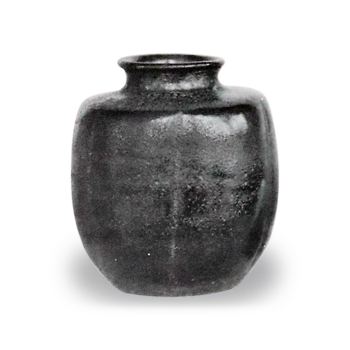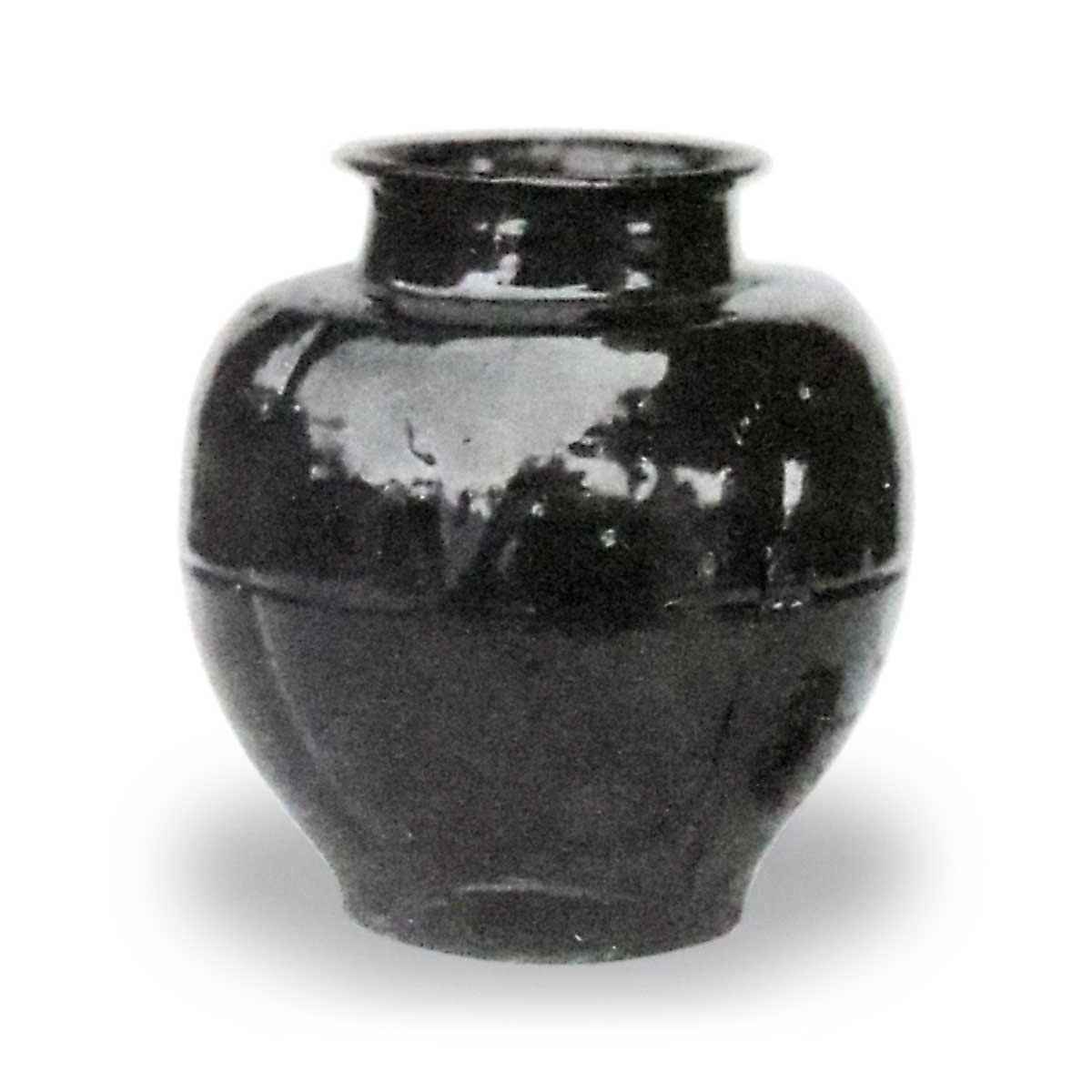
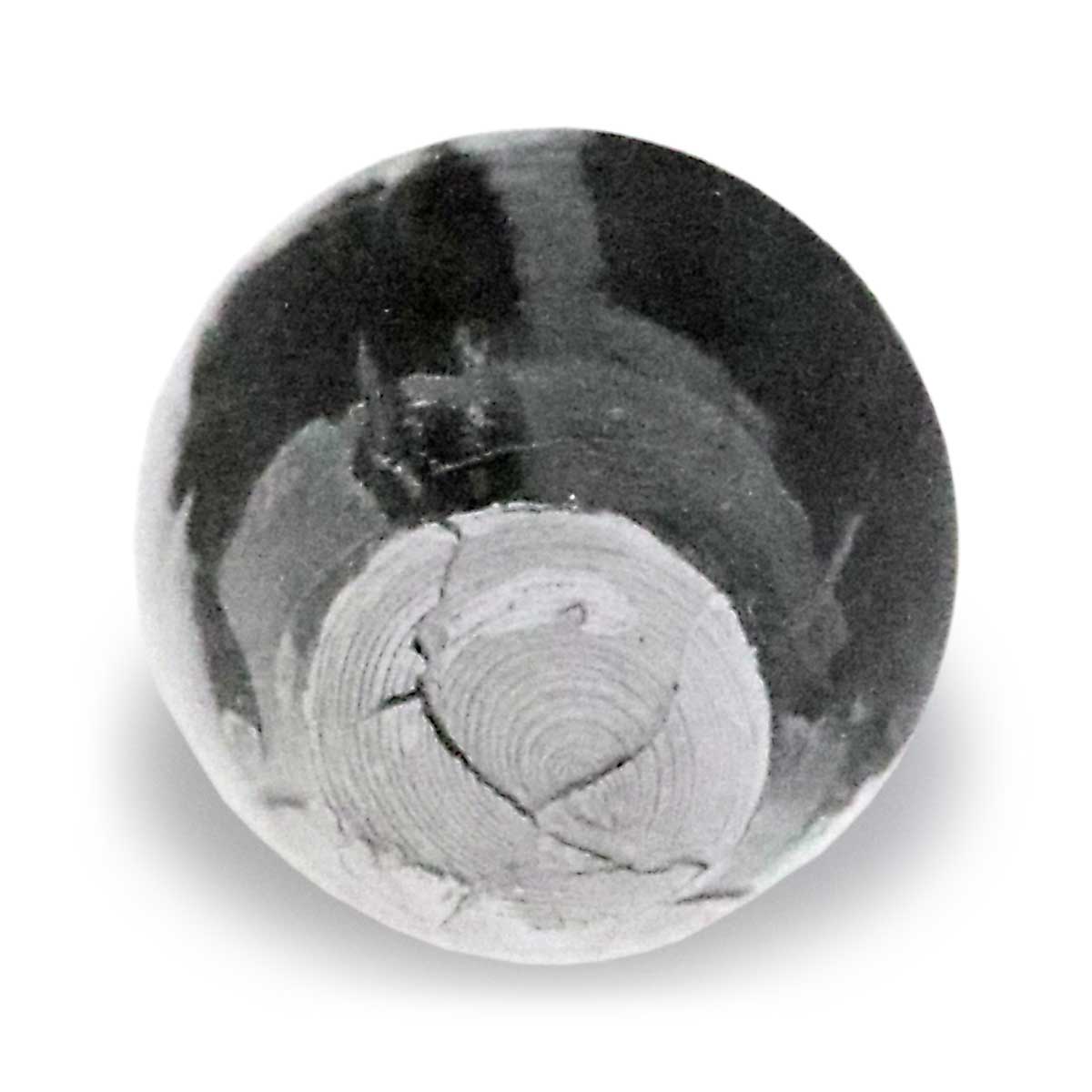
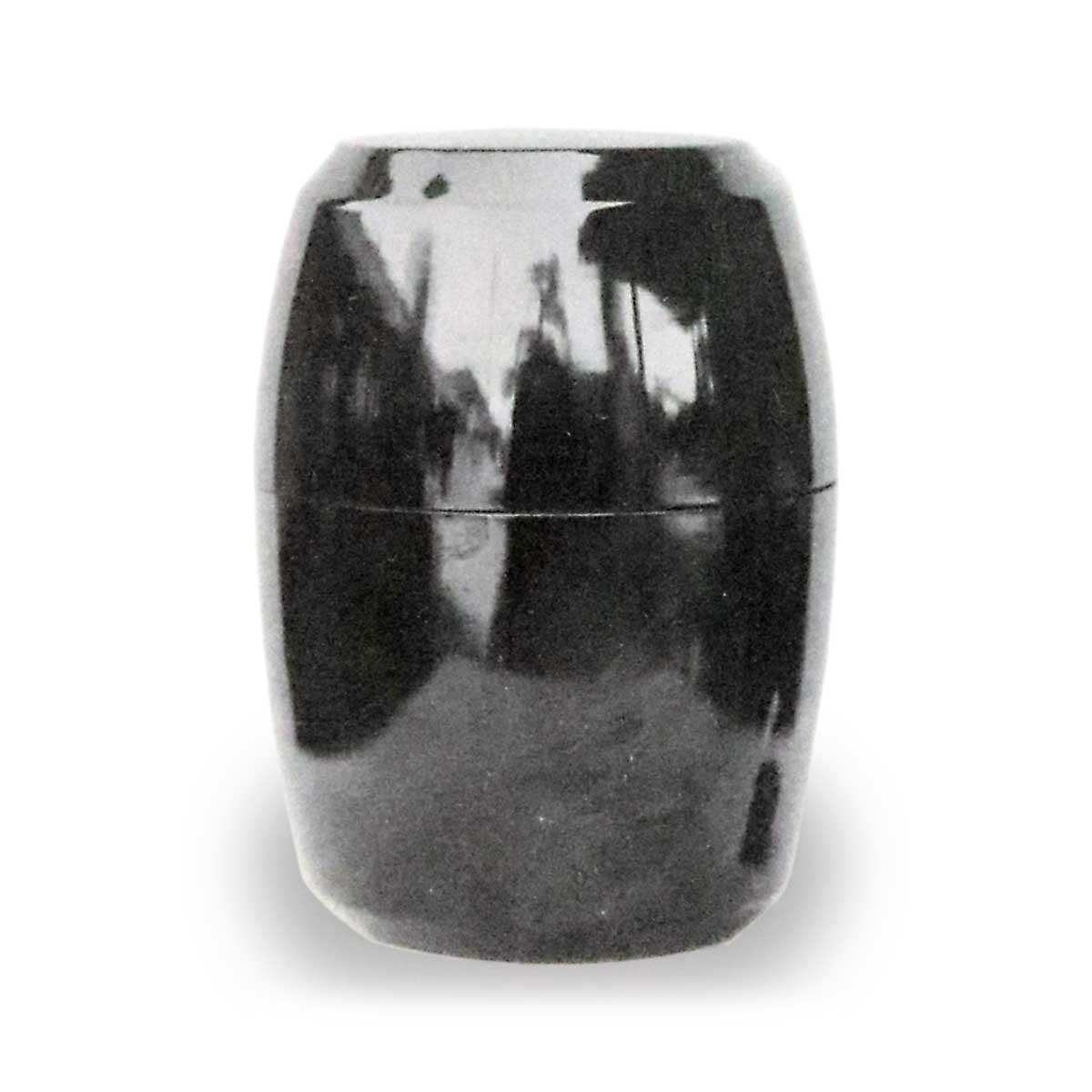
A tall-bodied tea caddy made in China (Han-style), currently in the collection of Baron Yorimasa Arima.
Origin of the Name
There is an ancient Seto tea caddy called “Hirate Katatsuki” that was once owned by Hirate Nakatsukasa Kiyohide, a retainer of Oda Nobunaga. The fact that this Han-style tea caddy happens to share the same name is likely because it, too, was once owned by him (Hirate Kiyohide).
Modern Equivalents of Dimensions and Weight
Height: Approx. 8.0 cm (2 sun 6 bu 5 rin)
Body Diameter: Approx. 7.7 cm (2 sun 5 bu 5 rin)
Mouth Diameter: Approx. 4.2 cm (1 sun 4 bu)
Base Diameter: Approx. 3.9 cm (1 sun 3 bu)
Koshiki (neck) height: approx. 1.2 cm (4 bu)
Shoulder width: approx. 1.1 cm (3 bu 5 rin)
Weight: approx. 117.8 g (31 monme 4 bu)
List of Accessories
There are two lids, both with a su (recess). One is by Juami, and the other is by Kobori Enshu.
The storage bag is made of purple habutae silk with a purple cord.
There is one protective cover (bag) by “Shibayama Koto.”
(Note: Originally, there were two bags—one by Kamakura Koto and one by Shibayama Koto—but the paper covering the lid records that the Kamakura Koto bag was transferred to another tea utensil called the “Hideji Natsume.”)
The storage box is made of paulownia wood with Shunkei lacquer and features a hanging lid; it contains the Shibayama Koto bag and a wooden mold. There is one wooden mold with an ivory lid, housed in a double-layered bag made of purple habutae silk.
The Hiki-ya is black lacquered and housed in a leather pouch with a long brown cord.
The inner box is black lacquered. The outer box is made of chamfered black-lacquered zelkova wood, and the paper covering the lid bears the inscription “Hirate Katatsuki.” The outer case is made of paulownia wood with Shunkei lacquer and features a lock; it is wrapped in a leather pouch with a brown cord (lined with navy-blue kaiki fabric).
Catalog and Accompanying Documents
One catalog is included, containing the following details:
・Hirate Katatsuki
・Pouch (Hino-ma-michi, Kamakura-ma-michi)
・Lids (1 by Juami, 1 by Kobori Enshu)
・Letter from Yuraku (Oda Nagamasu) – 1
・Letter from Hino Yuishin (Terushi) – 1
・One letter from Funakoshi Yoshu (Kagenori)
There is one accompanying note, written in the hand of Oda Yuraku.
Contents of the historically significant accompanying note (letter)
・Letter from Oda Yuraku (Jōan)
“(Omitted) I was informed that Lord Doi Ōsukedō visited on the evening of the 12th and delivered the pottery, and I am greatly pleased.
I was told that when you presented the katamuki tea caddy you received upon your return to His Lordship (the Shogun), he praised it highly, which is a source of the greatest joy (I am overjoyed). I can only imagine how pleased you must be.
January 3rd, Nyuan, Yuraku (Seal)
To Lord Kinchin-in (Isshin Soden)”
・Letter from Hino Yuishin (Terushi)
“It has been some time since we last corresponded. I hear that you have acquired a tea caddy and even presented it before the Shogun; I find this most auspicious and deeply appreciate it. Therefore, as a small token of my appreciation, I am sending you a small piece of ‘Shimakantō’ fabric, just as it is. I hope it may be of some use to you, and I offer it to you with this letter. I shall explain the details when we meet in person. With deepest respect.
Chisai (Seal) Yuishin
To Venerable Kinchin-in”
・Letter from Funakoshi Iyo-no-kami (Kagenori)
“P.S.: I have handed the tea caddy over to Gonbei. That is all.
I have humbly read your letter. First of all, it has been a long time since we last corresponded. I was shown the tea caddy and saw it for the first time in a long while; it is truly magnificent. As Lord Kobori Enshū stated, it is undoubtedly a Tang-era piece (made in China). Please treasure and keep it safely. I have conveyed the details to Gonbei. With deepest respect.
January 25th, Funakoshi Iyo-no-kami (Seal)
To Venerable Kinchin-in”
・Nakamura Hanbei’s Catalog
This catalog was written in February of Kyōhō 12 (1727). It records the dimensions and characteristics (two amber-colored glaze flows, four vertical lines, one horizontal line, a crack in the bottom, etc.) of two tea caddies, “Itte-hira-katatsuki” and “Furusato,” and states that they were delivered to the Imperial Storehouse prior to being dispatched to Kurume for Imperial use.
Provenance
This tea caddy was originally a treasure of the Kinchin-in (Ishin Soden) at Nanzen-ji Temple in Kyoto. It was presented to the second shogun, Hidetada, for his inspection and received his praise; it is a piece of distinguished lineage, having been gifted a Kanto-style pouch by the court noble Hino Yuishin. (The Ganka Meibutsu Ki states that it was “in the possession of Lord Nakayama no Shuma.”) It subsequently came into the possession of Nakayama no Shuma and appears to have been passed down to Kobori Enshū. Records of the Arima family indicate that it was gifted to the Arima family by Enshū.
Academic Inspection Record (Appraisal Record) from the Taisho Era
On October 11, 1921 (Taisho 10), this tea caddy was physically examined at the residence of Count Arima Yorimasa in Asakusa, Tokyo.
The rim is of the “ryōsogi” style, with a thin edge and a deep twist. The base of the koshiki (rim) protrudes, and the shoulders are powerfully (sharply) flared. A single thick horizontal groove runs around the body, and the shape tapers sharply from the hem downward. From the tip of the shoulder to the edge of the base (including the saucer), there are four vertical Academic Field Notes from the Taisho Era (Appraisal Record, Continued)
(Continued from previous page)
……Vertical spatula marks (spatula lines) are incised at regular intervals, standing slightly at an angle, giving it the shape known as “dō-takashi.”
From the rim downward, the vermilion-colored clay (body) is visible, though there are variations in depth depending on how the glaze has adhered. The thread-cutting marks are fine and remain extremely distinct, but there is a large fire crack (a crack formed during firing) extending toward the center of the base, and the amber-colored glaze has spattered, obscuring (masking) part of the thread-cutting marks.
Overall, a slightly rich amber-colored glaze covers the piece, with yellow glaze (yellow glaze) cascading down from the shoulder tips and stopping at the edge of the base (with a foot ring). Additionally, there is a blackish pattern below the shoulder. In other areas, the cascade of yellow glaze extends from the shoulder tips to the edge of the body’s horizontal bands.
Around the rim, there are scattered spots of “glaze cracking” where the glaze has deteriorated, and the scraped finish around the base is intriguing; overall, it is a “O-wabimono” piece with a very austere and rustic charm.
Inside, the glaze covers the rim, while below that, coarse wheel marks are visible, and the center of the base has a deep, swirling shape.
It feels extremely light in the hand, and while it appears to be of a slightly younger (newer) period, the appearance of the yellow glaze is magnificent, making this a tea caddy with many highlights.