Tokyo—Collection of Mr. Nobuyo Masuda
[Name]
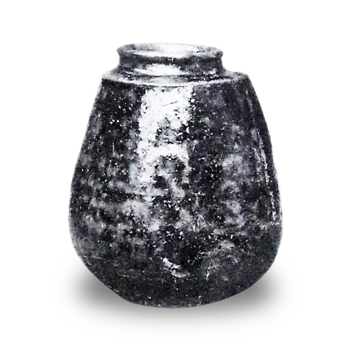
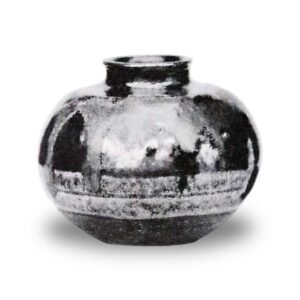
A persimmon-shaped tea caddy (a tea utensil for storing tea) produced at the Seto Kiln.
[Dimensions]
Height: Approx. 6.06 cm (2 sun)
Body diameter: Approx. 7.58 cm (2 sun 5 bu)
Mouth diameter: approx. 3.03 cm (1 sun)
Base diameter: approx. 3.36 cm – 3.48 cm (1 sun 1 bu 1 rin – 1 sun 1 bu 5 rin)
Neck height: approx. 0.76 cm (2 bu 5 rin)
Shoulder width: approx. 0.97 cm (3 bu 2 rin)
Weight: Approx. 66.75 g (17 monme 8 bu)
*(Converted using the following values: 1 sun ≈ 3.03 cm, 1 bu ≈ 3.03 mm, 1 rin ≈ 0.303 mm, 1 monme ≈ 3.75 g)
[Accessories]
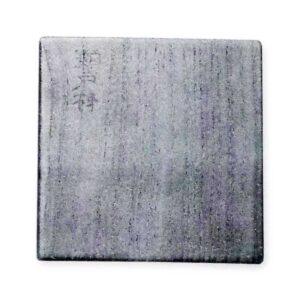
・Lid: 1 piece: Kako (paper or carved design affixed to the underside of an ivory lid)
・Storage pouch: 1 piece: Brown habutae silk, with brown drawstrings
・Cover pouches: 2 pieces:
- White ground with cloud pattern in Kinran (shiroji kumomon kinran); lining is “kabechoro”; drawstring is brown
- Tsumugi-weave Kinran (tsumugi-ji kinran); lining is “yatsure”; drawstring is purple
・Storage box: Paulownia, natural finish (inscribed in ink with “Seto-gaki Fukuro”)
・Hikiya: Black lacquered, lacquered fittings
Pouch: Nadeshiko chirimen cotton, lined with color-changing vertical-striped Donshu, with brown cord fasteners
・Box: Paulownia, natural wood
Inscribed in ink with “Seto-kaki”
(The inscription is said to be by Kobori Enshū or Sōkei)
[Miscellaneous Notes]
・“Kaki Seto: The pouch has a brown ground with gold accents on the body and a white ground with cloud patterns accented in gold. Inscribed in vermilion. Presented to Lord Kinoshita at the end of Kansei 4 (1792).” (From the Tsuchiya Storehouse Ledger in the Hōian Collection)
・“Persimmon: Old Seto. The body is generally persimmon-colored, with yellow glaze covering the slightly dark areas (as shown in the tea caddy illustration). The clay is old and well-worn. It features a twisted rim as shown in the illustration; the box is attributed to Lord Kei (such as Matsuura Seizan) and is an ‘Old Seto Persimmon’” (From Hōian Bunko, Item No. 17)
[Provenance]
Originally owned by Tsuchiya Sagami-no-kami and recorded in the Tsuchiya Storehouse Ledger. It was passed to Kinoshita Yamato-no-kami toward the end of Kansei 4 (1792), and after traveling to various locations, it came into the possession of the current owner (Mr. Nobuyo Masuda).
[Inspection Record]
On June 4, Taishō 10 (1921), I examined the piece in person at the residence of Mr. Nobuyo Masuda in Akashi-chō, Kyōbashi Ward, Tokyo.
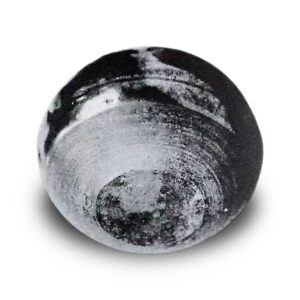
The rim has a shallow fold, and the shoulder line is sharply defined. The body is flared, with shallow wheel marks forming terraces that extend to the edge of the base (with a tray-like rim), resulting in a thread-cut base. Overall, the colors—persimmon-gold, black amber glaze, and yellow amber glaze—are intricately intermingled. The fascinating effect created by about five streaks of yellow glaze, of varying lengths, cascading down from the shoulder is indescribably magnificent. Furthermore, there are patches of persimmon-colored glaze within the black amber glaze; on the interior, glaze covers the rim, while the area below it features an extremely smooth wheel-thrown surface, and the center of the base forms a slight protrusion in a swirl pattern.
The popular legend that “Tōshirō mixed Chinese and Japanese clays to create this piece” likely refers to a tea caddy such as this. It feels light in the hand and, at first glance, appears to be of Chinese origin (Tang-style). From the rim downward, the unglazed body is a mouse-gray color, revealing fine white “ishi-haze” (traces left by small stones that have burst within the clay). This teapot is flawless, offers many visual highlights, and boasts a magnificent form.