

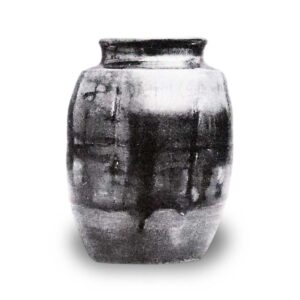
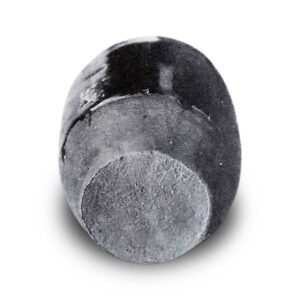
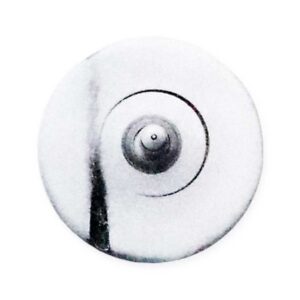
Collection: Baron Takashi Masuda
Name
The Chaki Bengyoku-shū states, “It is so named because the body of the tea caddy is positioned high.” Furthermore, in Tsuda Sōyuki’s Sōyuki-ki, under the entry for the morning of November 19, Tenshō 9 (1581), regarding the tea gathering hosted by Shioya Sōetsu, it is written: “I saw the tea caddy for the first time. It is a Dōdaka. The clay is not good, but the glaze is good. The rim is not well-made.” This indicates that the name “Dōtaka” was already in use by this time.
The “Dōtaka” passed down through the Kishū Tokugawa family was made in China (Tang ware) and is called “Kii Dōtaka.” On the other hand, this tea caddy is an ancient Seto ware (Japanese product) and, because it was passed down through the Mizoguchi family, lords of the Shibata Domain, it is called “Mizoguchi Dōtaka.”
Dimensions (converted to centimeters)
・Height: approx. 9.7 cm (3 sun 2 bu)
・Body diameter: approx. 7.4 cm (2 sun 4 bu 5 rin)
・Mouth diameter: approx. 4.5 cm (1 sun 5 bu)
・Base diameter: approx. 4.8 cm (1 sun 6 bu)
・Shoulder width: approx. 0.9 cm (3 bu)
・Koshidaka (height of the kettle body): approx. 1.1 cm (3 bu 6 rin)
・Weight: approx. 142.5 g (50 monme 3 bu / calculated at 1 monme = 3.75 g)
Accessories
・Lid: 1 (plus 1 spare lid attached to the wooden form)
・Cover pouches: 3
- Persimmon-colored ground with diamond pattern
- Brown-colored ground with cloud pattern
- White-colored ground with Myōshin-ji pattern
・Storage box: Paulownia wood, natural finish (bearing an inscription by Kobori Enshū)
・Wooden form: Rosewood with ivory lid (in a box)
・Hikiya: Made of sentōboku wood, with characters in gold powder
- Pouch: Navy-blue ground with tortoiseshell-patterned peony round crest, Tang-style weave (lined with a vermilion sheath-shaped cover, purple cord)
・Inner Box: Paulownia wood, Shunkei lacquer (bearing an inscription by Kobori Enshū)
・Outer Box: Paulownia wood, Shunkei lacquer
・Accompanying Document: 1 copy (memorandum)
- Memorandum (Contents):
・Tea caddy: Tall-bodied, shoulder-protruding style
・Tea caddy: Flat-bottomed
・Tea caddy: Standard size
・Hanging scroll: “The Brush of the Chinese Monk” (by Tōkan Goku, Ryūundō Dōchō), with an inscription by Monk Kōgetsu
・Incense burner: Square celadon (with an inscription by Sen no Rikyū on the box)
(The five items listed above were received as collateral from Lord Kobori Enshū (Izumi-no-kami) on December 1 of last year. After we advanced the funds, repayment became difficult, so all five items were transferred to us. We have now sold them to Lord Shinshū for 500 ryō and recovered the full amount. Accordingly, we are sending two documents: a promissory note borrowed from the Kobori family and a deed of transfer for the items.)
June 28, Genroku 8 (1695) — Ken Sōchi (to Takaku Sukenoshin, Terao Gidayū, and Kimiji Saemon)
・Enclosed scroll: 1 scroll (written by Kobori Enshū)
Document regarding the composition of the items (includes descriptions such as “Mukan,” “Dōtaka,” “Takina,” and “Yaezakura”)
・Enclosed written note: 1 copy
Five items of equipment on deposit (Hotaru: 170 ryō in koban; Dōtaka: 525 ryō; Taigai: 522 ryō 2 bu; Celadon Unashi: 70 ryō; Black Kana: 210 ryō; Total: 1,032 ryō 2 bu)
Miscellaneous Notes (from various sources)
・Matsuya Hoki
Dōtaka exist in both Chinese and Seto styles. They feature a tall rim and a shape that flares inward at both the top and bottom.
・Meibutsu-ki
Owned by Mizoguchi Hōki-no-kami. Viewed on February 4, Kanpō 3 (1743). It resembles a tea bowl and reveals the clay body. It has six ridges and an okame-okoshi foot.
(Dimensions: Height approx. 9.7 cm, body diameter approx. 7.5 cm, rim diameter approx. 4.8 cm, shoulder width approx. 6.4 cm, base diameter approx. 5.1 cm)
・Chaki Mekiri-shū
Passed down in the Mizoguchi family. The base glaze is persimmon-colored, with black glaze scattered here and there. The clay is brown, and the base has a thread-cut finish. It resembles the work of Fujishirō Shunkei.
・Collection of Tea Utensil Appraisals
Some may not know the origin of the term “tall body,” but it refers to the fact that the body of this tea caddy is positioned high.
(Dimensions: Height approx. 11.2 cm, Body circumference approx. 28.0 cm, Mouth diameter approx. 4.5 cm, Base diameter approx. 5.5 cm)
・Tsurezure no Tomo (by Matsuyama Seika)
Acquired for 418 yen at the Mizoguchi family auction on April 11, Meiji 37 (1904).
Provenance
Passed down through the family of Mizoguchi Hōki-no-kami, lord of the Echigo-Shinobata Domain. It came into the possession of Mr. Yanosuke Akahoshi during an auction of the family’s collection in Meiji 37 (1904), and was acquired by Takashi Masuda for 16,000 yen at the Akahoshi family’s second auction on October 8, Taisho 6 (1917).
Field Notes (Record of Observation of the Actual Object)
On July 18, Taisho 9 (1920), I had the privilege of viewing and appreciating the actual object at the residence of Baron Takao Masuda in Gotenyama, Shinagawa, Tokyo Prefecture.
The rim is wide, with the edges folded outward to form a shallow rim; the body tapers toward the middle, and the shoulders are distinctly flared. The body is plump and rounded, with six thick vertical ridges running around its circumference at nearly equal intervals—some slightly diagonal, others vertical—giving it a shape resembling a pumpkin (Akuta). It is said to be named “Tōtak” because of the raised areas between these ridges.
Part of the area below the rim reveals the reddish unglazed clay body, and the base, formed by pressing a board into the clay, features a dense, mesh-like pattern across its entire surface.
Overall, it is covered with a bluish vitreous (bidoro) glaze; however, around the body, there is a ring-shaped gradient with blackish tones within the blue glaze, and the glaze pool around the middle is thicker, with an even deeper black hue. The inner rim shows cord-marking, followed by shallow wheel marks, and the center of the base forms a swirl pattern.
There is one repair mark on the rim. It feels heavy in the hand, and based on the texture of the clay at the base, there are theories suggesting it may be of Chinese origin (Tang ware), or that Fujishiro may have mixed Japanese clay with Chinese clay to create it. However, given that the quality of the glaze unmistakably conforms to the conventions (characteristics) of Seto ware, it is reasonable to view this piece as a unique variation (unusual piece) from the ancient Seto kiln.

