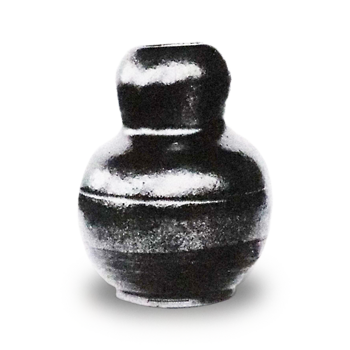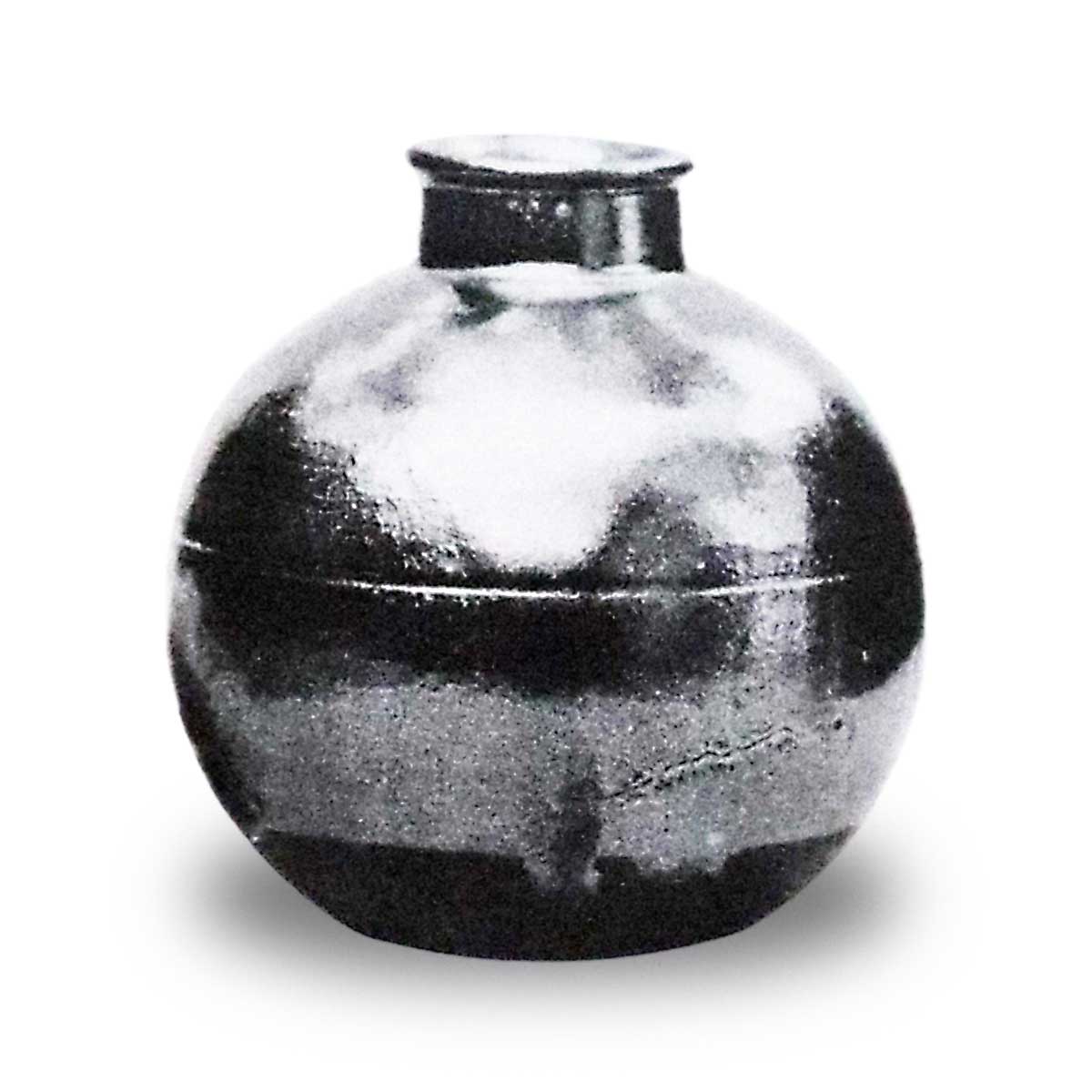
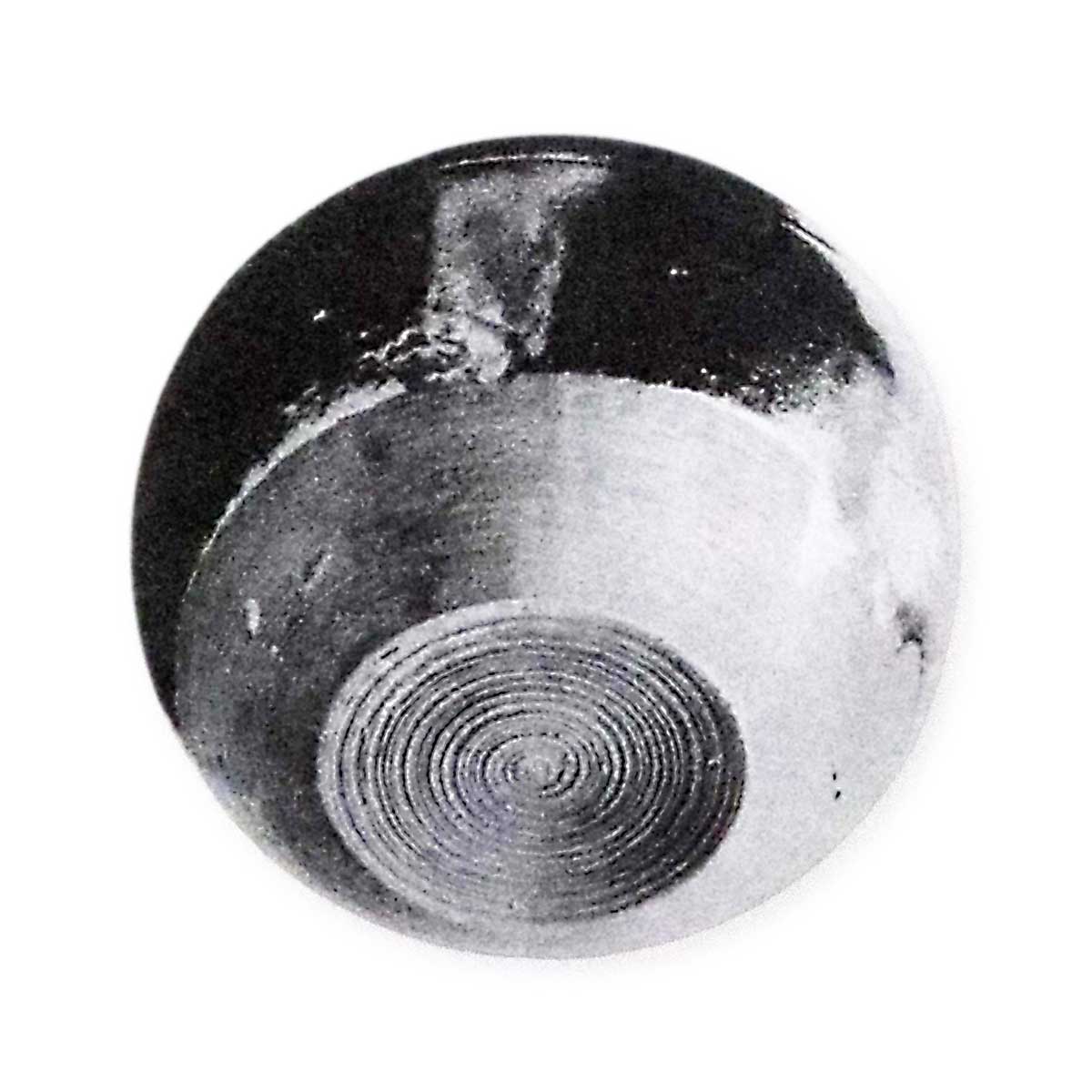
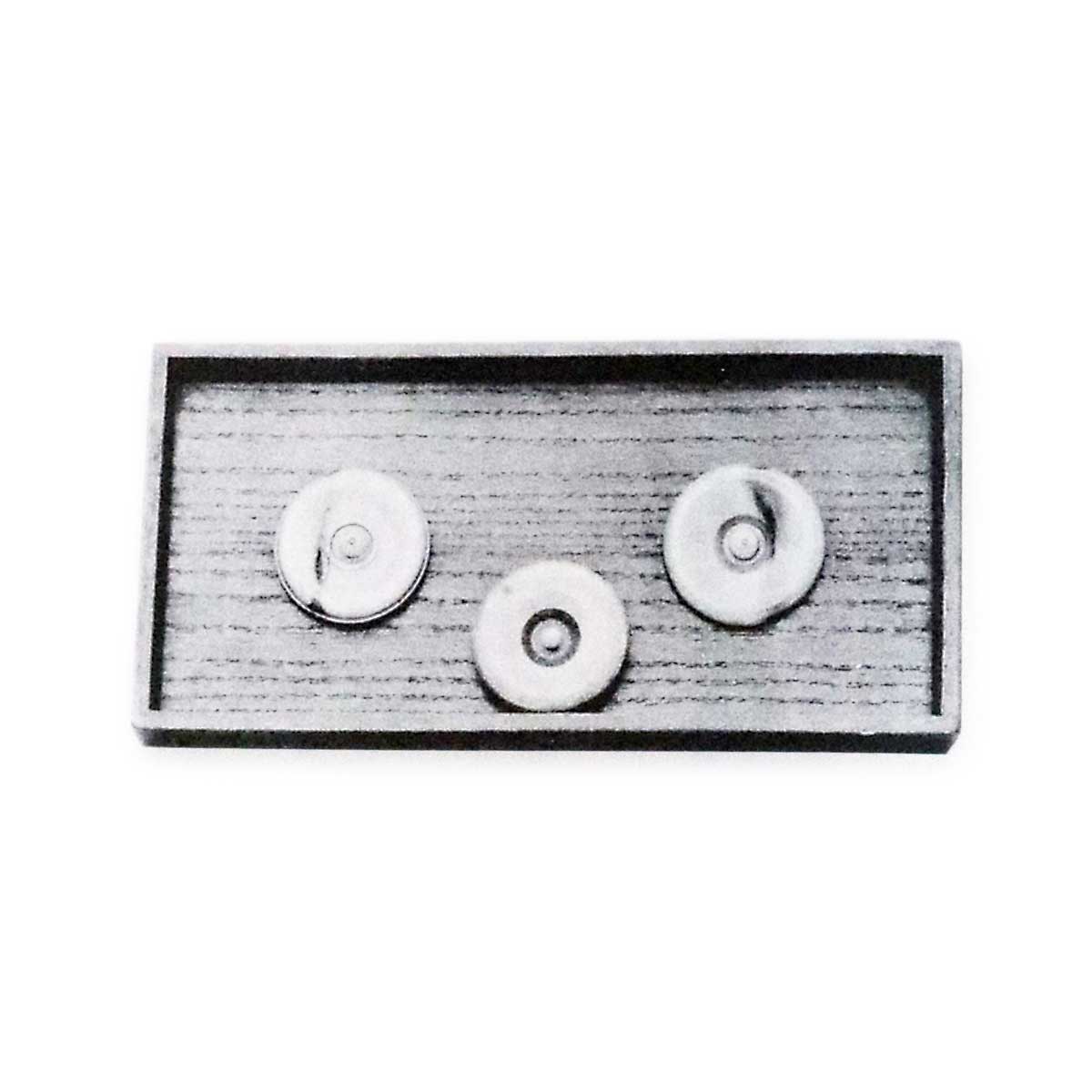
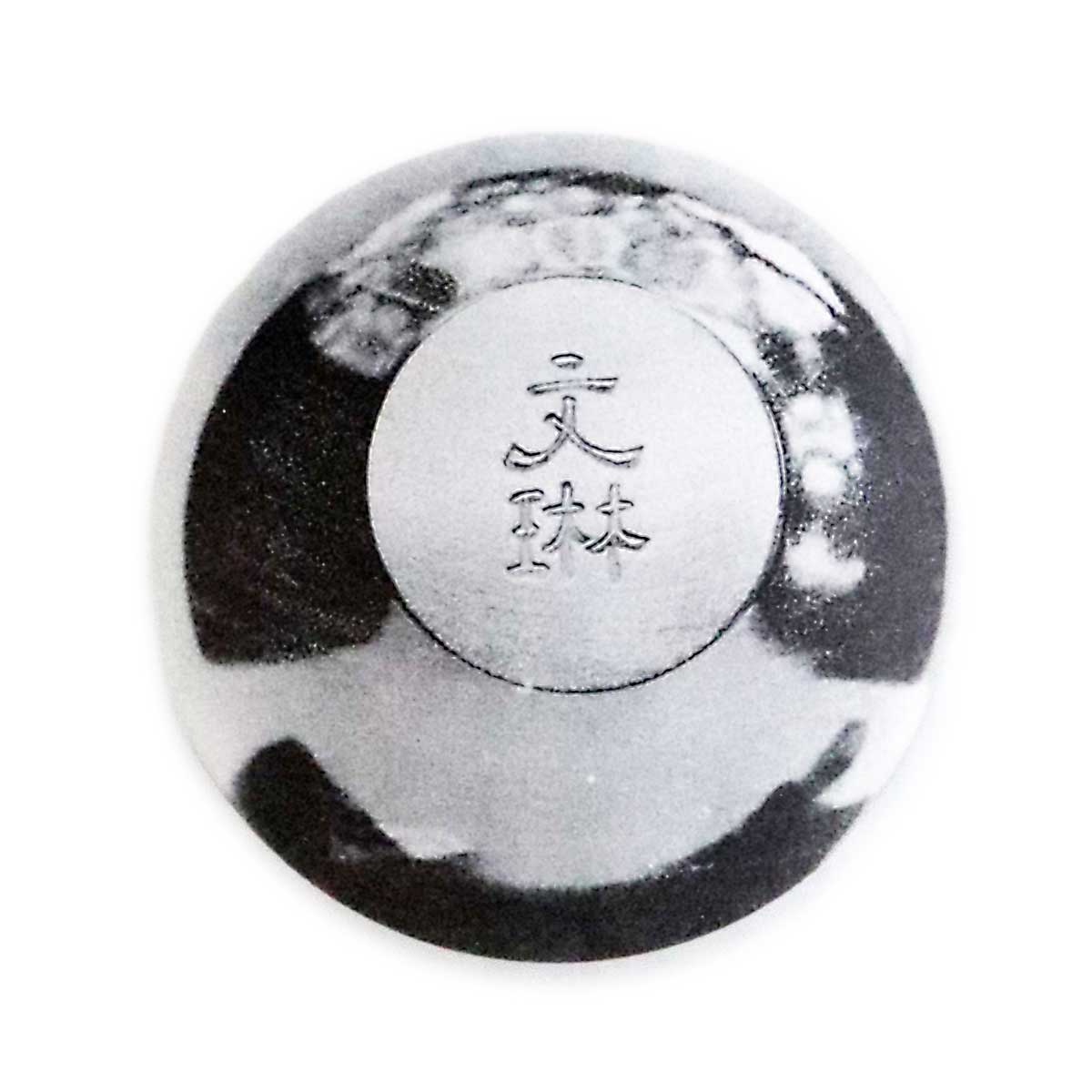
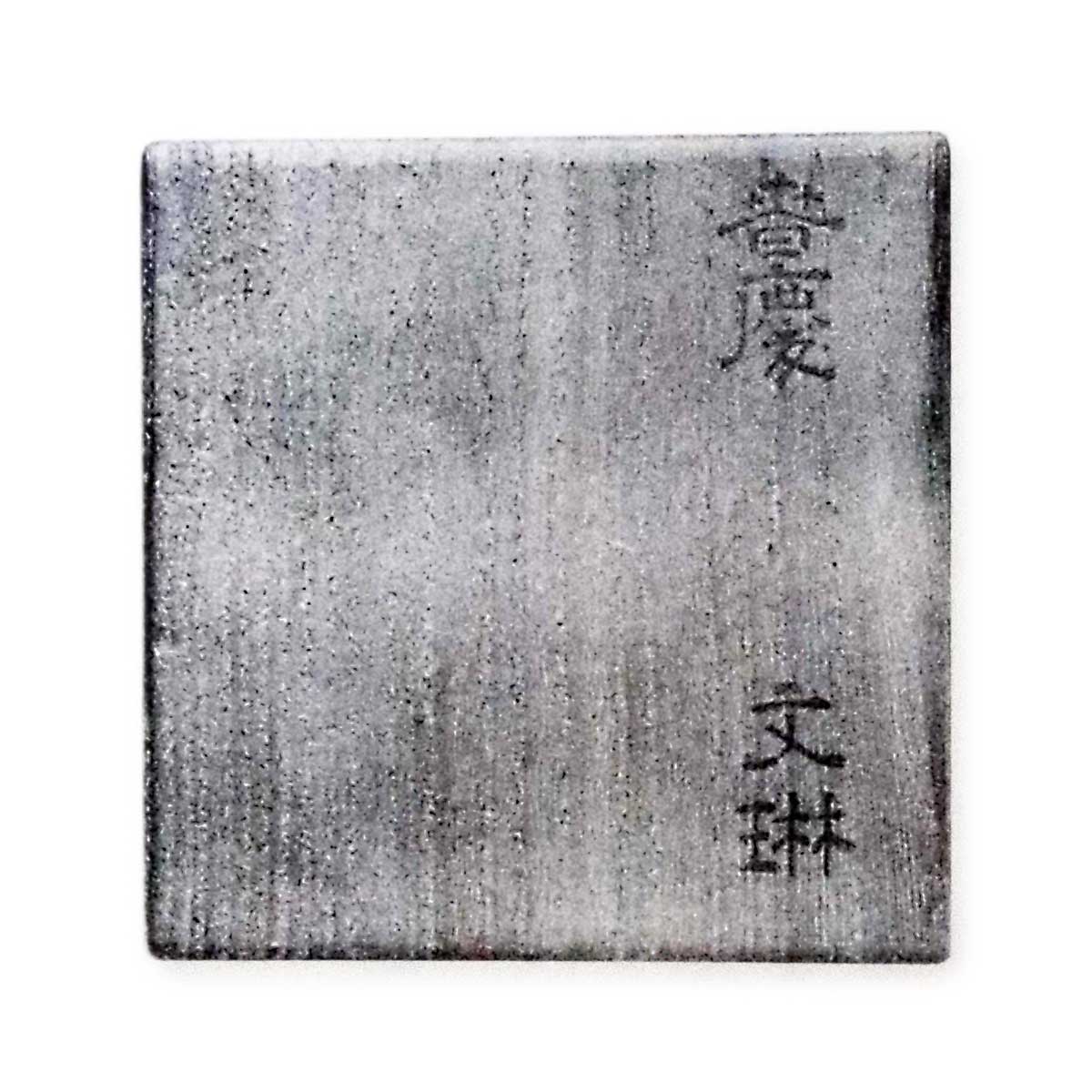
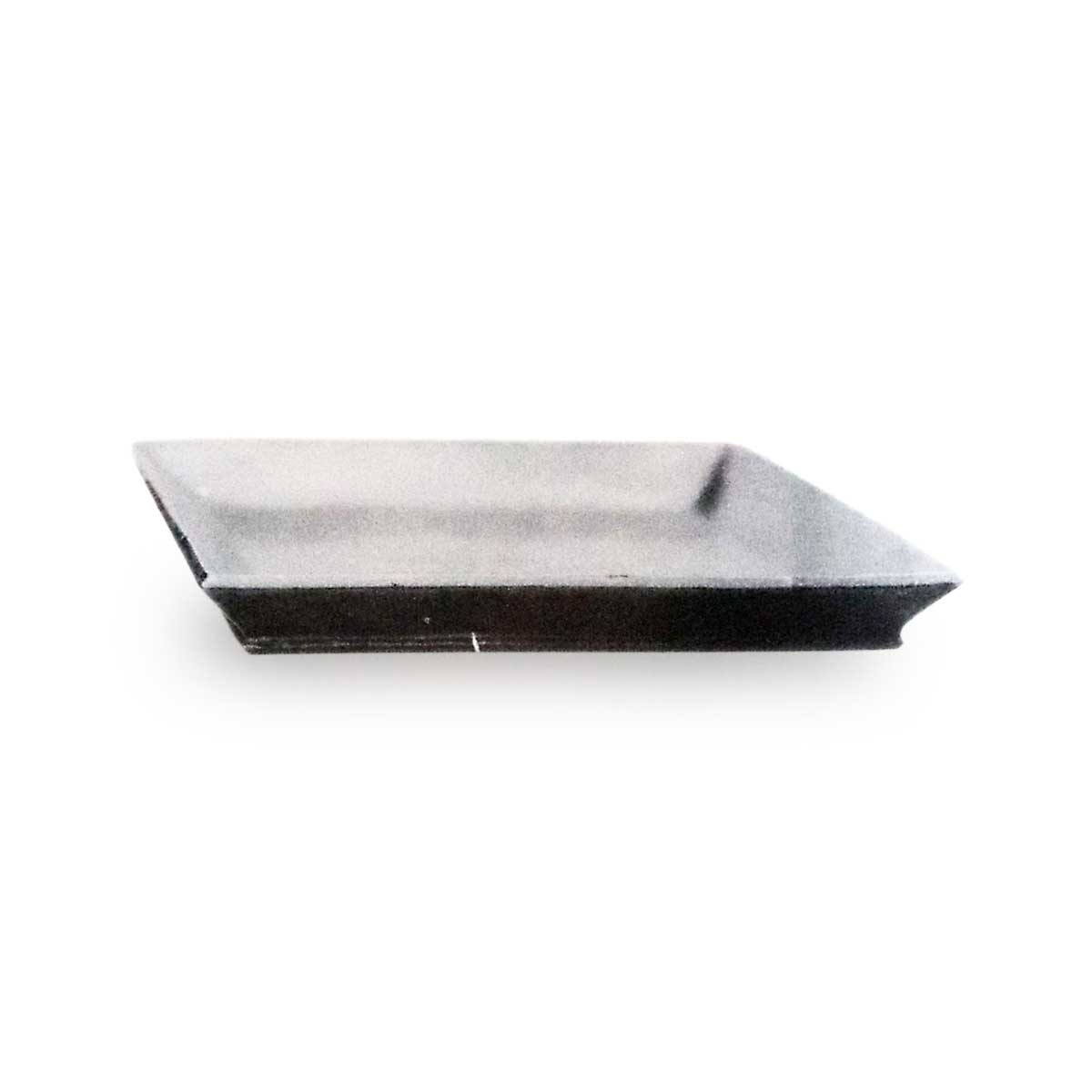
Famous Piece from the Revival Period; Collection of Mr. Masayoshi Kato, Tokyo
Description
This is a Bunrin tea caddy made by Shunkei.
Dimensions (Unit conversions: 1 sun = approx. 3.03 cm, 1 bu = approx. 3.03 mm, 1 rin = approx. 0.303 mm, 1 monme = approx. 3.75 g)
Height: 2 sun 5 bu 5 rin (approx. 7.7 cm)
Body Diameter: 2 sun 5 bu (approx. 7.6 cm)
Mouth Diameter: 9 bu (approx. 2.7 cm)
Base Diameter: Just over 1 sun 2 bu (just over 3.6 cm)
Koshiki Height: 3 bu 6 rin (approx. 1.1 cm)
Weight: 20 monme 8 bu (approx. 78 g)
Accessories
・Lids: 3 pieces (2 of which feature “Kuwanosu” carving)
・Storage pouches: 2 pieces of white habutae silk
・Cover pouches: 2 pieces
- Waniwa Junko (Lining: Kuzure-Kōkai; Cord: Light Purple)
2. Junko with Carp Crest (Lining: Kabechiyoro; Cord: Enshu Brown)
・Storage Box: Paulownia wood, black-bound lacquer finish (kurokukuri-ai-nuri), silver-powder lettering, inscribed by Matsudaira Norimura
・Hikiya (Carrying Case): Karin wood, double-carved, inscribed “Bunrin,” inscribed by Kobori Enshu
Hikiya Pouch: Aragawa (Lining: Nishiki; Cord: Light Purple Weave)
・Inner Box: Unfinished Paulownia wood, with an inscription by Kobori Enshū reading “Shunkei Bunrin”
・Outer Box: Unfinished Paulownia wood, with an inscription by Takekoshi Hōgetsu reading “Vessel listed in the Meibutsu-ki: Shunkei Bunrin”
Inscription on the back of the lid cover (summary):
“This is the Shunkei Bunrin listed in the Meibutsu-ki. Since the outer box had been left unvarnished since the time it was owned by Lord Matsudaira Sakon-shōgan (Norimura), when it was passed down to me (Ryōhan), I requested Lord Takekoshi Hōgetsu to inscribe it; the 12 characters on the surface are in Lord Hōgetsu’s own hand. November, Ansei 6 (1859). From the collection of Ryōhan, a scholar of ancient calligraphy.”
・Accompanying tray: Heishu (red lacquer); base is black lacquer
Dimensions: Length × Width: 6 sun 6 bu (approx. 20.0 cm); Mirror section (internal dimensions): Length × Width: 4 sun 9 bu (approx. 14.8 cm); Base: Length × Width: 5 sun 6 bu (approx. 17.0 cm); Height: 8 bu 3 rin (approx. 2.5 cm)
・Matching Box: Unfinished paulownia wood, nail-fastened box, inscribed “Heishu”
Accompanying Notes (3 letters)
(Inscription on wrapping paper): “A letter from Lord Takekoshi Hyōbu-shōyū Hōgetsu. This arrived when I had him write the characters on the front of the outer box.”
[Letter 1: Letter from Takekoshi Hōgetsu to Ryōban (Chōgen)]
(P.S.)
This may not be to your liking, but I cannot act carelessly, and I am filled with shame. I humbly submit this.
(Main Text)
I was deeply impressed to see the Otome camellias blooming so beautifully. Should you happen to find a single blossom during your visit to the villa’s flower garden, as I have heard you are a rare guest, please present it to that person in accordance with their tastes. I hope this will be of some use to you. My home is a humble one, but I wrote the inscription on the box with all my heart. However, I apologize for my clumsy handwriting. I have been keeping the lid of this precious vessel for quite some time, which has weighed heavily on my conscience, so I am sending it to you first. Respectfully.
November 3rd, Hōgetsu (seal)
To Mr. Tsūgen (Kobitsu Ryōhan)
[Second Letter: Letter from Kobitsu Ryōhan to Masayoshi Kato]
(P.S.)
Although we were introduced through Mr. Itami, due to various circumstances, I have already paid my respects to Mr. Itami on my own behalf; therefore, I would be grateful if you could also extend your regards to him. Please be aware of this.
(Main Text)
Thank you very much for visiting me yesterday. In fact, you expressed a strong desire to acquire this tea caddy, which I have owned for many years. This has long been a treasured heirloom in my family, and although many people have asked to purchase it in the past, I have always declined. However, on this occasion, I was deeply moved by your extraordinary enthusiasm and the passion with which you spoke, so I have decided to accept your request, even turning down offers from others. Although it is a bit sad and painful to part with something I have cherished so dearly, I could not ignore your feelings. Therefore, I have set aside my attachment to this treasured piece and decided to part with it on this occasion. Please cherish it for many years to come. This tea caddy is a highly acclaimed piece in the world of the tea ceremony, and its presence and elegance are truly unparalleled. Kobori Enshū (Sōfu) himself respectfully restored it, and the accompanying inscription is also executed with great care. It is a masterpiece with a rich history. I was deeply moved—and, though I may sound presumptuous—truly impressed by how profoundly you were touched by it. For these reasons, I have decided to part with it. I believe this is a sign of some special connection. I, too, am very pleased to be able to pass this on to you. I have also received and gratefully accepted your kind words of thanks regarding this matter. If the opportunity arises, I would be delighted if you would invite me to a tea ceremony. For now, please accept this letter of transfer.
January 18, Meiji 23 (1890) — Ryōban (seal: Chōgen)
To Mr. Masayoshi Kato
[Letter No. 3: Deed of Transfer and Certificate of Authenticity by Ryōban]
Listed in the Meibutsu-ki
Shunkei Bunrin Tea Jar
・Pouch: Pure silk with carp crest
・Same: Pure silk with interlaced flower wreath pattern
・Craftsman: Karin wood, carved characters, Kobori Enshū
・Same pouch: Arigawa
・Lid: Two pieces
・Storage pouch: White ha-ni-jū
・Box: Unvarnished wood, inscription on lid: Kobori Enshū
The tea caddy described above has been in our family’s possession for many years, but as you have strongly requested it on this occasion, we have decided to transfer ownership to you. Accordingly, we earnestly ask only that you treasure and cherish it as a treasured possession in your household for many years to come.
January 18, Meiji 23 (1890) — Ryōban (seal)
To Mr. Masayoshi Kato
Postscript: As stated in the main text, in connection with the transfer of this treasured tea caddy, I received a letter of appreciation along with a token of gratitude of 500 yen, which I accepted with gratitude for your kind gesture.
Certificate of Authenticity (One Copy) by Ryōban, Expert in Ancient Calligraphy
“The Shunkei Bunrin tea caddy by Kobori Enshū Masakazu, the carved characters on the body of the caddy, and the four characters inscribed on the lid of the box are all authentic autographs of Matsudaira Sakon-shōgan Norimura; furthermore, the characters written in silver powder on the lid of the pouch-style box are also, without a doubt, authentic autographs.”
June of the Year of the Ox—Ryōban, Expert in Ancient Calligraphy
Miscellaneous Notes (Excerpts from Various Records)
[Entry from the Meibutsu-ki]
Shunkei Bunrin: Originally owned by Tsuchiya Soshu (Tsuchiya Toshinao), it was later passed down to me (Matsudaira Sakon-shogun Norimura).
Dimensions: Height: 2 sun 5 bu 4 rin (approx. 7.7 cm); Body diameter: 2 sun 4 bu 6 rin (approx. 7.5 cm); Mouth diameter: 9 bu 5 rin (approx. 2.9 cm); Base diameter: 1 sun 2 bu (approx. 3.6 cm); The cord-cutting pattern is a swirl design.
Two pouches: Hanawa-chigai Junko (lining: light green kabechiyoro; cord: light purple), and a pouch with a carp crest (lining: kabechiyoro; cord: Enshu brown). The handle is made of rosewood; the pouch is Aragawa (lining: brocade; cord: light purple). It has three lids. The box is made of untreated paulownia wood.
[Entry in Kokin Meibutsu Ruiju Shui]
All descriptions of dimensions and accessories are identical to those in the Meibutsu-ki.
[Entry in Geian Bunko, Series A, No. 17]
Shunkei Bunrin: Two pouches (Itsukushima, Wai-donsu). The handle is made of rosewood with no color applied to the carved name. The inscription on the box reads “Shunkei Bunrin.” It is difficult to distinguish whether this is the work of Lord Enshū; the persimmon-colored ground is covered entirely with extremely fine gold flecks. In one spot on the “snow avalanche” (nadare) side, a “mountain split” (yamawari) pattern has been applied; the earth-colored area is a slightly pale reddish-purple, and the thread-cut pattern forms a whirlpool.
Provenance
Originally owned by Tsuchiya Sōshū, it was later passed down to Matsudaira Sakon Shōgen Norimura, author of San-saku Mono Meibutsu-ki (Three Volumes of Notable Artifacts). It subsequently came into the possession of a calligraphy scholar, but in Meiji 23 (1890), it was presented to the Kato family by the calligraphy scholar Ryōban.
Record of Actual Observation
On July 17, Taisho 9 (1920), I observed the item in person at the residence of Mr. Masayoshi Kato in Motozono-cho, Kojimachi Ward, Tokyo City.
The rim of the mouth is shallowly flared and somewhat thick; the body is quite tall, with a single recessed groove running around the rim and another around the body. Below these body grooves, leaving only the areas with glaze drips intact, lines resembling those made by bamboo joints or a bamboo scraper encircle the entire tea jar.
From the hem downward, the vermilion-clay-colored unglazed body is exposed, and fine wheel marks are visible on the clay surface. Additionally, small areas where the glaze has missed and horizontally elongated irregularities in the clay (unevenness) can be seen.
The base is flat, and the swirl-patterned rim is very distinct.
Overall, it has a deep “kaki-kaneji” (persimmon-gold) base that appears almost chestnut-brown; from the tip of the shoulder, a streak of the same color drips down like an avalanche, converging from both sides to form a single line around the indented groove on the body, before splitting and ending within the unglazed clay at the hem. To the right of this decorative motif, near the waist, there is a horizontal line; the glaze is not rough, and the overall luster is strong, making this an exceptionally splendid and elegant tea jar.
The interior is glazed up to the rim, with wheel marks visible below; overall, it is in pristine condition.