

From the collection of Marquis Nagataka Asano
[Name]
Named after the color of its glaze, this is a type of pottery produced at the Shunkei Kiln.
[Dimensions and Weight]
Height: 2 sun 8 bu 9 rin (approx. 8.8 cm)
Body diameter: 2 sun 2 bu (approx. 6.7 cm)
Mouth diameter: 1 sun 2 bu (approx. 3.6 cm)
Base diameter: 1 sun 3 bu 5 rin (approx. 4.1 cm) *Swirl-patterned rim (Uzu-ito-giri)
Shoulder width: 4 bu (approx. 1.2 cm)
Koshiki height: 3 bu 5 rin (approx. 1.1 cm)
Weight: 34 monme 4 bu (approx. 129 g)
[Accessories]
・Lid: 1
・Storage pouch: Pale yellow habutae silk; cord is dark brown
・Bags: 2
- Navy-blue ground with fine vine pattern in Kinran (gold brocade); lining is “yatsure”; cord is purple
- Period-style pieced green tea design (jidai kiritsugi wakecha moegi); cord is iridescent and brown
(The two on the right are each in their own box)
・Wooden mold: Paulownia wood, with lid—1 piece
・Hikiya: Made of ivory; the lid features characters in gold powder; inscribed with “Nezumi Shunkei” in Enshū calligraphy
[Sticker / Box Inscription]
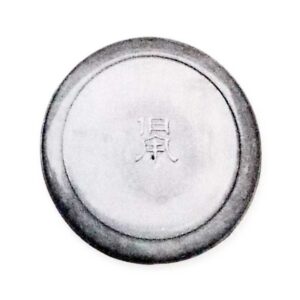
A circular seal bearing the character “Nezumi”
・Pouch: Nishiki-te; lined with Dutch cotton; no cord
・Box (1 box): Made of paulownia wood, Shunkei-style lacquer; features a sticker inscribed with “Nezumi Shunkei”
[Miscellaneous Notes]
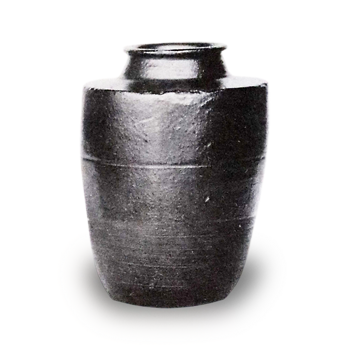
Nezumi. Formerly owned by the Matsudaira Gishū (Asano family, lords of the Hiroshima Domain). The attached label reads “Nezumi Shunkei.” The Hikiya is made of ivory and bears a gold-powder inscription by Lord Enshū. The pouch features particularly exquisite komon patterns on a velvet base, including Ōuchi Nishiki, red shark skin, yellow flower-patterned shark skin, and small cobblestone patterns. It is torn and has become thin. It features a “Kin-ke Shunkei” (golden luster) glaze with a “Uzu-ito-giri” (swirl-thread cut) pattern; there is a single droplet of glaze pooled at the front, exhibiting a golden luster. The entire piece has a golden luster (illustration of the tea caddy included).
(From Shokake Meiki Shū)
[Record of Actual Viewing]
On May 11, Taishō 9 (1920), I had the privilege of viewing this piece in person at the residence of Marquis Nagatake Asano in Hiroshima City.
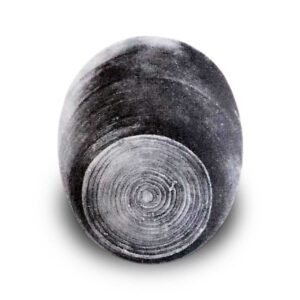
The rim’s “kukurikaeshi” (curved rim) is somewhat deep; the area below the “koshi” (waist) protrudes, and the rise of the shoulder (“kikkari”) is firm. A single sunken ridge runs around the body, and the clay at the hem rises high, revealing the deep gray-brown unglazed base of the bottom. The swirling thread-cut pattern on the bottom is truly magnificent.
Amid the chestnut-brown metallic luster characteristic of Shunkei-yaki, a single streak of glaze runoff extends from the tip of the shoulder to above the body’s cord pattern, created by the “tomo-glaze” technique. Inside, the glaze covers the rim, while below that, wheel marks are visible, and the center of the base forms a swirl pattern.
There are traces of a spatula press on a portion of the shoulder, which adds a subtle point of interest to this tea caddy; however, overall, it possesses a restrained and calm atmosphere with minimal decoration. Pieces of this style have traditionally been called “Nezumi Shunkei” and are considered a variety of Shunkei ware.
