
Accessories: Box, label
Provenance: Sakai family of Wakashu
Dimensions
Height: 8.1–8.9 cm, Mouth diameter: 11.3–13.3 cm, Body diameter: 12.9 cm, Foot diameter: 5.5–6.0 cm, Weight: 470 g
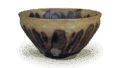
This is believed to be one of the earliest works created by Seto potters who moved to Mino and began producing tea bowls for “wabi-cha” (a style of tea ceremony emphasizing simplicity and austerity). This is also confirmed by the discovery of pottery shards from the same kiln during excavations at an ancient kiln on the western slope of Mount Asama (Ena Town, Ena District, Gifu Prefecture).
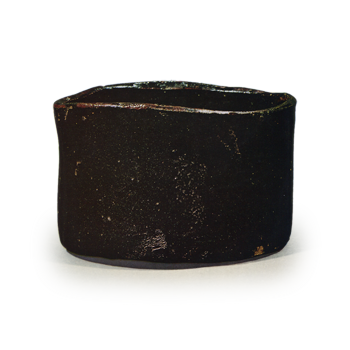
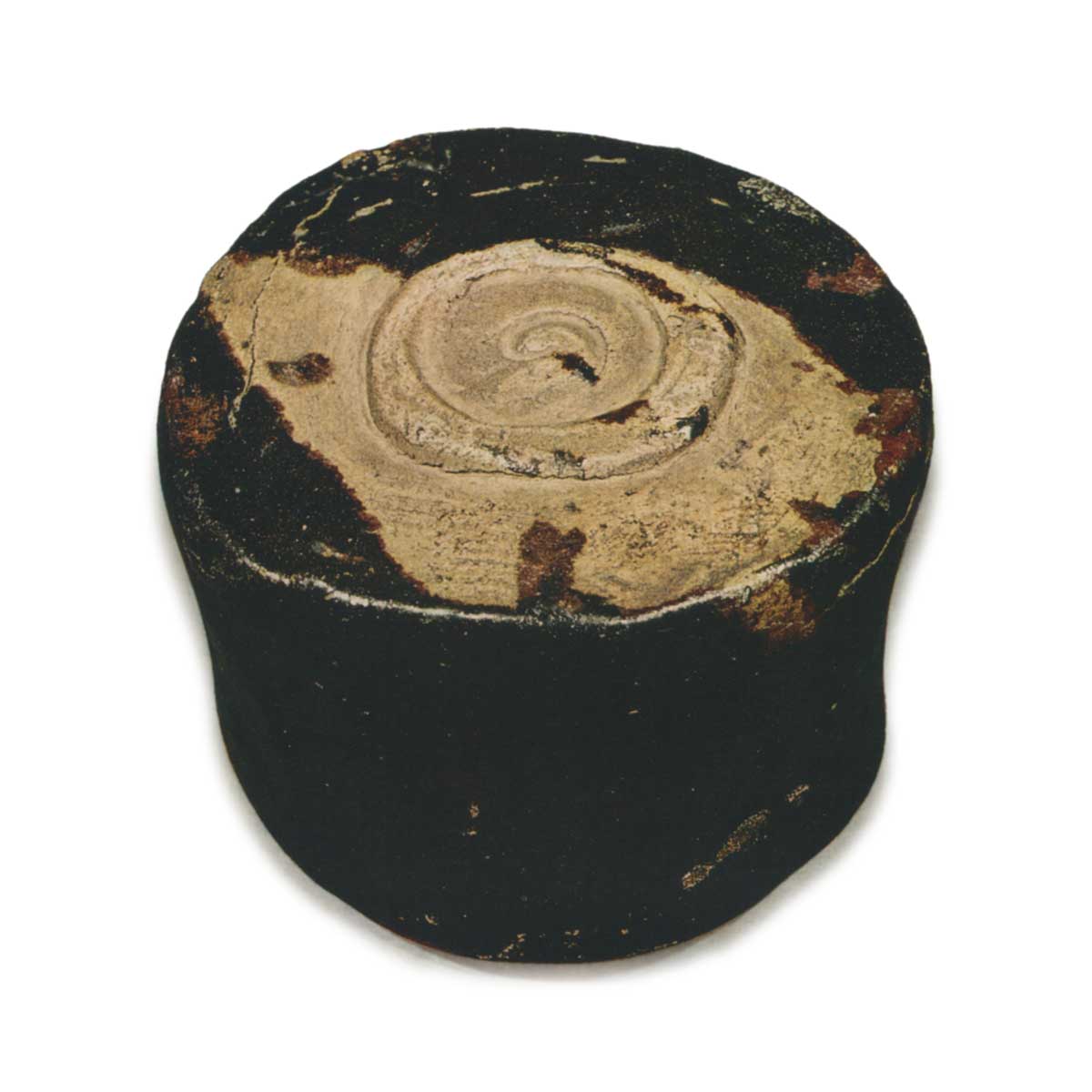
Although it is also called “Tencho Black,” the bottom is perfectly straight, and it is unclear whether there is a foot, which is a distinctive feature of this tea bowl.
Among the excavated pieces, some have a seam on the body, suggesting that they were originally shaped to resemble “wage” (a traditional Japanese headband).
Additionally, the base clay of the foot was coated with “mizu-yu” (water glaze) to prevent it from being stained by tea, which is a remarkable and noteworthy feature.
Furthermore, the shape of the “Shino tea bowl” evolved from the shape of the Tencho-kuro.
Although it has a very austere feel, it is also majestic, and this tea bowl is undoubtedly a masterpiece among masterpieces.