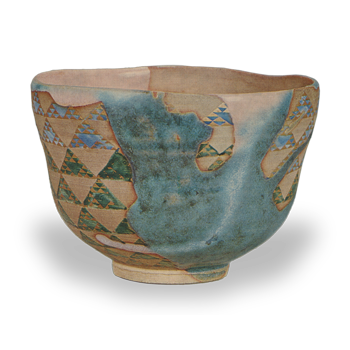
Accessories: Box, lid underside, inscription, colored paper
Provenance: Kaga clan senior retainer Motoda family—same clan samurai Shinohara family
Recorded in: Tokyo Tea Ceremony Record, First Collection, Volume 1, Taishō Meiki Kan (Guide to Famous Tea Utensils of the Taishō Era)
Dimensions
Height: 8.9–9.5 cm Mouth diameter: 11.8–12.7 cm Foot diameter: 4.7 cm Same height: 0.6 cm Weight: 249 g
This is a tea bowl that Ninsho deliberately created by venturing beyond his specialty of honryo (traditional tea bowls) in an attempt to artificially enhance its elegance. Whether the result is successful or not is left to the viewer’s judgment.
The previous “Senryu” showcases Ninsei’s true skill, but this “Katamani” is different. Ultimately, it is clear that he is attempting to capture the natural changes that should occur through technique and deliberate calculation.
The base clay is Shigaraki clay, but the glaze is applied in a flowing manner to highlight the interesting changes in the glaze, demonstrating exceptional skill.
I did not have the space to touch on this in the main text, but after Ninsho, this tradition of Kyoto ware took shape, and particularly Ninsho, Kansan, and Mokume came to be known as the three great masters. However, when viewed from the lineage of “wabi-cha” or the lineage of “wabi-cha” tea bowls, this represents a significant transformation.
The inscription “Katamani” by Kanamori Sōwa is also appropriate for a Ninshō tea bowl.