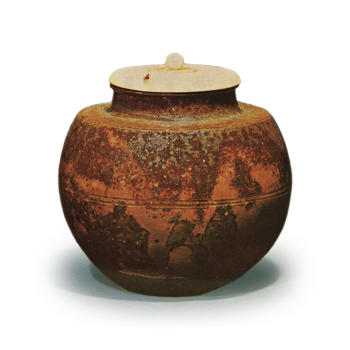

Former name: Matsumoto Katatsuki, Chinese, Daimeibutsu
Important Cultural Property
Accessories
Lid, one
Four covers
Outer box, black lacquer, gold lettering, inscription
Grinder, one, black lacquer, made by Fujishige
Grinder cover, one, leather
Haneeda Goro construction, square tray
Outer box, black lacquer, gold lettering, inscription
Provenance
Matsuya Genzaburo Hisamasa (Matsuya I, Momoyama period) — Matsumoto Tamaharu (high disciple of Tamakyu, Muromachi period tea master) — Ashikaga Yoshimasa — Murata Tamakyu — Furuichi Harima (Muromachi period tea master) — Matsuya Genzaburo Hisayuki (Matsuya II, late Muromachi period tea master) — Shimazu family — Nezu Aoyama
Recorded
Written by Fukada Masayume, “Kissa Yoroku,” Matsuya Hisashige Diary, Meibutsu Mekiki, Yukizakusa Chado Wakugai, Kokon Meibutsu Ruiju, Matsuya Kaiki, Tsuda Soun Chayu Nikki, Imai Sohkyu Nikki Nukui, Sohzan Nikki, Matsuya Nikki, Sanza Monogatari, Matsudaira Fumai Den
Dimensions
Height: 7.7 cm, Mouth diameter: 4.7 cm, Body diameter: 8.5 cm, Base diameter: 5.0 cm, Weight: 113 g
Owner
Nezu Museum, Tokyo
This tea caddy has been highly prized since the early days of tea ceremony.The distinctive features of this tea caddy are its rare flat shoulders and bulging body. In particular, the glaze patterns, which were chosen by the four master craftsmen Jukō, Rikyu, Oribe, and Enshū according to their individual preferences, and the fact that each of them added their own favorite cover, demonstrate how highly this tea caddy was appreciated.
Until the end of the Edo period, it was said that people would visit Matsuya in the hope of seeing this tea caddy, which was considered one of the three most famous tea caddies along with the heron by Seiki and the tray by Zensei. These three pieces were later given to the Shimazu family, but the heron by Seiki has not survived to this day.
In any case, this tea caddy is one of the most legendary Daimeibutsu among tea connoisseurs.