Height: 19.0 cm, Mouth Diameter: 12.7 cm, Foot Diameter: 17.8 cm
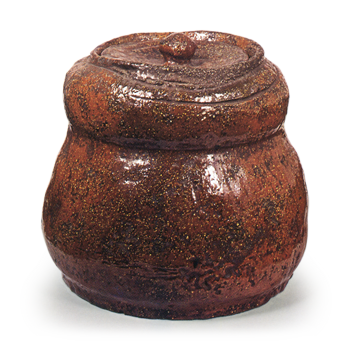
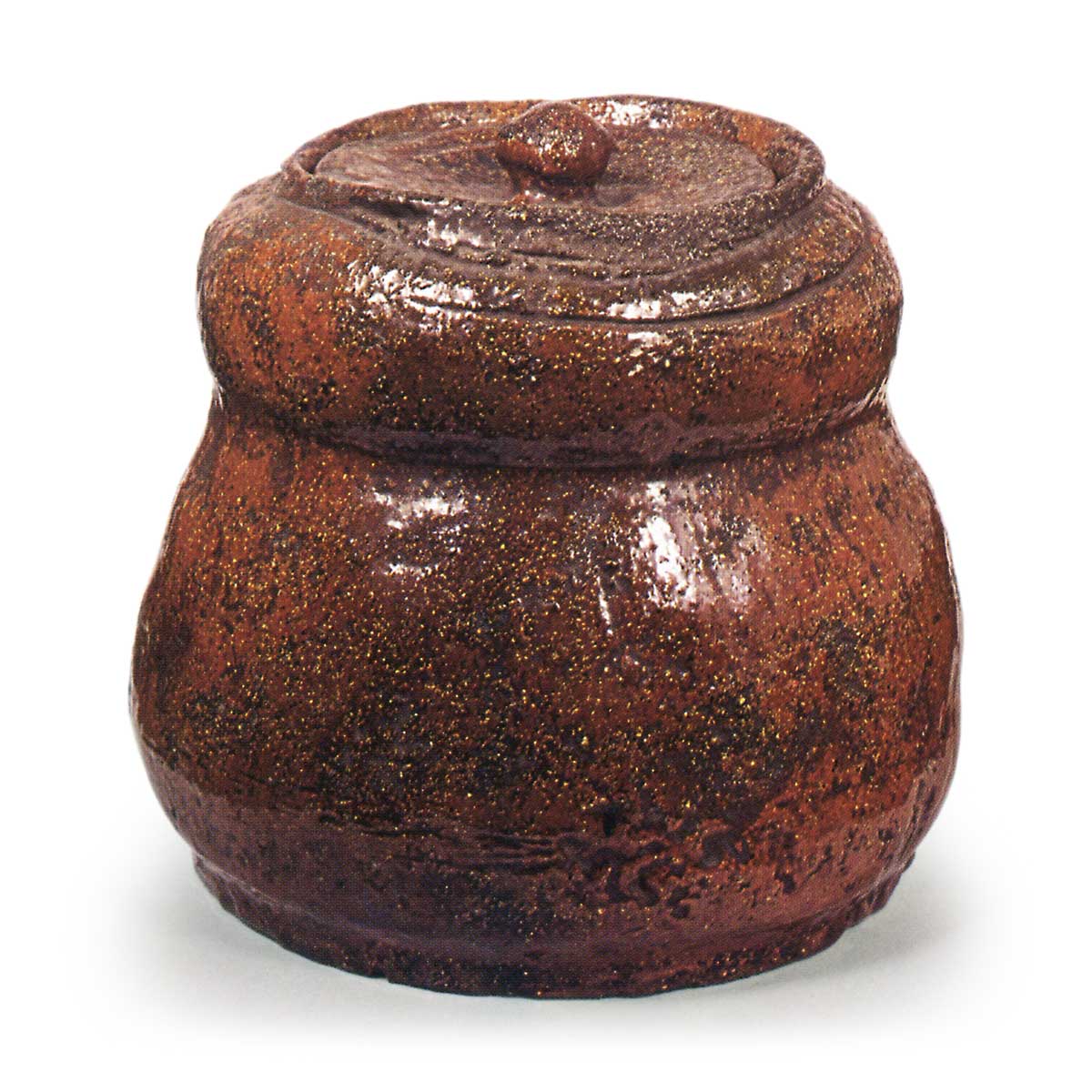
This is a gourd-shaped water jar with a tapered body, featuring a rough, hand-molded appearance. However, the craftsmanship around the rim and the incised lines running along the shoulders are quite exceptional. It appears to be modeled after a Shigaraki water jar; the amber glaze covering the entire surface is thin, revealing the sandy clay body beneath. It seems the amber glaze was applied specifically to highlight the interesting texture of this raw clay surface. The base has been flattened with a spiral-shaped scraper, leaving a narrow rim of folded clay around the edge. The body features large, wide vertical scrapes, and the inside of the base is coated not with amber glaze but with red Raku glaze. It is a style well-suited for wabi-cha.
Height: 19.0 cm, Mouth Diameter: 12.7 cm, Foot Diameter: 17.8 cm
This is a gourd-shaped water jar with a tapered body, featuring a rough, hand-molded appearance. However, the craftsmanship around the rim and the incised lines running along the shoulders are quite exceptional. It appears to be modeled after a Shigaraki water jar; the amber glaze covering the entire surface is thin, revealing the sandy clay body beneath. It seems the amber glaze was applied specifically to highlight the interesting texture of this raw clay surface. The base has been flattened with a spiral-shaped scraper, leaving a narrow rim of folded clay around the edge. The body features large, wide vertical scrapes, and the inside of the base is coated not with amber glaze but with red Raku glaze. It is a style well-suited for wabi-cha.