National Treasure
Accessories: Outer box (black lacquered), medicine chest lid, label on the underside of the lid, attached paper, inscription
Accompanying letter written by Priest Ikkei Sōshu
Dimensions
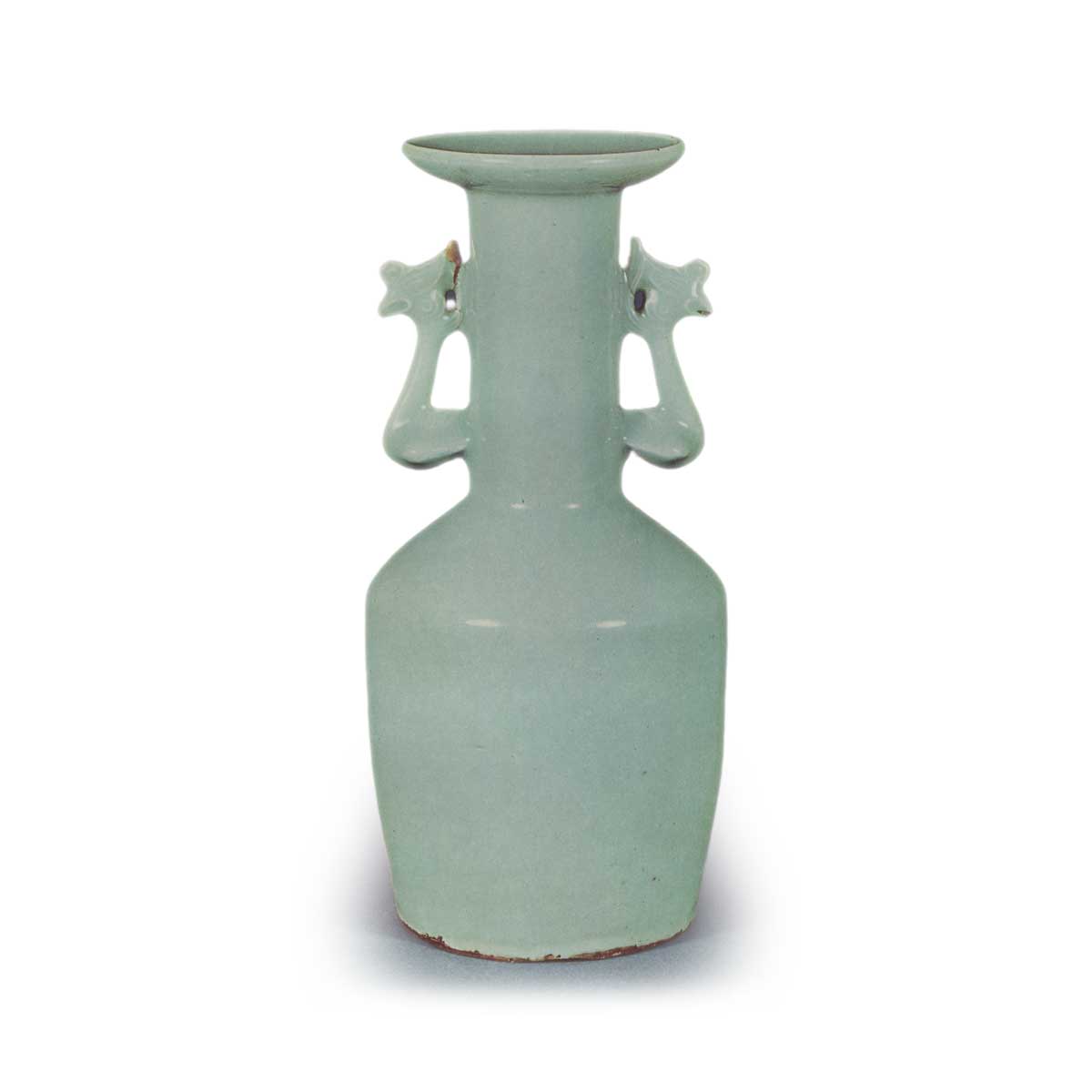
Height: 30.8 cm, Body diameter: 14.2 cm, Base diameter: 11.7 cm, Weight: 1780 g
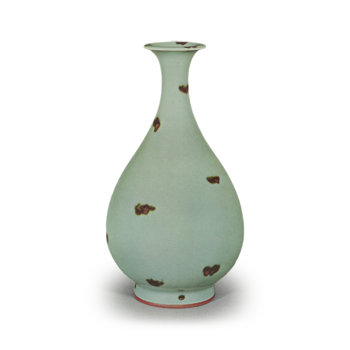
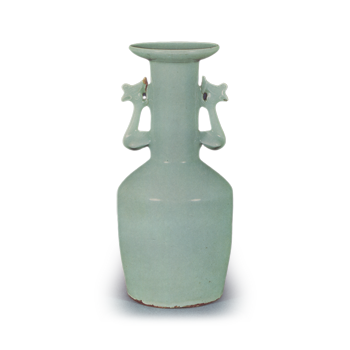
Although celadon flower vases come in various shapes—such as bamboo shoot, bottle, middle gourd, and lower gourd—Japanese tea masters have long regarded the phoenix-ear style as the highest rank. As mentioned in the introduction, the three most famous phoenix-ear flower vases in Japan are:
Mansei (formerly in the collection of Bishamon-do)
Sensei (in the collection of the Yo-mei Bunko)
Formerly in the collection of the Yamaguchi Gendō family, Unsigned
are the three most famous examples (it is said there are two others, but they are of no consequence). As mentioned earlier, a Hōji flower vase—which was believed to be found nowhere else in the world—was discovered in a single instance at the National Palace Museum in Taipei.
The reason phoenix-ear vases are so highly prized is that they possess the air of a sovereign at first glance. The powerful presence of the phoenix ears with their wings spread is well balanced with the vessel as a whole; the rim opens straight, the body has a softness to it, and the jade-green color seems almost to overflow.
It was housed at Bishamon-do Temple in Yamashina until after the war, and the name “Mansei,” along with the Kondo family’s “Sen,” is an imperial inscription by Emperor Go-Sai. The note by Sōshu Ikkei of Daitoku-ji states “Shikan,” indicating that there is a small flaw near the phoenix’s head that has been repaired with gold.