Daimeibutsu
Accessories: Inner box—unfinished cedar
Outer box—unfinished paulownia, with label and inscription
Cover—navy blue ground with waterfowl design, Donshu silk
Accompanying letters: Two letters—Rikyū’s “Musashi-abumi” design (from Sen no Rikyū to Furuta Oribe)
From Ittō Soshitsu to Ueda Kodōji
Dimensions
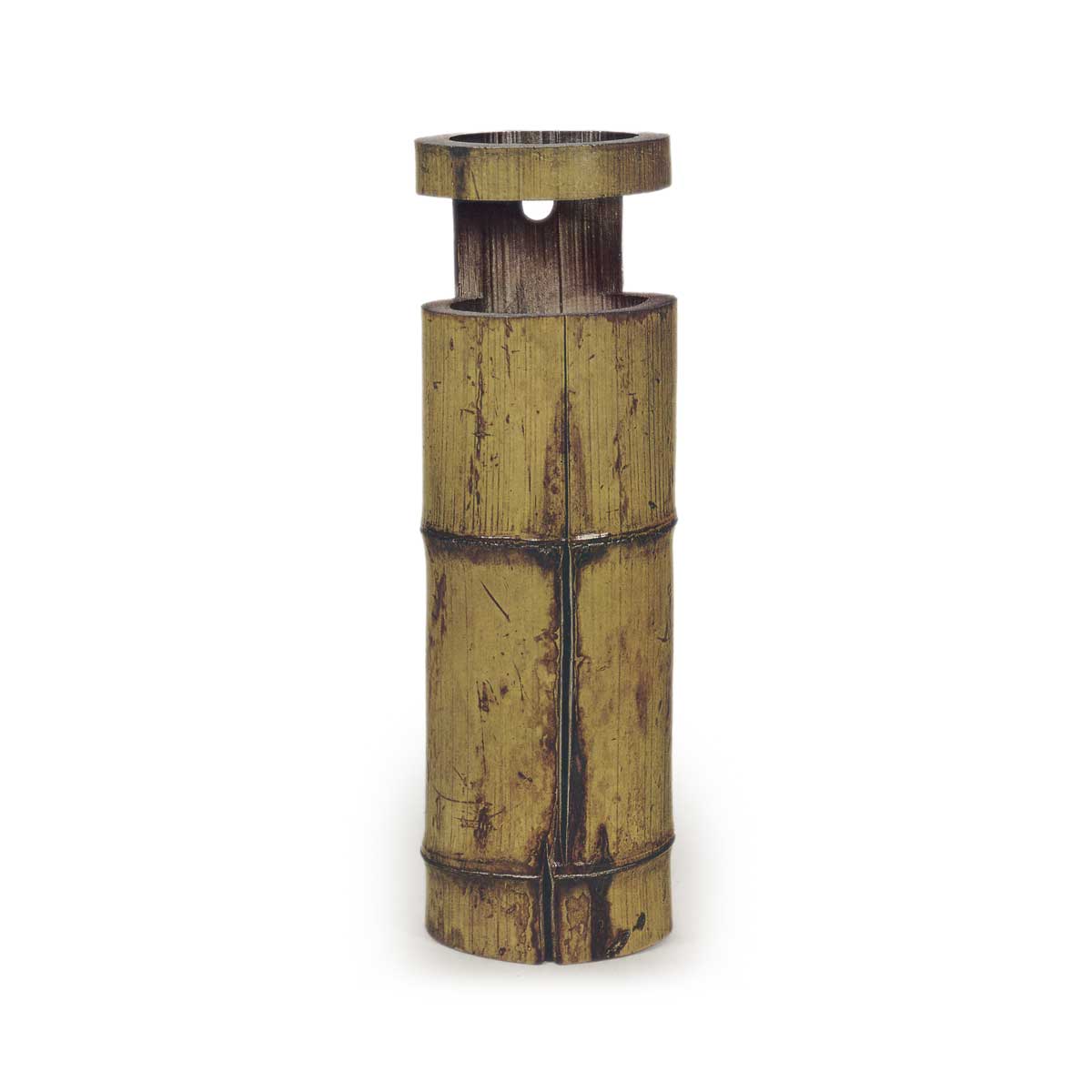
Height: 33.4–34.0 cm; Mouth Diameter: 10.5–10.8 cm; Base Diameter: 10.3–11.2 cm; Thickness: 1.5 cm; Weight: 884 g
Owner: Tokyo National Museum
In the 18th year of the Tenshō era (1590), when Hideyoshi attacked the Hōjō forces at Odawara, Rikyū, who accompanied him, cut three flower vases from bamboo in Nirayama, Izu, while at the camp. This marked the beginning of bamboo flower vases; in addition to the single-cut vase, he kept one for himself and gave the other to his son, Shōan, after returning to the camp.
One of the vases was cylindrical in shape and inscribed with the name “Shakuhachi,” while the third was a double-cut vase inscribed with the name “Yachō.”
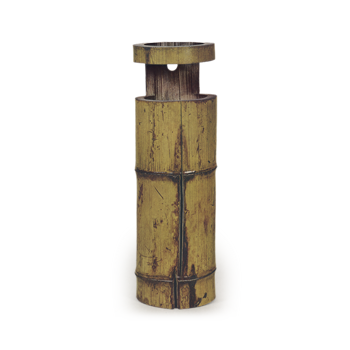
The single-cut vase given to Shōan had a single crack running through two joints, so Shōan inscribed it himself, carving “Onjō-ji” on the back. This was a witty touch by the tea master, inspired by a crack in the bell at Onjō-ji (Mii-dera).
The circumstances surrounding the carving of these three vases from Nirayama bamboo are made clear in a letter from Rikyu to Oribe (the famous “Letter from Musashi-abumi”).
This flower vase stands 30–40 cm tall, a slender and elegant form even among most flower vases (not limited to bamboo, but including ceramic ones as well). Whether considered in terms of the historical significance of Rikyu’s founding, the quality of the bamboo, or Shoan’s inscription, it embodies Rikyu’s spirit of wabi—using bamboo as a flower vase—and its status as the king of bamboo flower vases is unshakable.
Furthermore, tracing the provenance of this vase reveals that around the Kyōwa era (1801), Honya Chōga—an art dealer close to Fumai—purchased it from the Fuyuki family in Fukagawa, Edo, for 250 ryō (equivalent to 800 ryō in modern currency), and presented it to Lord Matsudaira Fumai. In the Shōwa era, it was donated by the Matsudaira family to the Tokyo National Museum.
Accompanying letter from Ittō Soshitsu (to Ueda Kodajiro of the Fuyuki family in Fukagawa, Edo)
Rikyu Ichijukiri Inscription
Known to the 8th head of Onjo-ji
This is the flower vase
It is said to be the first of the Ichijukiri style
It has been passed down from my ancestors
Please keep it in your treasured collection
Incomplete
April 28
To Lord Ueda Kodajiro, Ittō (Seal)