
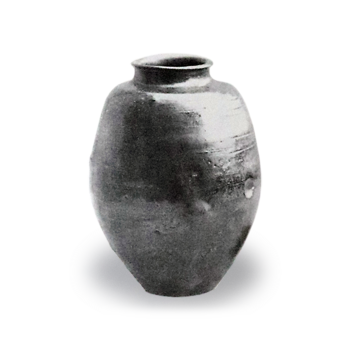
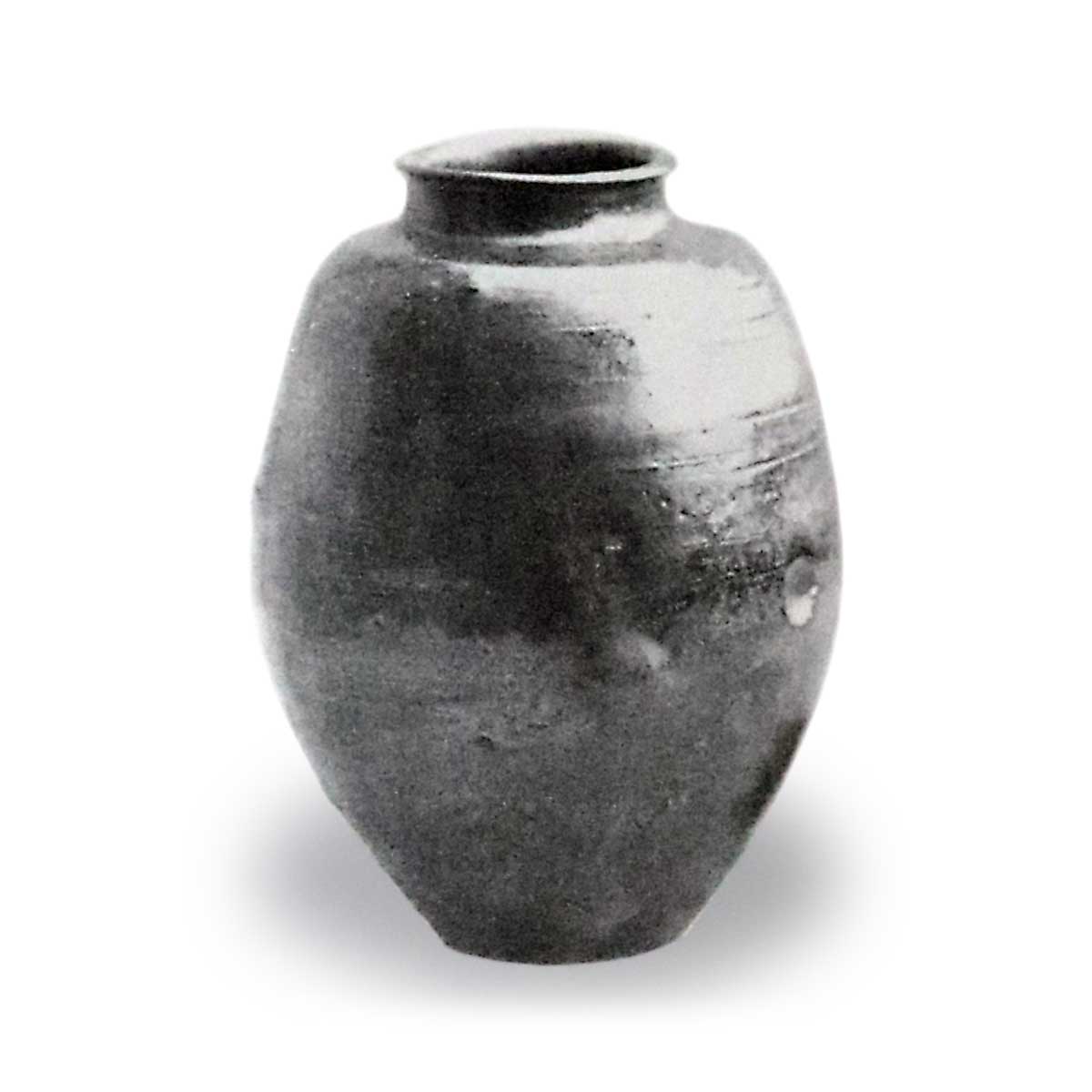



A Chinese tea caddy, also known as “Sassakatatsuki.”
It is currently in the collection of Baron Iwasaki Koyata.
Origin of the Name
It was named for the lump-like protrusions found in various places on the body of the tea caddy. It is also called “Sassa Katatsuki” because it was once owned by a man named Sassa Magosuke (the older brother or a relative of the Sengoku-period warlord Sassa Narimasa).
Modern Equivalents of Dimensions and Weight
Height: Approx. 8.7 cm (2 sun 8 bu 8 rin)
Body Diameter: Approx. just under 6.6 cm (just under 2 sun 2 bu)
Mouth diameter: approx. 3.0 cm (1 sun)
Base diameter: approx. 2.7 cm (9 bu)
Koshiki height: approx. 0.7 cm (2 bu 3 rin)
Shoulder width: approx. 0.6 cm (2 bu) – approx. 0.9 cm (3 bu)
Weight: approx. 92.6 g (24 monme 7 bu)
List of Accessories
There are two lids; one of them is a colored piece by Rissa.
There are four types of carrying pouches.
・Shōzaburō Kōtō (lining: Tamamushi, cord: floral pattern)
・Dan-kin (lining: peach-colored Kaiki, cord: purple)
・Dan-moori (lining: navy Nanako, cord: purple)
・Oishi Tatami Junko (lining: striped kabechoro, cord: brown)
The bag box is black lacquered.
There are two types of Hiki-ya: inner and outer.
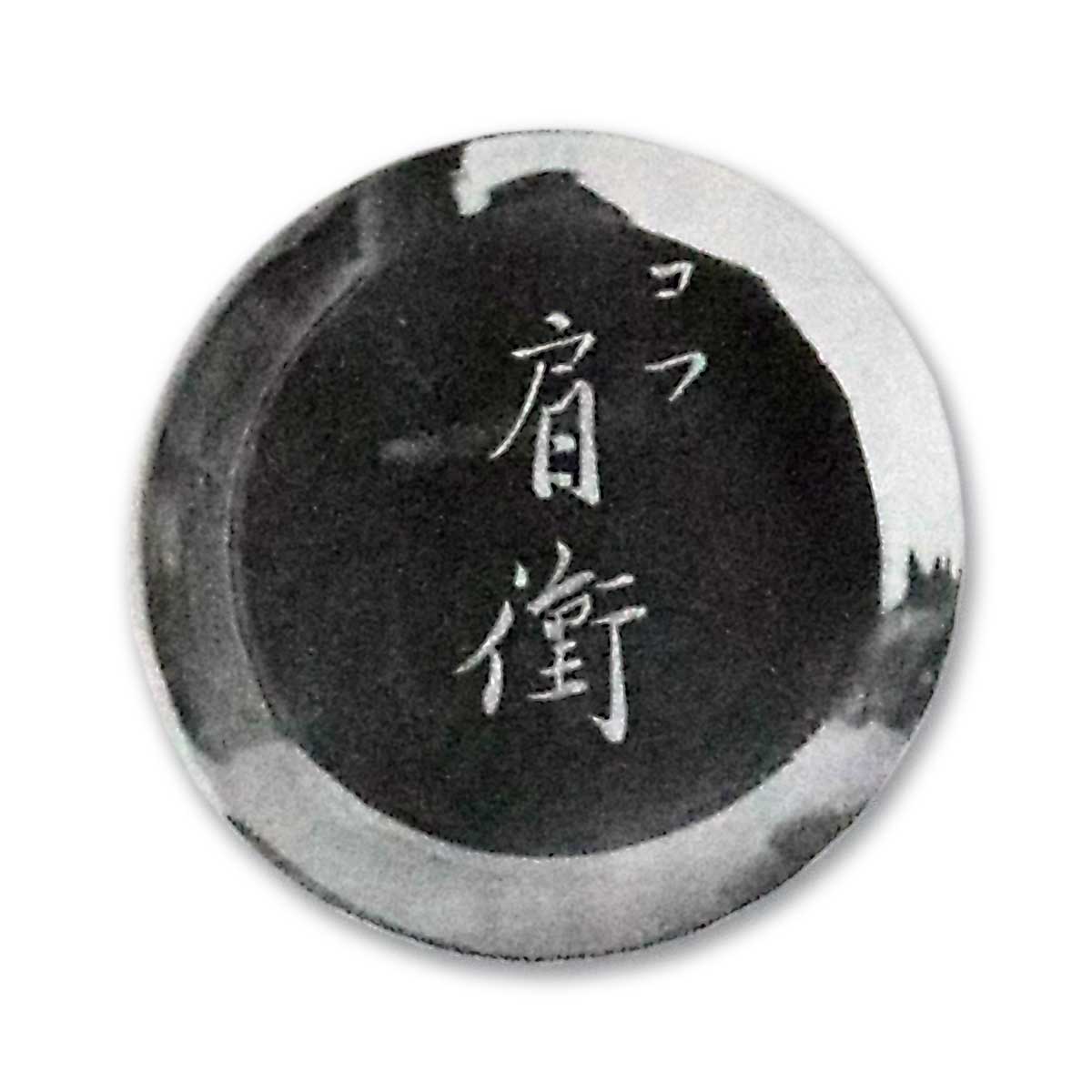
・The inner Hiki-ya is black lacquered and inscribed with “Kofu Katatsuki” in gold powder. These characters are said to be in the handwriting of Ashikaga Yoshimasa. The bag is made of purple leather, and the cord is light yellow.
・The outer Hikiya is also lacquered black and bears the characters “Koma Katatsuki” written in gold powder. These characters are said to be in the handwriting of Soami. The pouch is made of brocade (lined with striped Kaike fabric, with a flower-patterned cord).
The inner box is made of untreated paulownia wood and is newly crafted.
The outer box is lacquered black and bears the character “So” (indicating it is in Soami’s handwriting) written in gold powder.
The accompanying tray is a Wakasa-style tray (diameter approx. 19.7 cm, rim diameter approx. 14.8 cm, base diameter approx. 17.1 cm, height approx. 2.6 cm). The untreated paulownia box containing this tray bears characters said to be in the handwriting of Murata Jukō, the founder of the tea ceremony. Another thin “red square tray (Ima-watari Imperial Square Red Tray)” is also included.
The outer box is black lacquered and features a lock.
There are four accompanying documents.
(Illustrations and dimensions of the tea caddy have been omitted.)
“It is said that the tea caddy shown here was once owned by Sasa Magosuke and others; having examined it, I find it to be a truly extraordinary and magnificent tea caddy (continued on the next page).”
The quality of the clay, the shape of the rim, the front profile, the traces of the thread-cutting, and the finish of the yellow and persimmon-colored glazes—in every respect, it is of unparalleled elegance.
It is said that the famous “Ichiba tea caddy,” currently treasured by a man named Kimura Kyūemon who lives in Shimotachiburi Ogawa, Kyoto, is worth about 15 pieces of gold; however, this tea caddy is far superior in appearance. It is truly a top-tier piece among Chinese tea caddies. Having examined it, I am deeply impressed. Therefore, I hereby certify it as such. End.
New Year of the Goat, Kawazumi Shichiemon Mitsutaka (Seal)”
Notes on the Teapot’s Characteristics and Provenance
(Memo describing the teapot’s characteristics)
Chinese-style Kofu (knobbed) shoulder-striking teapot
Height: 2.7 sun, width: 2.2 sun, circumference: 6.9 sun. Clay: red clay. Mouth: 1 sun. Base: 0.9 sun. Height from mouth: just over 0.2 sun. Shoulder width: 3 mm. The upper glaze is black; the lower glaze is persimmon-colored. It has striations, with one lump (knob) and one depression (yukubo). A cascade of yellow glaze has flowed over it.
Pouch: The pouch with the long cord is made of Shokuro-kin; the pouch with the short cord is made of Kinmouru (made by Fujishige Fujimoto).
End.
“The tea caddy with the lump on the right is a precious heirloom passed down through generations of our ancestors, so I am presenting it to you; please be fully aware of this and handle it with care.
October 11, 1774 (An’ei 3) Heizaemon Eitei (seal)”
A History of Remarkable Transitions (Records of the Makita Family)
“Kofu Katatsuki Tea Jar
During the Kan’ei era (1624–1644), my great-great-grandfather, Makita Eikuni, possessed this tea jar as a treasured heirloom and enjoyed the tea ceremony with it until the end of his life.
Later, his eldest son, Eikuni, succeeded to the family headship at a young age, but this tea utensil left our family and passed to the home of Sasa Magosuke.
The tea master Sakuma Shōkan (Fukansai) repeatedly pleaded, ‘Please let me have it,’ but the Sasa family did not agree. After Nagakuni had grown up, he pleaded earnestly, but his wish was not granted.
Subsequently, for reasons unknown, it came into the possession of Seizaemon, a weaver in Nishijin, Kyoto. When Eiro of that family traveled to Kyoto, he pleaded for it, but his wish was not granted at that time either. However, later, due to the strong desire of Eishō of the same family, it finally returned to our family (the Makita family).
It is an item to be treasured for generations to come. The details of its transmission through the generations are unknown because the records were lost in a fire during the Year of the Ox in the Hōreki era a few years ago; however, I am recording this here as a testament to its legacy.
January of the 9th year of An’ei (1780) Makita Hikoemon Eitei (Seal)”
Record from the Sasa Family’s Inventory Ledger
Among the Sasa Family’s Notable Chinese Antiques
- Knotted-shoulder tea caddy
・Lid (also known as the handle): Black lacquer with gold lettering. It is said to be “in the hand of Lord Ashikaga Yoshimasa.” There is also another piece with gold-powder lettering said to be “in the hand of Soami.”
・Matching tray: A Wakasa tray with a red interior. The inscription on the box reads “Now crossing…,” and it is said to be in the hand of Murata Jukō.
・Tea caddy pouches: There are four, housed in a single box. (Shōzaburō Kōtō, Dan-kin, Dan-keori, Ōishi Tatami Junko. The long cord on the Dan-kin pouch is said to have been attached by Jukō.)
・Spare lids: Two (one of older design and one by Ikeshima Tatsusa).
・A copy of Hyōan’s “Daimyōbutsu Katatsuki” from the Tenshō era: 1 copy
・Certificate of Authentication (appraisal document) and letter by Fujishige Fujigen: 1 copy
Summary of Provenance
Around the Kan’ei era (1624–1644), this tea caddy was in the possession of Makita Eikyu. However, upon his death, his son Eikuni inherited the family estate at a young age, and as a result, the tea caddy left the Makita family and passed into the hands of Sasa Magosuke.
Sakuma Shōkan (Fukansai), a collector of famous tea utensils, frequently requested that it be sold to him, but the Sasa family refused. Even after Nagakuni came of age and asked for “my father’s heirloom to be returned,” his request was again denied.
Subsequently, through unknown circumstances, it came into the possession of Seizaemon, a weaver in Nishijin, Kyoto. Nagatomo of the Makita family earnestly sought to acquire it, but ultimately was unable to do so. However, during the generation of Makita Nagamasa, he earnestly sought the item, and it was finally returned to the Makita family (they succeeded in buying it back). These circumstances are detailed in a written record by Makita Hikoemon Nagasada from the 9th year of An’ei (1780).
Its subsequent history is unclear, but it was in the possession of Kawaguchi Hisaharu of Kaga (Ishikawa Prefecture) when, in 1886 (Meiji 19), Baron Iwasaki Yanosuke purchased it for “700 yen” through an introduction by Akatsuka Sōshū, a tea master of the Enshū school, and it has remained in his family to the present day.
Academic Inspection Record (Appraisal Record) from the Taisho Era
On November 4, 1920 (Taisho 9), this tea caddy was physically examined at the residence of Baron Iwasaki Koyata in Takanawa, Tokyo.
The rim is thin and sharply defined. The body is low, the shoulders are slightly rounded, and the body flares out before tapering toward the base. The white clay (unglazed body) is visible below the base, and the traces of the thread-cutting technique remain extremely fine and distinct.
The overall color is a shade of persimmon with a metallic sheen, over which a black metallic glaze creates a mottled pattern. It spreads intermittently like mist from the tips of the shoulders, and coarse wheel marks extend down to the area of the horizontal ridges on the body.
On the body, there is a raised area that resembles the “lump” (kobu) from which the piece derives its name. From the shoulder, yellow glaze flows diagonally down this lump and stops at the base near the unglazed clay. This pool of glaze is thick and has a slightly bluish-black hue.
To the left of the lump, there is a concave area, and in another indentation that resembles a small hole, black glaze has settled.
Fine wheel marks run along the base, and there are two spots that look like they were pressed by a finger (fingerprints).
Inside, glaze covers the rim of the mouth; below that, fine wheel marks run around the interior, and the center of the base is slightly raised.
Although completely free of damage, the overall design is as fascinating as it is magnificent. Against the persimmon-colored glaze, the black glaze drifts like mist (aitaiki), and the cascades of yellow glaze create a beautiful scene reminiscent of “sunset clouds.”
Furthermore, the “knob” adds a charm unlike any other, making it a highly distinctive and captivating “oddity” even among the many Chinese-made “Tang-style shoulder-pushed tea caddies.”

