From the collection of Viscount Hidenobu Koide, a collector of Chinese ceramics
Name
In Kanamori Tokusui’s book Honchō Tōki Kōshō (A Study of Japanese Pottery), it is stated: “The term ‘Taikai’ refers to a vessel with a wide, spacious rim and shape, likened to the sea; conversely, a vessel with a small rim is called ‘Utsumi,’ meaning ‘inner sea’ or ‘cove.’ In the past, a Taikai was placed alongside tea caddies such as the Nasu or Katatsuki. Before grinding the tea, the tea leaves were first transferred to the Taikai, and only then were they placed into the tea caddy. According to Rikyū’s philosophy, using a ōkai as a hikidame (a vessel for temporarily storing ground tea) was considered undesirable because both the tea caddy and the ōkai were made of pottery; thus, lacquerware was used for the hikidame. It is also said that in ancient times, ōkai were sometimes displayed on tables in main halls or study rooms.
In Endō Genkan’s book Chayū Hyōrin Taisei, it is stated that in the past, a tea ceremony was considered incomplete without a Chinese-style ōkai, but from the medieval period onward, katatsuki (teapots with protruding shoulders) came to be highly prized, and the ōkai naturally fell out of use. However, the ōkai is still used for tea ceremonies held on a daiko (tea table). The appearance of the uchikai teapot is the same as that of the ōkai, but it is noted that those with firmly protruding shoulders are called uchikai, while those with rounded shoulders are called ōkai.
In Chaki Meibutsu Zui by Kusama Waraku, it is written: “The ōkai appears to have a wide, spacious rim. Since the interior of the tea caddy was likened to the sea, it was formerly called uchi-kai, while the smaller type was called ko-uchi-kai. Later, from the time of Lord Kobori Enshū onward, the larger type came to be called ōkai, and only the smaller type was referred to as uchi-kai. In the past, Tang-style tea caddies such as the nasu, Bunrin, and maru-tsubo were always accompanied by this ōkai. Naturally, when using the tea caddy on the right for the tea ceremony, one would first store the ground tea in the ‘Ōkai’ and then transfer it from the ‘Ōkai’ to the Chinese tea caddy. The inscription in Lord Enshū’s own handwriting on the box of an antique Chinese-style ‘Ōkai’ tea caddy from the Kose-to tradition, reading ‘Hikidame’ (storage), stems from this tradition.”
Dimensions
Height: approx. 7.1 cm (2 sun 3 bu 5 rin)
Body diameter: approx. 10.2 cm (3 sun 3 bu 5 rin)
Mouth diameter: approx. 6.1 cm (2 sun)
Base diameter: approx. 5.8 cm (1 sun 9 bu)
Height of the neck (koshiki): approx. 1.5 cm (5 bu)
Shoulder width: approx. 1.1 cm (3 bu 5 rin)
Weight: 43.4 monme (approx. 162.8 g)
Accessories
・Lid: 1 piece, plain
・Sacred object pouch: white chirimen crepe; white tying cord
・Pouch: 1 piece; made from a scrap of goshuin paper (lined with scarlet kaiki silk); wisteria-colored tying cord
*Inscribed with the date May 15, the first year of the Wanli era (1573).
・Storage box: Paulownia wood, natural finish, with 3 compartments
・Wooden mold: Mulberry wood, 1 piece
・Hikiya (cylinder for storing the tea caddy): Zelkova wood, Shunkei lacquer finish, black interior
Pouch: Stiff-striped Guangdong cotton (lining: brown ground with peach-patterned Donshu fabric), brown drawstring
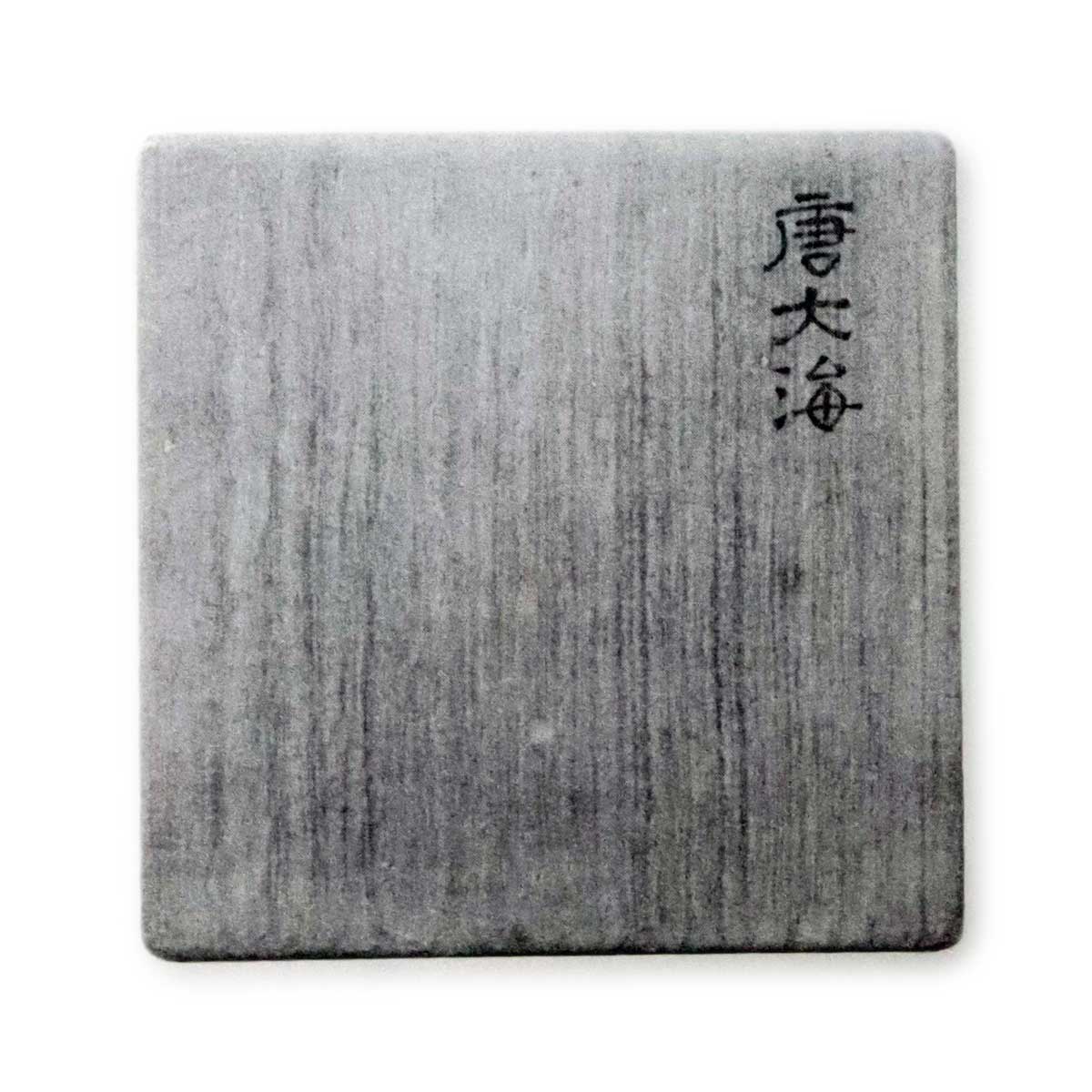
・Box: Paulownia, natural finish; features “Tang Da Hai” by Kobori Enshū
Miscellaneous Notes
Tang Da Hai: Height approx. 7.1 cm (2 sun 3 bu 5 ri), mouth diameter approx. 6.0 cm (1 sun 9 bu 8 rin), body diameter approx. 10.0 cm (3 sun 3 bu 1 rin), thread-cutting diameter approx. 5.2 cm (1 sun 7 bu).
There are two pouches: one is made of Donshu fabric with a red ground, featuring a shark-skin pattern with alternating circles and a dragon motif inside the corners (the lining is light yellow “Umi-ki,” and the drawstring is purple); the other is made of Guangdong cotton with a “Tachi-Kojima” pattern (the lining is Donshu with an “Umi-ki” pattern, and the drawstring is purple). The Hikiya has a round, black-lacquered piece, and the pouch is a magnificent example made of red-island-patterned Dutch cotton (lined with Donshu, with a purple tying cord). The inscription on the paulownia box, written by Sōfu (Kobori Enshū), reads “Tang Daikai.”
(From Kokin Meibutsu Ruiju)
(Note)
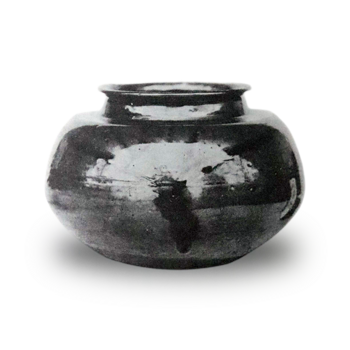
The “Supplementary Entries” section of Kokin Meibutsu Ruiju lists three types of Tang Daikai. The first is a Tang Daikai approximately 7.3 cm (2 sun 4 bu) tall, with no record of the owner’s name (currently owned by Mr. Yamaryu Imamura and the Taira family). The second is a Tang Daikai approximately 7.1 cm (2 sun 3 bu 5 rin) tall, attributed to Kuchiki no Kami (current owner unknown). The third is the Tang Daikai mentioned above (shown in Image 1). Although the description of its accompanying items differs from that of the piece in the collection of Viscount Koide, its dimensions are nearly identical, so it is included here for reference.
In the middle volume of Matsudaira Norimura’s Meibutsu, two types of Tang Daikai are listed. One is the Tō-taikai owned by Kobori, approximately 7.3 cm (2 sun 4 bu) in height (currently in the collection of Mr. Ryū Imamurayama and the Taira family); the second is the Tō-taikai owned by Tsuchiya Samon, approximately 7.0 cm (2 sun 3 bu) in height (the one listed in the Kokin Meibutsu Ruiju as belonging to Kuchiki no Kami).
Tang Daikai
Height: approx. 7.1 cm (2 sun 3 bu 5), mouth diameter: approx. 6.0 cm (1 sun 9 bu 8 rin), thread-cutting diameter: approx. 5.2 cm (1 sun 7 bu). The pouch is made of Donshu; the inscription on the box reads “Sōfu” (Kobori Enshū); the clay is nezu-tsuchi. (Illustration of the tea caddy included)
(From Chaki Zunmon-sho)
Record of Actual Observation
On April 15, Taishō 10 (1921), I viewed the actual piece at the residence of Viscount Hidenobu Koide in Yakuōji-chō, Ushigome Ward, Tokyo.
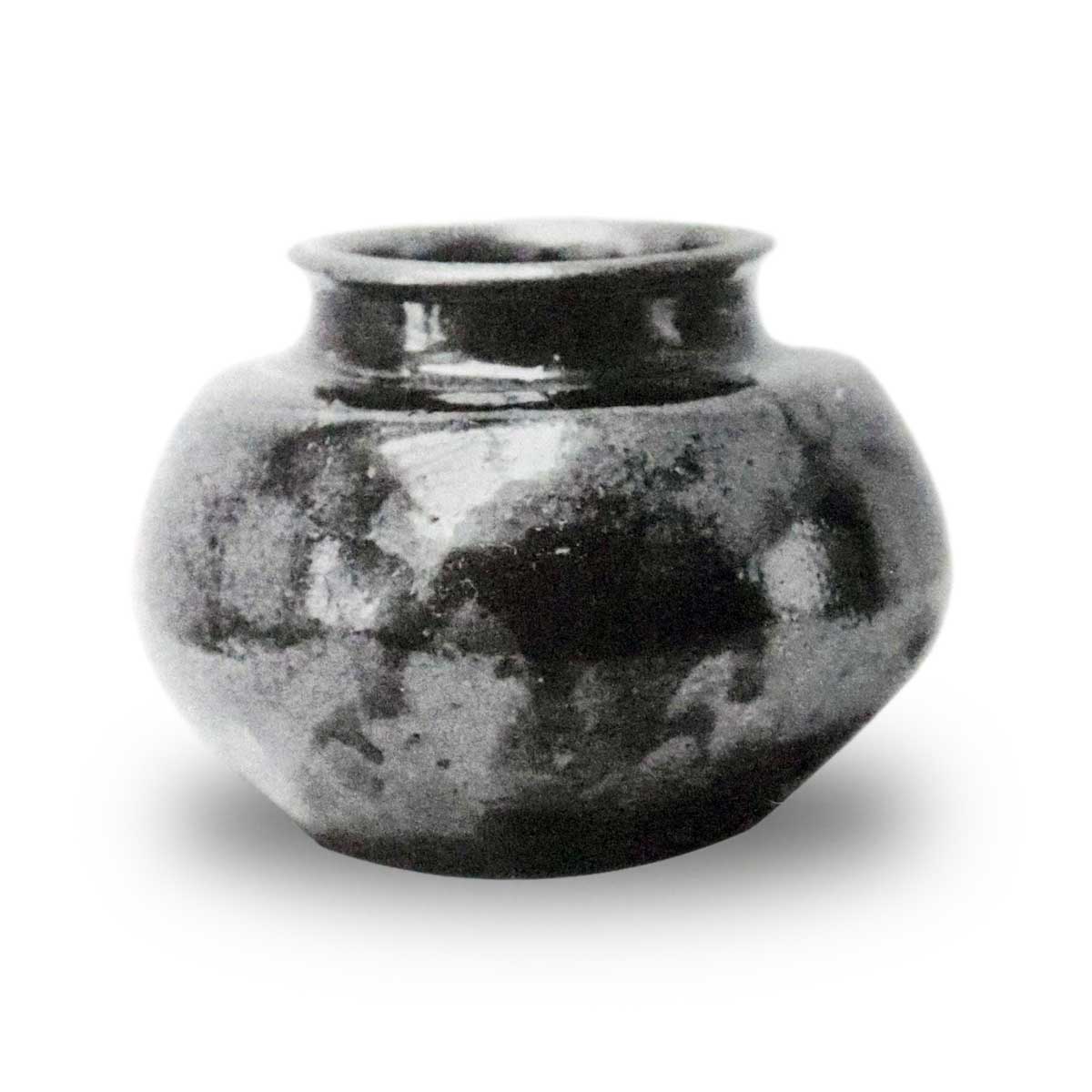
The rim has a deep fold; the bulge below the koshiki and the shoulders protrude distinctly, and a single sunken ridge runs around the edge of the koshiki. The body is flared, tapering from the hem downward. The glaze stops low; the clay has a reddish hue with a hint of iron, and the base is flat.
Overall, the piece combines a persimmon-gold hue (a persimmon color with a metallic luster) with pale purple, over which a black amber glaze creates a scenic effect. The design features a broad avalanche of mixed black and brown glazes flowing from the shoulder down to the base. A blue-lapis-lazuli hue appears at the tips of the glaze drips, and traces of the same color can be seen in places such as the rim and the shoulder. The body features areas of “kaki-kin-ki” where the glaze has not adhered, outlined by black glaze; the black glaze on the shoulder is particularly striking, with an extremely rich variety of glaze patterns.
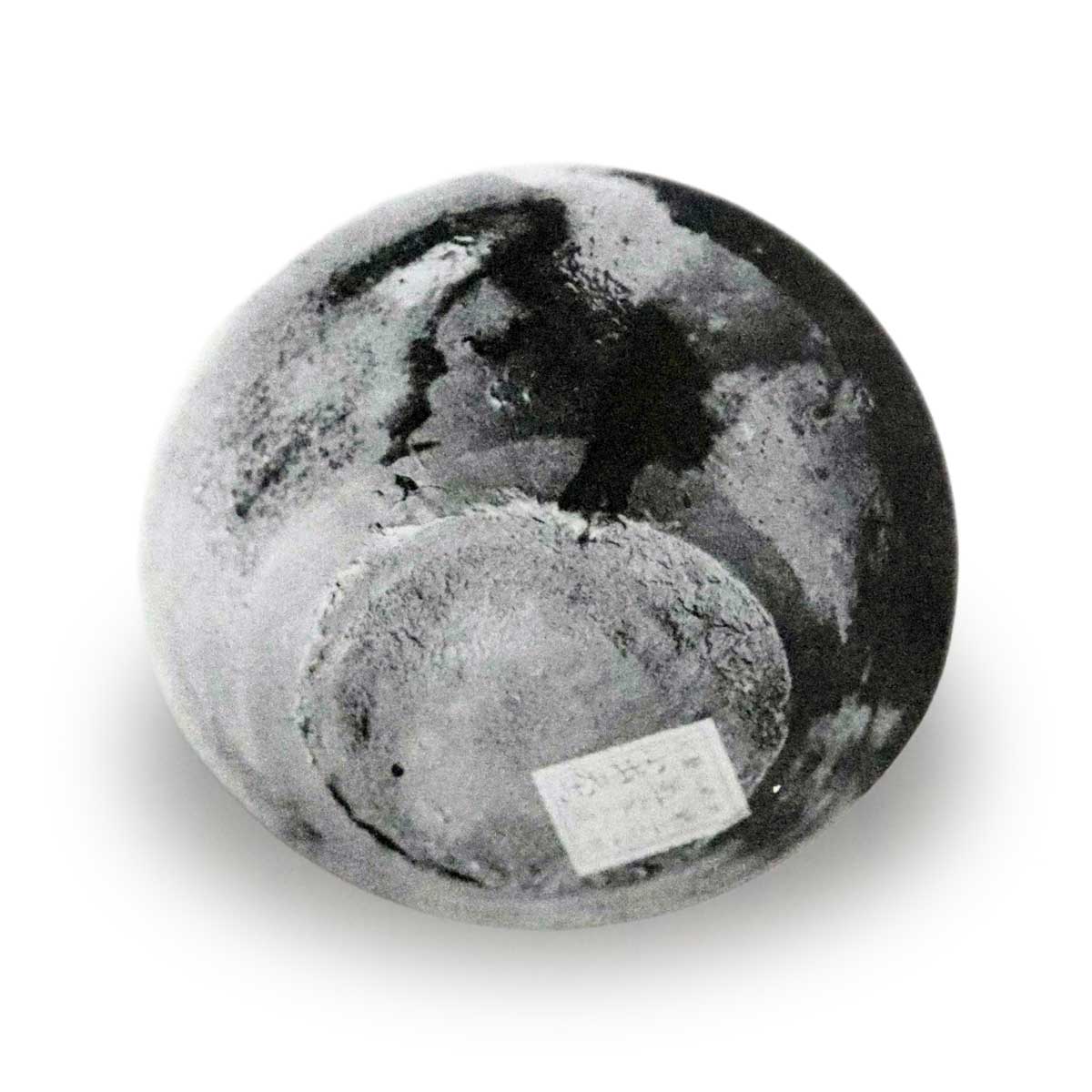
Inside, the glaze covers the rim, while below that, a watery glaze covers the entire interior, featuring an avalanche of black glaze. The base is entirely covered in black glaze that has lost its luster, with rough wheel marks circling it, and the center of the base forms a swirl pattern. It feels light in the hand; it is an ancient piece, free of any damage throughout, and is a most complete and elegant “Great Sea” vessel.