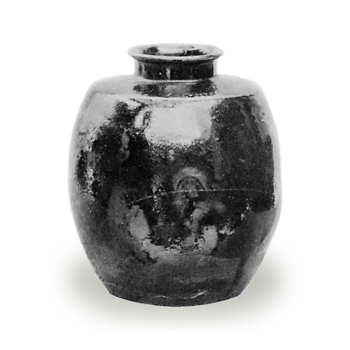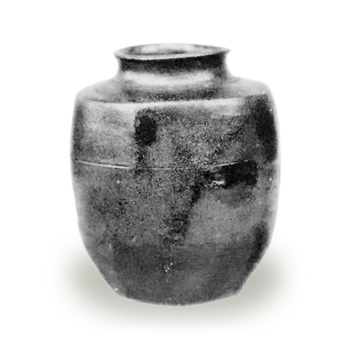


Chinese-made (Made in China) Daimeibutsu Collection of Count Tadamasa Sakai
[Origin of the Name]
It is named after Aoki Minbu Hōin Jōken, who once owned it.
[Dimensions]
Height: Approx. 8.9 cm (2 sun 9 bu 5 ri)
Body Diameter: Approx. 7.5 cm (2 sun 4 bu 7 rin)
Mouth Diameter: Approx. 4.2 cm (1 sun 4 bu)
Base Diameter: Approx. 4.5 cm (1 sun 5 bu)
Neck Height: Approx. 1.0 cm (3 bu 3 rin)
Shoulder Width: Approx. 1.4 cm (4 bu 5 rin)
Weight: Approx. 124.5 g (33 monme 2 bu)
[Accessories]
・Lids: 2 (one of which is ivory)
・Omonobukuro (bag for the tea caddy): Moegi-colored satin (donsu), with brown cord knots
・Shifuku (covers): 2
- Shimotsuma satin (lining: Jodai Kaiki, cord: purple)
- Shōō-donzu (lining: iridescent, cord: brown)
・Inner box: Unfinished paulownia wood box. Inscribed with “Katatsuki-fukuro.”
・Outer box: Unfinished paulownia wood box.
・Hikiya (wooden container to protect the tea caddy): Black lacquer
Bag for the Hikiya: White leather (cord: brown)
・Inner box: Unfinished paulownia wood box. Inscribed with “Aoki Katatsuki.”
・Outer box: Paulownia wood, black “kaki-awase-nuri” lacquer. Inscriptions in gold powder on both front and back.
Front: “Aoki”
Back: “A personal possession of Tōshōgū (Tokugawa Ieyasu), bestowed upon Goto Shōzaburō. Presented by the Goto family.”
・Outer Case (outermost box): Made of pine; board thickness is 8 bu (approx. 2.4 cm).
[Miscellaneous Notes]
“Higashiyama Imperial Treasures Sub-Register”: Aoki Katatsuki. Owned by Yorinobu Hyūga-no-kami (Akechi Mitsuhide).
“Gomono Godogu Ki”: Aoki Katatsuki (Katatsuki). A treasure of the Shogunate. Presented by Yorinobu Hyūga-no-kami; the item on the right is a tea caddy bestowed upon Gotō Shōzaburō.
“Kokin Meibutsu Ruiju”: Katatsuki. Tang-style (made in China). Daimeibutsu. Owned by Gotō Shōzaburō.
Morning of the 7th day of the 12th month, Tenshō 8 (1580) – Gathering at the residence of Lord Yorinobu Hyūga-no-kami
Attendees: Tsutsui Junkei, Tsuda Sōyuki
Arrangement: A double-layered turnip-shaped flower vase containing narcissus; on the floor, a calligraphic inscription of a large lantern (omitted) … Without a katatsugi tray or a bag, the tea was taken out of the basket and served, etc.
(Tsuda Sōyuki’s Tea Ceremony Diary)
Morning of the 25th day of the first month, Tenshō 10: Gathering at Lord Yorinobu Hyūga-no-kami’s residence
Hakata Sōshaku, Tsuda Sōyuki
On the tatami mat: a Katatsuki-style tray, a furo-style flat kettle—a gift from His Lordship. First, in the hand-washing room: a paper scroll by Teika on the tatami mat, with an inkstone stand in front—belonging to Lord Teika. In the hand-washing room, the Katatsuki was lowered to the water jar’s location, etc.
(Tsuda Sōyuki’s Tea Ceremony Diary)
Aoki’s tea caddy (belonging to the Shogunate) was marked with red ink and had some scorch marks, but it was not a problem.
(Record of Meibutsu)
Mori Tadamasa (actually the sixth son of Katsunari, Governor of Mimasaka)
In the fifth year of Keichō, he was granted 137,000 koku of land, including Sarashina and Kōzuki, and resided at Kawana-jima Castle. In the eighth year, he was granted the entire province of Mimasaka, ruling over 185,000 koku, and built Tsuyama Castle. He distinguished himself in the Battle of Osaka. In the second year of Genna, he was granted a wakizashi by Tōshōgū, made by Aizen Kunitoshi. Later, he was granted a tea caddy by Aoki Katatsuki. He passed away in Kyoto on July 7, 1634, at the age of 65.
(Kansei Revised Genealogies of Various Families)
Aoki Mori, Governor of Mimasaka. A pale yellow donzu in a bag. Second-ranked long-handled container.
(Imperial Tea Ceremony Utensil Register)
Aoki Katatsuki, presented by Mori Mimasaka-no-kami. Height: 2 sun 8 bu 4 rin; body: 2 sun 5 bu 2 rin; with raised edges and a fiery luster. On the 19th day of the first month of Meireki 3 (1657), it was damaged in a fire during the Imperial Palace fire and was subsequently repaired (illustration of the tea caddy included).
(Tokugawa Marquess Family Utensil Register)
(Note) There are two Aoki Katatsuki tea caddies listed in the Tokugawa Marquess Family Utensil Register. One is 2.84 inches in height, presented by Mori Mimasaka-no-kami. The other is 3 inches in height, presented by Matsudaira Awa-no-kami; this is the one. Furthermore, the Meibutsu (Record of Ancient Treasures) states, “The Aoki Katatsuki passed from Aoki Hoin to Matsudaira Awa-no-kami.” Aoki Hoin refers to Minbu Hoin Jōken, who passed away at the age of 86 in the 18th year of Keichō.
Aoki: Daimeibutsu; a famous piece; owned by Goto Shōzaburō, currently the Lord of Himeji.
(Notes by Fushimiya)
Aoki Katatsuki: Chinese in origin. It is from the same period as the Iki Katatsuki, and they share the same maker and glaze. Furthermore, when compared to pieces such as the Nitta, Setaka, and Fudō, although the glaze is from the same period, this piece is of inferior quality.
(From “The Origins of Seto Pottery” by Matsudaira Fumai)
Aoki Katatsuki: Total height 3 sun 1 bu; mouth diameter 1 sun 4 bu 5 rin; body diameter 2 sun 5 bu 5 rin; base 1 sun 5 bu 5 rin; raised rim; two pockets; Shimotsuma (back: plain sea-green; cord: purple); Shōō donzu (back: same as above; cord: brown) (illustration of the tea caddy and base included).
(Hōan Bunko, Series A, No. 17)
Aoki: Height 3.5 sun, width 2.45 sun, mouth 1.5 sun, base 1.4 sun, foot ring 0.3 sun (sketch of the tea caddy included)
(Meibutsu-ki)
Transmission History
Originally owned by Aoki Minbu Hōin Jōken, it was passed on to Akechi Mitsuhide, then came into the possession of Tokugawa Ieyasu. Around the Genna era, Mori Mimasaka-no-kami Tadamasa received it as a fief, but Tadamasa subsequently presented it to the shogunate. However, during the Great Fire of Edo (the Meireki Fire) on January 19, Meireki 3 (1657), this tea caddy was destroyed in the fire because it had been stored in the treasure house of the Honmaru (innermost bailey) of Edo Castle. Although the box and other accessories were completely destroyed, the tea caddy itself was fortunately not shattered into pieces and was repaired using lacquer. Subsequently, this repaired tea caddy was granted to Goto Shozaburo (who was a supplier to the shogunate’s Kinza mint), and it is said that it was later passed from the Goto family to the Sakai family (the household of Count Sakai Tadamasa) in Himeji.
[Record of Actual Viewing]
On December 5, 1920, I viewed the actual object at the residence of Count Tadamasa Sakai in Haramachi, Koishikawa Ward, Tokyo.
The rim is slightly warped, the lip is shallow, and the lower part of the neck (koshiki) protrudes, with a recessed line running all the way around it. The shoulders protrude sharply and powerfully, and the sunken line on the upper part of the body runs around approximately half the circumference of the tea caddy. The base is made with a “board-cut” construction (cut from a slab), and there are three fire cracks (cracks caused by fire) of varying sizes on the bottom surface.
The overall surface has a bluish tone, with a faint layer of dark brown glaze around the shoulders; the luster of this glaze is particularly beautiful in the area just below the shoulders. The body shows lacquer repairs (made to fix fire damage), and from the hem downward, the raw, mouse-gray clay is exposed; there is a single, somewhat long sunken line around the base.
Inside, glaze covers the rim of the mouth, while below that, wheel marks are visible, and the center of the circular base protrudes slightly. Set against the overall blue glaze, the slightly reddish speckled pattern creates an interesting visual effect. Furthermore, features such as the slightly warped rim give this teapot a somewhat unconventional style for a Chinese-made piece, which is arguably its most distinctive characteristic.