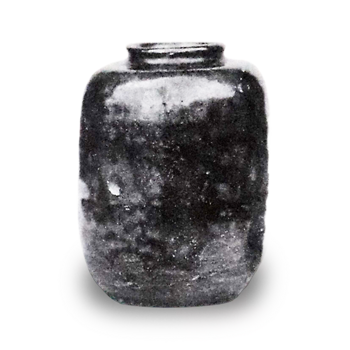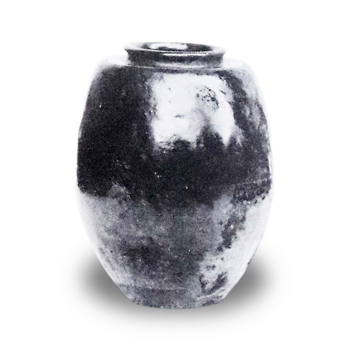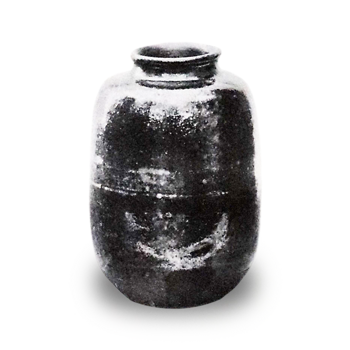


An ancient Seto Daimeibutsu; owned by Count Matsudaira Naoaki
[Name]
The Fushimiya Memoirs state, “The Rokujō Katatsuki was once owned by the Rokujō family of Tokyo (Kyoto).” The Rokujō family descends from the Murakami Genji clan and took its name from the fact that the residence of its ancestor, Koga Arifusa, was located in the Rokujō district of Kyoto. Arifusa was appointed Junior First Rank, Minister of the Interior, in June of Gen’ō 1 (1319), and his descendants held the position of Grand Counselor as their highest rank for generations. In the Meiji era, the family was enrolled in the peerage and granted the title of Viscount.
[Dimensions]
・Height: Approx. 8.2 cm (2 sun 7 bu)
・Body diameter: Approx. 5.6 cm (1 sun 8 bu 5 ri)
・Mouth diameter: approx. 2.9 cm (9 bu and a half)
・Base diameter: approx. 2.7 cm (9 bu)
・Weight: approx. 93.4 g (24 monme and 9 bu)
(Height from base to rim: approx. 4.2 cm / 1 sun and 4 bu)
[Accessories]
・Lid: 1 (made of ivory, bearing an inscription by Lord Fumai)
・Lid box: Paulownia wood, natural finish
・Storage pouch: Purple habutae silk; cord: purple
・Covering pouches (4 pieces)
- Silver-patterned (lining: woven-colored; cord: pale yellow; top: indigo; drawstring: pale green)
- Stone-paved antique gold-patterned (lining: iridescent; sea: pale green; cord: purple)
- Gold-ground antique gold lattice (lining: jade-beetle, sea: ki, cord: brown)
- Chōraku-ji cut-bottom large lantern (lining: storage-room color/brown, sea: ki, cord: purple)
・Pouch box: Paulownia wood, natural finish, with beveled edges
・Handle: Hikiya, with a connecting piece - Pouch: Red-haired stripe (lining: brown, characters: striped, cord: faded yellow)
・Inner box: Paulownia wood, natural finish, with beveled edges
・Outer box: Tame-nuri lacquer, with black-dyed lock
・Wrapping: Floral cloth, lined with Onado-colored brown ha-ni-bu
[Miscellaneous Notes (Excerpts from Literature)]
・Kokin Meibutsu Ruiju
Rokujō Katatsuki: Ancient Seto, Daimeibutsu, owned by Matsudaira Dewa-no-kami. Height approx. 8.2 cm, body diameter approx. 5.6 cm, shoulder diameter approx. 4.7 cm, mouth diameter approx. 2.9 cm, base diameter approx. 2.7 cm, distance from bottom to rim approx. 4.2 cm, weight approx. 93.4 g. One ivory lid; a purple-feathered double-layered imperial pouch; an ivory-handled Hikiya; a red-and-white-striped pouch (brown lining, character-patterned stripes, yellow cord); a paulownia wood box with a white lacquered surface; a sumi-nuri outer box; 10 sarasa-patterned wrappings; 4 pouches (silver lattice, yellow-sky-blue velvet [iridescent lining, purple cord], “Koro-ori-yoshi: Chōrakuji-kiridoko-dō” [lining: kaiki, cord: purple], “Ishidatami-kinran” [lining: tamamushi, cord: purple], “Kinji-kinran” [lining: tamamushi, cord: tea-brown]), the pouch box has a white paulownia folding-screen finish, and the wrapping is sarasa grass. (Illustration of the tea caddy included)
・Meibutsu-ki
Kose-to Rokujō Katatsuki; owned by Sō Tsushima-no-kami (of the Sō clan, lords of the Tsushima domain). (Dimensions, accessories, and illustration of the tea caddy included)
・Karokikan
Owned by Rokujō Unshū-no-kimi (Matsudaira Fumai). It has a pale persimmon color, with black sesame-like specks forming a mottled pattern across the entire surface. The shoulders are slightly flared, and the balance between the flared shoulders and the base makes this an excellent piece. There are two unglazed areas (hima). The mouse-gray body features a fine, thread-cut base, giving it an elegant appearance. (Dimensions, accessories, and illustration of the tea caddy included)
・Seto Toki Sakan (Author: Matsudaira Fumai)
This is an Old Seto Rokujō Katatsuki. It is from the same period as “Haraki” and “Moshio.”
・Heian Bunko, Volume A, No. 9
Kose-to Rokujō Katatsuki: A persimmon-colored body with a skillfully crafted rim. The body is fine-grained, and black glaze has been applied. The thread-cut pattern is fine; the shoulders are flared with an open feel, and small black stone flecks are scattered in patches. The shoulders are slightly rounded.
・Chōen Hiryaku
Rokujō Katatsuki: Purchased in the spring of Meiwa 8 (1771, the Year of the Yin-Wood Rabbit) in Osaka from Tomiki Hachizōemon, who was liquidating his estate. Currently owned by Lord Matsudaira Dewa-no-kami. (Includes dimensions, accompanying items, and an illustration of the tea caddy)
・Fushimiya Memoirs
Rokujō Katatsuki: An ancient Seto ware Daimeibutsu. Formerly owned by the Rokujō family of Kyoto; originally belonged to Mune-Tsushima-no-kami. Purchased around the An’ei era from Yamakoshi Rihei, a merchant in Edo. A Daimeibutsu valued at 1,000 ryō at the time.
・“Record of Lord Ōsaki’s Tea Utensils”
Rokujō Katatsuki: Purchased in An’ei 7 (1778) through Yamakoshi’s mediation for 500 ryō and 30 silver ingots.
・“Record of the Daien-an Tea Gathering”
・October 12, Bunka 8 (1811) at Komaguruma-an; Host: Lord Fumai
Guests: Honda Suruga-no-kami, Nedo Sōsei, Hikita Hifumi
- Floor Display: Calligraphy by Zen Master Hokkan
- Tea Caddy: Rokujō Katatsuki (Pouch: Navy-blue ground with antique gold lattice pattern)
- Flower Vase: Ishū-kō single-layered (Flowers: Winter chrysanthemums, narcissus)
- Tea Bowl: Ido (Inscription: Miyoshino)
・February 12, Bunka 13 (1816) — In a slightly larger-than-standard three-tatami room — Host: Lord Fumai
Guests: Honda Bungo-no-kami, Chigara Seiemon, Yamaguchi Soichi, Yoshimura Kan’a
- Wall hanging: Calligraphy by Yōshō
- Tea caddy: Rokujō Katatsuki (Pouch: Chōraku-ji)
- Flower vase: Celadon with flying-dragon handles
- Tea bowl: Hake-me (Inscription: Yamaji)
・February 16, Bunka 13 (1816) Host: Lord Fumai
Guests: Matsudaira Shūno-no-kami, Matsudaira Chikara; Attendant: Ryōsai
- Wall hanging: Calligraphy by Yōshō
- Tea caddy: Old Seto Rokujō Katatsuki (Pouch: Chōraku-ji)
- Flower Vase: Reef-pattern with Flying Dragon Handles (Flowers: Peach, Forsythia)
- Tea Bowl: Antique Brush-stroke Pattern (Transmitted from the Yagura family)
[Provenance]
Originally owned by the Rokujō family of Kyoto, it was later passed down to Mune-Tsushima-no-kami, the lord of the Tsushima Domain, and subsequently came into the possession of Tomiki Hachizōemon of Osaka.
In Meiwa 8 (1771), they came into the possession of Yamakoshi Rihei, a Kyoto dealer in tea utensils, and it is said that in An’ei 7 (1778), he sold them to Lord Matsudaira Fumai for 500 ryō. It is said that the market value at that time was 1,000 ryō. On April 28, Taishō 6 (1917), during the exhibition commemorating the 100th anniversary of Lord Fumai’s death held in Matsue City, it was exhibited by the Matsudaira family at Kōunkaku within the former Matsue Castle grounds.
[Field Notes (Record of Observing the Actual Object)]
On May 27, Taishō 7 (1918), I viewed the actual object at the office of Count Matsudaira Naoaki in Matsue City.
It is a small katatsuki, with a rounded rim and shallow ridges. There is one repair mark on the rim. Overall, persimmon-colored mottled patterns are applied over a dark amber background; the “avalanche” pattern formed by the glaze flow is somewhat wide, and the areas where the glaze pooled show a hint of beautiful blue. There is a round indentation in the center of the slender, thread-cut base, and a ring of sunken grooves (linear indentations) runs around the middle of the body. From the rim downward, the mouse-gray unglazed base shows wheel marks, within which the characters for “Hotsure” appear in a worm-eaten-like pattern. This is a Kose-to shoulder-shaped tea caddy with a strong sense of wabi (austere beauty), rich in elegance, and possessing a unique charm.