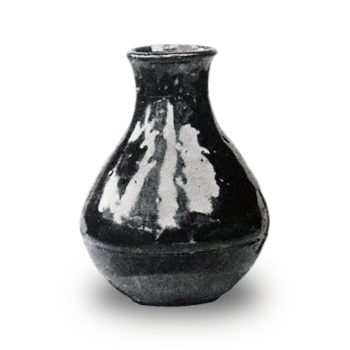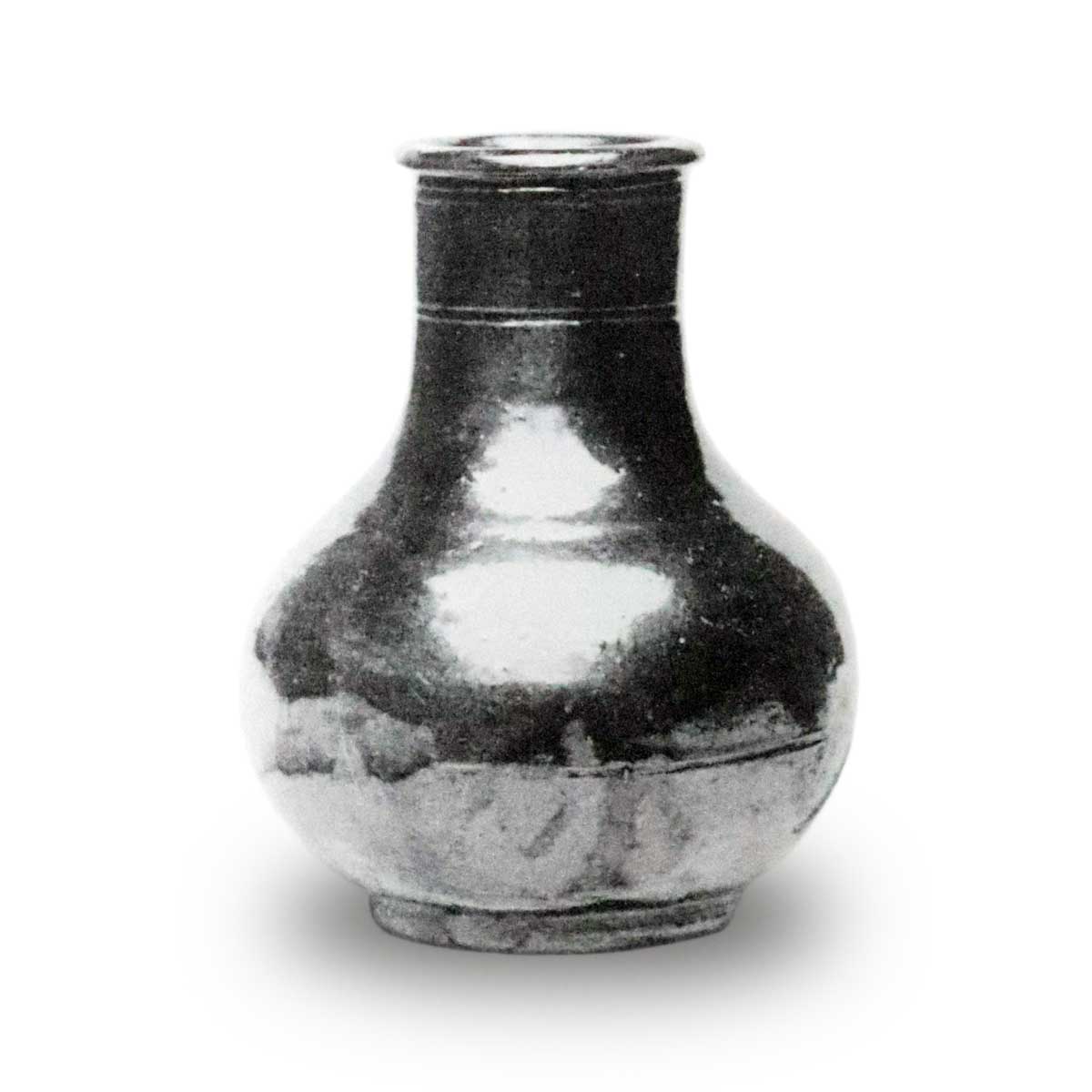
Chinese import; Kyoto; Collection of Higashi Honganji Temple
Name
A Chinese tea caddy shaped like a crane’s neck.
Dimensions
Height: approx. 10.0 cm (3 sun 3 bu)
Body diameter: approx. 8.0 cm (2 sun 6 bu 5 rin)
Mouth diameter: approx. 3.9 cm (1 sun 3 bu)
Base Diameter: Approx. 4.5 cm (1 sun 5 bu)
Height of Round Base: Approx. 0.4 cm (1 bu 4 rin)
Length of Neck: Approx. 4.1 cm (1 sun 3 bu 5 rin)
Weight: Approx. 109.1 g (29 monme 1 bu)
Accessories
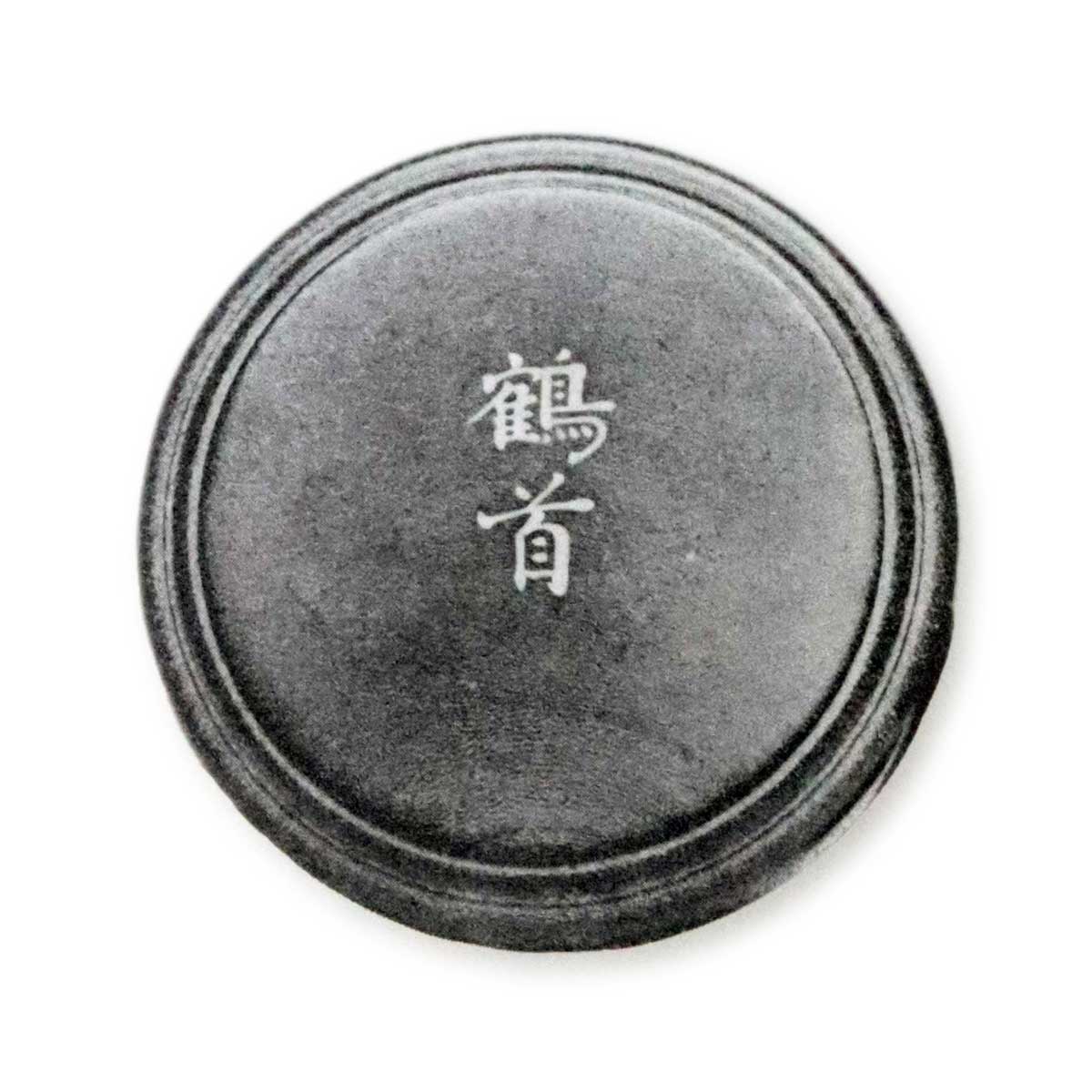
・Lids: 3 pieces, with “su” (pattern)
・Storage pouch: White chirimen; white tying cord
・Pouches: 3
Higashiyama-zori (lining: iridescent; tying cord: purple) in the style of Furuta Oribe
Mochizuki Koto (lining: iridescent; tying cord: floral) in the style of Kobori Enshu
Light yellow ground with dragon pattern (lining: iridescent; tying cord: purple) in the style of Furuta Oribe
・Pouch box: Paulownia, natural wood, with labeled paper lining
“Honganji Tsuru-kubi”
・Hikiya (tea caddy case): Tagayasan wood, with ivory inlay on the label
“Tsuru-kubi Tea Caddy Pouch”
“Tsuru-kubi”
Pouch: Purple leather (lining: purple umi-ki; tie cord: floral-colored)
・Inner Box: Paulownia, natural wood; the rim of the box is inlaid with black persimmon wood
・Outer Box: Black lacquer
Miscellaneous Notes
The “Crane’s Head” tea caddy is so named because of its long neck. Among high-quality pieces, some have a circular base while others do not.
(From Chayū Shōden Shū)
Crane Neck: There is no deeper meaning behind this name other than the fact that the teapot has a long neck. The clay is red, the rim’s fold is standard, and the thread-cutting marks are delicate (thin and beautiful). The base glaze is red, and the overglaze is sesame glaze with white, star-like specks, which is one of the highlights of this teapot. According to Tegami, “Water droppers, standard-style, persimmon-neck, and crane-neck forms are found in all kinds of pieces; there are also black-glazed thread-cut examples. These are called ‘small-jar-style’ and are made in the same manner as Chinese imports. They are also fired in Seto and found among Chinese imports; in any case, this shape commands a high price.”
(From Manpō Zenshū and Bengyoku-shū)
Crane’s Neck: Made in China. It dates from the same period as the Kaneyaya Katatsuki. Compared to the Aburaya Katatsuki, the application of the glaze is characteristic of the same era, but it is inferior in terms of age and style.
(From The Origins of Seto Pottery by Matsudaira Fumai)
Record of Actual Observation
On May 19, Taishō 9 (1920), I viewed the actual piece at Higashi Hongan-ji Temple in Shichijō, Shimogyo Ward, Kyoto City.
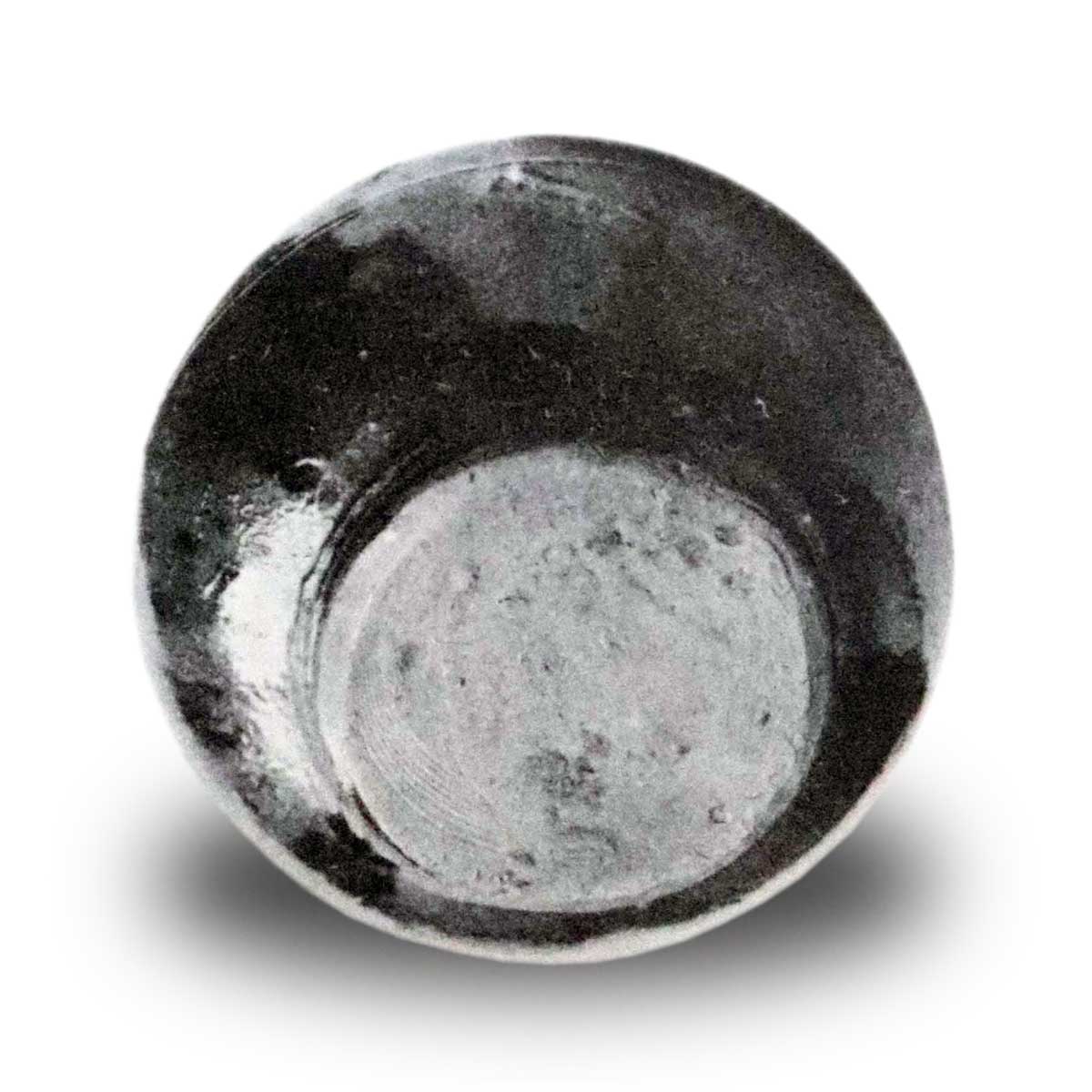
The rim is shaped like a kamaboko (fish cake), curving gently from the inside to the outside, with a grooved surface on the underside. A single recessed groove runs around the neck below the rim and another around the body; some of these grooves are partially interrupted. The section below the body flares out in a rounded shape, and the base is raised in a circular platform, with a narrow band of unglazed clay visible around its perimeter. Most of the base is flat, with faint traces of thread-cutting visible at the corners.
The glaze is a deep purple; black amber glaze cascades like an avalanche from around the rim, and a long, avalanche-like pattern extends all the way to the edge of the raised circular base, where the glaze pools thickly, revealing a blue-lapis-lazuli hue within. To the right of this decorative motif, there is a shorter avalanche of black glaze, and the pool of glaze there also reveals a blue-lapis hue. Between these two lines—one long and one short—there are areas where the glaze has not adhered, creating an interesting visual effect.
Inside, the glaze covers the rim, and a single streak of glaze reaches down to just below the neck’s ridge. The wheel marks are sharp and distinct, and the center of the base is slightly concave. This is the largest of the crane-neck tea jars, a majestic masterpiece that is truly one of a kind.