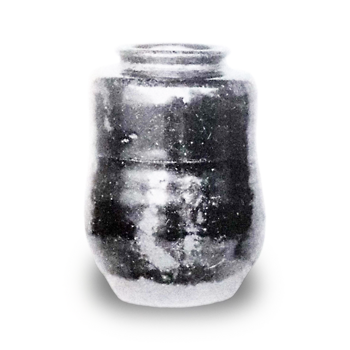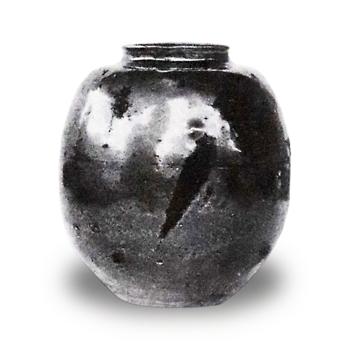
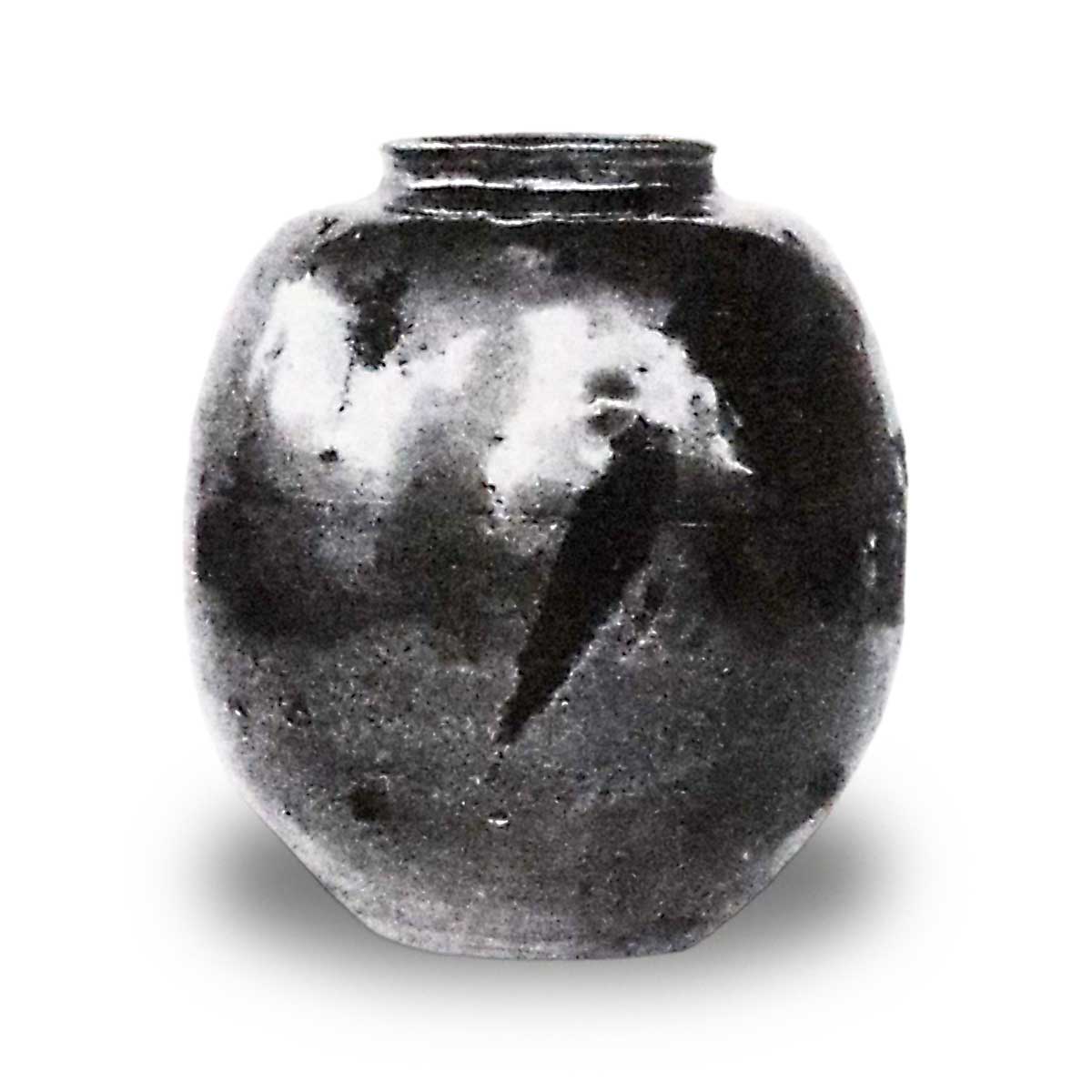
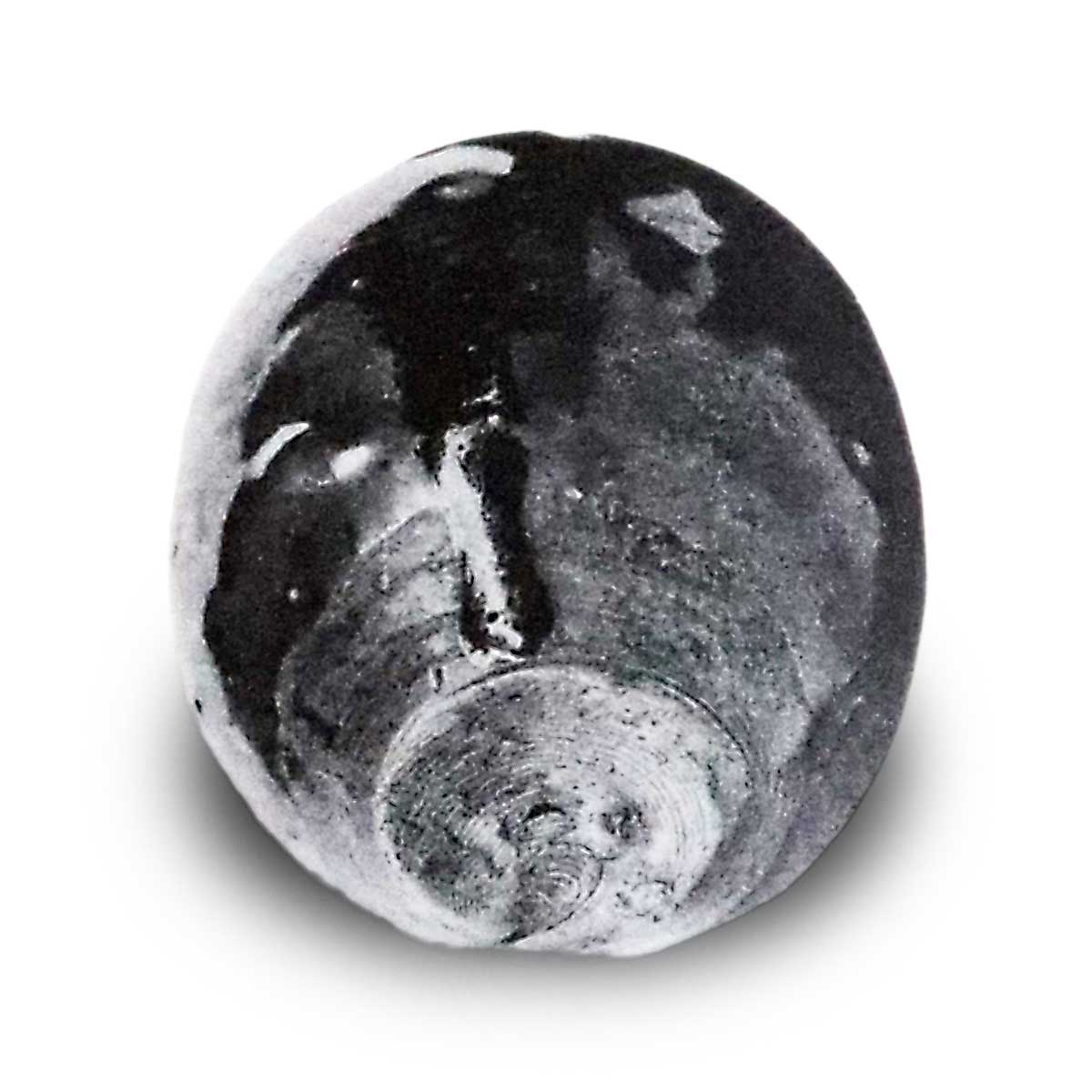

Old Seto, Revival Meibutsu, Collection of Count Tadamichi Sakai
Name
This name derives from the fact that the areas where the glaze has been removed along the central waistline of the tea caddy (a small jar in the Han or Seto style) form a pattern resembling bamboo leaves. This pattern is inspired by the following anonymous poem from the Kokin Wakashū:
“As if mocking me, summer mimics the sound of bamboo leaves rustling on a frosty night, while I lie alone.”
(On a summer night, the rustling of bamboo leaves seems to mimic the sound of a cold winter night when frost falls and I lie alone in solitude)
It is said that Kobori Enshū named this piece in reference to the meaning of this poem.
Dimensions (Converted to Modern Units)
・Height: Approx. 6.97 cm (2 sun 3 bu)
・ Body diameter: approx. 6.36 cm (2 sun 1 bu)
・Mouth diameter: approx. 4.55 cm (1 sun 5 bu)
・Base diameter: approx. 2.73 cm (9 bu)
・Rice height (depth of the bowl, rim height, etc.): approx. 0.39 cm (1 bu 3 rin)
・Weight: approx. 76.5 g (20 monme 4 bu)
Accessories
・Lids: 2 (one of which features a crescent-shaped inlay design)
・Storage pouch: Purple silk; purple cord
・Cover pouches: 4
- Donshu Teika: Back is Tamamushi; cord is purple
2. Dōgen Donshu: Lining is Kuzuyellow Sea Mist, cord is purple - Aoki Kantō: Lining is Enshū Brown, cord is Enshū Brown
- Shima Kantō: Lining is Iron-colored Sea Mist, cord is purple
・Hikiya (wooden storage container): Tagayasan wood. The lid (front) features the characters “Frosty Night” in gold powder, written in the hand of Sōfu (Kobori Enshū).
・Box: Shunkei lacquer. Features the characters “Frosty Night Bunrin” in gold powder, written in the hand of Sōfu.
・Storage pouch: Champa; lining is Enshū tea, cord is Enshū tea - Accompanying Hanging Scroll (Attached Hanging Scroll)
Although this hanging scroll was destroyed in a fire at the Edo residence, Lord Sakai Matajiro transcribed the poem from memory, as the Lord himself had memorized it. (In Matajiro’s own handwriting)
“Is it a medicine resembling bamboo leaves? Summer flies by so swiftly—on this frosty night, as the bamboo leaves rustle, I spend it alone.”
・Box for the Accompanying Hanging Scroll: Paulownia box. The underside of the lid bears the inscription: “On a frosty night—poem by Sōfu.”
(Note) The hanging scroll written by Sōfu (Kobori Enshū) was recorded in Kokin Meibutsu Ruiju and Meibutsu-ki, but since it was destroyed in the Edo fire, only a restoration and copy by Sakai Matajirō is currently included.
Miscellaneous Notes
・Description from Kokin Meibutsu Ruiju: Shui no Bu:
Shōya Bunrin (Old Seto). Height approx. 6.97 cm (2 sun 3 bu), mouth diameter approx. 4.55 cm (1 sun 7 rin), body diameter approx. 6.36 cm (2 sun 1 bu). Shows slight signs of repair. “Features a glaze resembling bamboo leaves.” Base diameter: approx. 2.73 cm (9 bu 1 rin). Comes with a lid (half-moon shape). The exterior of the pouch features a navy-blue ground with Kandou pattern; the interior is in a pale yellow iridescent “Umi-ki” pattern. Made by Hikiya (inscribed “Shōya” in gold powder by Sōfu). The outer box is finished in Tame-nuri lacquer with “Shōya Bunrin” inscribed in gold powder by Sōfu. The outer pouch is made of Donshu-ori fabric. It features an Ichimonji-style obi by Kobori Enshū (purple ground with small hollyhock crest and gold borders; medium brown ground with refined silk; top and bottom in brown refined silk) inscribed with the waka poem: “Sakashira ni natsu wa hito mane sasa no ha no sayaku, Shōya o wakahidori nuru.” The box for the hanging scroll bears the inscription “Shōya,” with a note on the side indicating that the poem was written by Kobori Enshū.
・Description from Meibutsu-ki:
“Shimoya Bunrin.” Owned by Sakai Shuri-dayu. The descriptions of dimensions and accessories are the same as those in Kokin Meibutsu Ruiju.
・Description from Kaan Bunko, Volume 6:
“Shōya Bunrin.” Owned by Sakai Shūri-dayū. Perhaps because the body of the tea caddy is coated with a glaze resembling bamboo leaves. (Includes dimensions, accessories, and an illustration of the tea caddy)
Provenance
Since Matsudaira Norimura’s Meibutsu-ki states that it was “owned by Sakai Shūri-dayū,” it is clear that it had long been passed down within the Sakai family. However, its provenance prior to that time is unclear.
Field Notes (Record of Observation of the Actual Object)
On April 28, Taishō 8 (1919), the actual object was observed and examined at the residence of Count Tadamichi Sakai in Yarai-chō, Ushigome Ward, Tokyo.
The fold at the rim is shallow, and although there is a small trace of repair on the rim, the rest is undamaged. Black glaze patterns stand out against a pale purple background, and the luster is truly magnificent. The recessed ridge running around the body has only one spot where the ridge is narrow and faintly connected. The glaze flow (nada-re) stops at the rim (base), forming a rounded shape resembling a droplet of dew. There are several flat, disc-like bulges above and below the body cord, with one spot next to the nada-re being particularly large. Directly opposite the decorative motif, a pattern resembling a single bamboo leaf runs diagonally across the body cord. It is said that Kobori Enshū likened this pattern to a bamboo leaf and named the piece “Shōya Bunrin,” drawing inspiration from an ancient poem. To the right of the decorative motif is a patch of dark persimmon-colored glaze about 1 cm (roughly three-bun) wide; below the rim, the grayish-brown unglazed clay body is exposed. The thread-cutting marks on the cut footring are fine and have been smoothed slightly by hand, yet the design is vivid and the form is exceptionally elegant—almost rivaling Chinese ware—making this a masterpiece unparalleled among Seto ware pieces. Inside, only the rim is glazed, and the base features a concave shape with wheel marks forming a circular pattern.