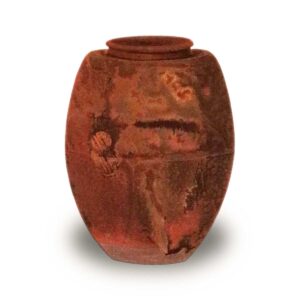


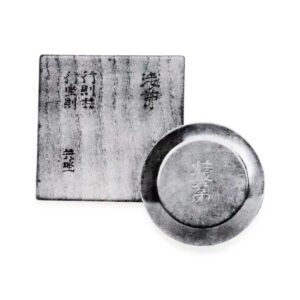


Kose-to, a Daimeibutsu; Collection of Marquis Toshiyuki Maeda
Origin of the Name and Quoted Poem:
It is unclear whether this tea caddy was already known as “Asadika” before the time of Kobori Enshū, but the poem cited in Enshū’s accompanying note reads:
“The color changes—on the shallow grass by the wayside, the dew rests; the autumn wind blows, carrying it to the tips of the leaves.”
(A waka poem by Former Middle Counselor Toshisada, found in the Shin Gosenshū, describing the autumn wind in the fields)
The name was likely chosen by likening the scenery (the aesthetic charm) of this tea caddy to the meaning of this poem.
Dimensions (converted to centimeters):
・Height: approx. 8.42 cm (2 sun 7 bu 8 rin)
・Body diameter: approx. 6.70 cm (2 sun 2 bu 1 rin)
・Mouth diameter: approx. 3.36 cm (1 sun 1 bu)
・Base diameter: approx. 3.03 cm (1 sun)
・Kushiki height: Approx. 0.42 cm–0.61 cm (1 bu 4 rin–2 bu)
・Shoulder width: Approx. 0.67 cm–0.61 cm (2 bu 2 rin–2 bu)
・Weight: Approx. 90.38 g (24 monme 1 bu)
Accessories:
・Lids: 4 pieces (kago)
・Lid box: Paulownia box, Shunkei-nuri lacquer finish, with black lacquer inscriptions
(Inscriptions: “Seto Katatsuki Asaji,” “Asamaya Katatsuki”)
・Artifact pouch: Brown silk (with brown cord)
・Pouches: 6 main pouches, 5 storage pouches
[Main Pouches]
- Shokko: Gold-lined Kōki yellow (purple cord)
- Futari Shizuka fabric: Gold-bordered purple ground with phoenix-dragon circle pattern (purple cord; white Umi-ki lining)
- White-brown ground with silver-bordered dragon cluster pattern (damaged inner cord)
- Donshu Junko fabric: Stone-paved pattern with inner flowers and treasure motifs (damaged inner cord)
- Aoki Koto (inner cord connection damaged)
- Mochizuki Koto Silk-Tied (cord connection: dark brown; inner lining damaged)
[Unpacked Items] - Purple Ground with Angular Dragons and Gold Lattice
- Kakura Gold Lattice on Faded Yellow Ground with Earthen Flowers and Rabbits
- White Ground with Parallel Angular Dragons and Gold Lattice
- Oosaka Cloth with Deep Floral Colors, Gold Lattice, Seven-Star Flowers, Plum Blossoms, and Rain Dragon Motifs
- Tiered-weave cord floral vine pattern
・Pouch box: Striped paulownia (unfinished wood)
Asama tea caddy pouches: 11 in total (5 of which are “Tokinuku Road”)
・Wooden mold: 1 (fits inside the Shokkin pouch)
・Hikiya (wooden base): Rosewood, rim with beaded edge, swirl pattern at the center of the bottom
・Lid: Ebony, with carved inscription (with verdigris)
“Asa-kaya” inscription: Kobori Enshū
(Inscription on the body of the Hikiya)
Asa-kaya shoulder-strike (inscriptions on the box, cover, etc.)
[Cover]
“When walking, walk together; when sitting, sit together” (Venerable Gyokushitsu)
“Yōmiko” (Sōhaku) (Kobori Enshū)
“The autumn wind blows through the leaves, carrying the dew that settles on the morning grass by the field where colors change”
Pouch: Champa, lined with a rough-textured “Fallen Flowers on the Shore” pattern in Donshu (with a tea-colored cord)
[Inner Box] Paulownia, natural wood (with Enshū inscription)
(Front) “Asamaya: When walking, walk together; when sitting, sit together”
[Outer Box] Paulownia, Shunkei lacquer, with iron latch (inscribed in black lacquer)
(Front) “Seto Katatsuki, Asa-kaya”
(Inscription on paper lining)
(Back) “Seto Asa-kaya Katatsuki (inscribed in vermilion). Confiscated from Inoko Naokata; other provenance details exist.”
[Master Box] Paulownia, natural wood (inscription visible across the grain of the wood)
“Seto Katatsuki, Asa-kaya”
Miscellaneous Notes
[Explanation (Household Inventory of the Marquis Maeda)]
“Asa-kaya” is a Daimeibutsu of ancient Seto ware, listed in the Kokin Meibutsu Ruiju (Compendium of Famous Objects Through the Ages). The body (clay tone) has a purplish hue, the underglaze is persimmon-colored, and the overglaze is yellow; the thread-like cracks on the bottom are extremely fine. The appearance of the design (when displayed) is asymmetrical (with the left and right sides showing significantly different expressions): one side is covered with a glaze that has a metallic luster, while the other side features a yellow glaze with amber tones, appearing as if coated with yellow wax. From the center of the body to the body cord, droplets of yellow glaze have pooled in an oval shape, resembling “ishi-haze” (stone bursts). The piece is thin-walled and lightweight. It features a single body cord; the shoulder is shaped like a “yahazu” (arrowhead), and there is a small speckled pattern beneath the asymmetrical design.
Master Gyokushitsu of Daitoku-ji sensed the spiritual dignity inherent in this tea caddy from a state of mind reminiscent of the primordial chaos before the creation of heaven and earth, and immediately expressed this in a praise inscription (meibun). Furthermore, the fact that Kobori Enshū (Sōfu) selected the ancient waka poem “The color changes…” to describe the craftsmanship of this tea caddy leaves one with nothing but profound admiration.
[From the Maeda Family Collection]
A “Asamaya Tea Jar” (Meibutsu). Dimensions and other details are listed in various collections of famous tea utensils. It comes with 11 pouches (Shokkin, Futari Shizuka white-ground dragon gourd with silver lattice, Kakukura, Oosaka, Murasaki Kaku Ryu—these are the main pouches. Also included are a white-ground angular dragon segmented pouch, Donshu Junko medium-sized Yabee Kanto, Kanto Kai-bukuro, and descriptions of other accessories). . The glaze is a yellow tinged with earth tones and a slight reddish hue; the thread-cut pattern on the bottom is “hon-fu” (authentic thread-cut) and extremely fine. The glaze cascading down the upper part of the body is entirely a bluish-yellow glaze, and there is a slight bulge at one point in the center of the body, where bluish-yellow glaze is also present. The lower edge of the glaze on the top of the stand is a persimmon-colored glaze. (Illustration of the tea caddy with detailed description included)
[From Meibutsu-ki]
Asamaya: Owned by Matsudaira Kaga-no-kami (Maeda family). Height: approx. 8.33 cm (2 sun 7 bu 5), body diameter: approx. 6.64 cm (2 sun 1 bu 9 rin), mouth diameter: approx. 3.36 cm (1 sun 1 bu), shoulder width: approx. 4.70 cm (1 sun 5 bu 5), base diameter: approx. 3.33 cm (1 sun 1 bu).
Pouch: Shokkin (with a cord-attached handle). Lid: Kā. Wood: The body is made of rosewood; the lid is made of ebony. On the body of the Hikiya, the following inscriptions are written in the hand of Priest Gyokushitsu: “When walking, walk together; when sitting, sit together—the seal of Yōmen-shi,” and in the hand of Enshū (Sōfu): “The autumn wind blows through the leaves bearing dew on the morning grass of the ever-changing fields.”
The pouch is a “chanba,” and the outer box is made of white paulownia wood, bearing the inscription “Asamaya: When walking, walk together; when sitting, sit together” written by Enshū.
It is crafted with such extreme thinness that, at first glance, one might mistake it for a Tang-style piece (made in China)—such is the quality and craftsmanship of this masterpiece. The base color is mouse-gray, and it features exquisite hon-ito-kiri (fine thread-cut) patterns.
[Literary Records]
・Kokin Meibutsu Ruiju: Asa-kaya, Old Seto, Daimeibutsu, Matsudaira Kaga-no-kami. (Includes entries on dimensions and accessories)
・Ganka Meibutsu Ki, Kokin Meibutsu Ki: Asa-kaya, Old Seto, Matsudaira Hizen-no-kami.
History
It was originally owned by Inoko Takumi, a retainer of Toyotomi Hideatsu. However, after Hideatsu’s downfall in the third year of the Bunroku era, Inoko fell on hard times and sought refuge with Maeda Toshitsune, the lord of the Kaga Domain. Because Toshitsune generously protected Inoko, the latter, overcome with gratitude, is said to have presented this tea caddy—which he had kept as a treasured possession—to him.
The eight characters “Gyō-soku kyō-za, Sō-soku kyō-za” carved on the body of this tea caddy by the Hikiya potter were written by Priest Gyokushitsu (posthumous Buddhist name: Sōhaku; pen name: Yōmen-shi), a high-ranking monk who succeeded Enkan Kokushi as the 417th abbot of Daitoku-ji. The deep relationship between the Venerable Gyokushitsu and Toshitsune can be inferred from the fact that when Toshitsune founded Hoshun-in within Daitoku-ji for his late mother (Hoshun-in), he invited the Venerable Gyokushitsu to serve as its founding priest.
It is said that the Maeda family has traditionally regarded this “Asa-ga” (tea caddy), the “Fuji-nasu” (tea caddy), and the “Daikōdō Kama” as the family’s “Three Meibutsu.” According to an anecdote passed down by an elder in Kaga (Kanazawa), Kobori Sōchū (a descendant of Enshū) once traveled all the way from Edo to Kaga, hoping to view this tea caddy, and stayed there for an extended period. However, he was ultimately unable to fulfill his goal of seeing it, and it is said that he copied a sketch of the tea caddy—which was in the possession of a certain feudal retainer—and returned to Edo.
Record of Actual Observation
On December 1, Taishō 8 (1919), I observed the tea caddy in person at the residence of Marquis Toshitame Maeda in Honfuji-chō, Hongō Ward, Tokyo.
The rim has a deep, flared edge; the short-necked shape features a slightly recessed gap in the “koshi” (the section between the rim and the body), forming a “yahazu” (arrowhead) shape. The shoulders are sharply defined, the body is full and tapers toward the waist, and a single, slightly wide sunken line runs down the center of the body like a straight line; overall, it has a plump yet extremely elegant shape.
Across the entire surface of the tea jar (the “universe”), a bluish glaze appears over a persimmon-colored metallic sheen, resembling waves lapping at the shore; the scene where the glaze cascades diagonally from the tips of the shoulders toward the middle of the body is indescribably magnificent.
Additionally, a petal-like, yellowish-white glaze appears along the body’s ridge; at first glance, it resembles “ishi-haze” (stone crackle), creating another fascinating visual effect.
Among ancient Seto tea caddies, this is a masterpiece in which the variations in the glaze (and the sheer number of them) are most striking; while one half features a subdued Seto glaze, the other half displays a bright glaze color reminiscent of Oribe ware, creating a contrast of yin and yang, or front and back. The magnificence of the landscape evoked by the ancient poem, “The changing colors of the shallow reeds by the field’s edge…,” cannot be fully described.
Below the body cord, the unglazed clay body reveals a metallic hue with a slight reddish tinge, and there is a single thin horizontal streak in this area. The thread-cut pattern on the bottom is fine, and there are two small stone-clamp marks on the rim. Inside, fine wheel marks run from the glazed rim downward, forming a swirl pattern at the center of the bottom.