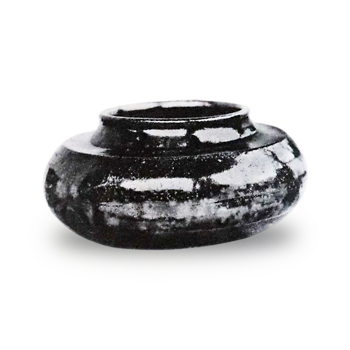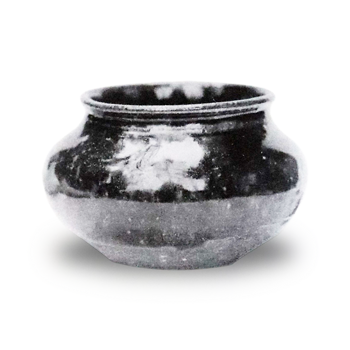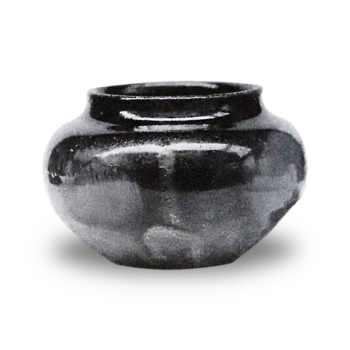
Collection of Mr. Tokushichi Nomura, Osaka
Name
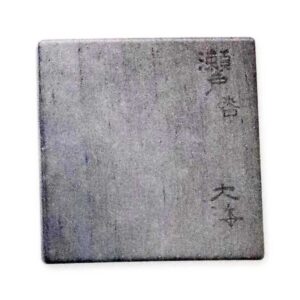
Although it is recorded as “Tani Taikai” in books on the tea ceremony, looking at the inscription on the box by Kobori Enshū, it appears that the two characters “Higuchi” have been combined into a single character. Therefore, was this tea caddy originally owned by a certain Higuchi, or is “Higuchi” a phonetic substitute for “Higuchi,” and does the entry in the book Kobori’s Bequeathed Utensils reading “Taikai Higuchi, Inatome Anzaemon” refer precisely to this item? One might speculate that it belonged to someone such as Higuchi Iwami-no-kami Tomohide, the owner of the “Higuchi Katatsuki.” For now, we will set this aside as a question and await the appraisal of future experts.
Dimensions (converted to centimeters)
Height: approx. 6.36 cm (2 sun 1 bu)
Body diameter: approx. 9.85 cm (3 sun 2 bu and a half)
Mouth diameter: approx. 6.36 cm (2 sun 1 bu)
Base diameter: approx. 4.70 cm (1 sun 5 bu and a half)
Rim height: approx. 0.82 cm (2 bu 7 rin)
Weight: approx. 243.8 g (65 monme)
Accessories
・Lid: 1 (with nest-shaped support)
・Cover: 1 (Enshū style, pale floral-colored dianthus crest; lining: iridescent; long cord: purple)
・Cover box (Paulownia)
“Tani Taikai”
[Inscriptions on the box, cover box, etc.]
“Taikai Tea Jar”
・Inner Box: Paulownia, natural wood (inscribed by Kobori Enshū)
“Seto Hikuchi Daikai”
Authentication Label: The five characters on the box lid are in Kobori Enshū’s own handwriting; authenticated as an ancient calligraphy piece
・Outer Box: Made by Nakamura Sōteki; interior features a pear-skin finish, exterior features a lustrous lacquer finish; characters on the box lid are in blue mother-of-pearl inlay (raden)
Miscellaneous Notes
Seto-ya Daikai Tea Jar (Made by Fujishiro)
[Dimensions] Height: approx. 6.06 cm (2 sun), Body diameter: approx. 9.85 cm (3 sun 2 bu 5), Mouth diameter: approx. 6.52 cm (2 sun 1 bu 5)
[Covering Cloth] Gold-threaded flower pattern on a pink background with dianthus motifs; purple lining; both the lid pouch and covering cloth are in the style preferred by Kobori Enshū. Includes a box inscription reading “Setoya Daikai” (written by Kobori Enshū [Sōfu]).
(From Kokin Meibutsu Ruiju: Shii no Bu)
Tani Daikai (Seto)
The descriptions of dimensions and accessories are the same as in Kokin Meibutsu Ruiju. However, an illustration of the tea caddy is included.
(From Unshū Matsudaira-ke Hon Meibutsu Ki)
・Higuchi with small shoulders (Kakimoto Ton’a, No. 3)
・Taikai Higuchi (Inatsuru Yasuzōemon)
(From Kobori’s Bequeathed Artifacts)
Old Seto Taikai (Setsuki, Taikai, Shikishima, Amanohara, Okomon, Yaezakura)
(From Toda Ichigen’an’s List of Meibutsu)
History of Ownership
It is believed to have originally belonged to a certain Higuchi (written as “Higuchi” using a phonetic substitute), and after passing to Kobori Enshū, it was bequeathed to Inatome Anzaemon as part of his estate. It subsequently changed hands several times before entering the Sekido family in Nagoya, and it is said to have passed from that family to its current owner (Mr. Nomura Tokushichi).
Record of Actual Viewing
On May 6, Taisho 9, I had the opportunity to view and appreciate this piece in person at the residence of Mr. Tokushichi Nomura in Bingo-cho, Higashi-ku, Osaka City.
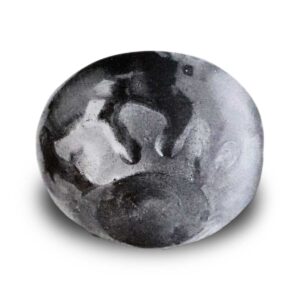
The rim of the mouth is shallowly folded and somewhat thick; on one side, various colors—including loquat, blue lapis lazuli, persimmon, and a metallic sheen—blend within a yellowish amber glaze. The other half is “mukei” (without patterns), showing no variations in glaze color; however, this actually greatly enhances the charm of this tea caddy.
Several streaks of “yunadare” (glaze avalanche) around the lower rim reach the very edge of the base and stop there, forming thick pools of glaze. The base has been scraped, revealing three to four ring-like lines around the rim, while the center is slightly sunken. Parts of the thread-cutting technique are visible. On the inside of the base, traces of gold-tinged glaze are present, while the lower rim is covered in a burnt-cedar-colored glaze with coarse, continuous spatula marks.
Overall, it possesses a beautiful luster, reflecting objects like a mirror. The interior is glazed just like the exterior, with most of it covered in black-amazu glaze.
While Seto’s “Great Ocean” tea caddies generally feature a rich variety of patterns (scenery), there is likely no other example as rich in visual appeal as this one.