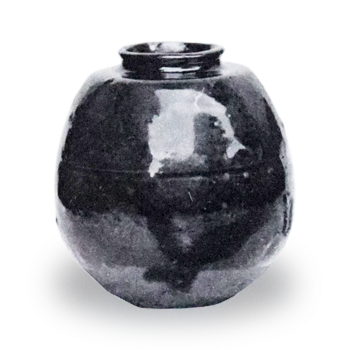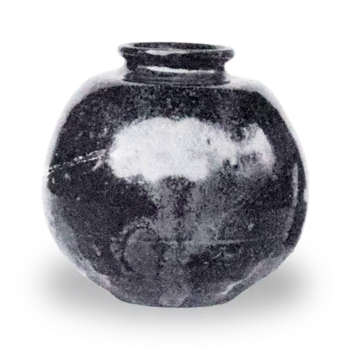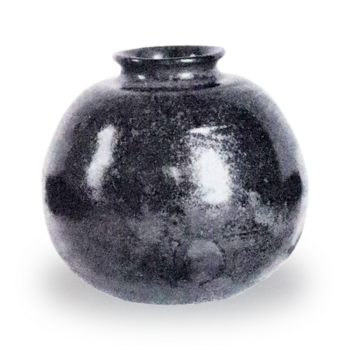
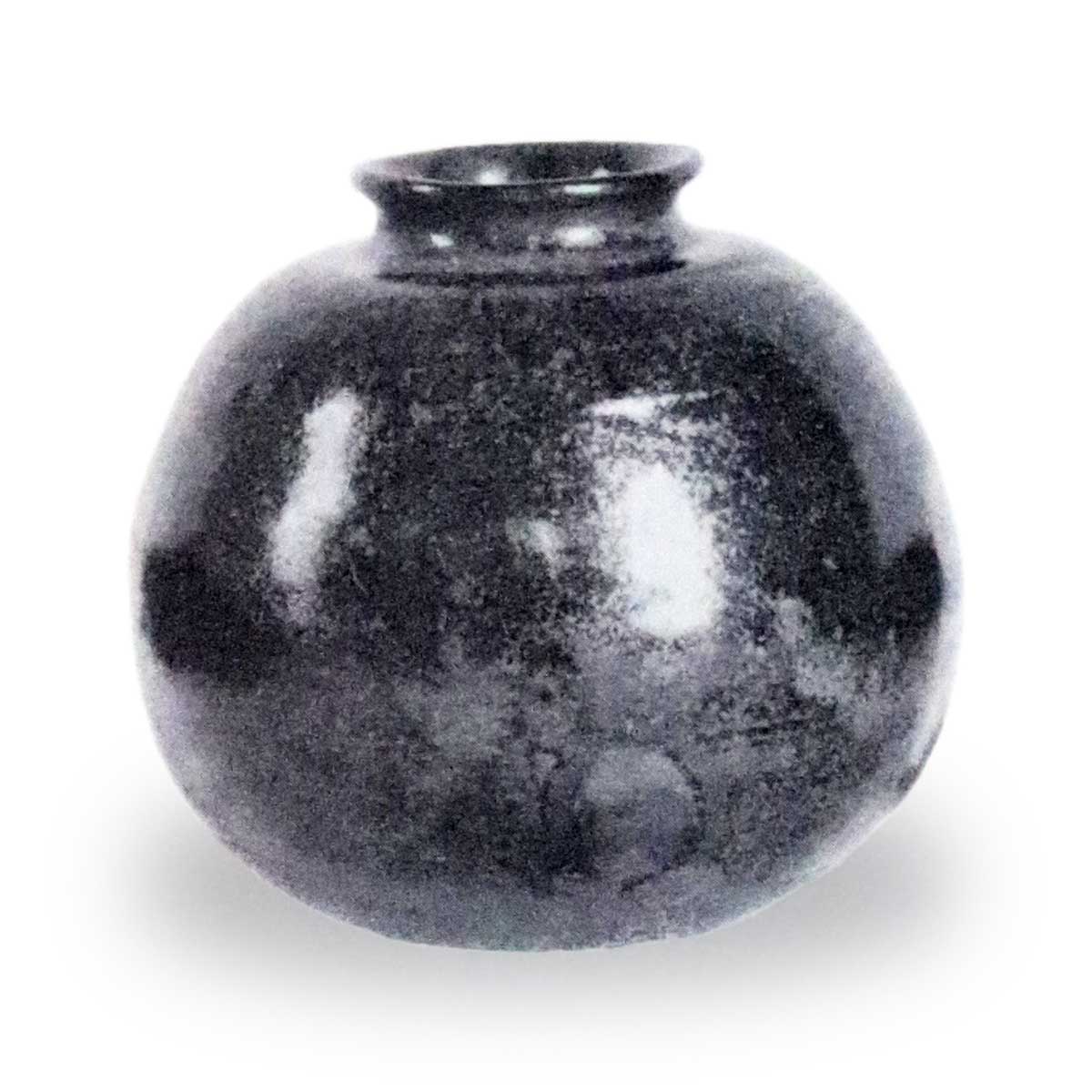
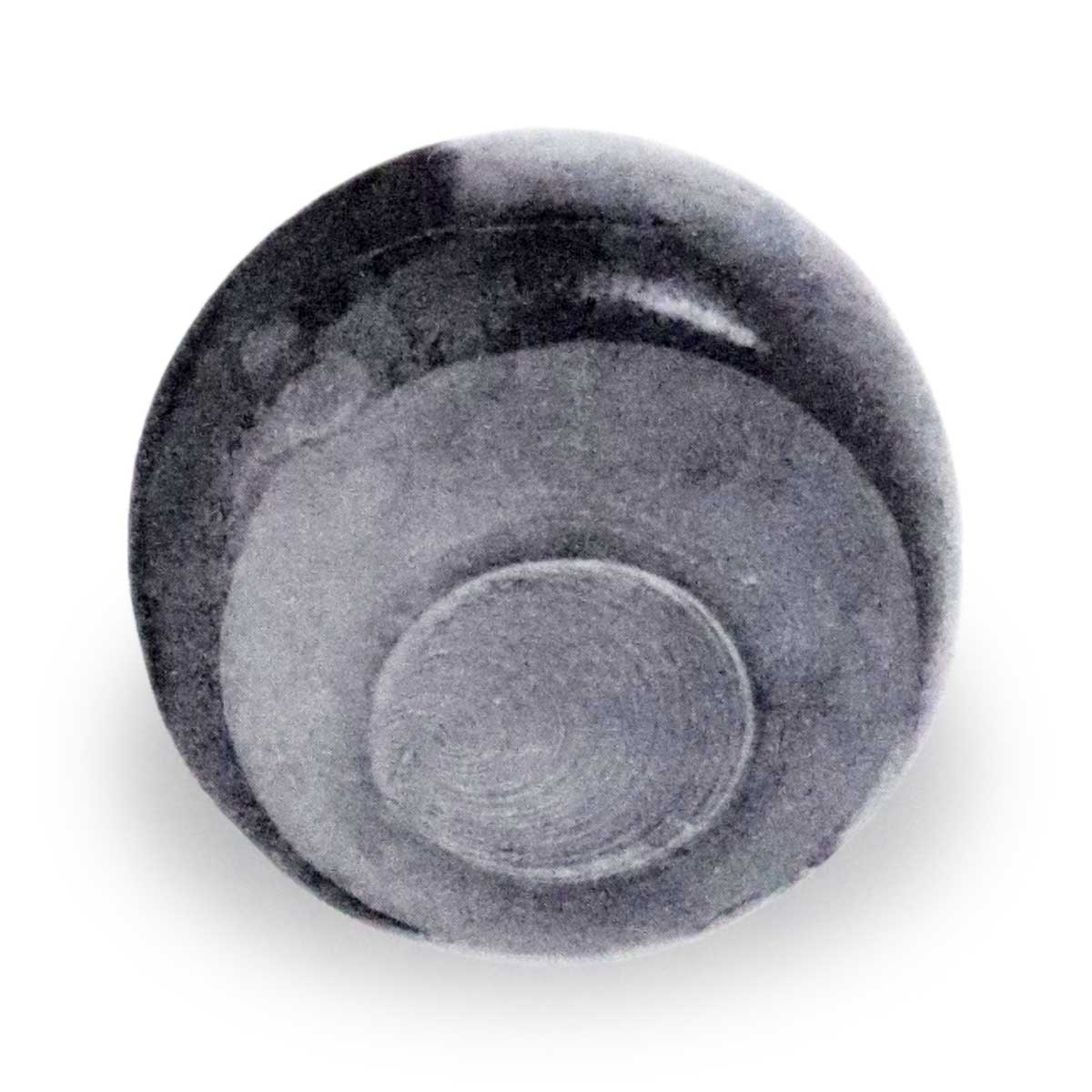
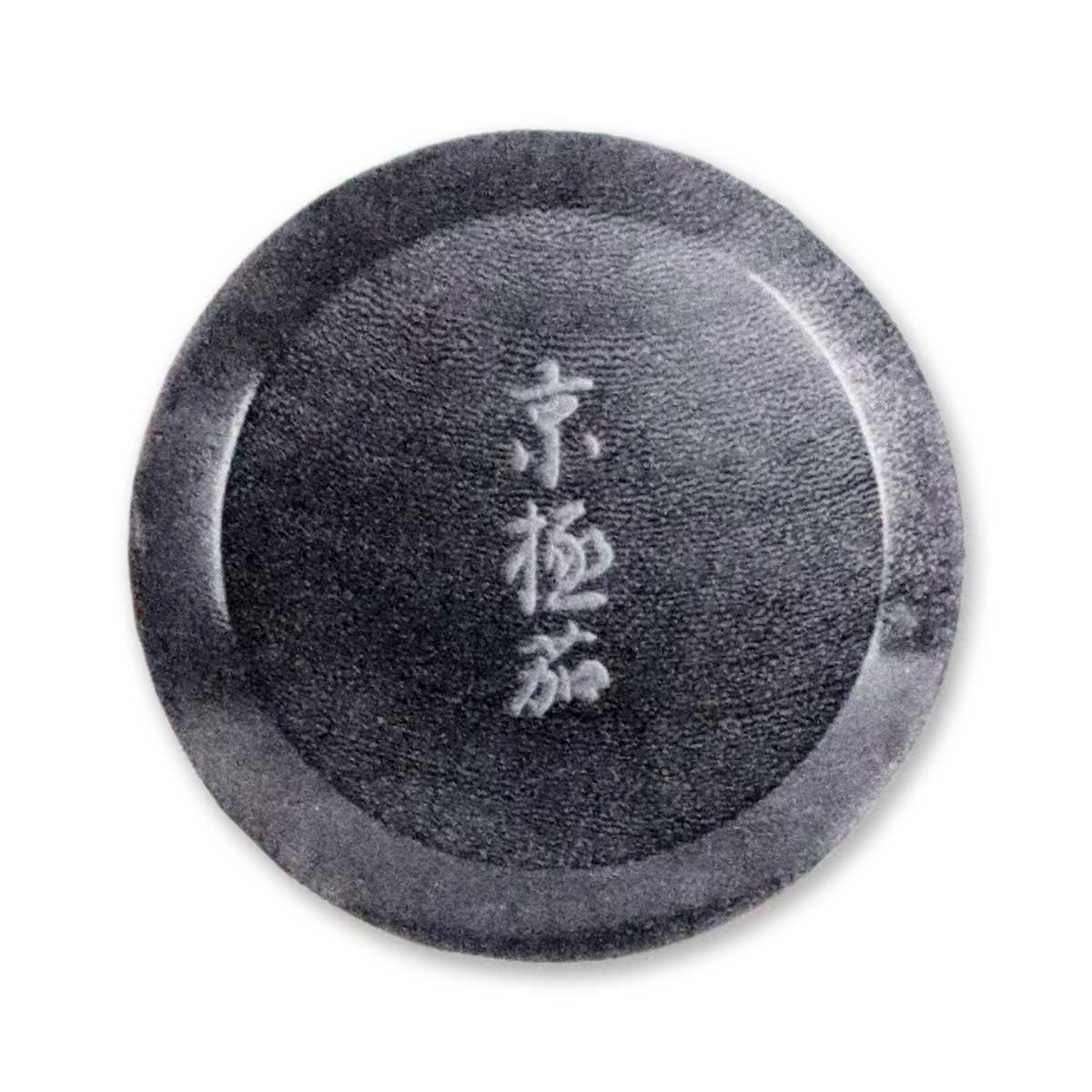
A famous Chinese Daimeibutsu; also known as the Oda Eggplant; from the collection of Marquis Tokugawa Yorinori
Name
The name “Kyogoku Eggplant” appears in the entry for Dōshitsu’s tea gathering in the second year of the Genki era (1571) in Tsuda Sōyuki’s Tea Ceremony Diary. It was likely originally owned by the Kyogoku family. It is also called the “Oda Eggplant” because it was once owned by Oda Sangorō (son of Yurakusai).
Dimensions
Height: 2 sun 9 rin (approx. 6.3 cm)
Body diameter: 2 sun 3 bu (approx. 7.0 cm)
Mouth diameter: 9 bu 5 rin (approx. 2.9 cm)
Base diameter: 1 sun (approx. 3.0 cm)
Koshiki (ring) height: 2 bu 1 rin (approx. 0.6 cm)
Weight: 17 monme 7 bu (approx. 66 g)
Accessories
Lids: 2
One features a window in the style preferred by Furuta Oribe; the other has no window.
The Oribe-style lid is housed in the kake-go (inner box within the main box) of the pouch.
Pouch: White chirimen silk; the cord fasteners are white.
Pouches: 2
Iron-colored ground, cloud-crane swastika pattern satin (donsu); lining is iridescent, cord ends are purple.
Iron-colored ground, plum-bowl arabesque pattern satin; lining is iridescent, cord ends are brown.
Pouch box: (holds the cloud-crane satin pouch)
Inner box: Paulownia wood, natural finish, with inscription in ink
“Kyogoku Eggplant Pouch”
Outer box: Paulownia, natural wood, gold-leaf lettering
“Kyogoku Eggplant”
Pouch box: (Holds the plum-bowl satin pouch and the Oribe-style lid)
Inner box: Paulownia, natural wood, ink inscription
“Kyogoku Eggplant Lid Pouch”
Outer box: Black lacquer, gold-leaf lettering
“Kyogoku Eggplant Lid Pouch”
Hikiya: Tagayasan wood; lid with gold-leaf lettering
“Kyogoku Eggplant”
Pouch: Dan-gae Karori; lining is Sayagata Hishika satin; cord fasteners are purple
Inner box: Paulownia, natural wood
“Kyogoku Eggplant”
Outer box: Black lacquer, gold-leaf lettering
Miscellaneous Notes
Kyogoku Eggplant
A Nasu tea caddy with a white star (spot) on the top (head) is called “Tsuyu” (Dew). Those with Tsuyu are considered superior. Kyogoku Nasu also has Tsuyu, but it is said to be located in the center.
Sogo Nasu, Kitano Nasu, Daigo Nasu, Bungo Nasu, Miohashi Nasu, Kyogoku Nasu, Shoo Nasu, Kii Nasu.
The one on the right is a Meibutsu eggplant-shaped tea caddy.
(From Shadō Shōdenshū)
Eggplant-shaped tea caddies have a recessed base (indentation), and this star (spot) is called “Tsuyu.” Those with Tsuyu are considered superior, and the Kyogoku Eggplant has Tsuyu.
(From Kissa Katsuhō Okugi Shū [Shuan Bunko Edition])
Some eggplant tea pots have white spots, and these spots are called “dew.” The Kyogoku Eggplant has such dew. Since those with dew are rare, they are considered superior. The tip of a glaze drip is also called “dew tip.”
(From Kissa Katsuhō Okugi-shū [Imperial Household Agency Edition])
A general overview of the famous eggplant-shaped Meibutsu tea caddies known to the public.
Kitano Nasubi, Daigo Nasubi, Bungo Nasubi, Sōgo Nasubi, Kyōgoku Nasubi (though it is said to have dew in the center), Shōō Nasubi, Mitsukushi Nasubi, Hyōgo Nasubi.
(From Secret Records of Tea Ceremonies)
In April of the second year of the Genki era (1571), at Dōshaku’s residence.
I had the opportunity to view the “Kyogoku Eggplant.” This was passed down from the tea master Handa Shōwa.
Its shape is exceptionally fine, with a rounded form, and its size is smaller than that of the Kujūkuhage Eggplant and others. The color of the glaze resembles that of the Kujūkuhage and is magnificent, appearing as if it has faded and peeled away. It possesses absolutely no slick, glossy sheen. The clay is pale yellow, and the thread-cut mark on the bottom is not vermilion. The base appears slightly indented, making it exceptionally beautiful. It has a rim, and the clay possesses a gentle smoothness, as if thickly coated with lacquer, giving the impression that one’s hand might slip off it; it is exceptionally well-presented (in the box).
(From Tsuda Sōyū’s Tea Ceremony Diary)
July 11, 1583 (Tenshō 11), noon: An impromptu tea gathering.
The Shōō Eggplant and the Matsumoto Eggplant were brought out and immediately placed alongside the Kyōgoku Eggplant.
I had the opportunity to view the Kyōgoku Eggplant once again; it was a smaller pot than when I had seen it before. While its shape is good and the rim is not particularly outstanding, the character of the clay is exceptionally interesting. It appeared slightly larger than the Matsumoto Eggplant. There is likely not enough difference in capacity to brew a single serving of tea. It has a bulge at the shoulder and appears to lack a band (ribbing on the body). In any case, I examined this pot more closely than before. However, it does not suit my taste.
(From Tsuda Sōyuki’s Tea Ceremony Diary)
The morning of July 14, 1583. I heard that Zenkai of Akahashi in Harima had presented a Kyogoku Nasubi, so I went to view it immediately.
(From Tsuda Sōyuki’s Tea Ceremony Diary)
The Kyogoku Nasubi is in the possession of the Lord of Honjo (such as Ashikaga Yoshiaki).
(From Yamagami Sōji’s Record and Collection of Meibutsu)
The Kyogoku Nasubi is one of those that have been scattered (lost or dispersed).
(From Higashiyama Gomono Naibetsuchō)
Nasubi: Chinese-style small jar; Daimeibutsu; Oda Sangorō.
(From Kokon Meibutsu Ruiju)
Kyogoku Nasubi: Chinese-style; Oda Sangorō.
(From Fushimiya Tekokoro Meibutsu Ki)
November 1, Enpō 6 (1678). As a token of gratitude for the succession to the headship of the Kofu Chūjō household, a ceremonial sword (inscribed: Kanehira, valued at seven ryo), 500 pieces of silver, and twenty sets of seasonal clothing were presented. As heirlooms of the late Kofu Saisō, a sword (inscribed: Bizen-no-kami Ie, valued at fifty-five ryo), the Kyogoku Nasubi tea caddy, a tray with a red interior, and the “Quail” tea caddy were presented.
(From Gyokuro-so)
The “Kyogoku Nasu” was a tea caddy that Lord Tokugawa Ieyasu used daily, and it was bestowed upon the Lord of Kii.
(From Kishu Family Documents)
On October 22, 1847 (the Year of the Goat), in Mahara. A tea ceremony hosted by the Grand Counselor of Kii.
Displayed in the tokonoma of the first room
Tea caddy: The Meibutsu Kyogoku Eggplant
The bag is made of Shōhōji satin. The tray is a diamond shape inlaid with blue mother-of-pearl.
Second Seating
Hanging scroll: A kaishi (poem slip) by Prince Arisugawa Teruhito (Waka: “Knowing the passing of spring and autumn, my aging self—counting the years of the pine and the crane”)
Flower vase: A single-layered cut bamboo vase by Jōshinsai, inscribed “Kikugawa.”
Flowers: Small magnolia blossoms.
Tea bowl: Ido tea bowl. The box bears an inscription by Sottakusai.
(From Chaji-ki by Miki Sōgi)
History
Originally owned by Handa Shōwa, a tea master of the Ashikaga Shogunate, it was subsequently passed down to Ishibashi Dōshaku. The Biographies of Tea Masters states: “Ishibashi Dōshaku lived in Sakai; also known as Ryōshaku, he went by the name Tennōjiya and presented tea to Oda Nobunaga.” There is a record of this tea caddy in Tsuda Sōyuki’s Tea Ceremony Diary regarding a tea gathering hosted by Dōshaku in April of the 2nd year of the Genki era (1571). It was subsequently passed down to Zenkai, a native of Banshu (Hyogo Prefecture), who presented it to Toyotomi Hideyoshi on July 14, 1583 (Tenshō 11). It later passed to Oda Yurakusai and then to his son, Sango Kakyū, before becoming the property of Tokugawa Ieyasu. In later years, the shogunate bestowed it upon Tokugawa Tsunashige, the Governor of Kofu. On November 1, 1678 (Enpō 6), when Tsunashige’s son, Tokugawa Tsunatoyo, the Vice-Governor of Kofu, presented his gratitude upon succeeding to the family headship, he offered this item to the shogunate as a memento of his father, Tsunashige. Subsequently, the lord of the Kishū Domain received it.
Record of Actual Inspection
On October 9, 1919, I inspected this item at the residence of Marquis Tokugawa Yorimichi in Iikura-cho, Azabu Ward, Tokyo.
This is a Chinese eggplant-shaped tea caddy. The mouth is small, the rim is deeply flared, and there is some repair work done with lacquer. At the base of the body, a bluish-white snake-and-scorpion glaze runs in streaks. Overall, the base glaze—which resembles a mixture of amber and pear-skin color (a yellowish brown)—is interspersed with patches of bluish-white glaze that drift like clouds across the center of the body, closely resembling the glaze quality of the “Zangetsu” or “Kokushi Nasu” styles. The sunken streaks around the waist are partially interrupted in some places and obscured by the glaze in others. The glaze is generally thin, and the glaze pattern forms a long, narrow ring where the glaze has been lost (glaze loss) along those sunken lines, revealing the clay at the edge. From the rim downward, the vermilion-colored clay is visible; while the thickness of the thread-cut (the mark where the bottom was separated) is uneven, it is distinct and exceptionally precise, unlike anything else. The interior is glazed up to just below the rim. When comparing its shape to that of the Akaneya Nasu, it appears slightly smaller and even more elegant. There is a single bluish-white glazed dot, approximately 3 mm (about 0.9 cm) in diameter, on the middle section; the Kissa Katsuhō Okugi Shū states, “There are Nasu-style tea caddies with white stars, and these stars are called ‘dew. “The Kyogoku Nasu has dew” refers precisely to this. Additionally, there is one spot where the glaze has been removed around the rim. It is an elegant and exquisitely crafted tea caddy, rich in visual appeal.