

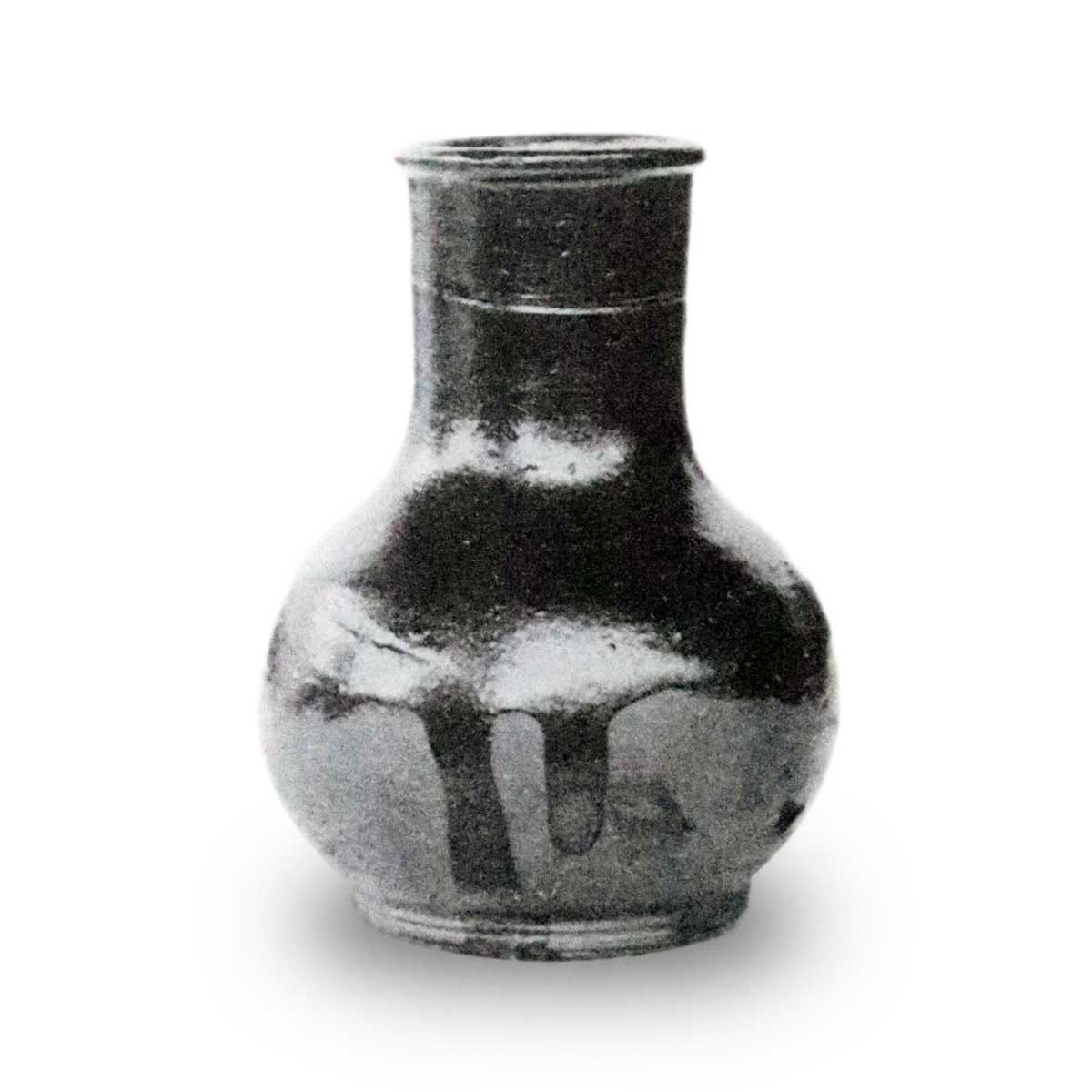
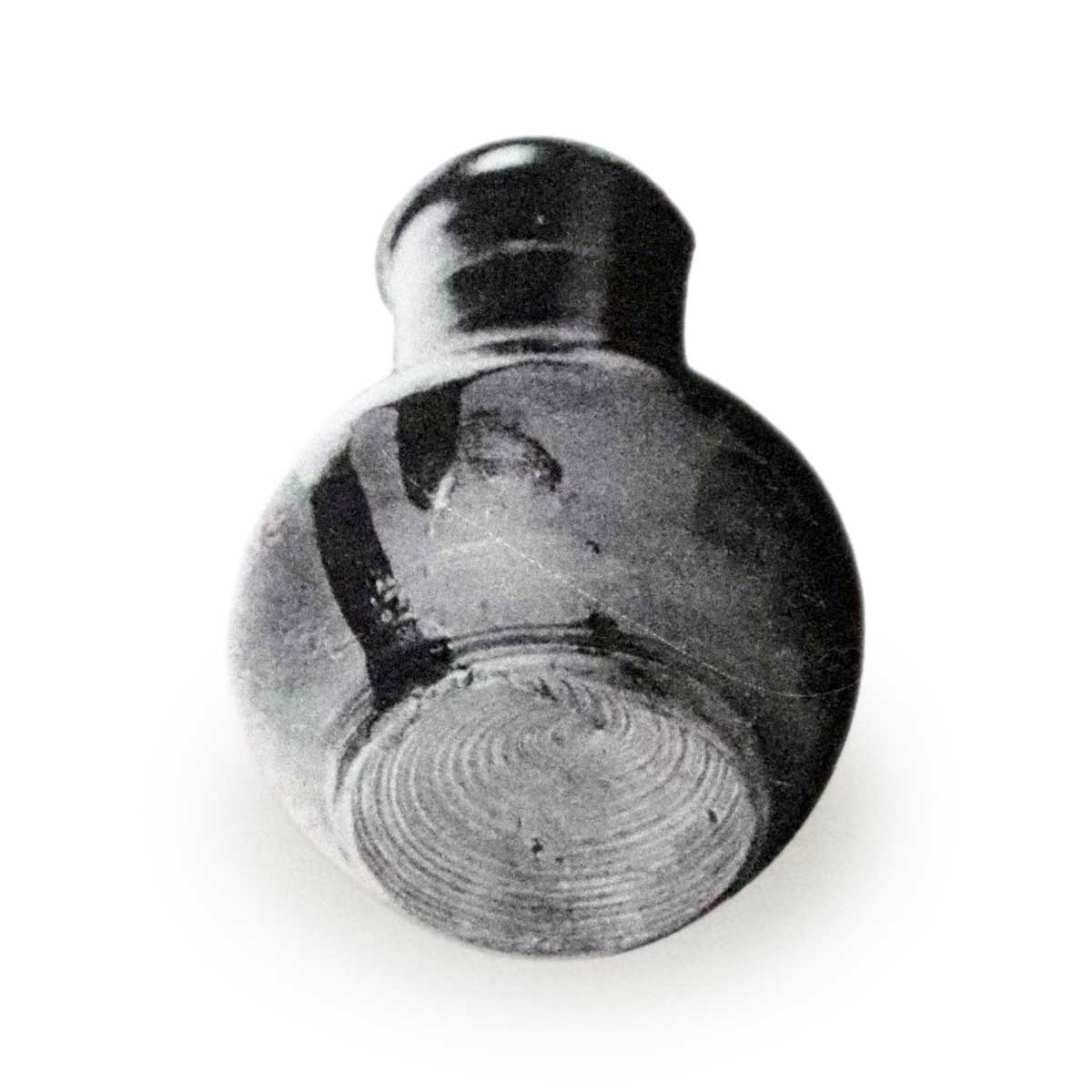
Made in China; a Daimeibutsu from the collection of Count Tadamichi Sakai
Name
Named after the crane-neck tea caddy once owned by Sen no Rikyu.
Dimensions
Height: Approx. 7.0 cm (2 sun 3 bu)
Body diameter: Approx. 5.5 cm (1 sun 8 bu)
Mouth Diameter: Approx. 3.0 cm (9 bu 8 rin)
Base Diameter: Approx. 3.5 cm (1 sun 1 bu 5)
Neck Length: Approx. 3.0 cm (9 bu 8 rin)
Weight: Approx. 135.8 g (36 monme 2 bu)
Accessories
・Pouch Box: Paulownia wood, natural finish; the inner lid holds three replacement lids
・Hikiya (cylinder for storing the tea caddy): Cherry wood, with gold-leaf lettering
“Rikyu Crane-Neck Tea Caddy, Includes Three Replacement Lids,” “Rikyu Crane-Neck”
・Inner box: Paulownia wood, natural grain
Pouch: Arisugawa brocade (lining: Donshu Junko; tying cord: Enshu brown)
“Rikyu Crane-Neck Tea Caddy”
・Outer box: Black lacquer with beveled edges and gold powder accents; gold powder lettering
“Rikyu Tsuru-kubi Tea Caddy”
・Lid: 1 piece, with a “su” (pattern); diameter approx. 3.3 cm (1 sun 9 rin)
・Replacement lids: 3 pieces
Rikyu style (antique)
Furuta Oribe style (new)
Kobori Enshu (Sohu) style (new)
・Storage pouches: 3
Hino Koto (lining: iridescent; tying cord: purple)
Donshu Junko (lining: sea mist; tying cord: purple)
White-ground Kinran (lining: iridescent; tying cord: purple)
・Accompanying trays: 2
・Inner and outer black-lacquered trays: approx. 13.9 cm on each side (4 sun 6 bu)
Inscriptions
“Black-Lacquered Inner and Outer Trays,” “Replica of a Kanto Imperial Item: Tang-Style Black-Lacquered Bunrin Tray,” “Rikyu Crane-Neck Side Tray”
“Rikyu Crane-Neck”
The seal of lacquer artisan Michie Kondo (12th generation) is on the reverse side
・Goro Tray: Approx. 18.8 cm on each side (6 sun 2 bu)
Wrapping cloth: Ancient sarasa
・Accompanying documents: 2 letters
Received in December of Bunkyu 1 (1861)
Copy of the Official Letter
I am writing to you on a separate sheet. In this bitterly cold season, I am delighted to hear that you are in the best of health. Now, since last autumn, there have been an exceptionally large number of requests from you, and I understand that you have taken special care in all matters and have been concerned about them—a fact that has reached the ears of His Highness (the Shogun).
In accordance with His will, it was conveyed through Hiraoka Tamba-no-kami that a set of tea utensils would be bestowed upon you in private. Accordingly, we are sending this gift in accordance with His wishes; please accept it with gratitude. That is all.
New Year’s Eve, December — Wakisaka Nakatsukasa-no-suke, Naito Kii-no-kami, Matsuda Heiizumi-no-kami
To: Sakai Wakasa-no-kami
“Rikyu Crane’s Neck” “Black-Lacquered Square Tray with Bunrin Design, Inside and Out”
September 14, Genroku 16 (1703)
Presented by Matsudaira Kazusa-no-suke, Retired
Notes on the Warm Seating Arrangement
When the “Rikyu Tsuru-kubi” tea caddy was originally presented by Matsudaira Kazusa-no-suke, it was accompanied by a square tray lacquered black on both the inside and outside; however, the tray was not bestowed upon us at the time of receipt. However, fortunately, I had previously noticed that the tray’s shape was quite interesting, so I asked the person in charge of tea utensils at the Sukiya-style tea house to create a replica of that tray. I then commissioned Kondō Dōkei to lacquer it as a copy and placed it alongside the Crane-Neck teapot.
Memorandum
Among the Imperial Tea Utensils
- Black-lacquered octagonal tray
To be paired with the “Shiratama Bunrin” tea caddy (note: the tea caddy is not included)
Approximately 19.4 cm (6 sun 4 bu) square
*Dimensions measured after the wooden mold was lacquered.
Net weight: approximately 228.8 g (61 monme).
The base of the Chinese piece appears to be a mud-like finish. Is that why it is so heavy?
That is correct.
December
September 14, Year of the Goat, Genroku 16
Matsudaira Kazusa-no-suke, Presented
Miscellaneous Notes
Rikyu Crane Neck: Chinese-made, a Daimeibutsu
(From Rinpō-kīryū)
Rikyu Tsuru-kubi: Weight approx. 135.8 g (36 monme 2 bu); height approx. 7.0 cm (2 sun 3 bu); width approx. 5.5 cm (1 sun 8 bu); mouth diameter approx. 3.0 cm (9 bu 8 rin); diameter of the circular base approx. 3.6 cm (1 sun 2 bu). It comes with three pouches: Shimama-michi, Kandou, and Ichijū-keihaku-Kinran. Persimmon glaze, vermilion clay, and thread-cut decoration. (Illustration of the tea caddy available)
(From Meibutsu-ki)
Rikyu Tsuru-kubi: Presented by Matsudaira Kazusa-no-suke, retired. Height: approx. 7.0 cm (2 sun 3 bu); body diameter: approx. 5.5 cm (1 sun 8 bu). Comes with three pouches: white ground with large Kinran, striped Guangdong, and manji-patterned Donshu. (Illustration of the tea caddy included.)
(From Illustrated Guide to Tea Caddies by Yoshimasu Kōen)
On the 28th day of the 6th month of the year of the Ox (Kyōhō 6, 1721), Tadaoshi Torii, Lord of Tamba, entered the castle in place of Yoshitaka and paid his respects to His Lordship Yoshimune, the Shogun. He presented one tachi sword, twenty sets of ceremonial robes, and ten ryō of gold as compensation for a horse, and expressed his gratitude for Yoshitaka’s retirement. He also presented one tachi sword (Masamune, valued at 300 mon) and one “Rikyu Tsuru-kubi” tea caddy (a Chinese import) to Lord Yoshimune. (Omitted) This, too, was an expression of gratitude for his retirement.
(From the Imperial University Historical Materials edition of Shimazu Ortodox Genealogy)
June 28, Kyōhō 6
Sword: Masamune (valued at 300 me)
Tea caddy: Rikyū Tsuru-kubi (Chinese import)
Formerly owned by Matsudaira Kazusa-no-suke
(From the Imperial University Historical Materials Collection, Record of Dedications of Heirlooms and Acquired Items by Various Families)
History
Originally owned by Matsudaira Kazusa-no-suke, these items were presented to the shogunate on September 14, Genroku 16 (1703), and were later bestowed upon the Shimazu family. On June 28, Kyōhō 6 (1721), Shimazu Satsuma-no-kami Yoshitaka presented them to Shogun Yoshimune as a token of gratitude upon his retirement, and they have been treasured by the shogunate ever since.
In December of Bunkyū 1 (1861), Sakai Wakasa-no-kami Tadayoshi (posthumous name: Onryō-in) received this item from Shogun Iemochi in recognition of his efforts as Kyoto Shoshidai regarding the marriage of Princess Kazunomiya.
Incidentally, Onryō-in had always been an exceptional connoisseur of tea utensils and had long coveted a celadon tea caddy (inscribed “Yoshino-yama”) from the shogunate’s secret collection. After Princess Kazunomiya’s marriage, the shogunate presented the “Yoshino-yama” to the Imperial Court, but the Court, in recognition of the Kyoto Shoshidai’s efforts, bestowed it upon Onryō-in. Since the shogunate also awarded her this “Rikyu Tsuru-kubi,” Lady Onra-in acquired two Meibutsu at the same time, fulfilling a long-cherished wish.
Record of Actual Observation
On April 25, Taisho 8 (1919), I viewed the actual object at the residence of Count Tadamichi Sakai in Yarai-cho, Ushigome Ward, Tokyo City.
The rim is rounded with a shallow fold. Midway along the long neck, there is a single sunken line running approximately halfway around the tea caddy. Overall, it has a lustrous, dark brown color; from the rim downward, the reddish earthenware clay is visible, and the height is uneven. Within this, there are three areas where the glaze has dripped in the same color; two of these are short, while one is long, extending all the way to the edge of the base. The base is circular with a distinct thread-cut edge, and on the opposite side of this surface, there are three black stain-like patterns. For a tea caddy of this type, the shape is compact and elegant, and the quality of the glaze is excellent. Furthermore, it possesses an unparalleled sense of wabi-sabi (a profound, unique tranquility), making it understandable why Rikyu held it in such high regard. Inside, the glaze covers the rim, while below that, a single streak of tannin-paper-colored glaze cascades down the unglazed clay to the base; the excellence of its craftsmanship is evident throughout.

