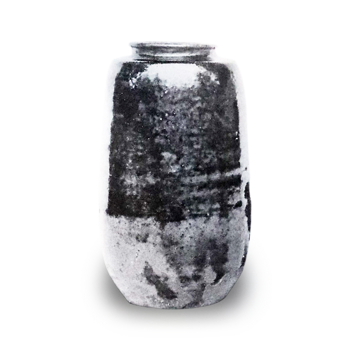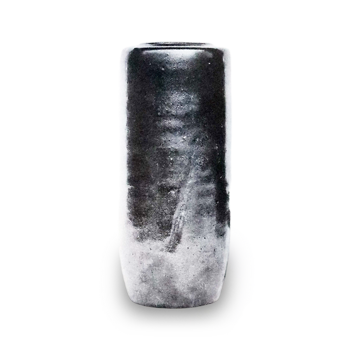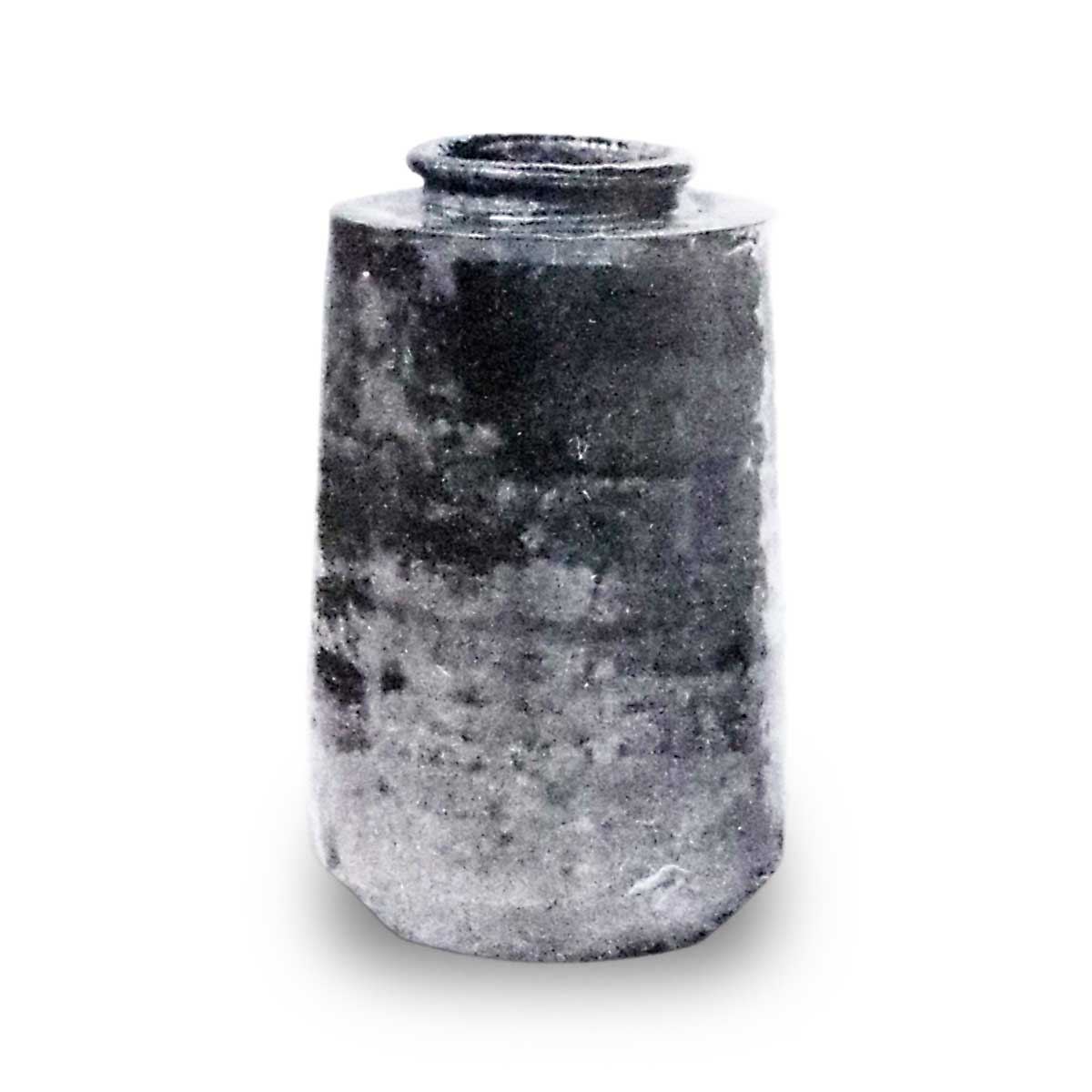
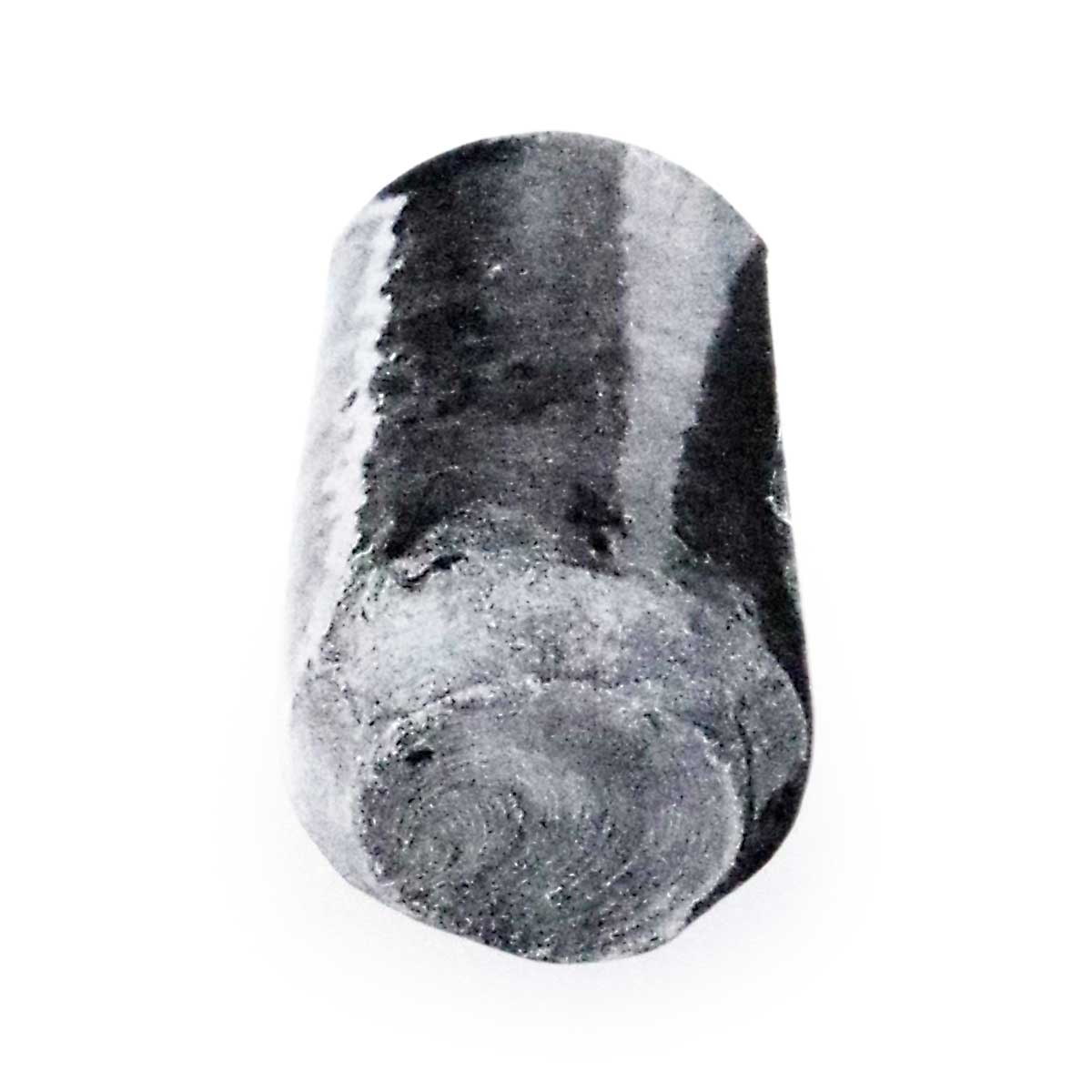
From the collection of Marquis Hosokawa Moritatsu of Furuseto
Name
This tea caddy is named after Kanamori Izumo-no-kami Yoshishige, who owned it. Yoshishige was originally the son of Nagao Kagenaga; he became the adopted son (a type of foster child) of Kanamori Nagachika and served Oda Nobunaga and Toyotomi Hideyoshi. In the Battle of Sekigahara in Keichō 5 (1600), he sided with Tokugawa Ieyasu; he later became the governor of Hida Province and distinguished himself during the Siege of Osaka. He passed away at the age of 58 on the 3rd day of the intercalary 6th month of Genna 1 (1615). He had once studied under Sen no Rikyū and his son, Shōan, mastering the tea ceremony, and his biography is recorded in the genealogy of tea masters.
Dimensions
Height: approx. 8.3 cm (2 sun 7 bu 5 rin)
Body diameter: approx. 5.2 cm (1 sun 7 bu)
Mouth diameter: approx. 3.0 cm – 3.0 cm (9 bu 8 rin or 1 sun)
Base diameter: approx. 3.5 cm (1 sun 1 bu 5 rin)
Neck height: approx. 0.5 cm (1 bu 7 rin)
Shoulder width: approx. 0.9 cm (3 bu)
Weight: approx. 132 g (35 monme 2 bu)
Accessories
・Cover (tea caddy pouch): 4 pieces (one of which has an old bottom, and one is in the style preferred by Hosokawa Sansai)
・Storage pouch: White chirimen (lined with white habutae; white cord knot)
・Pouches (tea caddy covers): 8 pieces
・Moe-green ground with phoenix-circle crest in Kinran (lined with pale gray-brown kaiki; period-style purple cord knot)
・Flower-colored small chrysanthemum and peony single-layer vine pattern in antique gold Kinran (purple cord knot; iridescent lining)
・Ivy-brown ground with Tang-style floral Fursu pattern (lined with dark brown Kinran; cord knots in purple)
・Floral-colored hanzō ground with snail-shell pattern Kinran (lined with grayish-brown kaiki; cord knots in purple)
・Brown ground with horizontal stripes and floral-colored woven-in patterns (cord knots in light purple; lined with iridescent silk)
・Onado-colored single-vine small peony antique Kinran, and double-vine medium peony antique Kinran with the same base color (both lined with light brown silk; cord knot is light purple)
・Sea pine-colored medium-sized Ouchi paulownia antique Kinran (lined with light green tsumugi; cord knot is purple)
・Pouch Box: Unfinished paulownia wood
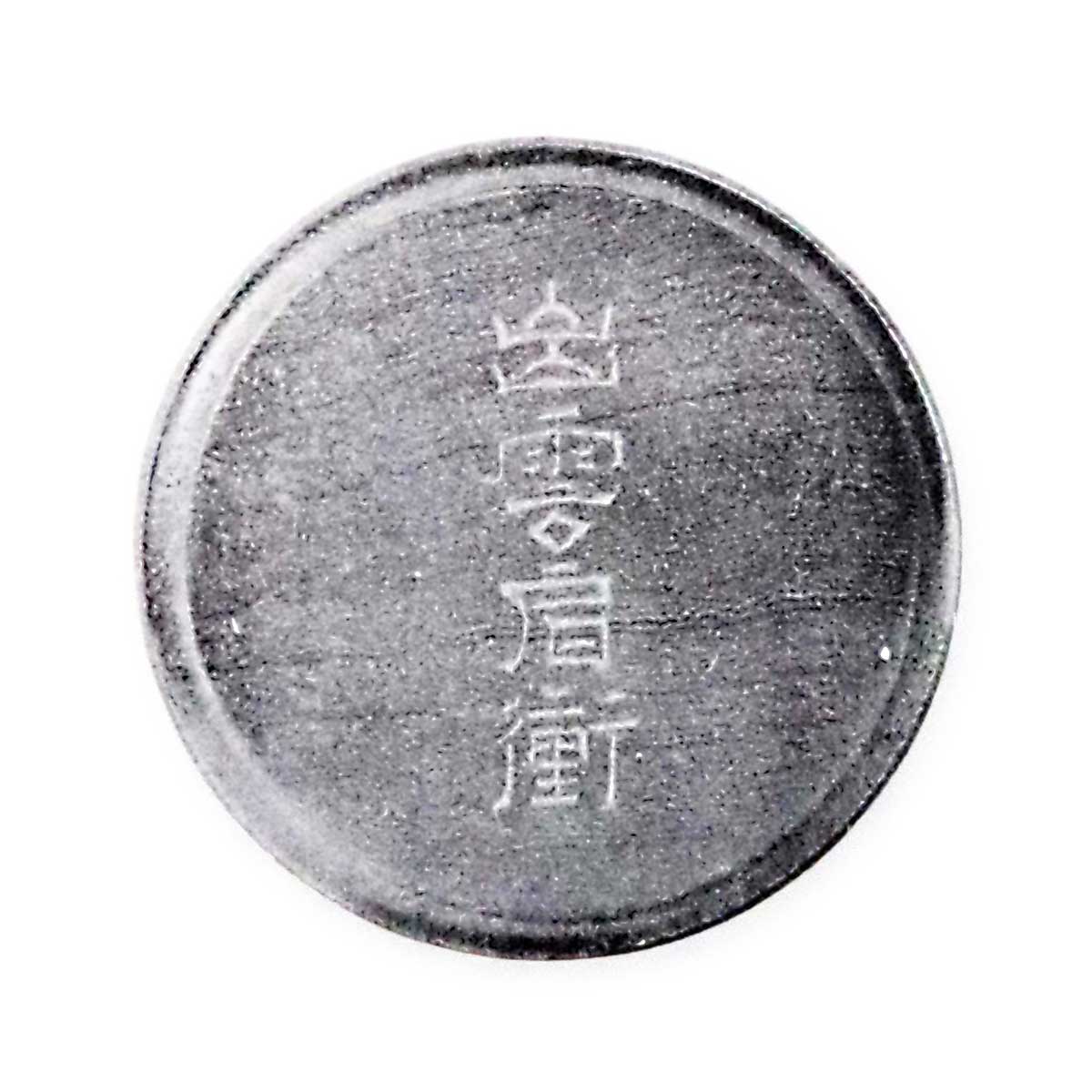
(Inscribed with “Izumo Seto Pouch Box”)
・Hikiya (wooden tea caddy holder): Made of sentouboku wood
(Carved with the inscription “Izumo Katatsuki” and filled with verdigris)
・Pouch for the Hikiya: Dutch-colored brocade (lined with pale yellow Guangdong silk; cord knot is purple)
・Inner box: Made of paulownia wood, with sumi-nuri lacquer finish and mitered edges. Features an inscription in gold powder
(the characters “Izumo Katatsuki”)
・Outer box: Unfinished paulownia wood
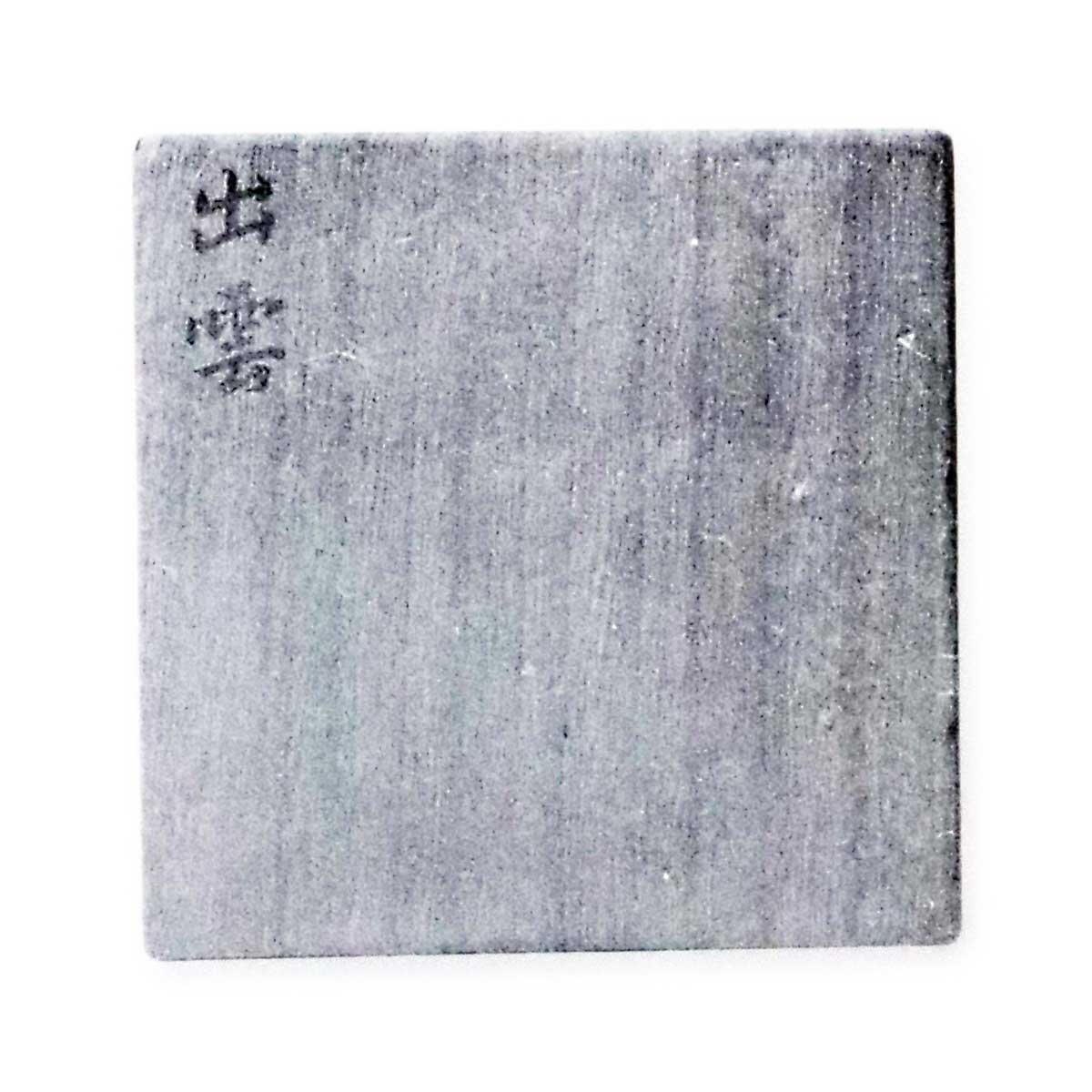
(The four lids are stored in a nested set. Features an inscription reading “Izumo,” written by Reion-in [Hosokawa Nobunori])
- Accompanying Letter (Inscription) “Izumo Katatsuki” – One copy
“The Origin of the Izumo Katatsuki”
This item was owned by Lord Kanamori Izumo-no-kami, who kept it in his private collection and never lent it to others. Hosokawa Sansai (Tadaoki) repeatedly and earnestly requested it, but the years passed without his request being granted. Later, Sansai requested it through Tani Dewa-no-kami, and it was presented to him by the Izumo Province (the Kanamori family). Even before the late Etchū-no-kami (Tadayoshi) succeeded to the family headship, he had earnestly desired this item, and it was presented to him. When Tadayoshi succeeded to the headship, he parted with various tea utensils, including the Nakayama Katatsuki, but at tea ceremonies where he devoted himself to the art of tea, he would present only this tea caddy. Later, during the reign of Higo-no-kami (Mitsunaga), it was presented to a certain individual. That is all.
May 20, Michinaka Sakai
(P.S.) There are eight pouches (shifuku) and one lid. The lid was ordered by Sansai, but it is unclear which of the pouches were ordered by Sansai and which by the late Etchū-no-kami. Therefore, I am presenting them as they are. That is all.
May 22: Sakazaki Seizaemon
Miscellaneous Notes
・The Izumo Katatsuki is an ancient Seto ware. It dates from the same period as the “Kamiya Katatsuki,” “Setsuki,” “Ōmi,” and “Asano Katatsuki,” and, like the Hatakeyama Katatsuki, is a type of ancient Seto ware.
(From The Origins of Seto Pottery by Matsudaira Fumai)
・The Nara Katatsuki was a gift from Lord Nobunaga to Kanamori Nagachika. When Lord Nobunaga requested to have tea at Honno-ji Temple, Nagachika took this out from his bosom and presented the tea to him; Lord Nobunaga was deeply impressed by Nagachika’s profound dedication to the tea ceremony. Subsequently, after Nagachika had departed on an errand to Ōmi Province, the Akechi Mitsuhide Rebellion (the Honno-ji Incident) broke out. Miraculously, this tea caddy escaped the fire and fell into Mitsuhide’s hands, and it was subsequently presented to Chikuzen-no-kami (Hideyoshi). Since Chikuzen-no-kami had long known that this item had been bestowed upon Kanamori by Lord Nobunaga, he immediately returned it to Nagachika (Hōin). This is the very item referred to in the Kanamori family as the “Izumo Katatsuki.” Alternatively, it is said that the “Nara Katatsuki” was originally owned by Matsuya Genzaburō of Nara, which Nobunaga then confiscated and kept in his private collection; it is unclear which account is correct.
(From Shinsho Taikōki)
・From a letter sent by Katō Kiyomasa to Ōki Tosa on December 6, Keichō 12 (1607):
We have been informed by Kondo Iwami-no-kami that the Izumo Katatsuki, formerly owned by Sakakibara Shikibu, was presented to Osuga Dewa-no-kami, but since Dewa-no-kami has passed away, it is now being put up for sale. We have been contacted with the suggestion, “Why not purchase it?” We intend to purchase it, so please make arrangements to ensure it does not fall into the hands of others. Regarding the payment, we will follow Furuta Oribe’s instructions, so please convey this to Shūshū (Furuta Oribe). If you need funds, I will advance the money and send it to you.
From Lord Kato Higo-no-kami of Izumo.
(“Kishu Family Documents,” “Meibutsu of Various Families”)
・Izumo Katatsuki, formerly owned by the Hosokawa family. This tea caddy is unattractive (plain). Height approximately 8.4 cm; diameter approximately 3.9 cm at a point 5 bu (approximately 1.5 cm) below the body; base diameter approximately 3.6 cm. It comes with four lids and eight pouches. Various protective covers are included, such as one made of Ōuchi Kinran brocade, and there is also a diagram of the tea caddy. A note in vermilion ink states, “The speckled pattern of the quail is beautifully rendered and truly magnificent.” Furthermore, although it is noted that “this tea caddy is unattractive,” when I borrowed and examined it in Meiwa 3 (1766), I found it to be an excellent example of ancient Seto ware made with white clay, and it was by no means inferior in appearance.
(From Makuan Bunko Hon Meibutsu-ki and Kokon Meibutsu Ruiju Shui-bu)
・Izumo Katatsuki, ancient Seto ware. The entire tea caddy is thick-walled and heavy; the glaze has a vivid persimmon color, and the black mottled patterns are exceptionally beautiful. The metallic luster is also magnificent. Large and small mottled patterns intermingle, with an amber hue visible through them.
The rim is thickly formed, and there are faint spatula marks on the shoulder. It is of excellent craftsmanship; the clay has a whitish hue mixed with sand, and shows traces of “ishi-haze” (crackling) and slip marks.
(From Rinpō Kiryū)
・Izumo Katatsuki, Old Seto. Owned by successive generations of the Hosokawa Etchū-no-kami family. It has some cracks (such as craquelure), and the base is “hon-ito-giri” (with the clay exposed). The shoulders are firmly flared (ikari-kata), and the entire piece has a dark brownish-black hue.
(From Makuan Bunko, Series A, No. 3)
・This tea caddy was a treasured possession of Kanamori Izumo-no-kami, but he eventually parted with it after Hosokawa Tadaoki (Sansai) repeatedly requested it. When Tadatoshi succeeded to the family headship, Tadaoki personally presented it to him and admonishing him, “You, too, must devote yourself wholeheartedly to the Way of Tea and use this. Otherwise, you will not be permitted to use it.” This anecdote illustrates just how closely they had guarded this tea caddy.
(From Documents of the Hosokawa Marquis Family)
History
Kanamori Izumo-no-kami Yoshishige discovered this tea caddy while exploring the central region of Hida Province, which had once been his domain (a practice known as “small teapot hunting”), but it was eventually ceded to the Hosokawa family at the earnest request of Hosokawa Sansai (Tadaoki). It is said that when Sansai presented this tea caddy to his son, Tadatoshi, he admonished him, “You, too, must devote yourself wholeheartedly to the Way of Tea before you may use this. Otherwise, you must not use it.” It is said that during the time of Hosokawa Mitsunaga’s son, it was sold to Inaba Mino-no-kami for 30 gold pieces, or that it was presented to Hotta Kaga-no-kami as one of Mitsunaga’s personal effects; while it is unclear which account is correct, there is no doubt that it left the Hosokawa family once during Mitsunaga’s lifetime. Subsequently, during the time of Hosokawa Tsunatoshi (Mitsunaga’s son), it returned to the Hosokawa family and has remained there to this day.
(From Imperial University Historical Materials (General Overview of the Daimeibutsu of the Hosokawa Marquis Family), etc.)
(Note) The Shinsho Taikōki states that the Izumo Katatsuki was originally owned by Oda Nobunaga, who gave it to Kanamori Nagachika; it then passed into the hands of Akechi Mitsuhide during the Honno-ji Incident, and subsequently became the property of Toyotomi Hideyoshi, who later returned it to Kanamori. Furthermore, a letter from Kato Kiyomasa states that the “Izumo Katatsuki” was originally owned by Sakakibara Shikibu, passed down to Osuga Dewa-no-kami, and that Kiyomasa attempted to purchase it after the latter’s death. Whether these “Izumo Katatsuki” are, in fact, the same tea caddy that has been passed down in the Hosokawa family, or whether they are different objects sharing the same name, cannot be determined with certainty at this point.
Record of Actual Viewing
On October 19, Taishō 8 (1919), I viewed this item in person at the residence of Marquis Hosokawa Moritatsu in Takada-Oimatsu-chō, Koishikawa Ward, Tokyo City.
The rim’s fold is somewhat deep, the shoulders are sharply flared, and the craftsmanship is so exquisite it could cut one’s hand. The shape is cylindrical, with the base (bottom) slightly bulging outward. From the rim downward, bold chamfering has been applied; the “ito-kiri” (the swirling marks on the base) is somewhat coarse, and within it there are two small “ishi-bazuke” (rock-like cracks). The rim of the base has an irregular finish, with the center taking on a slightly circular shape. Overall, black glaze appears in patches against a persimmon-colored, metallic-hued body; the luster of the black amber glaze is particularly beautiful around the shoulders. A single, narrow vertical groove extends from the tip of the shoulder to the middle of the body.
The tea caddy is slender and elongated, with crisp, well-defined craftsmanship that exudes an elegant and refined charm. The fact that it was used on numerous occasions at tea ceremonies held by the Hosokawa family can be inferred from the presence of as many as eight protective covers. Inside, the glaze covers only the rim; below that, the wheel marks are deep, forming a tomoe (swastika) pattern at the center of the base. The statement in Lord Matsudaira Fumai’s book The Origins of Seto Pottery—that “like the Hatakeyama (Katatsuki) style, this is a type of ancient Seto”—is a truly spot-on observation. Given its shape and artistic style, this masterpiece stands out as an exceptionally distinctive “unusual piece” even among Seto tea caddies.