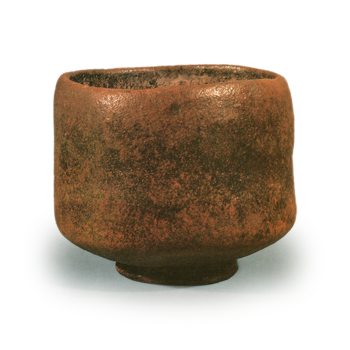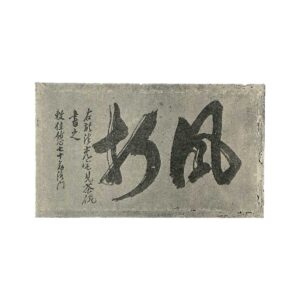
Kuro-raku, Famous Item
Accessories
Inner box: Paulownia wood, white wood, inscription by Yamada Sōgen, same inscription on the underside of the lid in the same hand
Outer box: Paulownia wood, white wood, lock with inscription
Additional inscription by En’yu Myokaku Zenji
Transmission
Sen no Rikyu — Genpaku Sōtan Ichihon’an Yamada Sōen — Edo Fukagawa, Fuyuki Kodaira — Tool merchant Hiroshima-ya Heijirō — Osaka, Kaga-ya Saburōbei — Nagoya, Tenman-ya Kawamura Kyūbei — Osaka, Tool shop Katsuhei — Kanazawa, Yoshikura Sōza — Kanazawa City, Ishiguro Family
Recorded
Kokin Meibutsu Ruiju (Collection of Famous Objects from Ancient and Modern Times) by Tominaga Gen, Tea Utensils: Names and Forms, Honcho Toki Koshō (Research on Japanese Pottery), Meibutsu Chawan Shū (Collection of Famous Tea Bowls), Kokon Chawa (Tea Talk from Ancient and Modern Times) by Kikuniya Hikojiro, Kansō Zatsuki (Random Notes from a Leisurely Window), Ansei 2nd Year New Group Seven Types Exhibition, Kushinroku (Record of Efforts) by Matsuyama Seika, Tsurezure no Tomo (A Friend in Leisure), Kanshū Ghibi (Random Notes from a Leisurely Residence)
Dimensions
Height: 9 cm, Mouth diameter: 8.5 cm, Body diameter: 9.0 cm, Foot diameter: 5.7 cm, Weight: 360 g
The inscription “Fūzuki” was written by Sōtan, and the indentation on the body was likened to a wind-broken eboshi hat, hence the name. The inscription on the box by Yamada Sōan is probably based on a tradition passed down from Sōtan.The body originally had red lacquer with Sōtan’s direct inscription of the two characters “wind-bent” and his signature, but these are now almost entirely gone.
This is a rare cylindrical shape, with a concave body and high foot, showing a style with significant variation.
The high foot is particularly large and sturdy, demonstrating the strength of the craftsmanship and characteristic of Nagajirō.