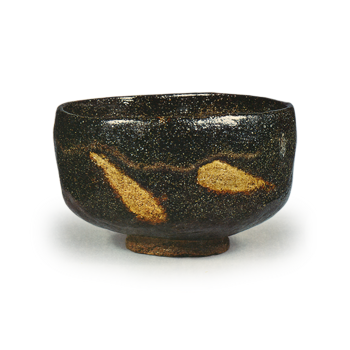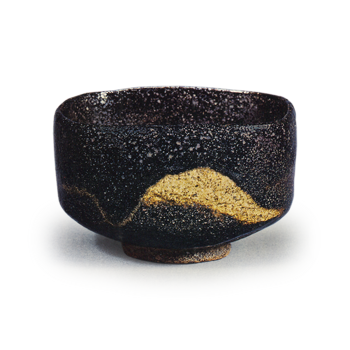


Kurogama, Nonkou Seven Types
Accessories
Box, paulownia, white wood
Same lid with inscription, written by Kakuza
Provenance
Osaka Kizuna-ya, Akahoshi family, Osaka, Yoshiyuki Isono
Published
Honcho Toki Koshō, written by Fushimiya Sōri, Meibutsu Chawan Zui, Hōki Bunko Otsu No. 2, Shōga Antique Digging Story, Kansō Zatsuki.
Dimensions
Height: 7.6 cm, diameter: 11.2-11.8 cm, foot diameter: 5.4 cm, height: 0.8 cm, weight: 320 g
Considered the foremost of the seven types of Nonkou, the Masu (rice measuring cup) with the name Kakuzai is shaped like a square.
The base is white clay, which is typical of Nonkou, and this is one characteristic that distinguishes it from Chojiro.
The glaze is thin and slightly curved, and the thick, glossy jet-black glaze unique to Nonkou forms a curtain-like pattern from the rim to the body, creating the so-called Nonkou curtain glaze. Continuing from the curtain glaze on the front, Nonkou’s signature yellow glaze appears in a distant mountain shape, creating a spectacular scene.
The careful blending of black glaze and firing techniques have produced a unique pearlescent glaze, and the innovative design of the curtain glaze and yellow slip have further enhanced the masterful shaping techniques. This level of skill has opened up a new realm distinct from Nagajiro’s work, earning it the praise of Kōetsu as “the masterful hand of Raku.”
Another characteristic is the wide perspective, which seems to have been influenced by Koetsu. Another characteristic of Nonkou is the light brown color of the black glaze in thin areas, which creates a sense of shade. A thin layer of water glaze is applied around the high ground of the clay, and the Raku seal is stamped inside, with five eyes on the tatami mat.