

Chinese Tea Bowl—Collection of Marquis Tokugawa Yoshichika
Name
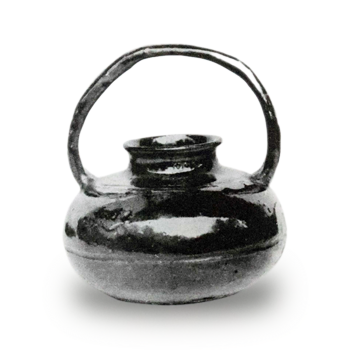
The “Ito-tsuki” (string-attached) or “Tsuri-tsuki” (hanging-attached) vessels described in tea ceremony texts such as the Manpō Zenshū typically feature a rounded base (with a slightly raised bottom) and a single-sided handle (with a loop attached to only one side). However, this is a flat-bottomed, handheld Tsuri-tsuki, constituting a distinct form of its own.
Dimensions
Height (including handle): approx. 8.2 cm (2 sun 7 bu)
Body diameter: approx. 7.4 cm (2 sun 4 bu 5 rin)
Mouth diameter: approx. 3.2 cm (1 sun 5 rin)
Base diameter: approx. 3.9 cm (1 sun 3 bu)
Height of the neck (koshiki): approx. 0.9 cm (3 bu)
Distance between the handles (at the mouth of the tea caddy): approx. 6.1 cm (2 sun)
Length of the handle (measured with a tape measure): approx. 13.3 cm (4 sun 4 bu)
Weight: approx. 84.4 g (22 monme 5 bu)
Accessories
・Lid: 1 piece, with a “su” (pattern)
・Inner box: Tagaya-san label
“Chinese-style tea caddy with hanging cord”
・Outer box: Paulownia wood; label with “Tame-nuri” inscription
“Chinese-style with hanging cord”
“Tea caddy with hanging cord”
(Affixed to the grain of the wood)
Miscellaneous Notes
A small jar with a hanging cord. There are about six or seven of them, a mix of good and poor quality.
(From Yamagami Sōji Ki)
Tsurutsuki (with hanging loop) small pots. There are perhaps six or seven of them, a mix of good and bad pieces.
(From Collection of Meibutsu)
Tea caddies with hanging loops are mostly Chinese or Okinawan items. When using a tea caddy with a hanging loop or an oil-barrel-style tea caddy, the tea scoop is placed face down and hung on the loop (string or ear).
To use a tea caddy with a string or an “abura-oke” style caddy
Turn the tea scoop face down and hang it on the string
(From Biographies of the Six Masters of the Tea Ceremony)
Record of Actual Observation
On June 5, Taishō 8 (1919), I observed the actual item at the residence of Marquis Tokugawa Yoshichika in Ōsone-chō, Higashi Ward, Nagoya City.
It is a Chinese-style tea caddy with a hanging handle; the black amber glaze has a beautiful luster. The rim is shaped with a standard fold, and the handle—like that of a flower basket—is tall, extending from both shoulders and crossing the center of the caddy. A single thick, recessed line runs around the rim, adjacent to the handle. Additionally, the sunken groove located slightly below the center of the body is misaligned in one spot. “Snake-and-Scorpion Glaze” (a glaze with a pattern resembling the scales of snakes and lizards) appears in places; it feels light when held, and the bottom is made of grayish-brown clay with a flat base. The handle is softly shaped, and the glaze appears to be dripping; this is truly a superb example of a Chinese tea caddy. This tea caddy comes in a paulownia wood box with only a label reading “Tea Caddy with Handle” attached; no pouch is in sight, but it is undoubtedly an item of distinguished lineage, and its accessories were likely lost during a period of upheaval. Not only is its shape rare and unconventional, but its craftsmanship is elegant, and it possesses the qualities of a “Meibutsu” (famous piece). I believe that even without its original accessories, it would still hold its own in the world, so I have decided to include it in this volume.