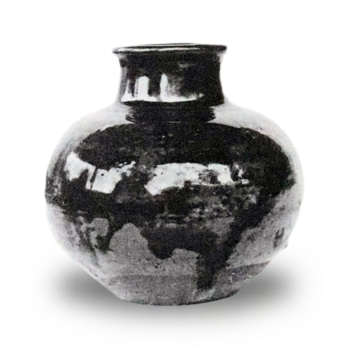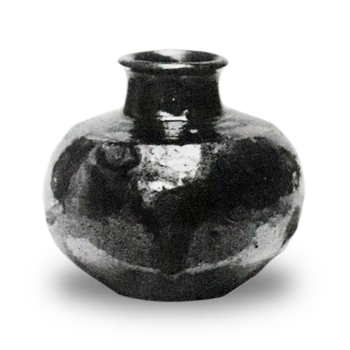


Made in China; Collection of Mr. Shochi Yabuuchi, Kyoto
Origin of the Name
It was likely given this name because it was the most famous round vase made in China during the Tenshō era. At that time, many lacquer artisans, kettle makers, and brazier makers went by the name “Tenka-ichi.” It is believed this was a buzzword of the era meaning “the very best.”
Dimensions (converted using 1 sun ≈ 3.03 cm and 1 monme ≈ 3.75 g)
Height: Approx. 6.67 cm (2 sun 2 bu)
Body diameter: Approx. 7.42 cm (2 sun 4 bu 5 rin)
Mouth diameter: approx. 3.03 cm (1 sun)
Base diameter: approx. 3.33 cm (1 sun 1 bu)
Height of the koshiki (steamer): approx. 1.45 cm (4 bu 8 rin)
Shoulder width: approx. 1.36 cm (4 bu 5 rin)
Weight: approx. 76.1 g (20 monme 3 bu)
Accessories
・Lid: 1 (with a recess)
・Storage pouches: 4
Yoshino Koto-ori (lined with Kai silk, brown cord)
Inscription on the box: Yabuuchi Family, 3rd Generation, Ken’ō
“En’an”
Bandaiya Koto-ori (lined with brown Kai silk, grayish-brown cord)
Inscription on the box: Yabuuchi Family, 6th Generation, Hirosai
“Modaya Rantō”
Hosokawa Tonsu (Lining: iridescent Kai silk; cord: brown)
Inscription on the box: Yabuuchi Family, 6th Generation, Hirosai
Front: “Hosokawa Tonsu”
Back: “Granted by Yūsai-ō (Hosokawa Yūsai)”
A piece of fabric formerly owned by Kato Fu’an (Lining: brown Kai silk; cord: floral pattern)
Inscription on the box: Kato Fu’an
“Rantō”
・Wooden mold: 1 piece, with an ivory lid
(Housed in a Yoshino Koto-ori bag)
・Hikiya (a tube for storing a tea caddy): Black lacquer
Inscription in vermilion lacquer: Yabuuchi Family, First Generation, Kenchū
“Enko”
Pouch made of thin Kobaya leather (lined with Wanli satin; brown cord)
・Inner box: Unfinished paulownia wood, with an inscription by an unknown author
“Height: approx. 6.51 cm (2 sun 1 bu 5)
Body: approx. 7.42 cm (2 sun 4 bu 5)
Mouth: Approx. 3.18 cm (1 sun 1 bu 5 men)
Base: Approx. 3.33 cm (1 sun 1 bu)
Weight: Approx. 76.9 g (20 monme 5 bu)”
Pouch made of iris-patterned leather; cord is brown
・Outer box: Chinese-made wickerwork base with vermilion-lacquered woolen trim (moulé), equipped with a lock
・Accompanying tray: Pinewood tray (a treasured heirloom passed down from Miyoshi Jikkyū to Yabuuchi Sōha; widely regarded as the “original” pinewood tray)
Lightweight, medium-weave fabric. The rim features a translucent lacquer finish; the inner rim and all four sides are painted vermilion; the outer rim and all four sides of the base are painted black; the remaining areas have a translucent lacquer finish.
Diameter: approx. 18.48 cm (6 sun 1 bu); diameter of the “mirror” (central depression): approx. 14.54 cm (4 sun 8 bu); base diameter: approx. 14.54 cm (4 sun 8 bu); height: approx. 2.88 cm (9 bu 5 rin)
The pouch features a chrysanthemum and paulownia pattern and is made in China
The box is made of untreated paulownia wood
The inscription on the front is by Kenchū, the first generation of the Yabuuchi family; the inscription on the back is by Sōha, the distant ancestor of the Yabuuchi family.
Front: “Marubo”
Back: “The pinewood tray is a Meibutsu. As a token of our close friendship, I was presented with this treasured item, which had been passed down in the family of Miyoshi Jikkyū, so I have placed it alongside the Marubo (round jar) passed down in my family. Sōha (seal)”
The pouch is made of iris-patterned leather; the cord is brown
Miscellaneous Notes
June 16, Meiji 34 (1901), Noon Host: Takusui Shōchi, 11th generation head of the Yabuuchi family
Guests: Matsuura Shingetsuan, Itō Sōyū, Iwami Jūsō, Ōkubo Hokkin
・Tokonoma: The two characters “Muden” (Calligraphy by Yabuuchi Chūsai)
・Flower Vase: Antique bronze elephant-ear vase (Rikyū’s inscription: “Hime-uri”), flowers: Kannon-sō
・Tea Jar: “Tenka-ichi-maru” jar (placed on a Matsuki tray (Matsunaga tray))
The box bears an inscription by Hosokawa Yūsai; the pouch is made of Yoshino Kōtō-ori fabric
・Tea Bowls: Five Banshō bowls, Ryukyu tea bowl stand
・Tea scoop: Made by Furuta Oribe; the tube was made by Yabuuchi Kenchū
(From Kokin Chayūshū)
June 23, Taishō 10 (1921), Noon. Host: Takusō Shōchi, 12th generation of the Yabuuchi family
Guests: Takahashi Hōan, Murayama Ryūhei, Tsuchihashi Kahei, Yabuuchi Setsuan
Tea Room: Tankodo
・Tokonoma: Hanging scroll—a letter from Sen no Rikyū
“The letter dated the 8th of this month arrived on the 17th. I have taken note of its contents. It is indeed a special honor that the flower vase has returned to your possession once again. I will certainly pay you a visit in early spring. With deepest respect. December 18—Seal of Hōsen-sō (Rikyū’s pen name)”
Tea Room: En’an
・Tokonoma: Hanging scroll—the five characters “破睡見茶功 (Seeing the Efficacy of Tea in Dispelling Sleepiness)” by Inka Kōji
・Flower Vase: Hime-uri; flowers: yellow licorice
・Tea Caddy: Tenka-ichi-maru Pot
Tray: Wakasa tray; pouch: Yoshino Kōtō-ori
・Tea bowl: Makumagawa (a gift from Toyotomi Hidenaga, the Yamato Daidōnagon)
・Tea scoop: Tōyōbō (including the matching tube)
(From Shin’yū Taishō Chadōki)
History of Transmission
It is said that the “Tenka Ichimaru” teapot was passed down from Ashikaga Yoshimitsu to Ashikaga Yoshimasa, who then bestowed it upon Sōha, the distant ancestor of the Yabuuchi family. Later, when Yabuuchi Kenchū inherited the Yabuuchi family, he inherited the relics of his distant ancestor Sōha, and this round jar has been passed down continuously within the family ever since.
Incidentally, Kenchū went by the pseudonyms “En’an,” “Yabuchū-sai,” or “Yabuinsai”; he was a native of Gifu and initially went by the name “Yabu Kenchū.” He studied the Way of Tea under Sen no Rikyū and practiced Zen under Kokushi Shun’ya Sōen at Daitoku-ji Temple, where he attained profound enlightenment. Since his family name was “Yabu,” and it seemed as though there was a karmic connection from a past life with the “Yabuuchi” clan, he eventually inherited that family and, with Rikyū acting as matchmaker, married the daughter of Furuta Oribe.
The Venerable Ryōnyo of Nishi Hongan-ji admired Kenchū’s character, invited him, and appointed him as his tea master. Since then, it has become customary for successive heads of Nishi Hongan-ji to receive full transmission of the Yabuuchi school. Kenchū also once enjoyed the favor of Toyotomi Hideyoshi (the Taikō) and lived in “En’an,” a tea room in the Jurakudai estate designed in the style favored by Murata Jukō. He later had this tea room relocated to his current residence in Nishinotoin (the site of Furuta Oribe’s former Kyoto residence) and styled himself the “Master of En’an.” He passed away on May 7, Kan’ei 4 (1627), at the age of 92.
Firsthand Account (Record of Actual Observation)
On September 25, Taishō 9 (1920), I had the opportunity to view this piece in person at the residence of Mr. Shōchi Yabuuchi in Nishinotoin Hanayachō, Shimogyo Ward, Kyoto City.
The rim features a deep, outward curve, and the base of the neck is broad. Overall, the body has a purple base with the aesthetic of the tea ceremony; a single line of black amber glaze runs around the neck, and on the outside of that, another raised purple streak encircles the vessel. The shoulders protrude slightly, and from the tips of the shoulders down to the body, the vessel swells plumply, while from the rim downward, it tapers plumply again.
Three areas of rich black amber glaze appear in pairs around the shoulder. When viewed from the front, the black amber glaze, which intersects as if collapsing together just below the shoulder, merges into a single strand around the body, draping down to the exposed clay at the rim; the tip of this strand is slightly thicker, and its black luster is particularly magnificent.
From the rim downward, the vermilion-clay-colored (reddish-brown) clay is exposed, and the fine wheel marks continue all the way to where the vessel meets the tray. The thread marks on the base are extremely fine, with a slight misalignment at their starting point. There is a large, horizontally elongated lacquer repair mark on the body, and while there are numerous other repair marks, the largest scar runs from the rim’s edge, through the tip of the shoulder, and down to the body.
Amid the overall purple glaze, black glaze forms a blur-like pattern in places, and both the purple and black colors possess an exceptionally beautiful luster. Inside, the glaze covers only the rim, and while the wheel marks extend throughout, the fact that the bottom is flat distinguishes it significantly from ordinary round jars.
In addition to the aforementioned features, there are about three horizontal marks where the clay adhered to the kiln (hitsuki) along the outer rim, and there are splashes of purple glaze within the clay at the rim. There are also a few splashes of glaze on the base, and the body has bumpy areas resembling fire blisters. Despite its great age, its light weight when held, and the abundance of visual highlights, its exceptional elegance and dignity truly live up to the name “Tenka-ichi.”