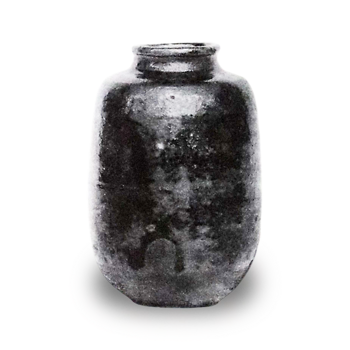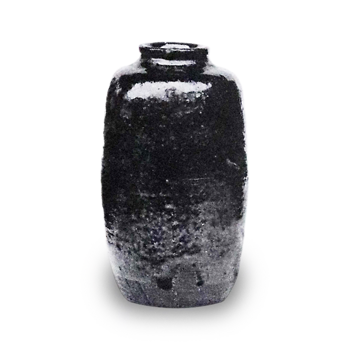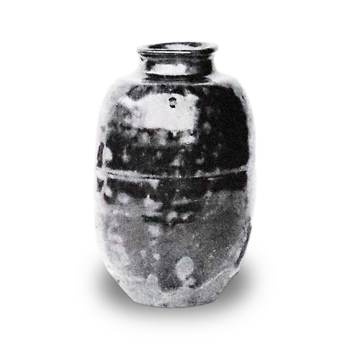
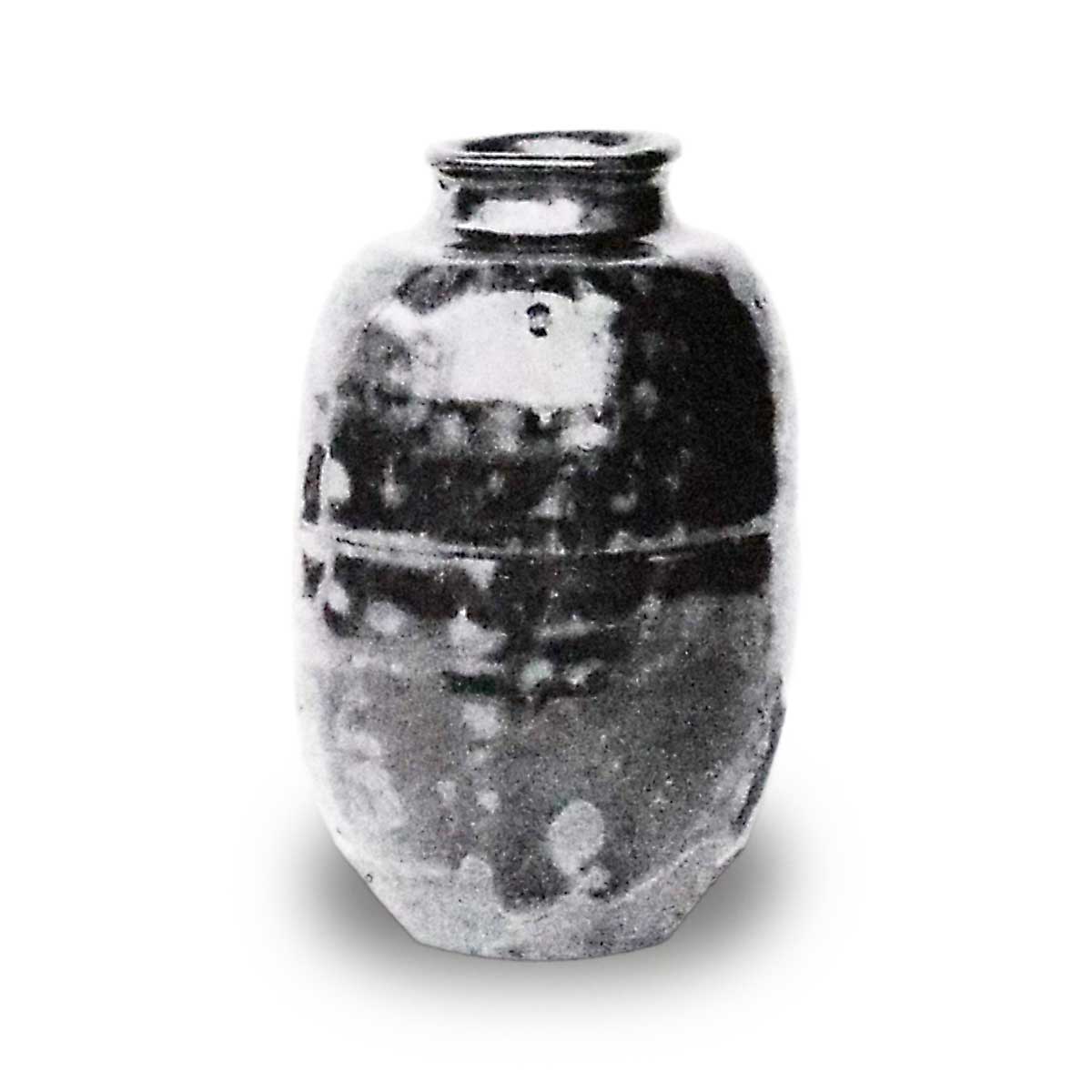
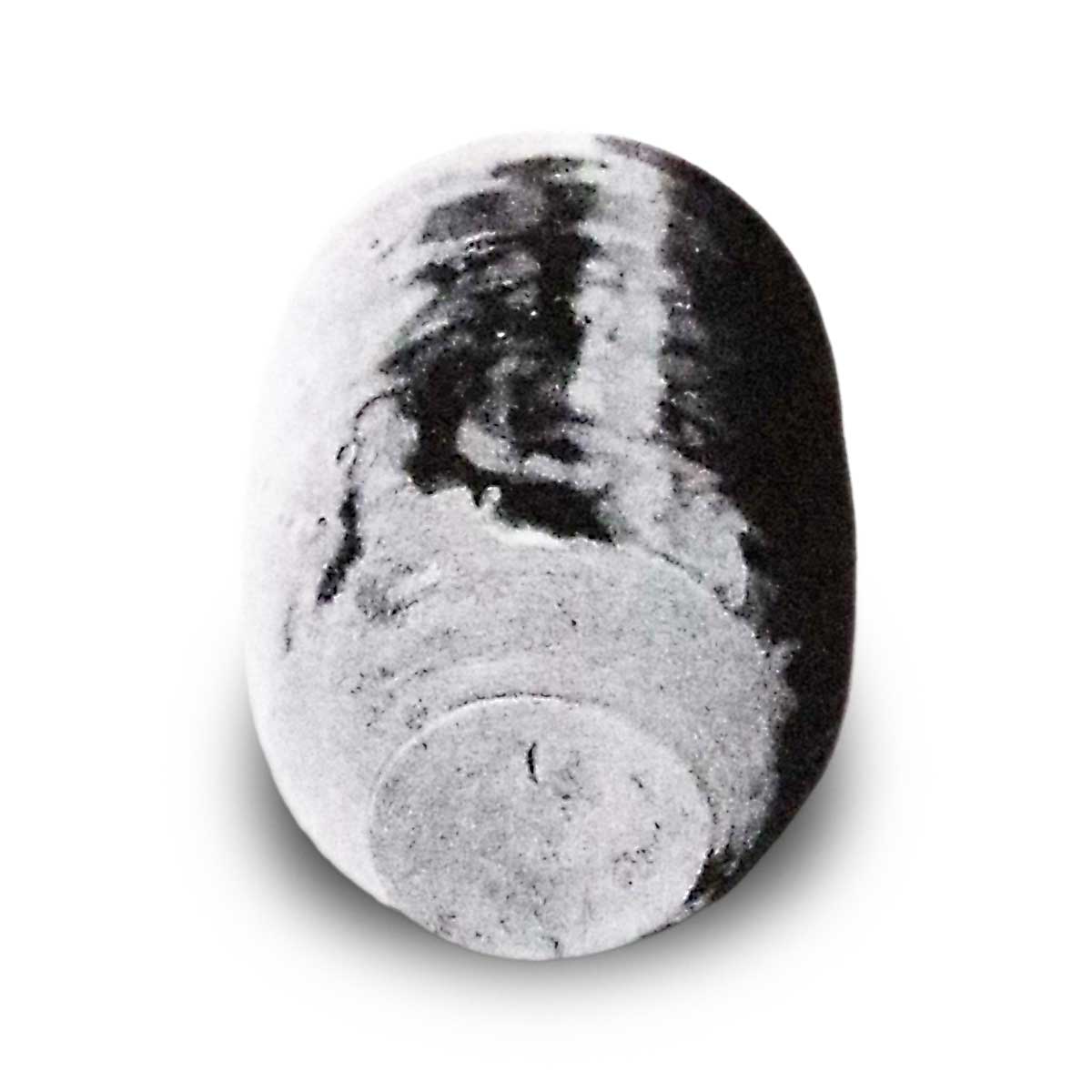
Old Seto, a Meibutsu of the revival period; Owner: Marquis Katsunosuke Inoue
Description:
This item belonged to the Sengoku-period warlord Kato Samonosuke Yoshiaki and was later passed down through generations of the Kato family of the Minakuchi Domain in Omi Province (Shiga Prefecture). Yoshiaki was enfeoffed with the 400,000-koku domain of Aizu in Kan’ei 4 (1627) and died in September of Kan’ei 8 (1631) at the age of 69. When Yoshiaki’s son, Akinari, caused a scandal and had his fief confiscated, Akinari’s son, Aki-tomo, was enfeoffed in Anō District, Iwami Province; however, in Tenna 2 (1682), Aki-tomo’s son, Kato Sado-no-kami Akihide, was granted a fief of 25,000 koku in Minakuchi, Ōmi. He became the progenitor of the present-day Kato Viscount family.
Dimensions (converted to modern units: 1 sun ≈ 3.03 cm, 1 bu ≈ 3.03 mm, 1 rin ≈ 0.303 mm, 1 monme ≈ 3.75 g)
Height: 2 sun 8 bu 5 rin (approx. 8.64 cm)
Body diameter: 1 sun 8 bu 5 rin (approx. 5.61 cm)
Mouth diameter: 9 bu to 9 bu 2 rin (approx. 2.73 cm to 2.79 cm)
Base diameter: 9 bu 5 rin (approx. 2.88 cm)
Neck height: 2 bu 5 rin (approx. 0.76 cm)
Shoulder width: 2 bu (approx. 0.61 cm)
Weight: 20 monme (approx. 93.75 g)
Accessories
・Lids: 2 (Kaku / wood grain with ivory-like patterns)
・Storage pouch: 1
・Cover pouches: 4
- Navy background with floral and rabbit design (Lining: Peach-colored Kaiki / Cord and fastener: Wisteria-colored)
*Kato Ko-katatsuki - Donshu Junko (Lining: Brown Umi-ki / Cord and Tugari: Brown)
- Hino Kantō (Lining: Light Green Umi-ki / Cord and Tugari: Purple)
- Shinba-giri (Lining: Light Green Umi-ki / Cord and Tugari: Pale Yellow)
・Storage Boxes: 2
1 box: No inscription / 1 box: Inscription as follows
“Two Ko-katatsuki Pouches” (Inscription by Honda Iyo-no-kami )
・Wooden Mold: Made of paulownia (stored in the pouch for Hino Kantō)
・Hikiya (wooden container): Made of rosewood
Pouch: Striped velvet (lining: iridescent / cord and fastener: brown)
・Inner box: Black lacquer (inscriptions in gold powder)
(Front) Old Seto Kogatatsuki—Vassal Honda Iyo-no-kami / A famous Meibutsu known as “Kato”
(Back) Inscription on colored paper (content as follows)
[Content of the inscription on colored paper]
A famous Meibutsu, of the same style as Zainan-an: Old Seto Kogatatsuki. Pouch: Kakukura, Otowa Nishiki / Masuryu, Hino Kantō
After being passed down from the Kato family of Minakuchi, Omi Province, to the Honda family of Kobe, Ise,
it was acquired by the Sakai family of Wakasa Province through the mediation of Munenaga.
・Outer Box: Paulownia wood (Kaki-awase lacquer finish)
・Accompanying Note: 1 document
“This Kose-to Ko-katatsuki was owned by Kato Samasuke and had been passed down within the Kato family of Minakuchi. Later, when it was released from the Honda family of Kobe, I acquired it through my involvement as an intermediary.”
Miscellaneous Notes
[From Meibutsu-ki]
Kose-to Ko-katatsuki, owned by Kato Sado-no-kami (written in red: May 26, Genbun 4 (Year of the Snake and Goat), received from Honda Yoshu). I examined it and viewed it again on November 8 of the same year. Its shape and glaze characteristics are generally similar to those of “Zaichū-an.” There is a single band (rib) running around the body. Compared to “Zaichū-an,” the body glaze is slightly thinner. There is a small chip on the rim, and a slight crack in the area where the glaze has pooled. Height: 2 sun 8 bu (approx. 8.48 cm); body circumference: 1 sun 8 bu (approx. 5.45 cm); mouth diameter: 9 bu (approx. 2.73 cm); base diameter: 9 bu and a half (approx. 2.88 cm) or 1 sun (approx. 3.03 cm); slightly warped. The lid’s socket and pouch feature a navy blue ground with a floral rabbit design (lining: light peach; cord: pale wisteria). There is no inscription on the vessel. (Illustration of the tea caddy included).
[From Kokon Meibutsu Ruiju]
Early Seto “Kobata-tsuki,” a Revival-period Meibutsu, formerly owned by Honda Iyo-no-kami. There is a small chip on the rim, warping on the base, and a crack where the glaze pooled. (Includes descriptions of dimensions and accessories).
[From Tsureku no Tomo (by Matsuyama Seika)]
Kato: A Revival-Period Meibutsu, owned by the Inoue family. There is a crack in the glaze pool and a small chip on the rim. Originally owned by Kato Samasuke Yoshiaki, it was passed down through the Kato family of Mizuguchi, then to Kobe Iyo-no-kami, and subsequently to the Sakai family of Wakasa. It is listed in works such as Sansaku Meibutsu-roku and Kokin Meibutsu Ruiju (includes dimensions, accessories, and an illustration of the tea caddy).
History
Originally owned by Kato Samosuke Yoshiaki, it was passed down through the generations to his great-grandson, Kato Sado-no-kami Akihide, but later came into the possession of Honda Iyo-no-kami Tadasumi (pen name: Airan), lord of the Ise-Kobe domain. Subsequently, through the mediation of Toda Munenaga (grandfather of the current head of the family, Yashichi), a tea utensil dealer in Osaka, it was acquired by the Wakasa Sakai family; it then passed through the Fujita family of Osaka before entering the collection of the Inoue Marquis family.
Record of Actual Viewing (Record of the actual viewing)
On October 22, Taishō 8 (1919), I viewed the piece at the residence of Marquis Katsunosuke Inoue in Miyamura-chō, Azabu Ward, Tokyo.
The rim is tight, and the flaring (nibikaeshi) is shallow. The shoulders are slightly sloping, the body protrudes slightly, and it tapers toward the base. Black-amber-colored quail-spot patterns cover the entire surface within a persimmon-colored metallic glaze, fully exhibiting the characteristics of the ancient Seto kiln, just like the Meibutsu “Chuzai-an.”
A single sunken ridge runs around the body, and the area below the rim reveals the reddish-hued unglazed clay body. The thread-cut finish on the base is fine and smooth, and the clay adhesion marks are visible only along the outer edge, leaving the center unobstructed.
There is a single chip or crack on the rim; inside, the glaze covers the rim area, while below that, shallow wheel marks are visible, forming a swirl pattern that extends to the center of the base.