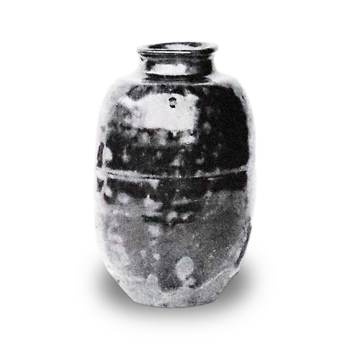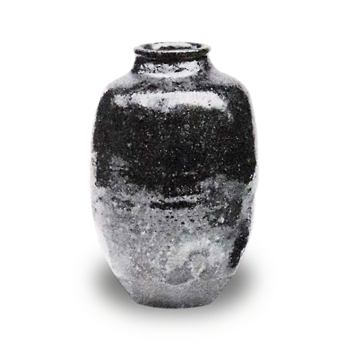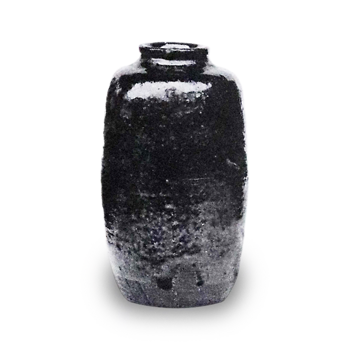
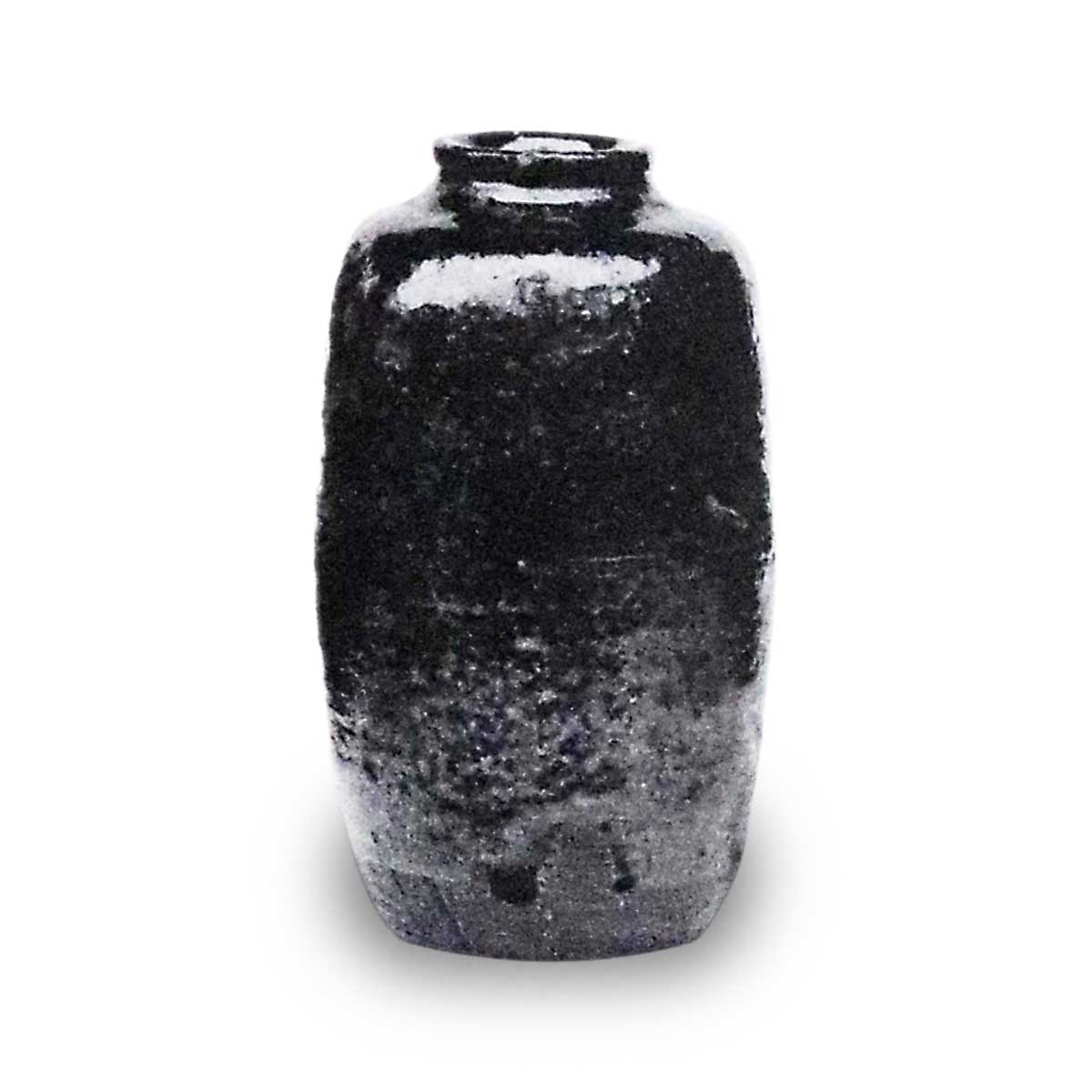
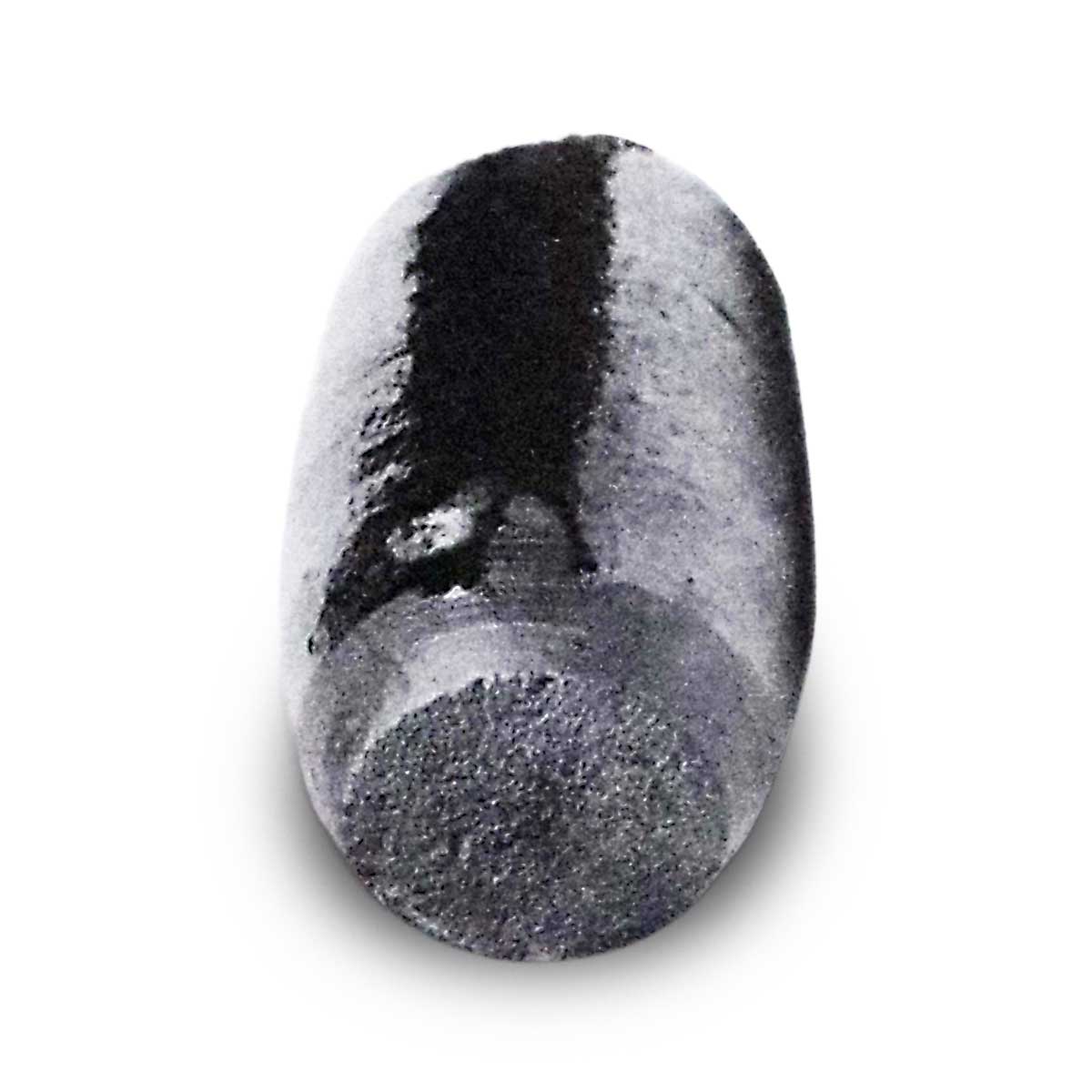
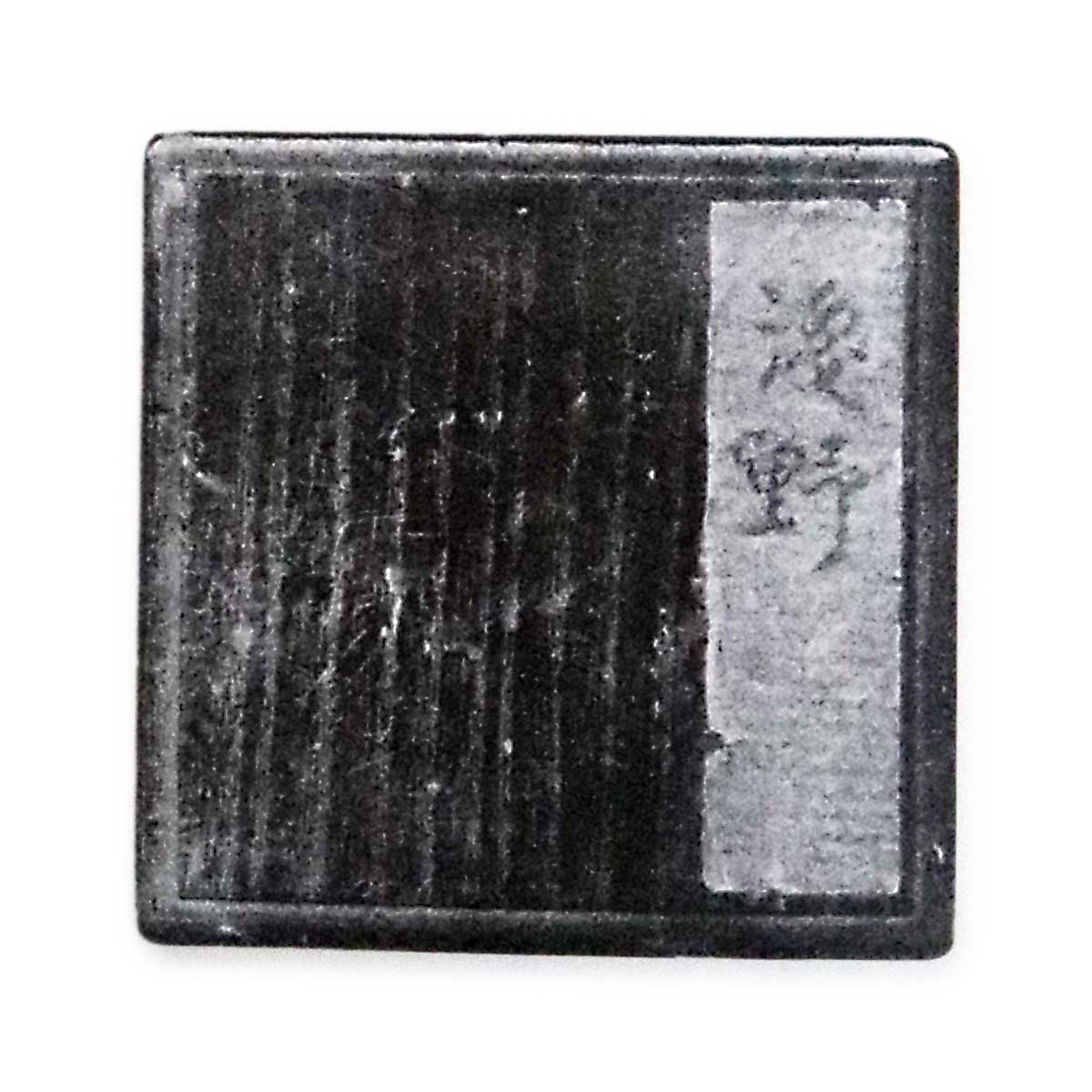
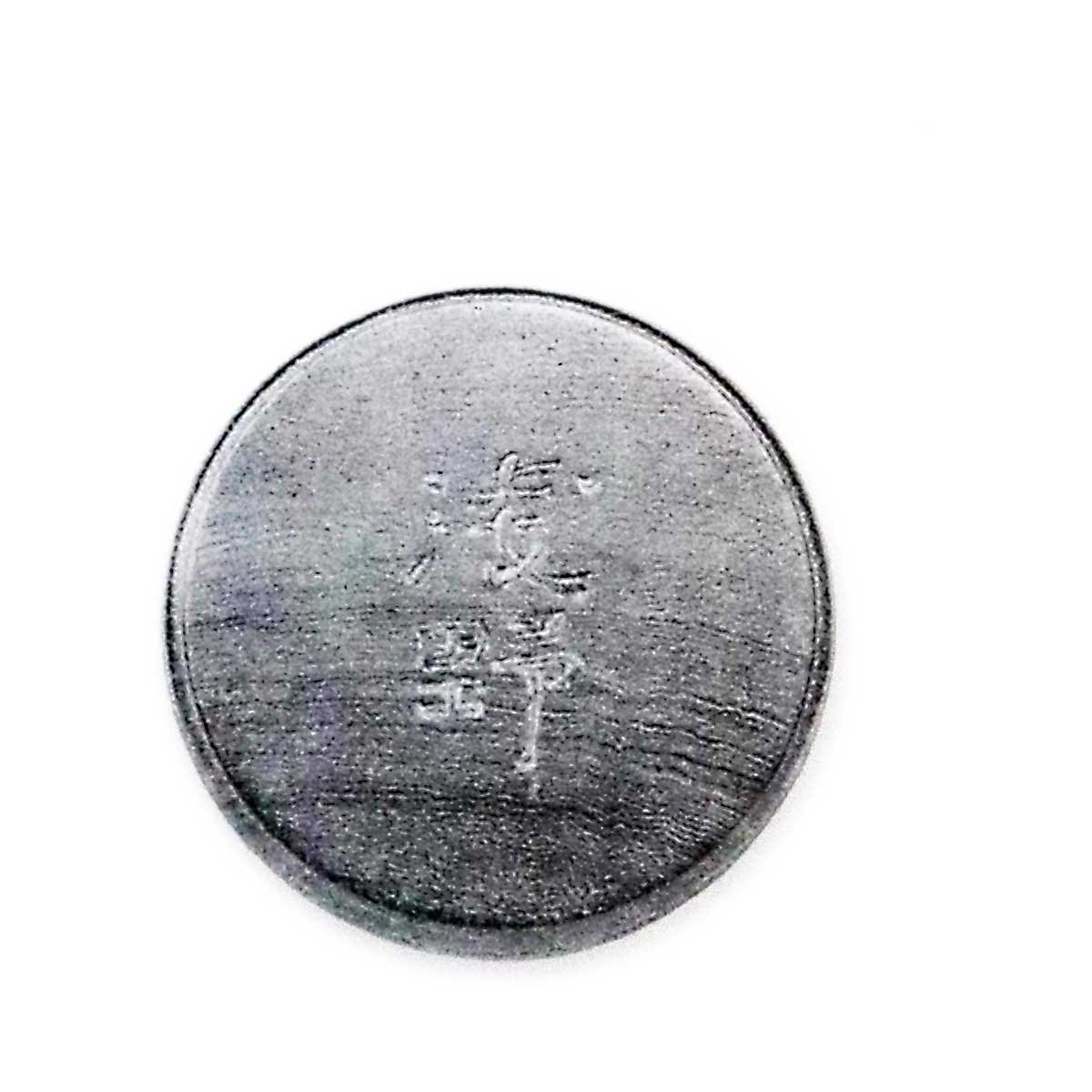
Old Seto, Revival-Period Meibutsu; Collection of Count Atsushi Matsuura
[Origin of the Name]
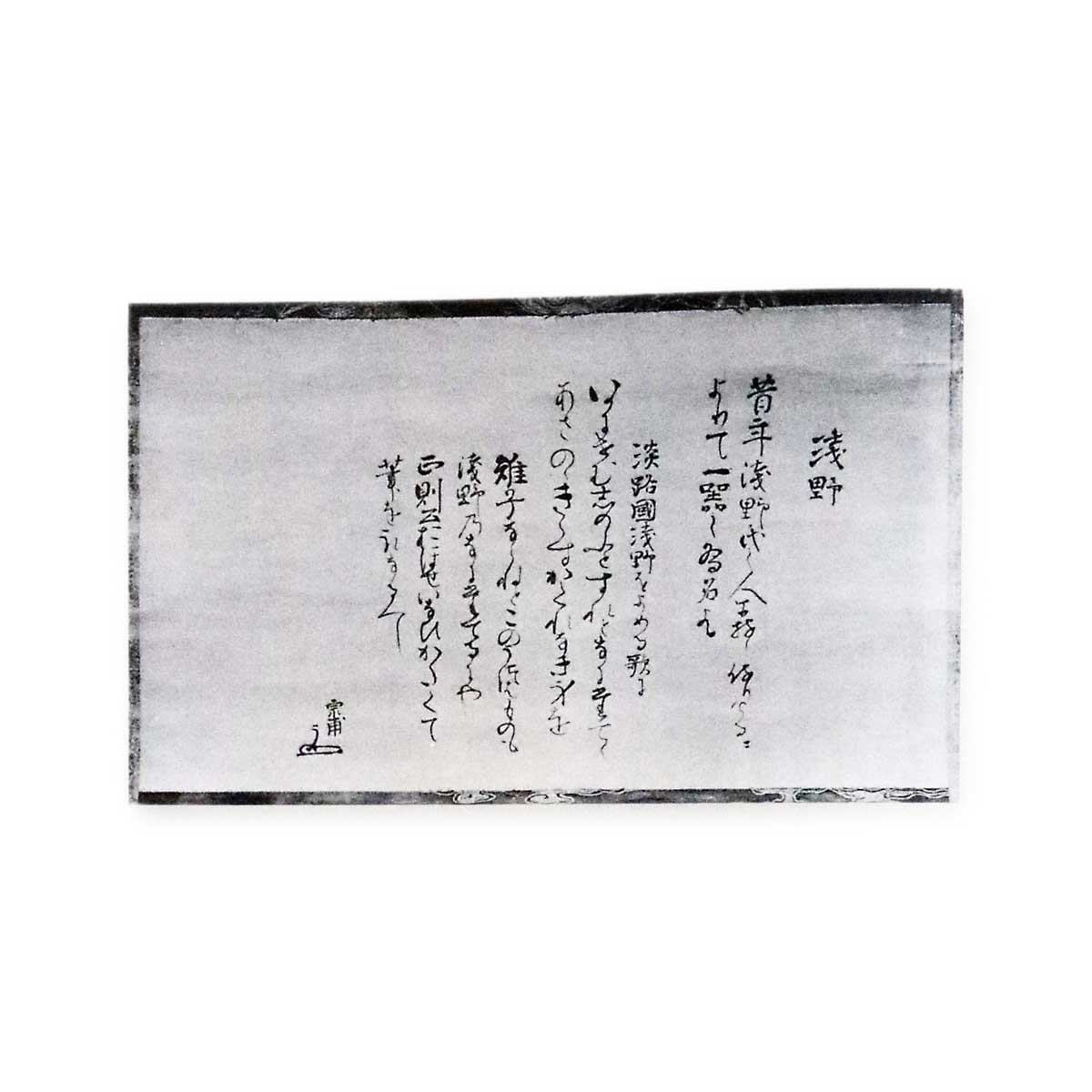
According to the accompanying calligraphic note by Kobori Enshū on the hanging scroll, this tea caddy (Katatsuki) derives its name from the fact that it was once owned by the Asano clan.
This was written by Enshū at the request of Lord Inaba Masanori, and the waka poem quoted therein—“What am I to do? To remember you, I set your name before me: the Asano pheasant —a form that cannot be concealed”—is a waka poem composed by Nijō Yoshimoto (formerly Senior Minister of the Right, later a Buddhist monk) and included in the “Shin’yō Wakashū” (New Leaf Collection of Waka), Section 2: Love.
[Dimensions (Converted to Centimeters)]
*Converted using the following values: 1 sun ≒ 3.03 cm, 1 bu ≒ 0.303 cm, 1 rin ≒ 0.0303 cm, 1 monme ≒ 3.75 g
・Height: 2 sun 9 bu 2 rin ≒ approx. 8.85 cm
・Body diameter: 1 sun 7 bu ≒ approx. 5.15 cm
・Mouth diameter: 7 bu ≒ approx. 2.12 cm
・Base diameter: 1 sun 1 bu 5 rin ≒ approx. 3.48 cm
・Neck height: 1 bu 7 rin ≒ approx. 0.52 cm
・Shoulder width: 2 bu ≒ approx. 0.61 cm
・Weight: 31 monme 9 bu ≒ approx. 119.6 g
[Accessories]
Lids: 3 pieces
・1 piece: Muka (plain: no engraving or decoration on the underside)
・1 piece: Sōho-gonomi-ka (in the style of Kobori Enshū)
・1 piece: Sansai Toriawase Muka (a matching lid associated with Hosokawa Sansai)
Storage Pouch: 1
・Shiro-habutae (white double-layered silk), cord color: white
Cover Bags: 4
- Stone-paved pattern with gold-inlaid waves and rabbit motif
Lining: Birch-colored (a reddish-brown), Usugai-iki
Cord color: Light purple
- Five-Color Stripe with Gold-Inlaid Railing and Diamond Pattern (Goshoku-suji Kinran Hishimon)
Lining: Tamamushi
Cord color: Purple - Oridome Kantō
Lining: Light Purple
Cord: Iridescent
- Hariya-giri
Lining: Iridescent
Cord: Purple
Pouch Box: Paulownia, natural wood
・Inscribed: “Asano pouch; contains two lids”
Hikiya (wooden container): Tagayasan wood
・Sunken carving with verdigris inlay
・Stamped with “Asano”
・Pouch: Magai weave; Lining: Suji-jusu; Cord fastening: Brown
Inner box: Paulownia wood, Shunkei lacquer finish
・Stick-on label with inscription (“Asano”)
Outer box: Paulownia wood, natural finish
・Attached label (inscribed with “Asano”)
Hanging Scrolls: 3 pieces (painted by Kobori Sōfu)
・Mounting: Top and bottom panels feature light yellow Donshu fabric with a variety of small komon patterns in an alternating fan-shaped design; the central panel features pale persimmon-colored Donshu fabric with a plum-patterned arabesque design; the windband features black fabric with a gathered gold-and-silver lotus crest; the scroll ends are made of ivory
・The text on the colored paper is as follows:
Asano
In years past, a member of the Asano clan once possessed this item, and because of it, he became renowned as a “Meikai”
In a poem composed about Asano in Awaji Province
“What am I to do? Though I wish to remain hidden, my name stands out—like the Asano pheasant, my true self cannot be concealed”
Though I am no pheasant, just as in this poem, I have made a name for myself in Asano
I took up my brush wishing to submit a correction to Lord Masanori
“Sōho (seal)”
Miscellaneous Notes
From Kokin Meibutsu Ruiju
Owned by Inaba Tango-no-kami Asano. Height: 2 sun 9 bu 1 rin (approx. 8.82 cm); mouth diameter: 8 bu 1 rin (approx. 2.45 cm); body diameter: 1 sun 7 bu (approx. 5.15 cm); base diameter: 1 sun 1 bu 9 rin (approx. 3.61 cm).
There are three lids (one “Sansai-style” matching lid, one “Sōfu-style” nest-shaped lid, and one lid bearing an inscription said to have been included from the time of its creation).
There are four pouches: one with a five-color striped gold-inlaid diamond pattern (lining: iridescent sea mist; cord: purple); one in the “Hariya-giri” style (lining: kai-ki); one in the “Oritome-kanto” style (lining: iridescent wall-pattern); and one with a rabbit motif on a gold-inlaid wave pattern over a cobblestone background (lining: kabashiro kai-ki).
The frame was crafted by Hikiya (“Asano” is engraved on it); the bag is made of magai-ori (lining: striped satin; cord: brown).
The upper case (box) is finished in Kiriharu-kei lacquer. The hanging scroll’s mounting features a black-ground, stitched-together gold lotus motif on an Ichimonji-style belt; the central border features a pale persimmon-colored Donshu silk plum blossom and arabesque pattern; the upper and lower sections feature a pale yellow pure silk fan-and-circle pattern in contrasting colors; and the scroll ends are made of ivory. (The description of the hanging scroll is as stated in the aforementioned accessories)
From Meibutsu-ki
Asano: Old Seto, Revival-Period Masterpiece—Asano Tango-no-kami (includes details on dimensions and accessories).
From Seto Pottery Guide by Fumai-ko
Asano Katatsuki: An example of Old Seto. It is from the same period as the Kamiya Katatsuki, Izumo Katatsuki, and Setsuki Daikai.
From Illustrated Record of Meibutsu Tea Utensils by Fushimiya
Asano Katatsuki—owned by Lord Inaba Tango-no-kami. The base color is persimmon-brown with a hint of gold (due to iron content), and the “shakōhan” (speckles resembling quail feathers) are arranged in a flowing pattern.
A thin amber glaze covers the shoulder, with a slight reddish tint. The clay has a sandy texture, and the base is formed by pressing a slab, with scattered grains of sand visible. (Dimensions, accessories, and an illustration of the tea caddy are included.)
From Tsurezure no Tomo by Matsuyama Seika
Asano: Old Seto. The persimmon-colored glaze displays a mottled pattern of golden flecks. It is listed among the entries in the April Meiji 26 (1893) Art Association Exhibition (owned by the Marquess Inaba; includes accessories and an illustration of the tea caddy).
History
Originally owned by a certain Asano, it was passed down to Inaba Masanori, lord of Yodo Castle, and became a treasured heirloom of the Inaba family for generations.
Subsequently, this tea caddy entered the possession of the Count Matsuura family around Meiji 35 (1902). Since Masanawa Inaba, then a Viscount, was the younger brother of Count Atsushi Matsuura (the second son of Kokoro Satuki), he entrusted this tea caddy to his family home (the Matsuura family) when he temporarily needed a substantial sum of money. It is said that the tea caddy remained with the Matsuura family and became part of their collection.
Field Notes (Record of Observation of the Actual Object)
On November 26, Taisho 8 (1919), I observed and appraised the actual object at the residence of Count Atsushi Matsuura in Mukoyanagihara-cho, Asakusa Ward, Tokyo City.
It has an elongated shape, with a tight rim and a low neck. The shoulders are rounded, and a rich black amber glaze is applied in a ring-like pattern. The lower portion reveals an earth-colored clay rich in iron, and the base is a “board-cut” base (cut from a slab rather than a thread-cut base), with grainy, pitted traces of sand still visible.
From the inner rim to the lower part of the body, wheel marks run around the vessel. Overall, this tea caddy gives a calm and understated impression, with no prominent decorative motifs. Above the body’s ridges is a diagonal spatula mark (a mark left by a spatula) approximately 3 bu (about 9 mm) long, and three small diagonal spatula marks are carved into the exposed clay at the base.
Although the glaze’s rich color may make it appear unassuming at first glance, this is a renowned tea caddy that exudes a sense of calm and is rich in quiet wabi (a sense of simplicity and austerity).