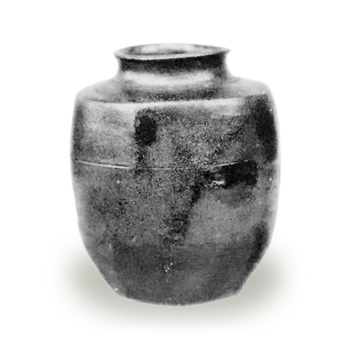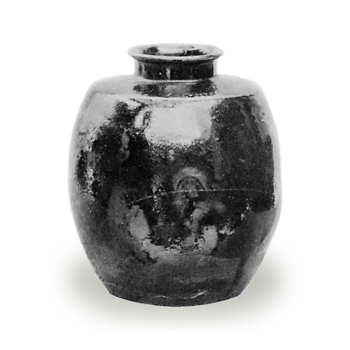
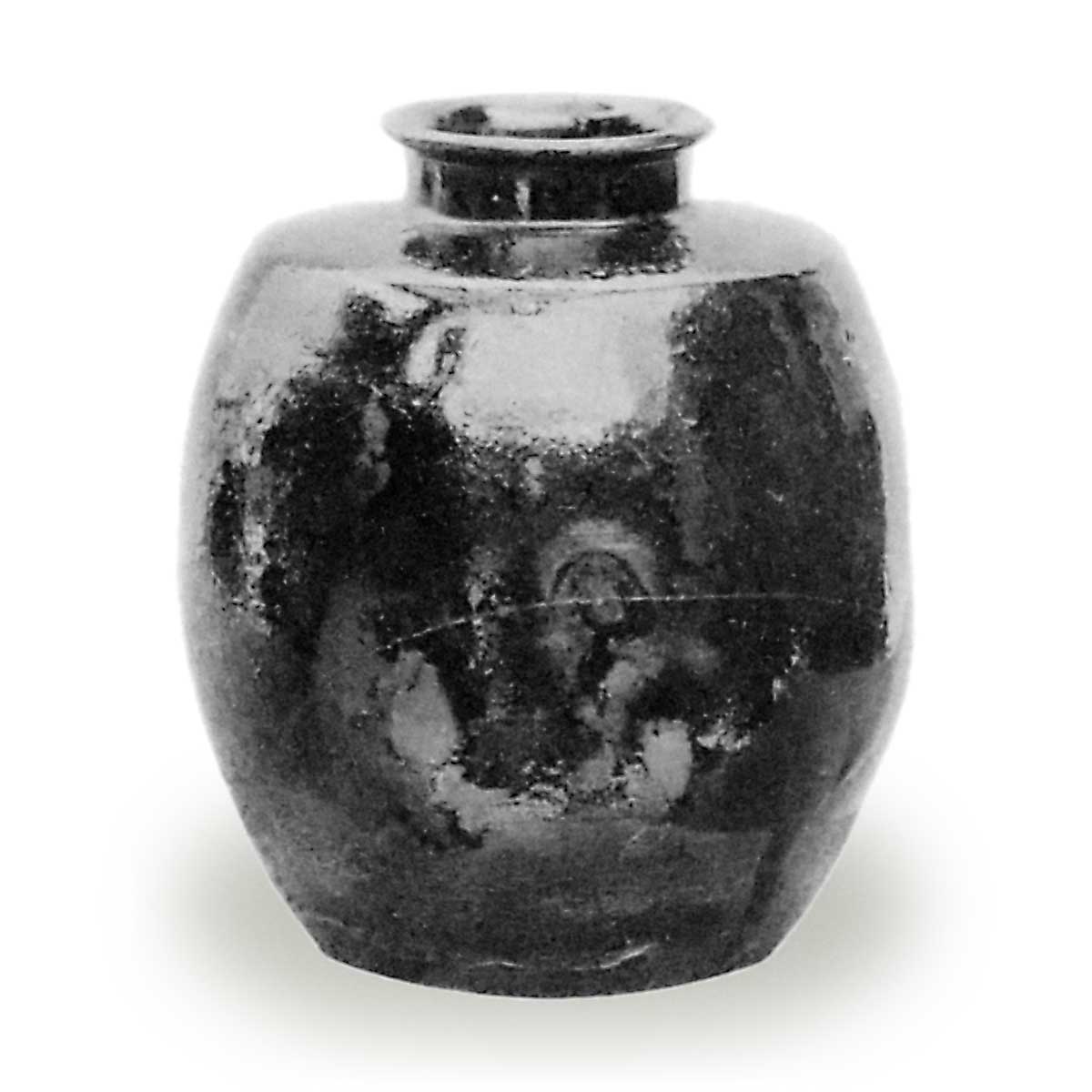
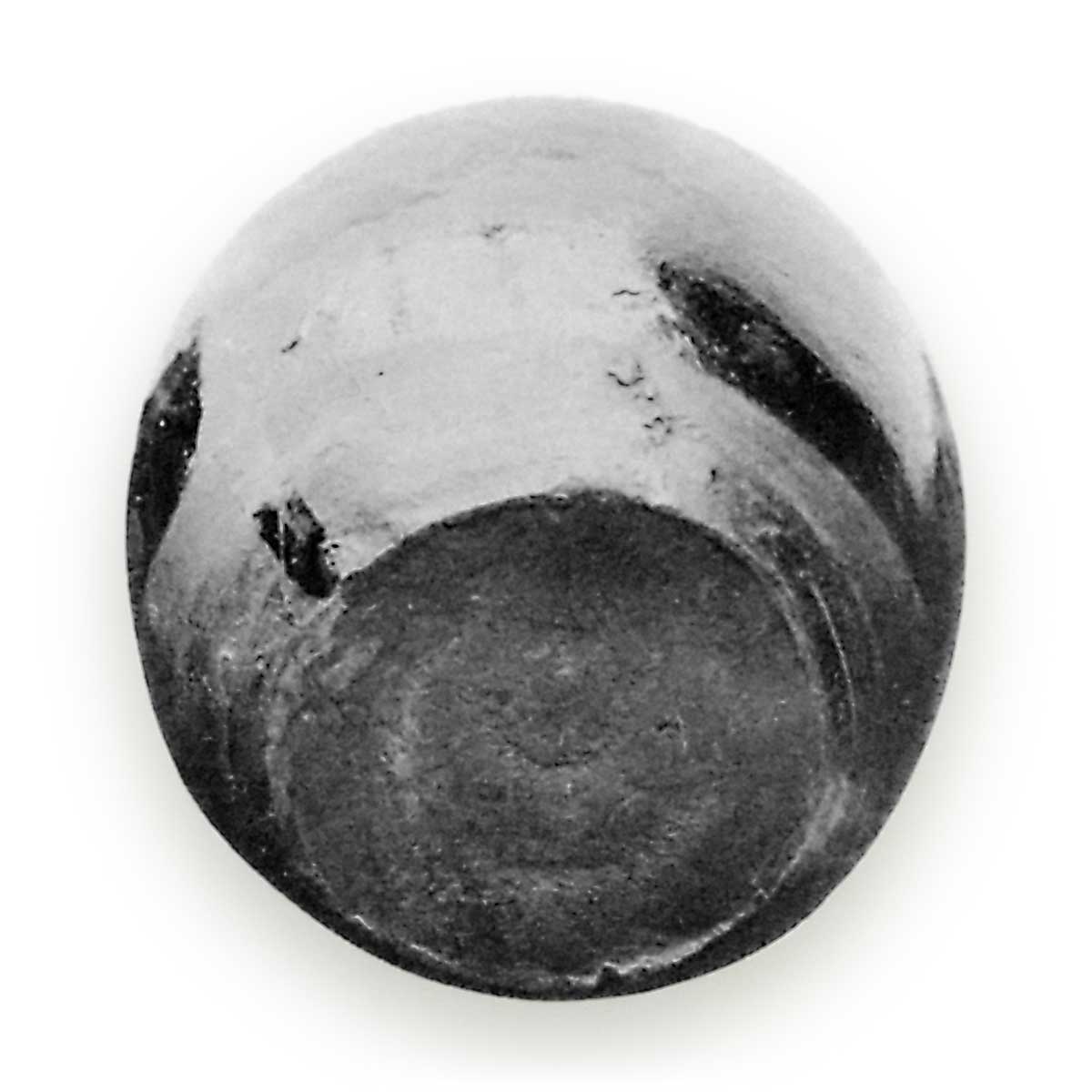
Made in China (Tang ware) | Daimeibutsu | Collection of Count Matsudaira Naoaki
[Origin of the Name]
The entry in the Higashiyama Gomono Naibetsu-cho that reads “Igi Seibei’s tea caddy” likely refers to this very piece. According to the Jijibun-hen, Seibei was originally from Owari Province (present-day western Aichi Prefecture); his original surname was Kagawa, and his given name was Tadashi. He changed his surname to Igi after distinguishing himself in battle at Mt. Igi in Mino Province (Gifu Prefecture). He served Ikeda Nobuteru (Tsuneoki) and greatly enhanced his reputation as a warrior by defeating the enemy in battles at Hanaguma Castle in Harima Province (Hyogo Prefecture), Yamazaki in Yamashiro Province (Kyoto Prefecture), and Inuyama in Owari Province. When Nobuteru’s son, Terumasa, came to rule Harima Province, he was awarded the rank of Junior Fifth Rank, Lower Grade, appointed Governor of Bungo Province, and became the lord of Miki Castle in that province, holding a fief of 37,000 koku.
On the other hand, the Unshu Hōbutsu Denrai-sho states, “The Iki Katatsuki was bestowed upon Iki Shichirōemon by Toyotomi Hideyoshi.” Whether this Shichirōemon and the aforementioned Seibei are the same person or different individuals cannot be ascertained with certainty today.
[Dimensions]
Height: approx. 9.3 cm (3 sun 8 rin)
Body diameter: approx. 7.7 cm (2 sun 5 bu 5 rin)
Mouth diameter: approx. 3.5 cm (1 sun 1 bu 5 rin)
Base diameter: approx. 4.7 cm (1 sun 5 bu 5 rin)
Shoulder width: approx. 1.5 cm (5 bu)
【Accessories】
・Ivory lid: 1
・Box for lid: Unfinished paulownia wood box, with an inscription by Matsudaira Fumai
“Iki Katatsuki Lid”
・Tea caddy bag (bag for holding the tea caddy): Brown chirimen silk, with a knot in the Enshu brown
・Covers (bags): 2
- Shōō satin (lining is light green kaiki, cord is purple)
- Amaryu-mon damask (lining: brown-blue kaiki silk, cord: purple)
・Bag box: Unfinished paulownia wood box, with an inscription by Matsudaira Fumai
“Iki Katatsuki Bag”
・Hikiya (wooden container to protect the tea caddy): Black lacquered, medium-sized (cylindrical)
Bag for the Hikiya: Leather (gray interior, brown exterior; cord is indigo velvet)
・Inner box: Unfinished paulownia wood box
・Outer box: Paulownia box with Shunkei lacquer finish. Features an inscription in black lacquer; interior lined with black-dyed paper; includes a lock.
Front of lid: “Iki Katatsuki”
Body of box: “Iki Katatsuki” (with a circle and dot symbol)
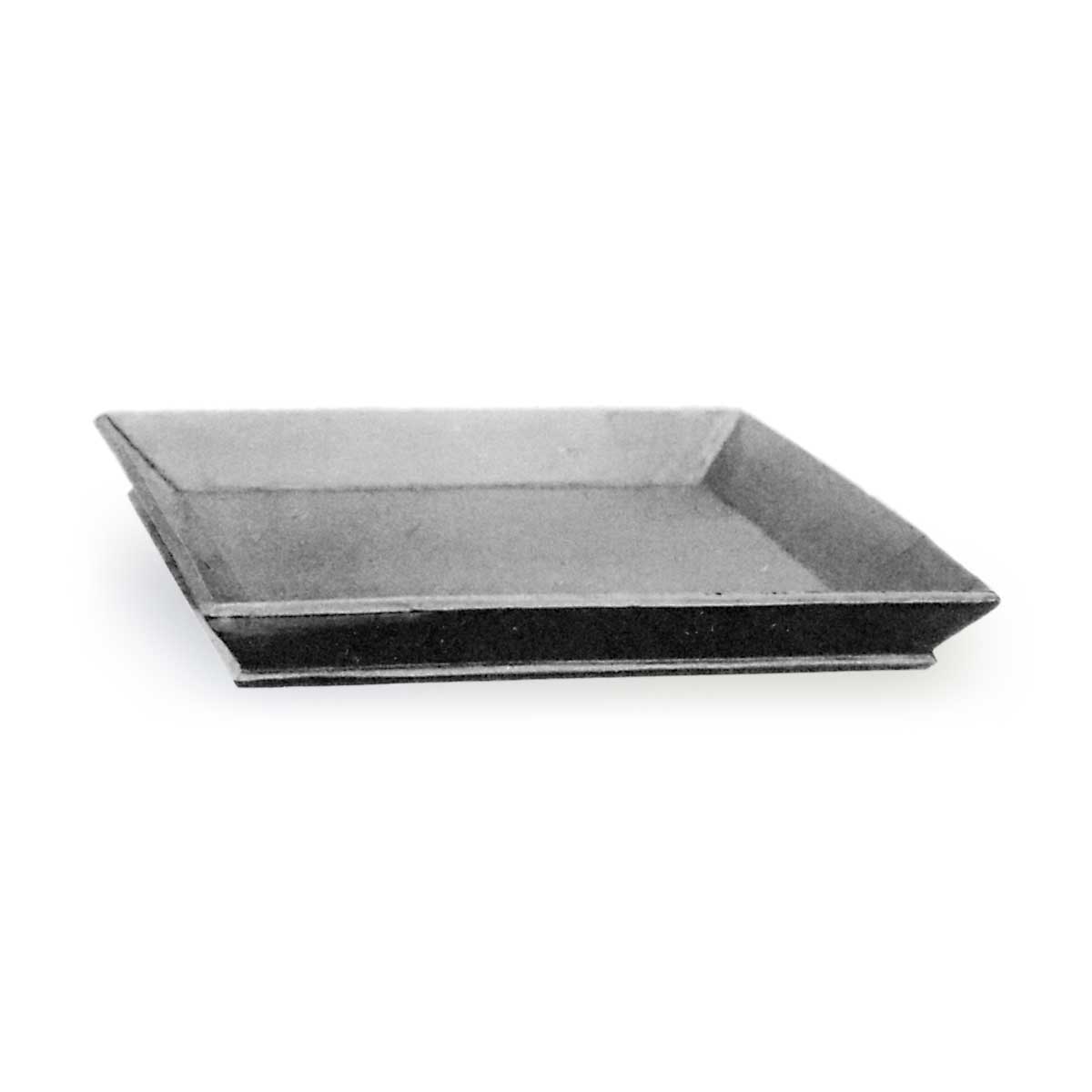
・ Accompanying tray: Tray with a red-lacquered interior
The tray measures approximately 19.7 cm square (6 sun 5 bu); the inner surface (mirror) measures approximately 14.8 cm square (4 sun 9 bu). The wrapping is white ha-ni-bu-e double-layered silk.
Tray box: Unfinished paulownia wood box, with an inscription by Matsudaira Fumai
“Tray with Red Interior”
The wrapping is sarasa, and the lining is Onado brown ha-ni-bu-e.
[Miscellaneous Notes]
“Higashiyama Imperial Treasures Sub-Register”: A tea caddy belonging to Iki Seibei. Its whereabouts are unknown.
“Unshu Treasure Transmission Records”: Iki Katatsuki (shoulder-rest). Chinese-made. Bestowed upon Iki Shichirōemon by Lord Toyotomi Hideyoshi.
Later, Lord Katsuragawa Shūho acted as an intermediary and purchased it. I have heard that the price was 300 ryō, but it is said that this item has traditionally been valued at around 3,000 ryō.
“Osaki-sama’s Record of Tools and Expenses”: Iki katatsuki. 165 ryō. Since Master Tsukike—also known as Katsuragawa Shūho—lived in Tsukiji, he was called Master Tsukike.
“The Origins of Seto Pottery” by Matsudaira Fumai: Iki Katatsuki. A Chinese piece. It was made during the same period as the Aoki Katatsuki, and both the maker and the glazing technique are the same. However, when compared to the Nitta Katatsuki, Setaka Katatsuki, and Fudo Katatsuki, although the glazing technique is contemporary, it is inferior in terms of historical age (prestige).
“Hōan Bunko, Series A, No. 9”: Iki Katatsuki. The overall base has a blackish hue with glaze drips, and the glaze is a blackish amber color. The base shows traces of being cut from a slab, forming a swirl-like pattern. The clay has a reddish tint; it is a smooth clay with visible wheel marks. Eaves-like shoulder (a shoulder that extends horizontally like a roof overhang).
“Rin-Hō-Ki-Ryū”: Iki. Chinese-style. Daimeibutsu. Owned by the Lord of Unshū (Matsudaira Fumai). The amber-colored glaze features “tomo-nadare” (two parallel glaze drips). It was made using the board-removal technique, and the clay is a blackish gray. It has a large crack.
[Provenance]
Originally owned by Toyotomi Hideyoshi, who bestowed it upon Iki Shichirōemon (some sources list him as Saibei). The subsequent history of its transmission is unclear, but it is said that Matsudaira Fumai acquired it through the mediation of Katsuragawa Shūho, a physician to the shogunate, for a price of 300 ryō. Shūho was a renowned Western-style physician who, as a hobbyist of antique art, was on friendly terms with Lord Fumai; he is also said to have served as a personal physician to Lord Hiratō (an ancestor of Matsudaira Naoaki).
【Record of Actual Viewing】
On May 27, 1918 (Taisho 7), I viewed the actual item at the office of the House of Count Matsudaira Naoaki in Matsue City.
The rim has a deep fold, and compared to other tea caddies of the same class, the diameter of the mouth is narrowed by about three or four bu (approximately 1 cm); the absence of sunken lines (sinking veins) around the body is a major characteristic of this tea caddy. Within the dark amber glaze, there are areas where the persimmon-colored glaze has worn away (revealing the unglazed clay), creating a truly magnificent luster. From the rim downward, the iron-red (reddish-black) clay body is exposed, and the base is made with a flat-bottomed construction (cut from a slab).
There are traces of repair (mending) around the shoulder and rim, and there is a large crack running from the center of the body to the base. At its widest point, the crack measures just over 2 sun 2 bu (approximately 6.7 cm). Although this piece has significant flaws, the tapered rim lends it a very refined elegance; among Chinese tea caddies, it can be said to possess a uniquely distinctive shape.