
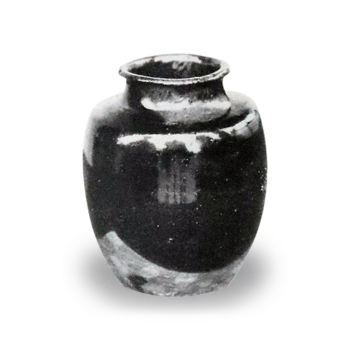

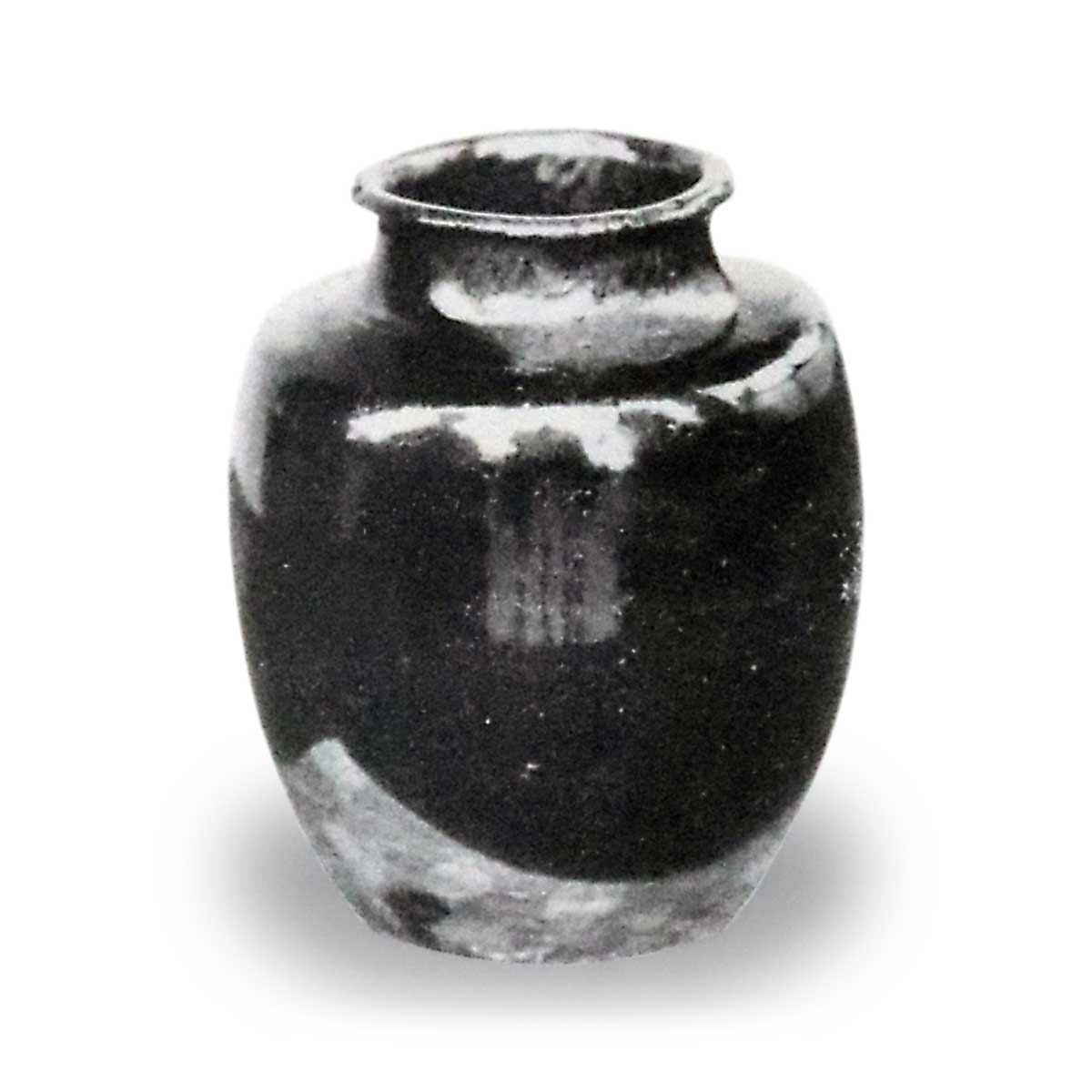

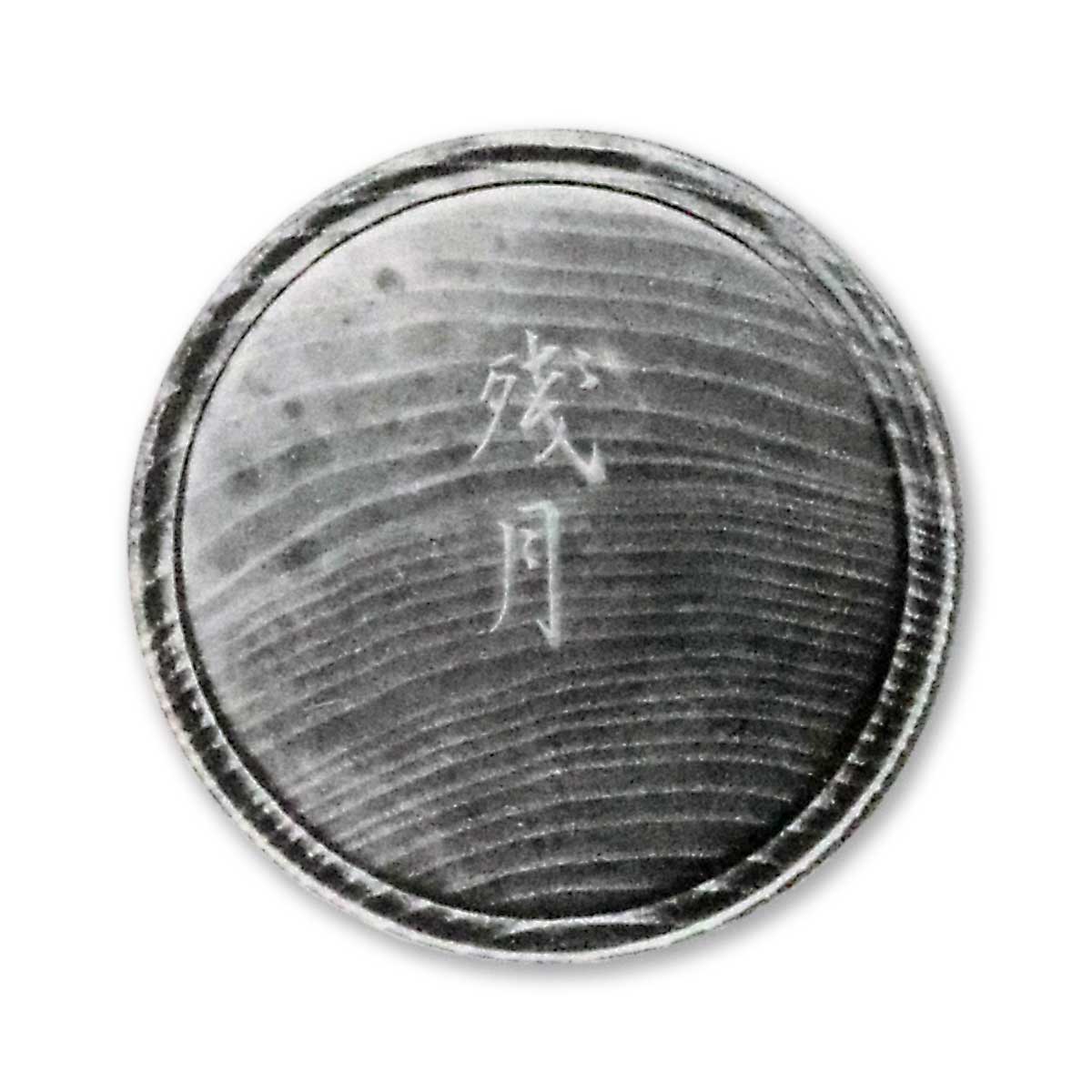

A renowned tea caddy made in China (Han-style), currently in the collection of Baron Naoaki Matsudaira.
Origin of the Name
It is believed that this name was given because the shoulder of the tea caddy features a faint white pattern resembling the “remnant of the moon” (the trace left by the moon in the sky). Kanamori Tokusui’s Kokon Chawa states, “Fortunately, there was a mark in the glaze that resembled the shape of a remaining moon, so it was named ‘Zangetsu’ and made into a tea caddy.” Additionally, a red-ink annotation in the Mikian Bunko edition of Ganka Meibutsu Ki under the entry for Zangetsu notes, “There is a fingerprint on the shoulder, and it resembles a moon.”
The same red-ink annotation also includes a theory that “it was named ‘Zangetsu’ because it is situated above the name of the famous ‘Unzan’,” but this is likely a later, forced interpretation.
Modern Conversions of Dimensions and Weight
Height: Approx. 8.2 cm (2 sun 7 bu 2 rin)
Body Diameter: Approx. 6.7 cm (2 sun 2 bu 3 rin)
Mouth Diameter: Approx. 4.1 cm (1 sun 3 bu 7 rin)
Base Diameter: Approx. 3.9 cm (1 sun 2 bu 8 rin)
Koshiki Height: Approx. 1.1 cm (3 bu 7 rin)
Shoulder width: Approx. 1.1 cm (3 bu 5 rin) – Approx. 1.2 cm (4 bu)
Weight: Approx. 91.1 g (24 monme 3 bu)
List of Accessories
There are two lids, and a nest (kago) is included. The unpainted paulownia wood box containing these items bears an inscription by Matsudaira Fumai reading “Zangetsu no Futa” (Lid of the Remaining Moon).
The storage pouch is made of purple habutae silk with a light green cord.
There are four types of protective covers (pouches).
・Shijira Kantō: The inscription on the box reads “Hino Kantō.”
・Kikkō Junko
・Unzan-giri
・Cha-kogashi Kantō
These are stored two of each in two unpainted paulownia boxes. One box is labeled “Zangetsu, two pouches, Kikkō Junko, Hino Kantō,” while the other box bears Matsudaira Fumai’s inscription reading “Zangetsu, pouch.” Each box is accompanied by a purple crepe wrapping cloth.
The case is made of mulberry wood and bears an inscription in gold powder. The pouch containing the case is made of brocade.
The inner box is made of paulownia wood with a lacquer finish and features an iron lock; the bag that wraps it is made of iris-patterned leather. The outermost layer consists of a plain paulownia wood box.
The outermost outer box is made of plain paulownia wood and features a blackened iron lock. The lid and corners of the box are adorned with red copper fittings, and there are carrying handles on both sides.
There is a wooden mold for a tea caddy made of karin (a type of wood), with the dimensions (height: 2 sun 7 bu 2 rin; circumference: 7 sun 2 rin; mouth width: 1 sun 3 bu 7 rin; base diameter: 1 sun 2 bu 8 rin) written in gold powder on the body. This wooden mold is housed in a plain paulownia wood box and wrapped in white ha-ni-ji fabric.
As an accompanying tray, there is a black square tray made by Hatada Gorō. Details such as the dimensions—with each side measuring approximately 19 cm (6 sun 4 bu)—are recorded; it is housed in a pale yellow habutae bag and stored in a tsumori-nuri lacquered box.
There is a single document regarding this accompanying tray, which states: “During the reign of Emperor Go-Hanazono, a master lacquer artisan named Hatada Gorō, who lived near the gate of Myōkaku-ji Temple in Kyoto, created this tray of his own design during the era of Lord Ashikaga Yoshimasa. Because it so perfectly suited the tastes of the time, people came to call it the ‘Hatada Tray.’”
Records of the “Zangetsu Katatsuki” in Various Tea Ceremony Records and Tea Books
・Sōtan Nikki: On the morning of November 21, Tenshō 20 (1592), Kamiya Sōtan and Kyūmu were invited to a tea ceremony hosted by Oda Yurakusai (Yuraku-rō) in Hizen Nagoya (present-day Karatsu City, Saga Prefecture; a base for the Korean Campaign). In the four-mat tea room, this katatsuki tea caddy was displayed on a hanging shelf without being placed in a bag. Sōtan observed and recorded: “The Zangetsu Katatsuki has a black glaze, a single line on the rim, and no band around the body. The clay is dark, and there are no glaze runs.” (This indicates that this renowned tea caddy was brought even to the battlefield.)
・“Yamagami Sōji Ki” and “Chaki Meibutsu Shū”: These state, “The Zangetsu Katatsuki was in the possession of Lord Hashiba Saemon-no-suke of Echizen (Tomita Nagashige, or perhaps another military commander).”
・Komeibuki: “Zangetsu was owned by Kyogoku Tango-no-kami (whose Buddhist name was Anchi-ō).”
・Ganka Meibuki: “It was once owned by Echizen’s Hashiba Saemon, and is now in the possession of this family (the Matsudaira family). It is said to have been named because it is considered superior to the Unzan Katatsuki. There is a finger mark on the shoulder, which resembles the moon.”
・Kokin Meibutsu Ruiju: A famous Tang-style katatsuki. Owned by Kyogoku Tango-no-kami.
・Rinpō Kiryū: A famous Chinese-made piece. Passed from Kyogoku Tango-no-kami to the Lord of Unshū (Matsudaira Fumai). Details such as its dimensions, the pattern on the bag (including a tea-checkered kantō), and the inclusion of a Haneda basin are recorded in detail. It describes the characteristics of the tea caddy as follows: “On a deep persimmon-colored ground, there is a yellow and white, worn-looking cascade; the base glaze is a translucent dark amber color. There is a band below the body, resembling the ‘Unzan Katatsuki’ style. It is made of grayish-brown clay with a hand-cut finish. The interior is glazed.”
・Sekkanso Chadō Wakuge: “It is currently in the possession of Matsudaira Etchū-no-kami (of the Hosokawa family), but in the past it was owned by Kyōgoku Yasutomo. I had the opportunity to view the piece brought by Tozawa Sakon on June 25 of the Year of the Snake.”
Comparison and Anecdotes Regarding “Zangetsu” and “Unzan”
・Chadō Denshinroku: Regarding the Chinese-style katatsuki tea caddies “Unzan” and “Zangetsu.” It is said, “One cloud, two mountains” (meaning one is Unzan, the other is Zangetsu, or perhaps that both are supreme), but it has been passed down that Unzan is of superior craftsmanship. Since the tea caddy Unzan is described in detail in the book Tōdabukuro, I will omit it here.
・Matsumoto Kenkyu Manpōshū: Zangetsu was owned by Matsudaira Etchū-no-kami (of the Hosokawa family). There is a waka poem composed by Shikibu Ōkuradono regarding this tea caddy: “Who, in the future, will gaze upon this moon? For me, it is painful to part with this tea caddy, like the moon lingering on the edge of a mountain.”
・Kankyū Gohitsu: The Zangetsu was treated as a priceless masterpiece not for sale in Kyoto, but it is now in Osaka. It was originally owned by Matsudaira Etchū-no-kami (of the Hosokawa family).
・*Fumai’s *Seto Tōki Ranshō***: The *Zangetsu* is of Chinese origin (Han-made). It was made during the same period as the Kokushi Nasu, Kitano Katatsuki, Matsuyama Katatsuki, and Kuga Katatsuki; specifically, it was crafted by the same potter and in the same kiln as the “Kokushi Nasu.”
・‘Bian Bunko’: Glaze has pooled over the entire surface, and the front (display side) appears to have a yellow glaze with a snake-and-scorpion (scaly kiln-change) pattern. There is a slightly rounded, reddish-purple area on the shoulder. The thread-cutting marks on the bottom are somewhat rough, and there is a scuff mark in the center of the base. On the reverse side of the front, there is a faint V-shaped pattern resembling snake scales. The rim is rounded, and the shoulder is also rounded. The clay is purple with a reddish tint, and the unglazed portion is raised. There is a slight, faint crack on the reverse side.
From an “ash tray” to a treasure worth 10,000 ryō?
“Zatswa Nikki” by Kanda Hakuryūshi and “Kokon Chawa” record a very interesting and somewhat ironic legend regarding this “Zangetsu Katatsuki.”
“It is said that the famous Luzon teapot was originally a Filipino urn for bones, but it is surprising to learn that the ‘Zangetsu’ tea caddy in the Sakakibara family was, in fact, once an ashtray for a tobacco tray. This trend of loving only such strange, old vessels and pouring vast amounts of gold and silver into them seems to have begun in the time of Sen no Rikyū.
The Sakakibara family possessed a famous tea caddy known as “Zangetsu.” This was originally an ash tray from a tobacco tray passed down in the family, but a certain tea master saw it and remarked, “What an interesting shape.” Fortunately, the glaze pattern resembled a crescent moon, so they named it “Zangetsu” and turned it into a tea caddy. Even though no one had specifically promoted it, it became hugely popular as the “Sakakibara Zangetsu Tea Caddy.”
Around that time, Kyogoku Yasutomo (Takahiro) was deeply passionate about the tea ceremony. Upon hearing rumors of this “Zangetsu,” he pleaded and bargained extensively until he finally purchased it for the staggering sum of “10,000 ryō of gold.” People at the time whispered to one another, “There are clever people who can turn an ashtray into a tea caddy worth 10,000 ryō, and there are fools who spend a fortune on such a thing. Human dispositions truly vary from person to person.“
After the Kyogoku Anchi line died out, it is said that this tea caddy came into the possession of a retainer of Matsudaira Rikushu (of the Date clan).”
(This anecdote symbolizes how the value of famous tea utensils was created by human ‘perception’ and “public interest,” and how vast sums of money were involved.)
The Confusion Between “Zangetsu Katatsuki” and “Unzan Katatsuki”
(Note: The “tea caddy that Kyogoku Yasutomo bought from the Sakakibara family” mentioned in the previous page of Kokon Chawa actually refers, historically, to the “Unzan Katatsuki” (which was passed down to Matsudaira Oki-no-kami of the Matsuyama Domain). It appears that the author of Kokin Chawa has confused the episodes regarding the two famous tea caddies, “Zangetsu” and “Unzan.”)
Sakakibara Tadamasa, Who Gained Fame by Selling a Famous Tea Caddy (A Record in Classical Chinese from Jijibunhen)
This is a record concerning Himeji Lord Sakakibara Tadamasa (by Saito Chikudo).
“Sakakibara Shikibu-no-suke Tadamasa, facing severe financial distress in the domain, put the family’s treasured artifacts up for sale. Among them was a tea caddy renowned throughout the land. Kyogoku Takahiro (of Tanshu) sought to purchase it for ten thousand gold pieces. Tadamasa ‘I have already cast aside a samurai’s sense of shame. I beg you to pay the entire ten thousand gold pieces in copper coins,’ he requested. Takahiro gathered copper coins from the markets of the capital (Kyoto or Edo), loaded them onto dozens of carts, and sent them to the Sakakibara residence. Tadamasa distributed all the copper coins he received to his impoverished retainers, keeping not a single coin for himself. People praised this act, and the story was passed down: “Sakakibara Tadamasa sold a masterpiece and gained renown throughout the land.”
Transmission to the Unshu Matsudaira Family (Lord Fumai)
According to the Unshu Hōbutsu Densai-sho (Record of the Transmission of Unshu Treasures), this Zangetsu Katatsuki came into the possession of Lord Matsudaira Fumai through the following historical events.
“This Chinese Zangetsu was originally owned by Lord Tokugawa Ieyasu (Tōshōgū), and was subsequently bestowed upon Sakakibara Yasumasa. Later, Lord Kyōgoku Yasutomo acquired it by offering a reward of 10,000 ryō in gold, and subsequently, it was transferred to Matsudaira Etchū-no-kami (of the Hosokawa family). Later, it was pledged as collateral by the Hosokawa family to the wealthy Osaka merchant Izumiya (the Sumitomo family) in exchange for a large loan. Years later, around the Kansei era (around 1800), the Unshu Matsudaira family purchased it from Izumiya in Osaka. The purchase price was approximately 2,000 ryō.”
Lord Fumai’s Last Will and the Nine Absolute Treasures
The biography The Life of Matsudaira Fumai (of the Unshū Matsudaira family), a great collector of tea utensils, preserves a list of the “Treasures Section” (nine items that must never be parted with) established by Lord Fumai.
(3) Treasures Section
- Zangetsu (Chinese-made tea caddy)
- Tanemura Katatsuki (Chinese-made tea caddy)
- Hino Katatsuki (Chinese-made tea caddy)
- Lord Teika’s small colored paper scroll “Yo no Naka yo”
- Daiei’s calligraphy
- Yamashi Seiran (painting by Gyokuboku)
- To-ura Kihō (painting by Mokkei)
- Kyodo’s calligraphy
- Calligraphy by Mujun (commonly known as “Itadashi”)
In September of Bunka 8 (1811), Lord Fumai issued a strict order to his son, Dewa-no-kami, stating, “The nine items listed above are treasures of the realm. They must be cherished for all eternity.” Since “Zangetsu” is included among these, it is clear how highly Lord Fumai valued and cherished this tea caddy.
Summary of the History of Ownership
Originally a personal possession of Ashikaga Yoshimasa (Higashiyama-dono), records in Sōtan’s diary from the 20th year of Tenshō (1592) indicate that it was used at a tea gathering hosted by Oda Yūraku; therefore, it is believed that Yūraku owned it at that time. Subsequently, it passed to Tomita Nagashige of Echizen, then to Maeda Toshiie, who presented it to Tokugawa Ieyasu, who in turn gave it to Sakakibara Yasumasa.
During the reign of Yasumasa’s son, Tadamasa, the domain faced financial hardship. When they attempted to sell this tea caddy, Kyogoku Takahiro (Anchi) requested to purchase it for 10,000 gold pieces (1,000 ryō). Tadamasa reportedly demanded that the entire payment be made in copper coins; it is said that he distributed all the copper coins—which were delivered in dozens of carts—among his retainers.
It was subsequently passed down to Matsudaira Etchū-no-kami (believed to be of the lineage of Shirakawa Rakō and Matsudaira Sadanobu), but later became the property of Izumiya Rokurōemon, a wealthy merchant in Osaka (of the Sumitomo family), as collateral for an advance he made on behalf of the shogunate. Around the Kansei era, Lord Matsudaira Fumai of the Matsue Domain purchased it for 1,000 ryō of gold (or, according to some accounts, approximately 2,000 ryō), and upon ranking his own treasured collection, he placed this tea caddy at the very top of his “treasures.”
Academic Inspection Record (Appraisal Record) from the Taisho Era
On May 6, 1918 (Taisho 7), this tea caddy was physically examined at the residence of Count Matsudaira Naoaki in Yotsuya Motomachi, Tokyo.
The mouth is relatively wide, with a rim shaped like the edge of a clam shell, and the flared rim is somewhat deep. The shoulder is rounded and powerfully flared (tsuki), the body is slightly flared, and the form tapers slightly from the hem downward. There is a single sunken line (a horizontal indentation) near the waist.
As a Chinese “Han-style” shoulder-flared tea caddy, it is on the smaller side, and the base glaze is a beautiful amber color throughout. As for its visual appeal (the highlight when viewed from the front), a bluish-white “Jakat-yū” glaze (scaly kiln-change) extends from the rim of the mouth to the area around the ‘koshi’ (the protruding base), forming a shape resembling a “remnant moon” (zangetsu) left in the sky; this is why it was named “Zangetsu.”
On the opposite side of the body, where this “Remnant Moon” pattern is found, the Jakat-yū glaze similarly drifts in uneven patches, creating the so-called “Dawn Clouds and Remnant Moon” (Kyōun Zangetsu) scene—a view of such exquisite charm that it defies description.
The areas where the glaze stops at the hem have irregular variations in height, with places where the vermilion-colored clay (the body) is deeply indented. This appearance resembles the shape of a “curtain hem that has been lifted.” The area where the clay is most exposed reaches a height of one sun and two bu and five rin (approx. 3.8 cm) from the base (the footed part), but on the front (the standing surface), the exposed clay is only five bu (approx. 1.5 cm) high.
The rim of the base is partially chamfered, and there are small splashes of amber-colored glaze (glaze splatter). The thread-cutting marks are fine, and there is a round, flat area about 2 mm (approx. 6 mm) in diameter at the center of the base.
Inside, the glaze drips down to the shoulder line, and below that, a thin, watery glaze covers the entire interior. The wheel marks are sharp and crisp, and the center of the base forms a swirl pattern.
Overall, as a shoulder-striking tea caddy, it falls into the “sloping shoulder” category. Its form and shape are not overly imposing; rather, it possesses a plump roundness that lends it a sense of dignity. Both the quality of the glaze and its texture are deeply evocative, making this a tea caddy of great charm.

