
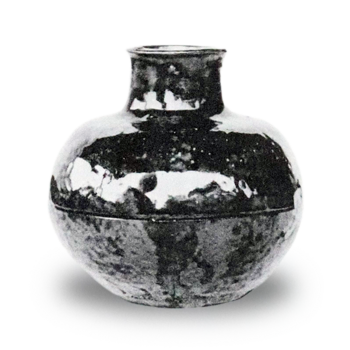
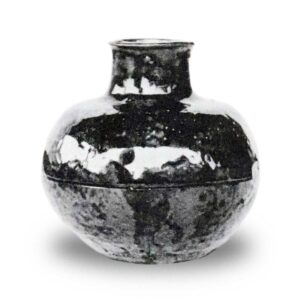
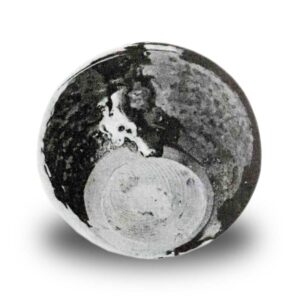
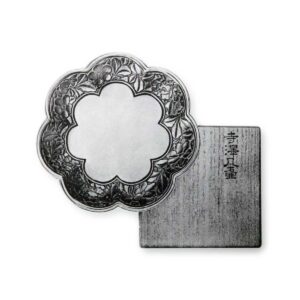
Chinese Ware, Daimeibutsu, Collection of Count Tadamichi Sakai
Name
This name derives from the fact that it was once owned by Terasawa Shima-no-kami Hirotaka. Terasawa Hirotaka was born in Owari Province in the 5th year of the Daiei era (1525). He served under Oda Nobunaga and later under Toyotomi Hideyoshi, gradually rising through the ranks to become the lord of Karatsu Castle in Hizen Province. He distinguished himself during the Korean Campaign and was granted an additional 20,000 koku in the Yado District of Chikuzen Province. At the Battle of Sekigahara, he fought alongside Tokugawa Ieyasu between Mino and Owari Provinces; as a reward, he was granted the Amakusa District of Higo Province, bringing his total holdings to 120,000 koku. He was a lifelong lover of tea utensils, and upon becoming lord of Karatsu Castle, he greatly promoted the local pottery industry. It is said that Shima-no-kami’s efforts contributed significantly to the survival of Karatsu ware to this day. He died on April 11, Kan’ei 10 (1633) at the age of 71. His Buddhist posthumous name was Kyūfu Sōka.
Dimensions
Height: approx. 6.97 cm
Body diameter: approx. 7.12 cm
Mouth diameter: approx. 2.88 cm
Base diameter: approx. 3.03 cm or approx. 3.94 cm
Height of the koshiki (steamer): approx. 1.82 cm
Weight: approx. 75 grams
Accessories
One set of two lids made of ivory; one of them has a recess on the underside
One storage pouch made of brown habutae silk; the cord is tied in a purple tsugari knot
Five pouches
One made of white gome-donsu silk; the lining is iridescent umi-ki pattern; the cord is tied in a purple tsugari knot
Mochizuki Kōtō: Lining in pale green iridescent tea-brown; cord tied in a purple tsugari knot
Ōtōgiri: Lining in pale green patterned sea-green; cord tied in a purple tsugari knot
Anahoya Donsu: Lining in sea-green; cord tied in a purple tsugari knot
Taishi Kōtō: Lining in sea-green; cord tied in a purple tsugari knot
One pouch box: Unfinished paulownia wood
Terasawa Maru-tsubo Pouch
One: Made of Tagayasan wood by Hikiya; lid top adorned with gold powder
“Terasawa”—written by Kobori Gonjūrō
Pouch: Red ground with gold cock’s head pattern; lining is white satin; cord is a brown tsugari knot
One: Inner box—unpainted paulownia wood; bears an inscription by Kobori Gonjūrō
“Terasawa Maru-tsubo”
- Outer box: Black lacquered, with brass rivets and front metal fittings
- Accompanying tray: Tsuishu-lacquered seven-leaf tray; interior is vermilion-lacquered, underside is black-lacquered; carved characters “Made by Yo Shigeru” on the bottom
Box: Unfinished paulownia wood
“Seven-Leaf Tray, Made by Yo Shigeru” written in ink; author unknown
“Terazawa Maru-tsubo” label - Accompanying documents: 4 letters
Terasawa Maru-tsubo
The Terasawa Maru-tsubo originally belonged to the Terasawa family; later, Kaibo Hanbei purchased it for 50 ryō and kept it in his possession. It was also acquired from the Rokkaku branch of the Mitsui family, having been passed down to them. However, it is the finest piece among Chinese-style round tea caddies and is truly one of a kind. Toward the end of the Tenpō era, Kobori Sōchū once remarked that, among the tea caddies then found in the Kansai region, the first was the Matsumoto of Nara, the second was the Kokuji of Yawata, and the third was the Terasawa of the Mitsui family. - The pouch by Mochizuki Kantō is of a much older era and of a different caliber than items commonly found in the world; it should be regarded as the authentic model for this type of fabric. However, since there is no other fabric of this kind in the entire country, special care must be taken in handling it, and it should be treated with the utmost care.
- The Taishi Kanto pouch is a rare piece; since the technique used differs from that of other fabrics in circulation, and because this type of fabric is extremely rare, special care must be taken in handling it, and it should be treated with the utmost care.
However, since this type of Taishi Kanto fabric is virtually nonexistent elsewhere in the country and is found only in this single pouch, it must be handled with the utmost care. - Regarding the Mochizuki Guangdong pouch: Although there was someone willing to pay over 200 ryō for this single pouch, under no circumstances should it be parted with.
- Regarding this Taishi Guangdong pouch: Although there was someone willing to pay over 160 ryō for this single pouch, under no circumstances should it be parted with.
As outlined above, please continue to treat these items with the utmost care and respect in accordance with the preceding provisions.
Mochizuki’s bag is an item of the very highest quality and is extremely rare. I believe it is a bag from Lord Shima-no-kami (Terazawa Hirotaka).
The fabric of the “Taishi” bag—while differing in technique from what is typically considered “top-grade”—is a fabric worthy of high esteem. I believe it is a rare item.
He is the grandfather of Munenaga (Mr. Yashichi Toda of Osaka). - Seven-Leaf Tray, Taisyu
Although the piece on the right has long been attributed to Yang Mao, it is not in fact his work; nevertheless, it is undoubtedly one of the “Ten Masterpieces” and is certainly a fine tray.
Miscellaneous Notes
Terasawa Maru-tsubo: Owned by Terasawa Shima-no-kami. It was passed on to Hon’ami Saburōbei, a disciple of Sen Chidō An.
(Meibutsu)
Terasawa Maru-tsubo: A small Chinese honey pot (komitsu). Hon’ami Saburōbei. Inscribed in red ink with “Mitsui Katsunosuke.”
(Honkanbuku Honkanka Meibutsu-ki)
Terasawa Maru-tsubo: Owned by Kaiho Hanbei. Originally owned by Hon’ami. Viewed on March 14, Kanpō 1 (Year of the Rooster, 1741) (Inscribed in red ink: “Currently in the possession of the Mitsui family in Kyoto”). Height: approx. 6.91 cm; body diameter: approx. 7.09 cm; mouth diameter: approx. 2.97 cm; base diameter: approx. 3.03 cm; height of the lid: approx. 1.82 cm. The pouch is made of white asagi silk, with a tamamushi-kaiki lining. The cord is purple. The pouch is made of tagayasan wood, with “Terazawa” written in gold powder in the handwriting of Kobori Gonjūrō, a Hikiya. The pouch is made of firm-striped velvet; the lining is white satin; the cord is tied in a brown tsugari knot. The paulownia box bears the inscription “Terasawa Maru-tsubo” in the handwriting of Kobori Gonjūrō. The box measures approximately 11.60 centimeters across. The lid consists of two pieces of ivory, one of which has a hollow on the inside. There are four pouches. One is in the Koto style by Mochizuki, lined with a round pattern in pale green iridescent tea-leaf design, with a brown tsugari knot. Another features a large lantern cut design, lined with a pale green mon-kaiki pattern. One is made of Anahoya satin, lined with a kaiki pattern, and has a purple tsugari knot. The fourth is a red, white, and black kasuri pattern in the Koto style, with a purple tsugari knot. The outer box is lacquered black and features brass rivet fittings. There is a slight chip at the screw joint. Additionally, there are traces of repairs in various places. The body, shaped like a “nadare” (avalanche), features a pattern resembling a sash. (Illustration of the tea caddy omitted)
(Meibutsu-ki)
Terasawa Maru-tsubo: Chinese ware; Daimeibutsu; owned by Mitsui. (Dimensions and details of accessories are generally the same as in the Meibutsu-ki. Includes an illustration of the tea caddy.)
(Collection of Famous Meibutsu Through the Ages)
Terasawa Maru-tsubo: Chinese-made; Daimeibutsu; owned by the merchant Mitsui Saburōsuke. The “nadarē” pattern in black glaze on a persimmon-colored ground is exceptionally beautiful.
It is a magnificent piece; the areas where the glaze has stopped are light brown, the “honshikiri” (glaze line) is extremely fine, and the clay is white; there is a crack in one spot on the lid. (Includes a description of accessories and an illustration of the tea caddy)
(Rinpō-kuryū)
Terasawa Maru-tsubo: Originally owned by Hon’ami, later by Kaibo Hanbei, and now in the possession of the Mitsui family. (Includes dimensions, details of accessories, and an illustration of the tea caddy)
(Chaki Meibutsu Zui by Kusama Waraku)
Terasawa Maru-tsubo: Owned by Kaibo Hanbei. Originally owned by Hon’ami. A red inscription reads: “Brought by Osaka-ya Yasubei during the An’ei era, brokered to the Mitsui family, and now owned by Mitsui Sōha.” (Dimensions, accessories, and an illustration of the tea caddy are included.)
(Chōen Hiroku)
Terasawa Maru-tsubo: A Han-style piece (made in China). It is from the same period as the Honno-ji Bunrin. Furthermore, when compared to the Aburaya Katatsuki, although the glaze composition suggests they are from the same era, this piece is chronologically slightly later; it is, after all, of the same caliber as the Hino Katatsuki.
(Written by Matsudaira Fumai, The Origins of Seto Pottery)
Regarding the Receipt for Items Held in Trust
Terasawa Maru Pot, Ikoma Katatsuki, Tamakashi Tea Jar
Echigo Ido, Underglaze-Blue Tea Bowl, Seto Tea Bowl
Regarding the six items listed above, it is a fact that I have taken them into my custody after receiving a loan of 1,500 ryō on this occasion. As promised, I will repay the money within a five-year term ending in the coming Year of the Monkey, with annual interest of 10.25%. At that time, I will undoubtedly hand over the aforementioned items. For future reference, I hereby submit this document as a receipt of exchange.
August, Tenpō 15 (Year of the Dragon, 1844) — Watanabe Gontai of Wakashū (Wakasa Province)
To Mr. Tanimatsuya Munenaga
(From the accompanying note on the Ikoma Katatsuki)
Provenance
Originally owned by Terasawa Shima-no-kami Hirotaka, the lord of Karatsu Castle; however, since Hirotaka had no biological sons, his second son, Hyōgo-no-kami Katataka, succeeded him. However, he was held responsible for the Amakusa-Shimabara Rebellion, had his lands confiscated, and shortly thereafter committed suicide, bringing the Terasawa family line to an end. Consequently, this tea caddy passed into the hands of Hon’ami Saburōbei, and later, Kaibo Hanbei, a money changer in Edo, purchased it for 5,000 ryō. During the An’ei era, it was transferred to Mitsui Sōha of Kyoto through the mediation of Osaka-ya Yasubei, but later passed into the hands of Tanimatsuya Munenaga, a tea utensil merchant in Osaka. In the eighth month of Tenpō 19 (*Correctly: Kōka 5 / Kaei 1, but left as in the original text), Munenaga deposited this round teapot, along with an Ikoma katatsuki, a Tamakashi tea caddy, an Echigo well, a sometsuke tea bowl, and a Seto tea bowl—a total of six items—were deposited with the Sakai family of Wakashū as collateral for 1,500 ryō in gold, and they ultimately remained in the family’s possession.
Field Notes
On April 28, Taishō 8 (1919), I examined the item at the residence of Count Tadamichi Sakai in Yarai-chō, Ushigome Ward, Tokyo.
This is a round Chinese jar. There is one spot of fusion (a mark where it adhered to another piece in the kiln) on the rim, and one crack extending from the rim to the middle of the body, which has been repaired with lacquer. On the underside of the rim, there are two chips the size of a grain of rice. The entire piece has a black overglaze applied over a purple base, and the luster is magnificent.
A single, continuous flow of glaze runs from the body down to the shoulders, curving as it reaches the base (near the bottom) where it stops. Glaze drips and other areas display “snake-and-scorpion glaze” (patterns resembling the skin of snakes and scorpions). A single recessed line runs around the body; on the opposite side of the flowing glaze, this line is interrupted for about one-third of the teapot’s circumference. The glaze stops low, revealing a small amount of unglazed clay at the edge of the base. There are two areas of glaze adhesion near the rim, as well as a horizontal streak approximately 2.4 centimeters long that resembles a spatula mark. The bottom surface is made of light grayish-brown clay, featuring a flat area and an adhesion mark in the center of fine thread-like cracks. The glaze has a beautiful luster, and this teapot is rich in visual variation.

