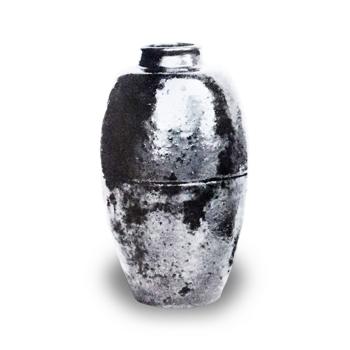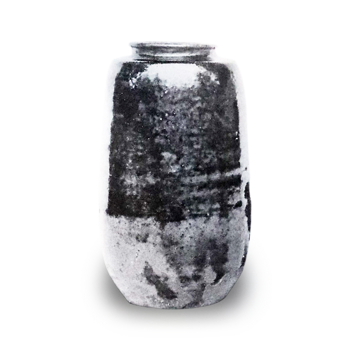
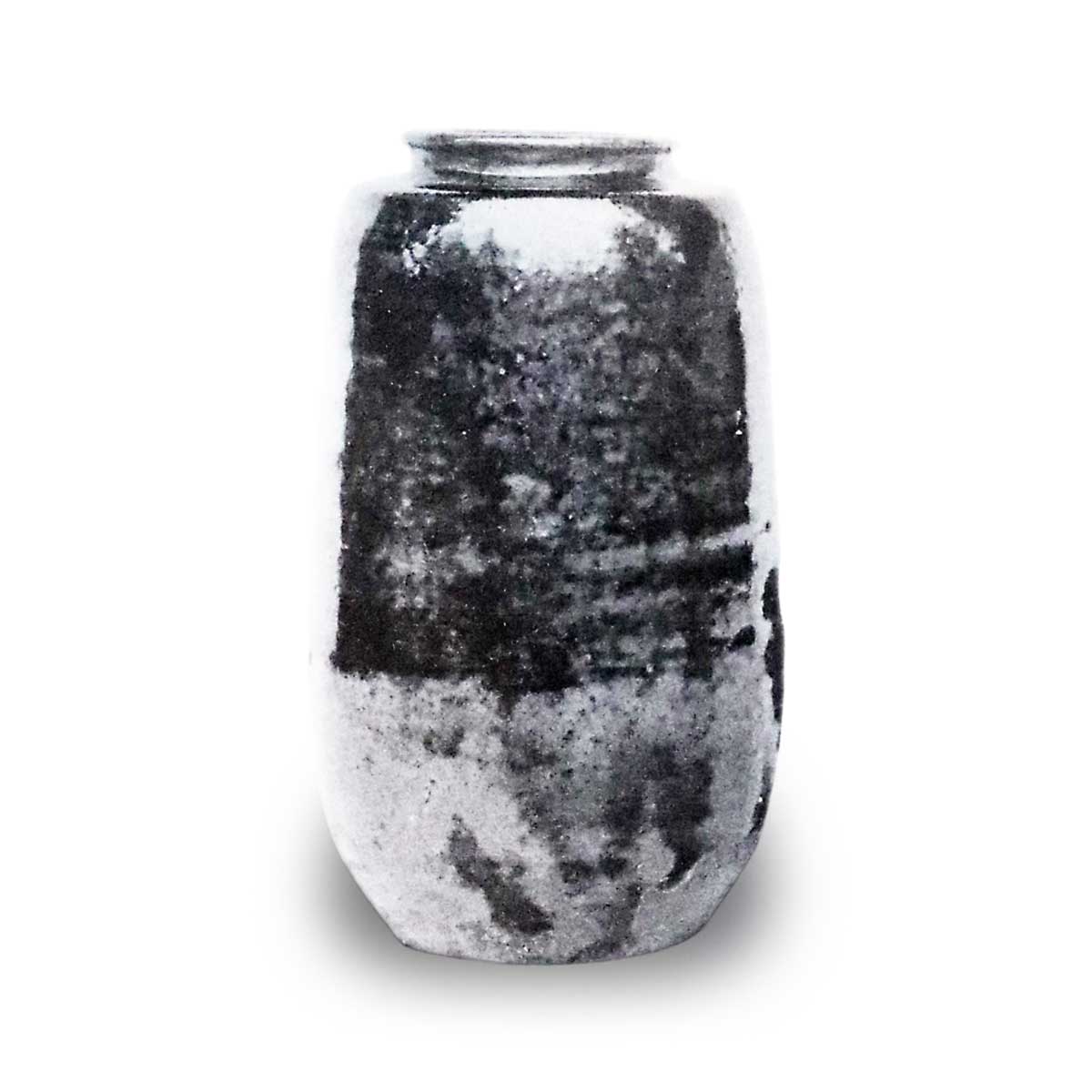
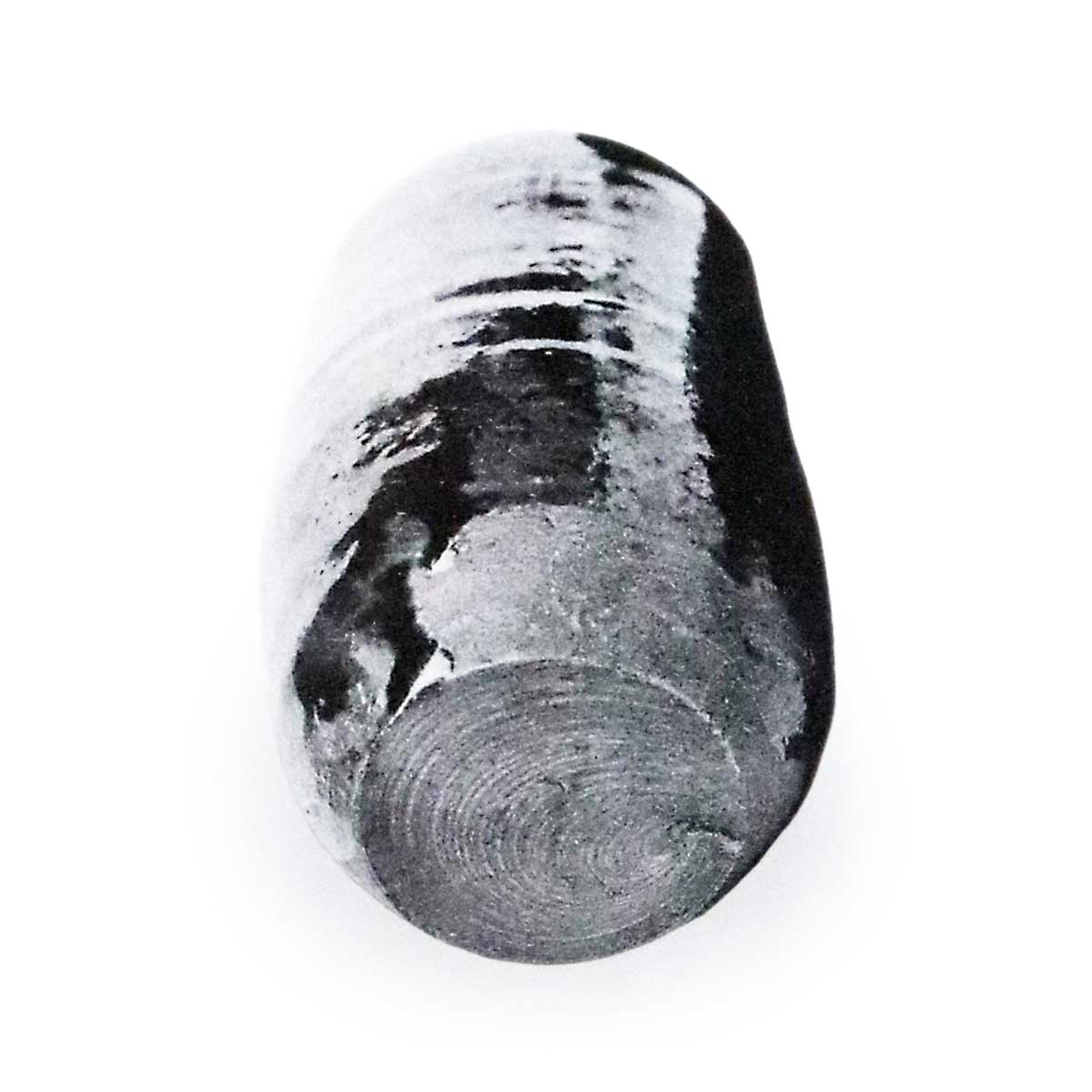
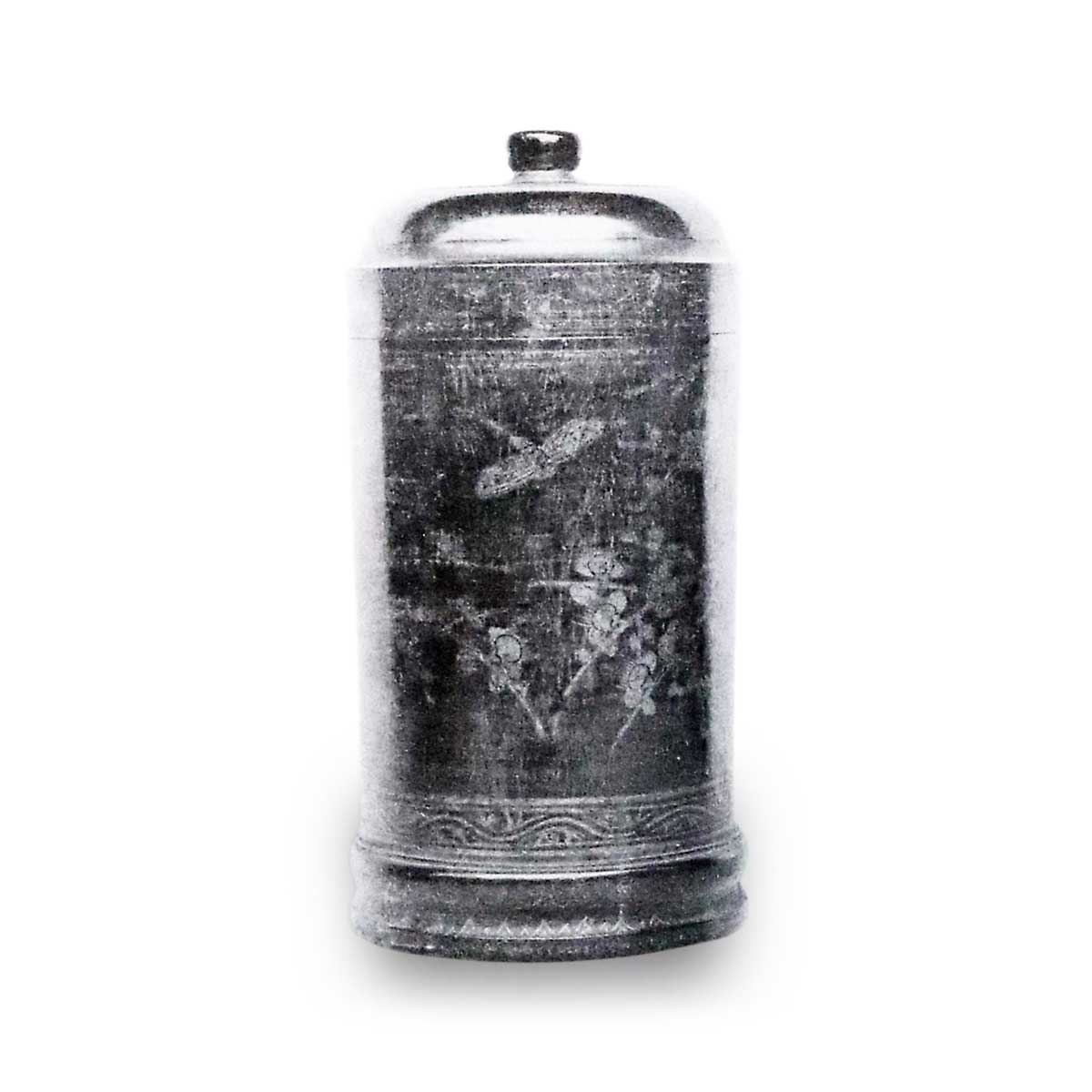
Seto-style Large Katatsuki; Collection of Marquis Tokugawa Yoshichika
Name
This name derives from the fact that it was once in the possession of the Honami family of Kyoto. It was likely a treasured piece of Honami Kōetsu’s collection.
Dimensions
Height: Approx. 11.8 cm (3 sun 9 bu)
Body diameter: Approx. 7.3 cm (2 sun 4 bu)
Body circumference: Upper part: approx. 20.9 cm (6 sun 9 bu) / Lower part: approx. 23.3 cm (7 sun 7 bu)
Mouth diameter: approx. 4.2 cm (1 sun 4 bu)
Base diameter: approx. 4.8 cm (1 sun 6 bu)
Koshidaka (height of the neck): approx. 1.5 cm (bu)
Shoulder diameter: Approx. 6.1 cm (1 bu)
Shoulder width: Approx. 1.7 cm (1 bu 5 rin)
Weight: Approx. 245.6 g (65 monme 5 bu)
*Converted using the following values: 1 sun = approx. 3.03 cm, 1 bu = approx. 0.303 cm, 1 rin = approx. 0.0303 cm, 1 monme = approx. 3.75 g.
Accessories
・Lid: 1 (Kuwanosu)
・Pouch (Shifuku): 1
Tea-colored Guangdong (Ontsugari, Tamamushi, Purple)
・Handle (Hikiya): Exotic wood (with a knob on the lid)
The body features plum blossoms and dragonflies; the lid features gold maki-e depicting a “treasure trove” motif
“Honami Katatsuki”
・Accompanying document: 1 certificate of provenance
・Seto-style Large Katatsuki Tea Caddy
Pouch: Kandou
Hikiya: Karin (rosewood) pattern, bamboo and plum blossoms, “Treasure Motif” maki-e
Although there are no records passed down by the tea ceremony masters (those in charge of the tea ceremony) regarding the provenance of this tea caddy, there is a tradition that it was previously presented by Takekoshi Ōmi-no-kami as a tea caddy known as the “Hon’ami Katatsuki.”
However, the exact circumstances remain unclear. It is said that in the past, Takekoshi Yamashiro-no-kami Michiteru purchased this Seto O-katatsuki tea caddy from the Hon’ami family in Kyoto for 300 gold coins and kept it in his possession; consequently, this O-katatsuki came to be known as the “Hon’ami Katatsuki.”
When Lord Zuiryū-in (Tokugawa Mitsutomo, the second lord of the Owari Domain) saw this tea caddy, he ordered a replica to be fired at the “Niwa-yaki” kiln (the domain lord’s private kiln), and had this replica (known as a “kage-yaki”) produced. Sōken Yamashiro-no-kami received this replica tea caddy as a gift in the presence of the Shogun (or perhaps the domain lord) in the third month of the Year of the Dog, Kanbun 10 (1670), when he traveled to Edo. That same year, an order was issued to produce another replica; in the tenth month of that winter, Kose Shin’emon traveled from their home domain (Owari) to Edo, carrying a receipt, and presented it to Senmura Sukezō, whereupon he was granted another replica.
- In the spring of the Year of the Snake, Enpō 5 (1677), Sōken, the Governor of Yamashiro, died of illness; as part of his estate, the “Large Shoulder-Strike Tea Caddy” and “Raikunitsugu’s Sword” were presented in Edo in March of that same year. The purpose of this event is recorded in the writings of Shima-no-kami. However, it is said that this Ōkatatsuki was presented at that time in accordance with a secret imperial directive.
- Upon comparing this Ōkatatsuki tea caddy with the two shadow copies of the grant certificate held by the Shima-no-kami family and examining them in detail, we found that their dimensions and shapes were exactly the same. Furthermore, the body of this tea caddy bore two small square stamped marks. Since both of the replica tea caddies also bore these same two marks, it was determined beyond doubt that this “Ōkatatsuki” was indeed the same one previously presented by the Shima-no-kami family.
- Regarding this Hon’ami katatsuki, we conducted a detailed examination due to the possibility of confusion in official records; however, as too much time had passed, it was not easily determined. For this reason, Yamamoto Michiharu had long been concerned about this matter and had systematically selected and collected similar tea caddies with matching dimensions and shapes. As a result of this recent re-examination, we have determined its provenance to be as described below.
Enkyō 2 (1745), 4th Month of the Year of the Ox
Enkyō 2 (1745), 5th Month of the Year of the Ox
In the Year of the Ox, Enkyō 2 (1745), Shima Shichirōemon (Kagashima Shichirōemon) was commissioned to investigate the provenance of tea utensils and other items; as the detailed provenance was thus established, this record is being formally documented once again.
Provenance
Hon’ami Katatsuki
As noted in the accompanying document mentioned above, Takekoshi Yamashiro-no-kami Michiteru, a senior retainer of the Owari Domain, purchased this item from the Hon’ami family in Kyoto for 300 gold coins. In the spring of Enpō 5 (1677), it was presented by the Takekoshi family to the Lord of Owari (the Tokugawa family) as part of the estate of Yamashiro-no-kami Sōken.
Field Observation Record
On June 6, Taisho 8 (1919), I observed the piece in person at the residence of Marquis Tokugawa Yoshichika in Ozone-cho, Higashi Ward, Nagoya City.
Seto Katatsuki. On a purplish ground glaze, black glaze forms a mottled pattern resembling quail spots. The “avalanche” of intentionally dripped black glaze stops near the base. It has a large, cylindrical shape, with thick wheel marks circling the body; the middle section bulges slightly, and the vessel tapers further from the rim downward. Made of grayish-brown clay, it retains a striking and clearly defined “thread cut” (the mark where the base was severed). Although the vessel is large in form, it has a relaxed presence, and the style lacks any sense of heaviness. It is a teapot that convinces one that it was indeed a treasured possession of Hon’ami Kōetsu himself, and standing before it, one is filled with boundless fascination.