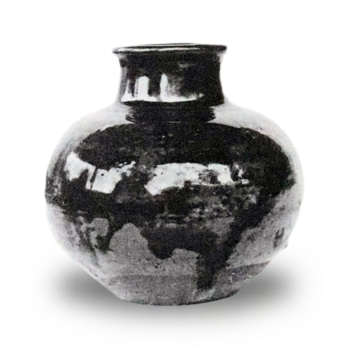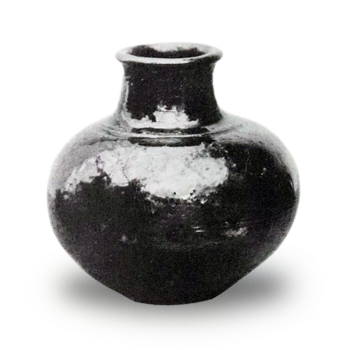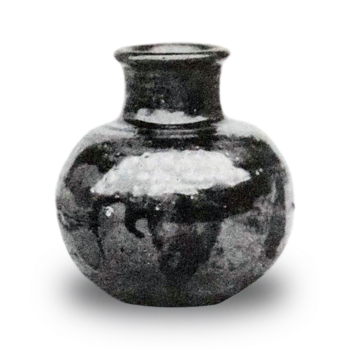
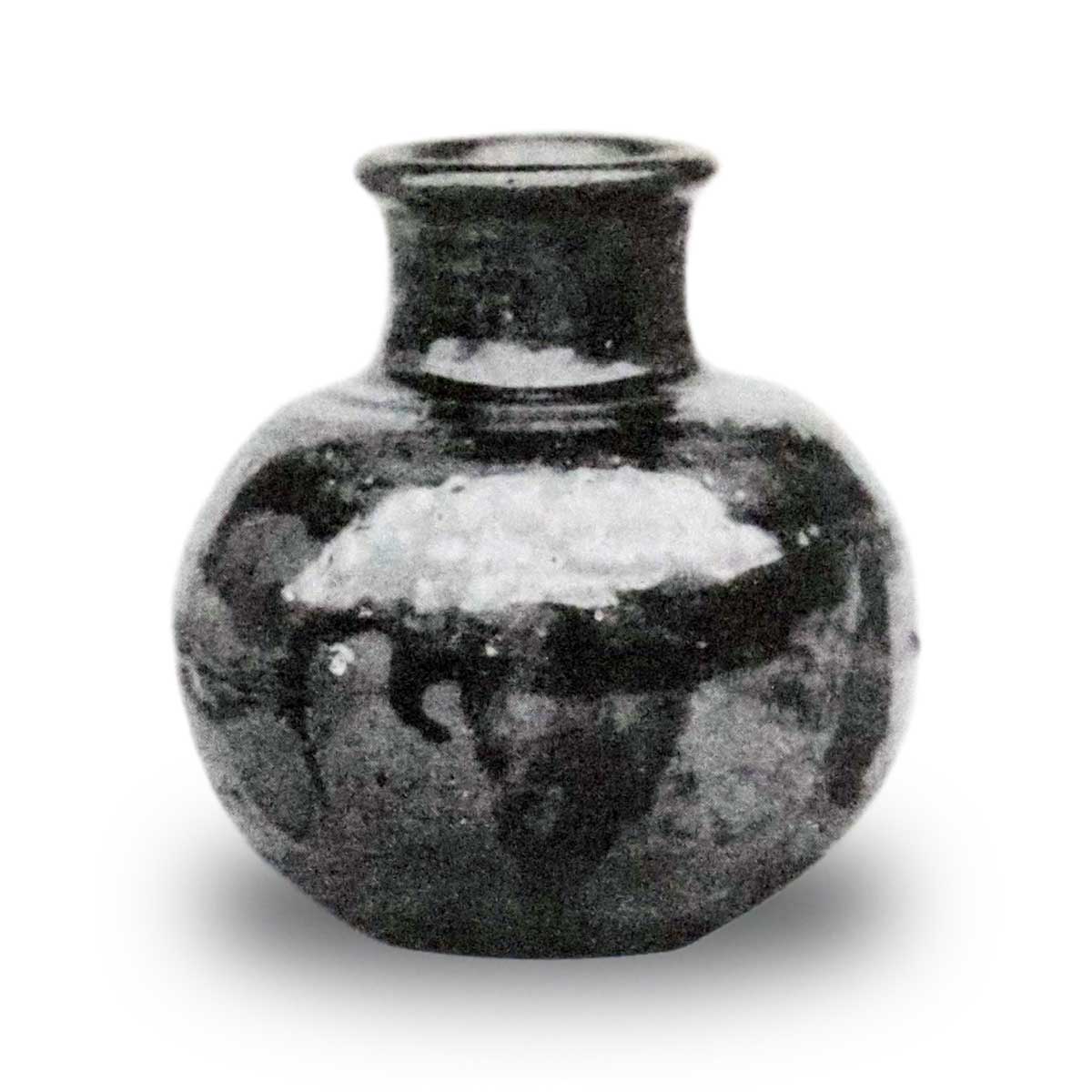
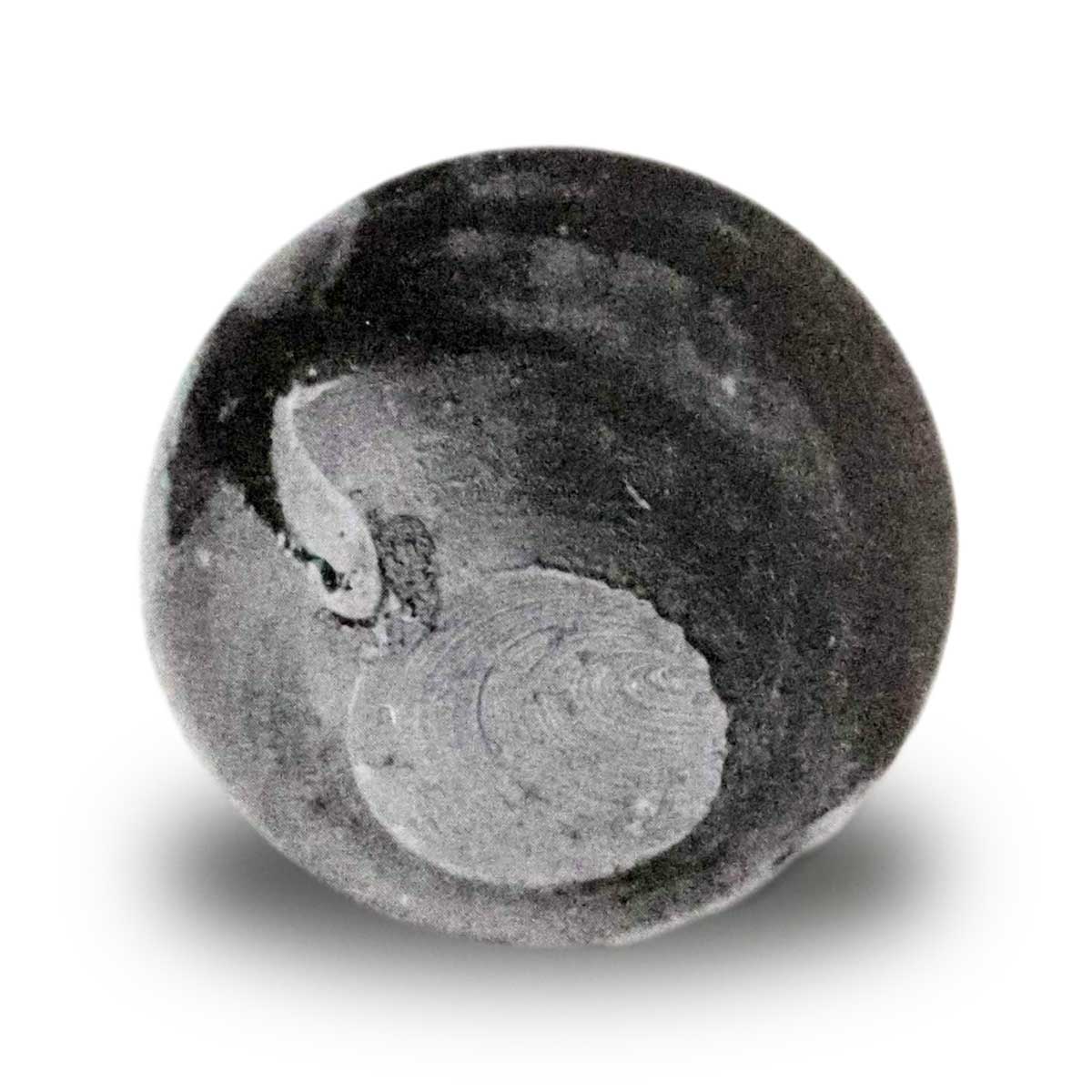
Made in China; Daimeibutsu; Collection: Baron Konoike Zen’emon
Origin of the Name
This name derives from the fact that it was once owned by Kanamori Izumo-no-kami Yoshishige.
Dimensions (converted using 1 sun ≈ 3.03 cm and 1 monme ≈ 3.75 g)
Height: Approx. 6.51 cm (2 sun 1 bu 5 rin)
Body diameter: Approx. 6.21 cm (2 sun 5 rin)
Mouth diameter: Approx. 2.73 cm (9 bu)
Base diameter: approx. 2.73 cm (9 bu)
Koshiki (lid) height: approx. 1.82 cm (6 bu)
Weight: approx. 52.1 g (13 monme 9 bu)
Accessories
・Lid: 1 (with a recess)
・Omonobukuro (bag for the tea caddy): Purple chirimen
・Covers (pouches): 4
Moe-green ground with a cornered dragon design (lining: iridescent Kai silk; cord: purple)
Satin with a bamboo vine pattern (lining: Kabe-dai; cord: purple)
Honno-ji fabric (lining: Kabe-dai; cord: brown)
Dogen satin (lining: Kabe-dai; cord: brown)
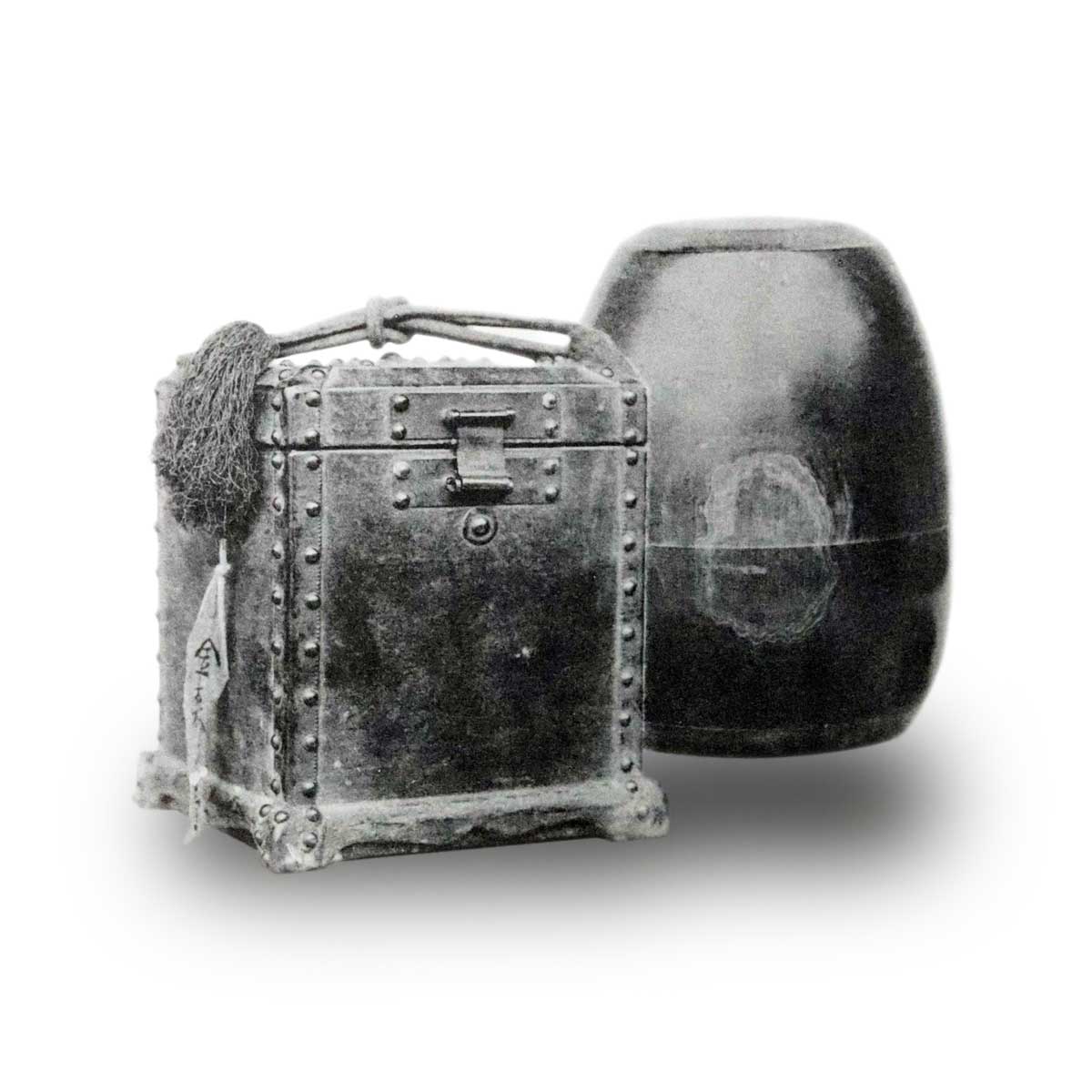
・Hikiya (tube for storing the tea caddy): Made of ivory. The pouch features a strawberry-patterned fabric (lining: navy blue Kaiki; cord: purple)
・Hikiya (cylinder for storing the tea caddy): Made of ivory
The pouch is made of Ichigo-zori fabric (lined with navy-blue Kaiki, with a purple cord)
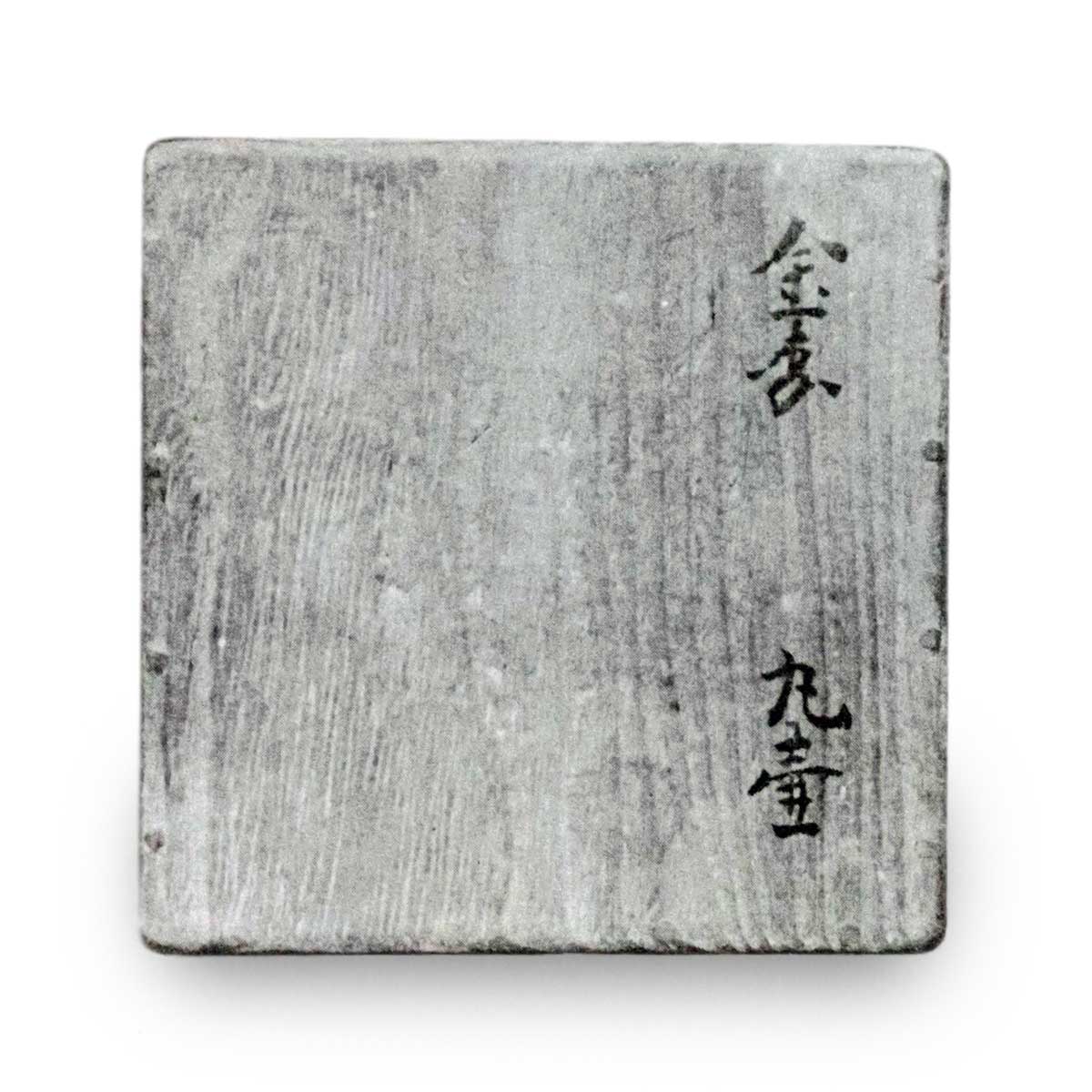
・Inner box: Made of untreated paulownia wood, with an inscription by Sakuma Shōkan
“Kanamori Maru-tsubo”
・Outer box: Made of Chinese mohair (mohair), with iron locks on all four sides
・Accompanying notes: 2 letters
“Certificate of Provenance for the Chinese Round Tea Jar Known as the ‘Kanamori Maru-tsubo’
The Chinese round tea jar shown here is a rare treasure that was once owned by Sakuma Shōkan. It was passed down to Ōkusa Shūzen-no-shō, the great-grandfather of the current head of the family, Shūzen, and has been in our family’s possession for generations. The aforementioned Shūzen-no-shō was Sakuma Shōkan’s adopted son and received the tea jar as a gift. The name “Kanamori Maru-tsubo” stems from the fact that this tea caddy was once a prized treasure owned by Kanamori Hōin (Nagachika), and it has been traditionally known as the “Kanamori Maru-tsubo” because he used this very tea caddy to present tea to Taikō Hideyoshi. End of document.
Vassals of Ōkusa Shuzen
Komiyama Takebe (Seal)
Yuō Nizaemon (Seal)
Kyōhō 3 (1718), April (Year of the Earth Horse)”
“Kanamori Katatsuki, known by the pseudonym Unzan
Lord Kyōgoku Tango-no-kami
Lord Matsudaira Oki-no-kami
Kanamori Maru-tsubo—received as a gift
Lord Mōri Kai-no-kami
Lord Sakuma Shōkan
The tea caddy shown on the right was once owned by Kanamori Hōin.”
・Authentication Label (Goku-fuda): 1
“Kanamori Maru-tsubo”
A drawing of the tea caddy by Sakuma Shōgan Naokatsu, an inscription on the lid, the four characters “Kanamori Maru-tsubo,” and a seal (印)
Miscellaneous Notes
Kanamori Maru-tsubo: Daimeibutsu. Made in China. Owned by Mōri Kai-no-kami. Height: approx. 6.60 cm (2 sun 1 bu 8 rin); body diameter: approx. 6.18 cm (2 sun 4 rin); mouth diameter: approx. 2.70 cm (8 bu 9 rin); height from shoulder to base: approx. 4.55 cm (1 sun 5 bu) and a little more. The body is made of ivory with a black lacquered interior; the box is made of paulownia wood with nine holes for lacing and crossbars on all four sides.
(From Kokin Meibutsu Ruiju)
Kanamori Maru Teapot—owned by Ogusa Yagoro. It has a single lid; the body is carved from ivory and lacquered black on the inside; the pouch is made of “ichigo-zori” fabric (with brown Kai silk lining). The box is made of paulownia wood, has nine holes for lacing, and features crossbars on all four sides. (Dimensions and an illustration of the teapot are included.)
(From Meibutsu-ki)
Kanamori Maru Pot—owned by Ogusa Yagoro. Height: approx. 6.51 cm (2 sun 1 bu 5 rin); bulge (body): approx. 7.27 cm (2 sun 4 bu); height to shoulder: approx. 4.55 cm (1 sun 5 bu); mouth diameter: approx. 2.58 cm (8 bu 5 rin); base diameter: approx. 3.03 cm (1 sun). Hikiya has an ivory body with a black lacquered interior; the pouch is made of Ichiko fabric (with a Uki lining and a purple cord). The box is made of paulownia wood; the outer box is made in China; it comes with two lids and four pouches (Honno-ji satin, a green-ground pouch with a cornered dragon design, Dogen satin, and an old bamboo-vine satin). There are two certificates of provenance. (Illustration of the tea caddy included)
(From Chaki Meibutsu Zui by Kusama Waraku)
Kanamori Maru-tsubo: A gift. Owned by Mōri Kai-no-kami.
(From Komeibutsu-ki)
Kanamori Maru-tsubo: A small jar made in China. Owned by Lord Mōri Kai.
(From Ganka Meibutsu-ki)
Kanamori Maru-tsubo: Made in China. Daimeibutsu. A gift. Owned by Lord Mōri Kai-no-kami.
(From Rinpō-kiryū)
Kanamori Koshige (Izumo-no-kami). Although he was actually the son of the Ito clan, he became the heir to Hyōbu-kyō Hōin Nagachika. Born in Mino Province in the first year of Eiroku (1558), he was appointed Izumo-no-kami in the 13th year of Tenshō (1585). During the Korean Campaign, he was stationed at Nagoya in Hizen (Saga Prefecture), where he was granted a round teapot and the Meibutsu sword “Enju no Tō.” He died in Fushimi on the 3rd day of the intercalary 6th month of Genna 1 (1615) at the age of 58.
(From Kansei Shūshū Shokafu)
Mōri Hidemoto (Sakyō-daifu, Kai-no-kami). Born in Tenshō 7 (1579) at Sarukake Castle in Bitchū (Okayama Prefecture). On October 9, the first year of Shōhō (1644), by order of the shogun, he prepared and served tea at a sukiya-style tea house in Nishijō Yamazato. Those who joined him were Hotta Kaga-no-kami Masamori, Nagai Shinano-no-kami Naomasa, Abe Bitchū-no-kami Masatsugu, and Yagyū Tajima-no-kami Munenori. He presented various gifts and staged five Sarugaku performances. Hidemoto further presented a scroll of the “Iroha” alphabet written by Prince Son’en, for which the Shogun bestowed upon him a Kanamori-maru teapot. He died on the 3rd day of the intercalary 10th month of Keian 3 (1650) at the age of 72. His first wife was the adopted daughter of Hideyoshi, and his second wife was the adopted daughter of Ieyasu.
(From Kansei Shūshū Shokafu)
On October 5, Shōhō 1 (1644) (*Note: Date varies), Hidekazu Mōri served tea at the Nishinomaru of Edo Castle (omitted). The shogun entered the sukiya and looked at the flowers as they were passed around. At this time, Hidekazu presented a calligraphic work by Prince Son’en, to which the shogun remarked, “This is a rare item,” and was deeply impressed. A short time later, he was bestowed a Kanamori Maru teapot, etc.
(From *Kimin-genkōroku*)
Kanamori Maru Teapot: Formerly owned by Ōkusa Yagorō; currently owned by Kōnoike Zen’emon. (Includes dimensions, accessories, and an illustration of the teapot)
(From Enshū Meibutsu-ki)
Kanamori Maru Teapot: Crafted in the style of a small teapot, the design of the “hima” (glaze-free area) on the shoulder is exquisite.
(From the Kōnoike Collection Register, which bears a colophon dated Bunka 2)
History
Originally owned by Taikō Hideyoshi, Kanamori Izumo-no-kami Yoshishige received this Maru-tsubo tea caddy, along with the Meibutsu sword “Enju no Tō,” while stationed at Nagoya in Hizen during the Korean Campaign. It subsequently became the property of the Tokugawa Shogunate. On January 9, Shōhō 1 (1644) (Note: The month differs from the previous account), when Mōri Kai-no-kami Hidemoto, acting on the orders of Shogun Iemitsu, prepared tea for him at the Nishinomaru of Edo Castle, he presented the shogun with a scroll of “Iroha” by Prince Son’en and received the shogun’s praise. At that time, he received this Kanamori Marutsu tea caddy as a gift from the Shogun. It was subsequently passed down to Sakuma Shōkan Naokatsu, and from his adopted son, Ōkusa Shūzen-no-shō, it was held by successive generations of the Ōkusa family, including Yagorō and his descendants, before being transferred from the Ōkusa family to the Kōnoike family in the third year of Kyōhō (1718).
Record of Actual Observation
On May 18, Taisho 10 (1921), I viewed this piece in person at the villa of Baron Konoike Zen’emon in Kitae Village, Nakagawa District, Osaka Prefecture.
The rim is round with a shallow outward curve, and there is a black streak below the rim’s edge. The neck is tall, with two black glaze streaks running around it. The body features a single sunken streak extending halfway down the tea caddy. From the base downward, the red-brown clay is exposed, and the thread marks are extremely fine.
Overall, it has a persimmon-colored hue with a hint of purple, and the luster of the black glaze is beautiful. A single streak of black glaze flows down from the tip of the shoulder, reaching all the way to where it meets the tray before stopping, revealing a hint of blue-green within it. The body has bumpy areas that bulge like rice crackers, and there are small areas of glaze loss (where the glaze has not adhered) above the ridges on the body. Furthermore, there are numerous fingerprint-sized marks on the clay around the base. It is in pristine condition; the luster of the black glaze, combined with the beauty and vividness of its front view, is beyond words.
Inside, the glaze covers the rim of the mouth; there are splashes of black glaze around the neck, and below that, shallow wheel marks form a swirl pattern at the center of the base. The unique, round, and substantial rim is unlike any other, and the tea caddy’s exceptionally tall body lends it a truly magnificent appearance. The glaze colors—purple, persimmon, and black—are all vivid and brilliant, making this a tea caddy with an intriguing design and charm.