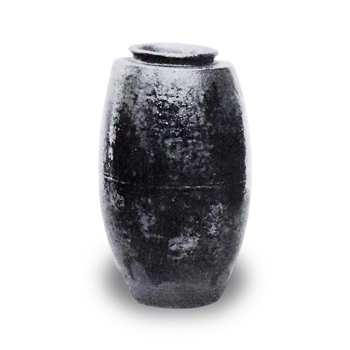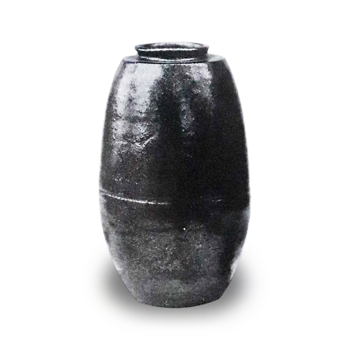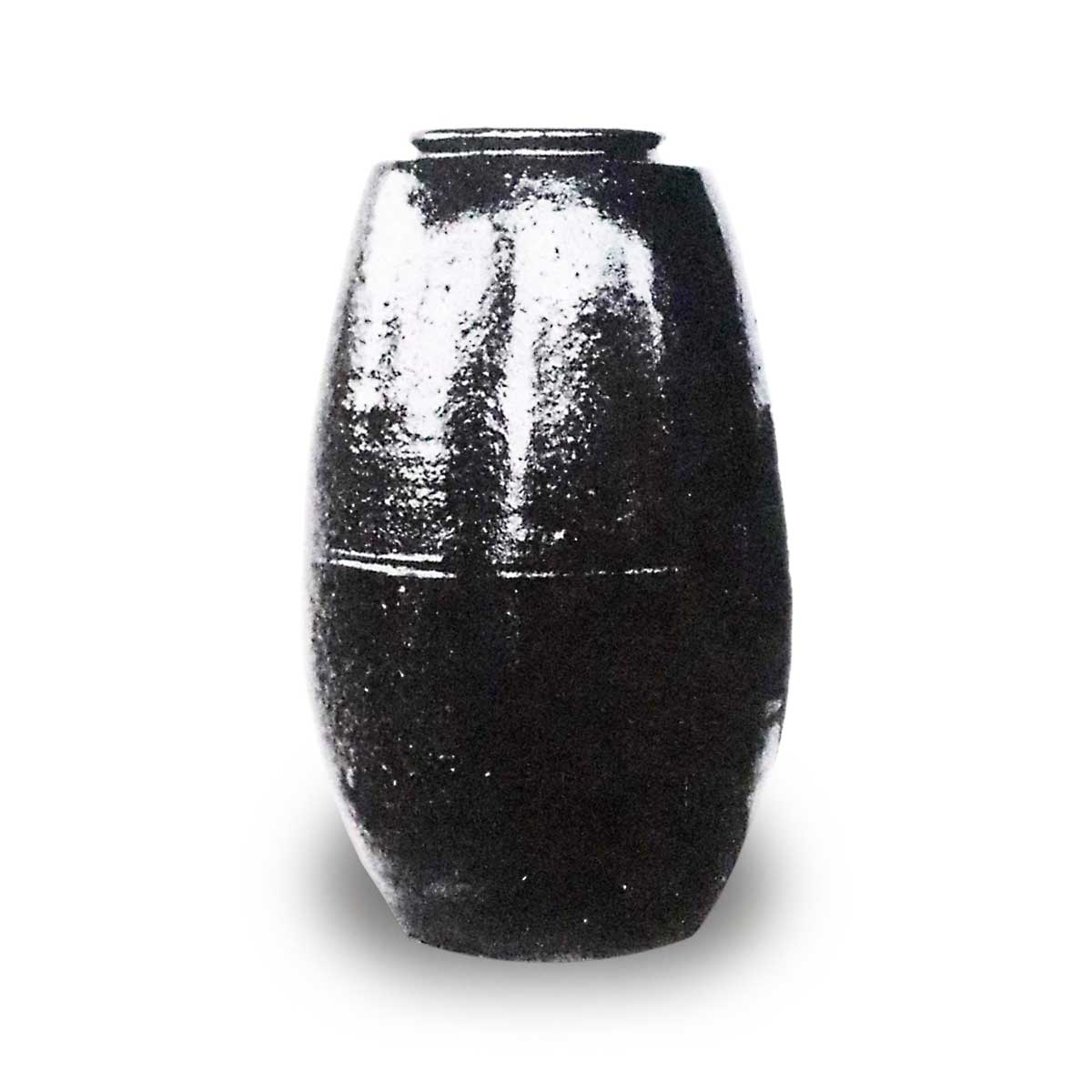
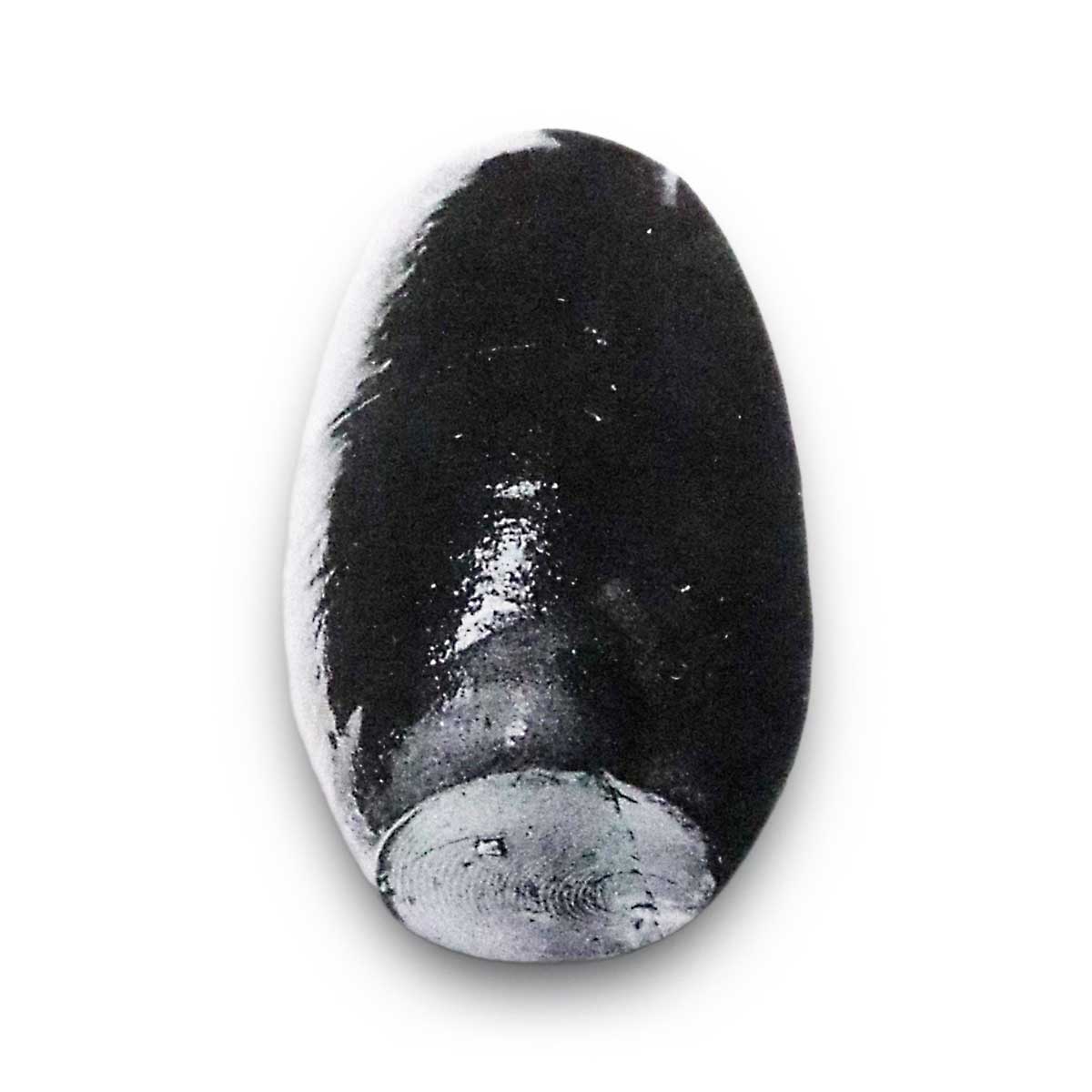
Old Seto—Daimeibutsu—Collection of Count Tadamichi Sakai
[Origin of the Name]
This name derives from the fact that it was once owned by Ikoma Sanuki-no-kami Masatoshi. His father, Sanuki-no-kami Kazumasa, first relocated his family to the Kanto region (Edo) in the 13th year of Keichō. This marked the beginning of the practice whereby daimyōs had their wives and children reside in Edo (as part of the witness and hostage system). The shogunate placed great trust in him; in addition to being granted over 170,000 koku in Sanuki Province (present-day Kagawa Prefecture), he was exempted from half of his various official duties. Masatoshi himself distinguished himself in the Battle of Sekigahara and the Summer Campaign of Osaka, and on February 28, Keichō 17, he was presented with this “Katatsuki” tea caddy by Tokugawa Ieyasu. This tea caddy is commonly known as the “Ikoma Katatsuki.” Masatoshi died on June 5, Genna 7, at the age of 36. His son Takatoshi, who succeeded him, was naturally dull-witted—to the point where he could not even distinguish between different types of barley. As fierce legal disputes arose among his vassals and the province could not be brought under control, his lands were finally confiscated (kaei) on July 11, Kan’ei 17.
[Dimensions and Weight]
Height: 3 sun 9 bu 5 ri (approx. 11.97 cm)
Body diameter: 2 sun 4 bu 2 rin (approx. 7.33 cm)
Mouth diameter: 1 sun 3 bu (approx. 3.94 cm)
Base diameter: 1 sun 4 bu 5 ri (approx. 4.39 cm)
Rim height: 1 bu 2 rin (approx. 0.36 cm)
Shoulder width: 1 mon 2 rin (approx. 0.36 cm)
Weight: 48 monme 9 bu (approx. 183.38 g)
[Accessories]
・Lid: 1 piece (made of ivory, with “kō” (holes or indentations) inlay on the reverse side)
・Storage pouch: White ha-niji fabric; the pouch cord is “tsugari” (braided cord) in purple
・Storage pouches: 2 “re-sewn pouches”
- Keitō-gire pattern, lined with Tamamushi-kaiki
- Donshu-suki-tsukai pattern
・Hikiya: Black lacquered, with chamfered edges
- Pouch for the Hikiya: Irogae Oranda-jima (color-changing Dutch stripe), cord in Kuzureki (faded yellow) color, Shuchin (a type of woven fabric)
・Inner Box: Black lacquer
- Pouch for the Inner Box: Irogae Karakusa-moyō Donshu (color-changing arabesque pattern), lined with Tamamushi Kaiki, purple cord
・Outer box: Paulownia wood, Shunkei-nuri lacquer finish, with a kake-go (shallow box placed inside)
・Accompanying letters (with notes attached): 2 letters
- “This Ikoma is the foremost masterpiece among the three considered the pinnacle of Oseto tea caddies.”
- “The three Oseto tea caddies are the Ikoma, the Hasegawa, and the third, which is also known as the Hirano or Hirate.”
- “This item was originally owned by the Mitsui family of Rokkaku and was subsequently acquired from them.”
[Record of Receipt (Deposit Slip)]
・Terasawa Maru-tsubo
・Ikoma Katatsuki
・Tamakashi Tea Caddy
・Echigo Ido
・Sometsuke tea bowl
・Seto tea bowl
Regarding the above six items, we have received a request for a 1,500-ryo royal commission (funding) and have therefore accepted them as collateral. We have received the funds as scheduled; the term is set at five years, and repayment is to be made annually with interest of five shu added. At that time, we will undoubtedly return these items. We present this document as evidence for future reference.
August, Tenpō 15 (1844)
[History of Ownership]
On February 28, Keichō 17 (1612), Ikoma Toyoki-no-kami Masatoshi (then serving as Governor of Sunpu Castle) received these items as a grant from Tokugawa Ieyasu in Sunpu. When Takatoshi, who succeeded Masatoshi, had his lands in Sanuki Province confiscated, he was forced to relocate with his son Sakon to Yajima in Dewa Province (present-day Yurihonjō City, Akita Prefecture); consequently, it is presumed that his descendants also faced financial hardship. In Sekken Sōchō: A Guide to the Mysteries of the Tea Ceremony by Kanji-an Munenobu, it is recorded that “it was once in the possession of the Ikoma family, but was pawned by their descendants and came into the possession of Kurata Shichirōemon in Edo.” Subsequently, it appears to have passed into the hands of Fuyuki Kiheiji (or Kodairaji), a wealthy merchant in Fukagawa, Edo, and was later passed on to Mitsui Hachirōemon (or Mitsui Saburōsuke) in Kyoto. Subsequently, as detailed in the aforementioned accompanying letter, the item was deposited as collateral and on consignment—along with five other items, including the Terasawa Marutubo—with the Sakai family of Wakasa (the ruling family of the Obama Domain) through the mediation of Toda Munenaga of Tanimatsuya.
[Field Observation Record from Taishō 8 (Actual Survey Record)]
On April 25, Taishō 8, the actual item was examined at the residence of Count Tadamichi Sakai in Yarai-chō, Ushigome Ward, Tokyo City (present-day Yarai-chō, Shinjuku Ward, Tokyo).
Aside from slight differences in the size of the rim and the height of the waist (the narrowed section), the texture of the shoulder’s craftsmanship, the recessed line (horizontal line) running down the center of the body, the purplish base glaze, and the atmosphere of the black glaze applied to the upper portion are all so similar that this piece appears to be an exact twin (sister piece) of the Meibutsu “Hasegawa Katatsuki.”
However, the vivid and crisp beauty of the pale grayish-brown or reddish-brown earthen color visible from the lower rim to the base of this tea caddy differs from that of the Hasegawa Katatsuki. Although the thread cut (the mark where the bottom was detached) is fine and neat, the piece shows overall signs of heavy use and wear, and the “ishi-haze” (a white protrusion caused by a small stone popping out inside the kiln) at its center stands out particularly as a single white triangular spot. There are two repair marks on the rim, but apart from that, it can be judged to be of exactly the same style and the work of the same artisan as the Hasegawa Katatsuki.