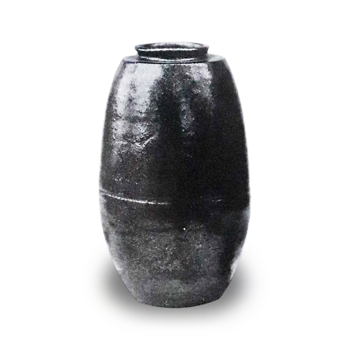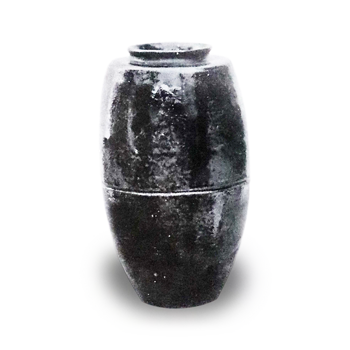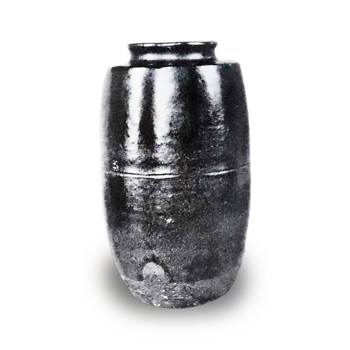
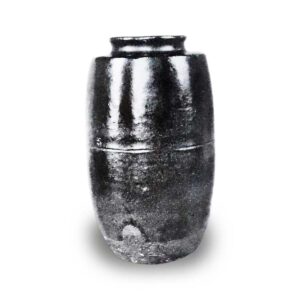
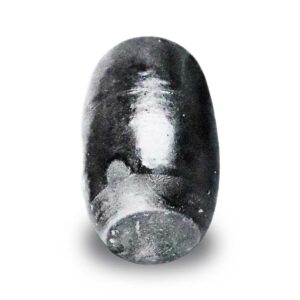
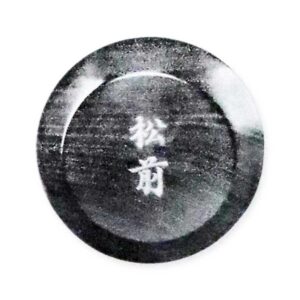
Old Seto—Daimeibutsu—Formerly in the Collection of Duke Tokugawa Ietatsu
[Origin of the Name]
It is believed to have been named after the surname of the teapot’s owner. According to historical records, it is thought to have been owned by Matsumae Toshihiro during the Tenbun era (c. 1532–1555) and by his son, Matsumae Yoshihiro, who died at the age of 69 in Genna 3 (1617).
[Dimensions and Weight]
Height: Approx. 11.7 cm (3 sun 8 bu 5 rin)
Body Diameter: Slightly over 7.1 cm (slightly over 2 sun 3 bu)
Mouth Diameter: Approx. 4.2 cm (1 sun 4 bu)
Base Diameter: Approx. 4.1 cm (1 sun 3 bu 5 rin)
Neck Height: Slightly over 0.8 cm (slightly over 2 bu 5 rin)
Shoulder width: approx. 0.9 cm (3 bu)
Weight: approx. 214.9 g (57 monme 3 bu)
[Accessories]
・Lids: 3 pieces (2 with knobs in the “Furuori” style, 1 in the “Enshu” style)
・Storage pouch: white chirimen silk; cord knots are white
・Cover pouches: 2 pieces
- Kumo-kirin [Lining: Kabechoro; Cord knot: White-brown]
- Hino Kanto [Lining: Tamamushi Kaiki; Cord knot: Purple]
・Storage box: Paulownia wood, natural finish
Inscription reading “Matsumae Katatsuki”
(Text on the box, illustrations, etc.)
・Hikiya: Made of rosewood, with gold-leaf lettering (inscribed with “Matsumae Katatsuki,” “two lids,” and “two pouches”; believed to be a piece favored by Kobori Shōkan)
・Inner box: Made of paulownia wood, natural finish
・Outer box: Black lacquered, with gold-leaf lettering (“Seto Matsumae Katatsuki”)
[Records from Various Sources (Miscellaneous Notes)]
・Catalog of the Tokugawa Family’s Artifacts and Paintings: The Matsumae Katatsuki was presented by Satake Ukyō-no-taifu (Yoshikata) on August 28, Genroku 16 (1703). The entire piece has a persimmon-colored, pear-skin texture; black glaze is beautifully applied over a metallic luster (kinki), and the black glaze encircles the area around the fire mark at the waist. This tea caddy is an ancient Seto ware piece. There is a single fine line on the body, and on the shoulder, there is an extremely thin, black, cloud-like glaze pattern (a natural effect of the glaze).
・Ganka Meibutsu-ki: Matsumae, Seto Katatsuki, owned by Satake Shuri-dono.
・Kokin Meibutsu Ruiju: Matsumae, Seto Katatsuki, Daimeibutsu, owned by Satake Shuri-daifu.
・Meibutsu-ki: Old Seto Matsumae Katatsuki. Formerly owned by Satake Ukyō-daifu; currently housed in Edo Castle. It has a cord, and there are repair marks on the shoulder. The waist band consists of a single stripe, and the base glaze is chestnut brown. It comes with one lid; the pouch is a Fujigotoki style; the handle is black-lacquered; and the outer box is Tame-nuri lacquered. Although there are no inscriptions on the piece itself, it is considered to be in the style favored by Kobori Shōkan.
・Chaki Zusunpo Teisho: Matsumae Katatsuki, owned by Satake Ukyō-daifu. The Seto base glaze is chestnut brown. There are repair marks on the rim and a crack on the shoulder. It has a single sash, and there are slight, faintly black, cloud-like patterns on the shoulder.
・Kansei Revised Genealogies of Various Families: On August 28, Genroku 16, Satake Yoshikata (Daizen-no-taifu) presented a “Matsumae Katatsuki” tea caddy, along with a sword by “Raikokumitsu,” to the shogunate as a memento of his father (Ukyō-no-taifu Yoshikata).
・Jō-go-dōgu: Matsumae Katatsuki, August 28, Genroku 16, from the estate of Satake Ukyō-daifu. Includes a third-class carrying case, two pouches (made by Hino Kōtō, purple-ground Kinran), and three lids (two in the “Kōori” style, one in the “Enshū” style).
[Provenance]
Originally owned by a member of the Matsumae clan, it was passed down to Satake Ukyō-daifu (Yoshikata), the lord of the Akita Domain. On August 28, Genroku 16 (1703), Satake Daizen-daifu Yoshikata presented it to the Tokugawa Shogunate (the Shogun at the time) as part of the estate of his father, Yoshikata. Since then, it has been preserved to this day as an item belonging to the Shogun’s household (Yanagi-ei Imperial Collection).
[Observation Record (Actual observation record from Taishō 7)]
On November 8, Taishō 7 (1918), I had the opportunity to view this piece in person at the residence of Lord Tokugawa Ietatsu in Sendagaya, Tokyo Prefecture.
This is an old Seto “Okatamotsu” tea caddy with a tall body, featuring a slightly deep, flared rim and sharply defined shoulders. A single sunken groove running around the middle of the body is interrupted only at a single point. The overall color is a dark persimmon hue—which could be described as chestnut brown—with a metallic sheen, and the glaze pattern (texture) shows variations in the black glaze. The base reveals grayish-brown clay, with a crescent-shaped area where it extends beneath the black glaze. The thread-cut finish is coarse, and in accordance with the tea master’s preference, one corner of the base has been slightly worn down into a crescent shape.
It is solid, dignified, and exudes great refinement. If one were to compare it to a person, it would be fitting to describe it as a figure of imposing stature—large, gentle, and of few words.