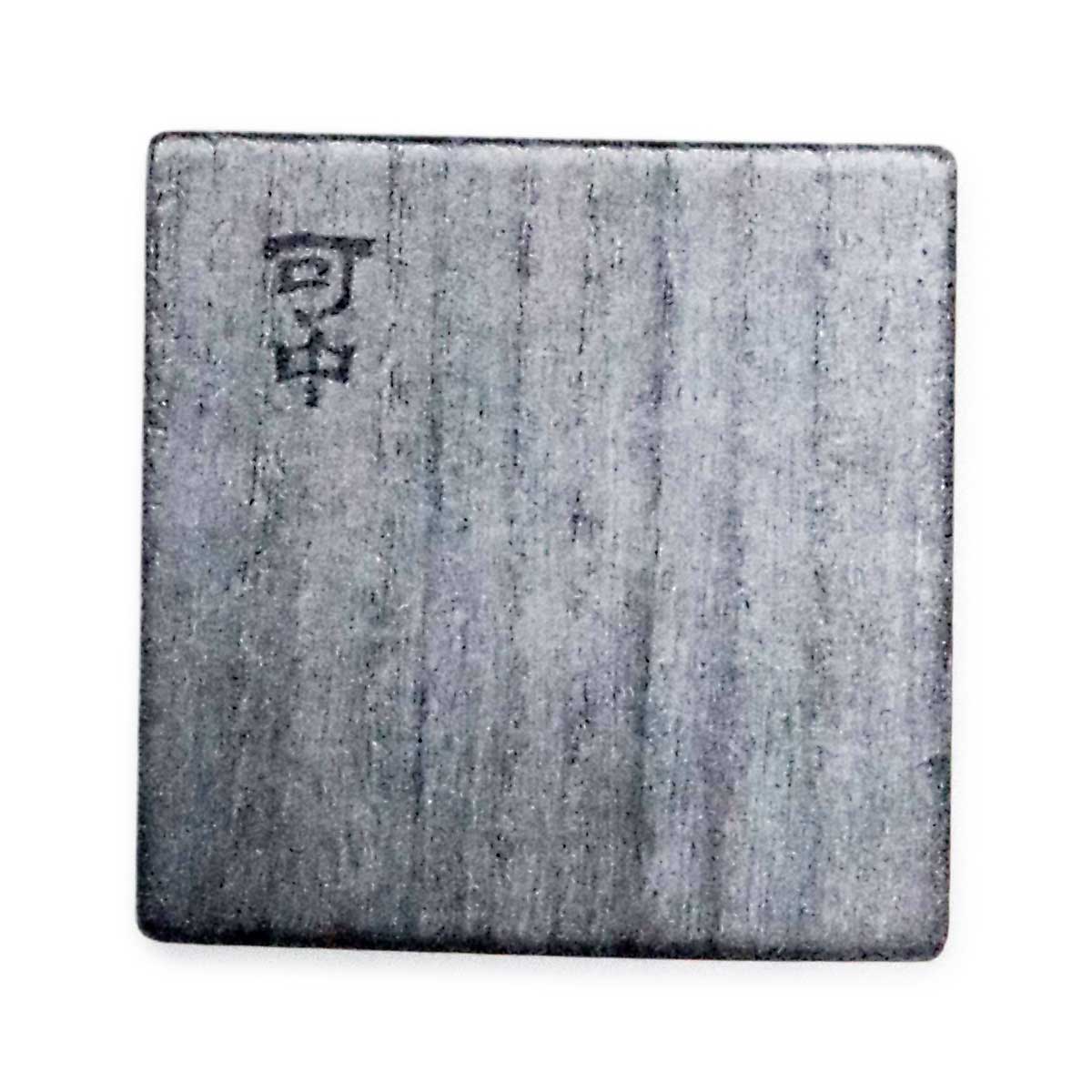
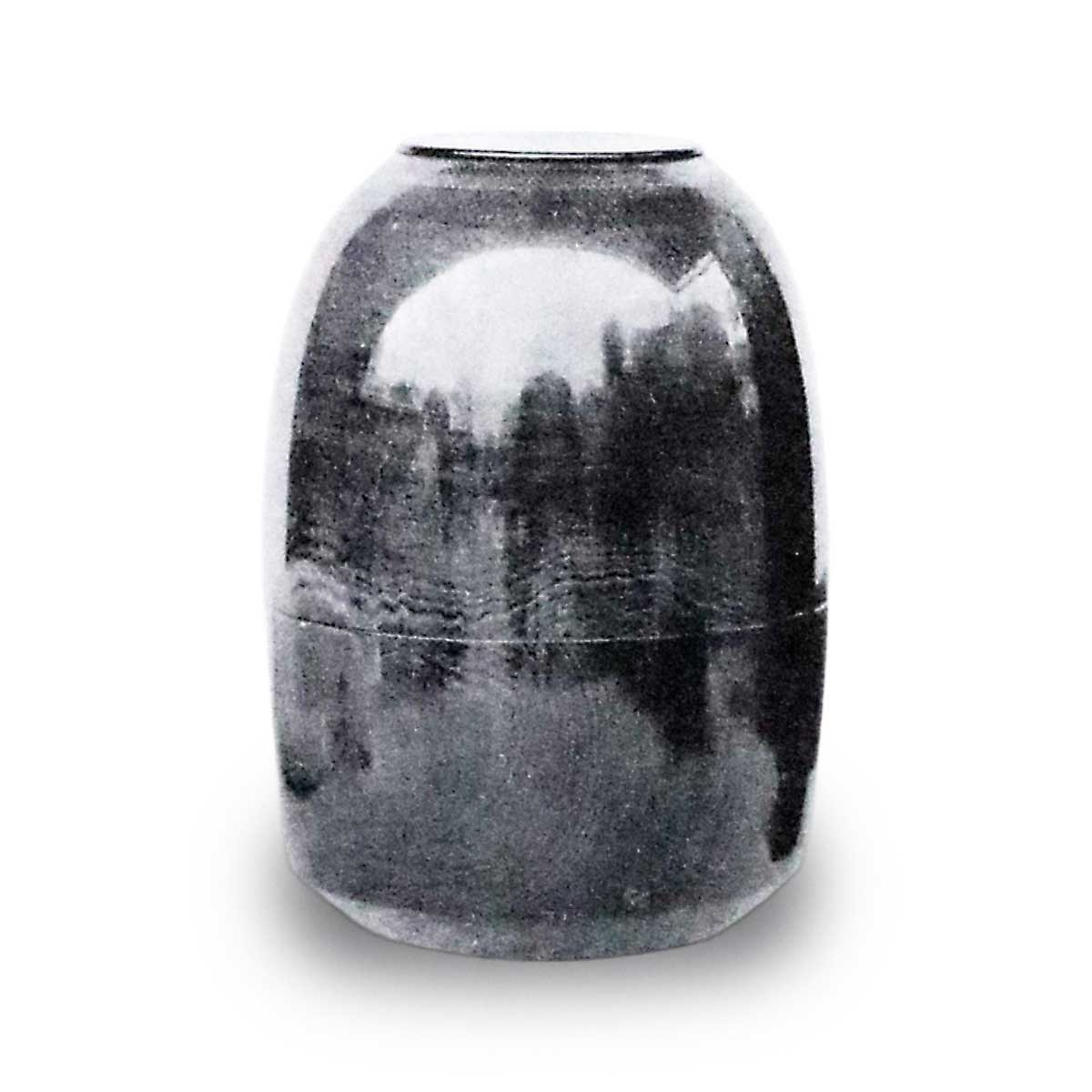
Old Seto, Revival-Period Meibutsu, “Baron,” Collection of Mr. Konoike Zen’emon
Origin of the Name
According to Gokuhi Mekiri-sho (Top-Secret Guide to Appraisal), the inscription “Wakuraba” derives from the presence of a single withered, crimson leaf (a diseased leaf: wakuraba) among the green leaves of summer. Regarding Kobori Enshū’s reasoning behind this selection of characters—even though the inscription was later changed to “Kachū”—this decision makes perfect sense. The clay around the base of the tea caddy features a slight bulge about the size of a little finger’s tip, which symbolizes what is known as “a flaw in a gem.” It is believed that the inscription “Wakuraba” was chosen based on this aesthetic concept. However, the poem from which it is quoted (the original poem) is the following, found in the “Miscellaneous Poems, Part 2” section of the Kokin Wakashū:
“A poem given to a court official while the poet was in seclusion at a place called Suma in the Province of Tsu following an incident during the reign of Emperor Tamura.”
Asahara Yukihira
“If anyone should ask about me at Wakuraba, tell them I am living in solitude at Suma Bay, boiling seaweed salt and shedding tears.”
(Meaning: If, by any chance, someone should ask after my whereabouts, please reply that I am living in solitude and melancholy on the shore of Suma, boiling seaweed salt while shedding tears.)
It is important to understand that the name of this tea caddy carries a very profound meaning, derived from a play on words combining the phrase “wakuraba ni” (meaning “by chance” or “accidentally”) with the plant term “wakuraba” (sick leaves).
Dimensions (converted to centimeters)
Height: Approx. 7.6 cm (2 sun 5 bu)
Body Diameter (waist section): Approx. 5.9 cm (1 sun 9 bu 5 rin)
Mouth Diameter: Approx. 2.3 cm (7 bu 5 rin)
Base Diameter: Approx. 3.0 cm (1 sun)
Neck Height: Approx. 0.5 cm (1 bu 7 rin)
Shoulder width: approx. 0.5 cm (1 bu 8 rin)
Weight: approx. 88.1 g (23 monme 5 bu)
Accessories
・Lids: 2 (one of which has a hole on the underside)
・Storage pouch: white chirimen silk; wisteria-colored braided cord
・Covering (pouches): 3 pieces
- White ground with silver brocade (lining: light green “Jidai Kaiki” pattern; cord: wisteria-colored braided cord) *Known as “Wakuraha-giri”
- “Dōtō-giri” (cord: wisteria-colored braided cord; lining: iridescent)
- “Shōhōji” (cord: wisteria-colored braided cord; lining: iridescent)
・Storage Box: Made of paulownia wood, natural finish
(Inscribed on the front: “Kachu-no-fukuro”; on the back: “Dōtō Ginran Wakuraha-kiretosu, Donshu Junko, Lid 2”)
・Wooden Mold: 1 piece, made of rosewood
(The storage box contains four dividers, accommodating the three covers and one wooden mold)
・Hikiya: Made of ivory, with a medium-sized body
(The lid features a carved inscription reading “Kachu,” filled with verdigris)
・Pouch (cover for the hikiya): Arisugawa style (lined with pale yellow wai-chigai satin; cord is brown twisted silk)
・Inner box: Made of paulownia, natural wood (bears a calligraphic inscription by Kobori Enshū)
Summary of Miscellaneous Notes and Records
Records from Various Sources
・Kokin Meibutsu Ruiju and Rinpō Kiryū:
Dimensions: Height approx. 7.6 cm, body diameter approx. 6.5 cm (at the widest part); mouth diameter approx. 2.4 cm. Comes with storage pouches by Shōhōji, Aoki Kōtō, and Shiraji Ginran, as well as an ivory inner case. The outer box is finished in black lacquer.
・Fushimiya Meibutsu Chaki-zu:
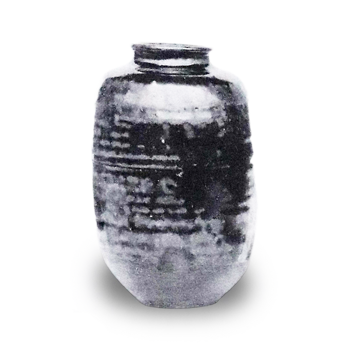
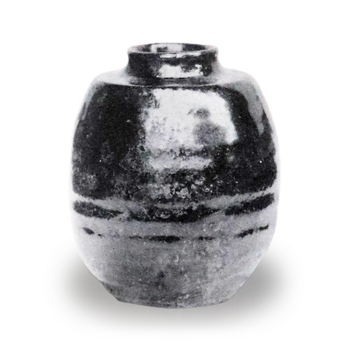
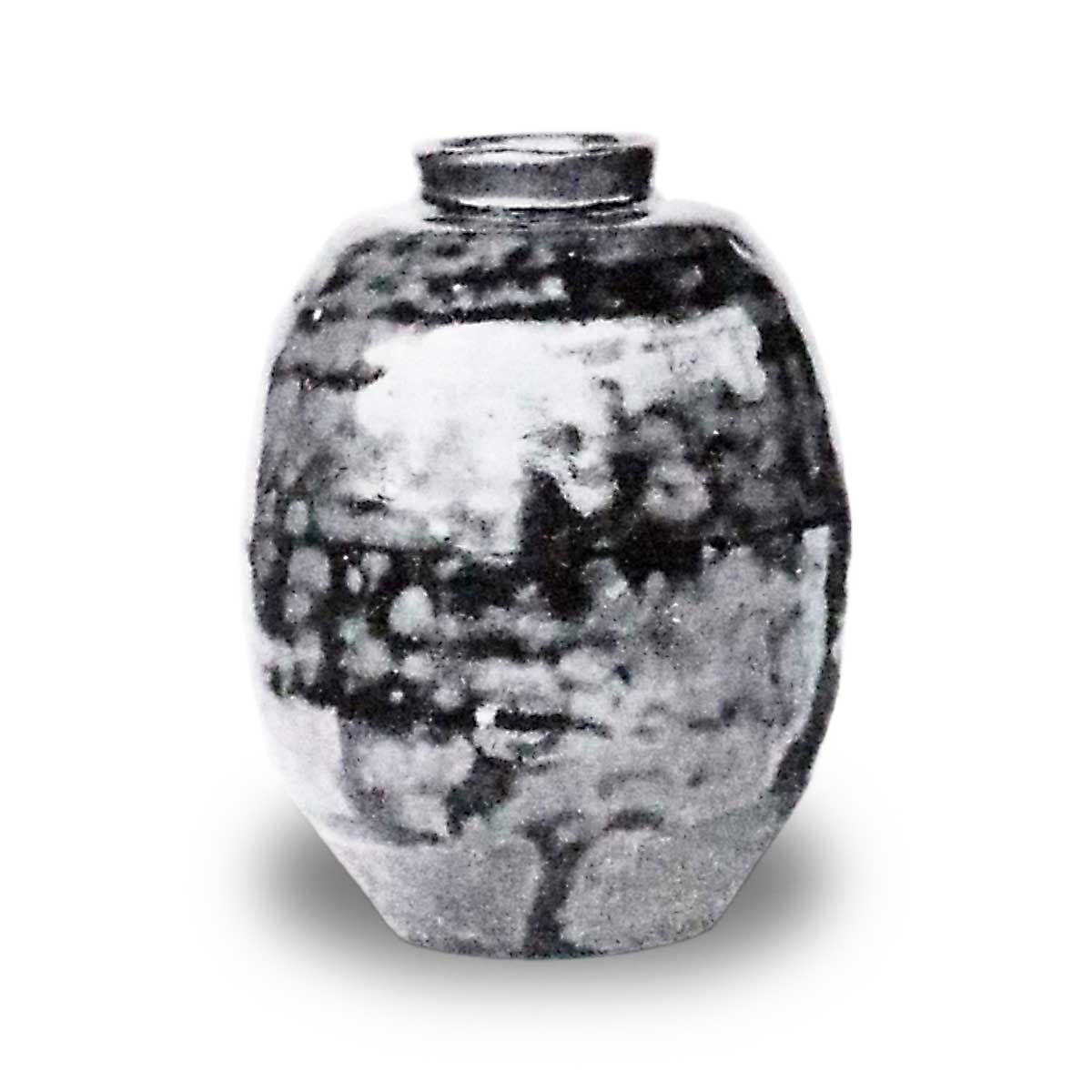
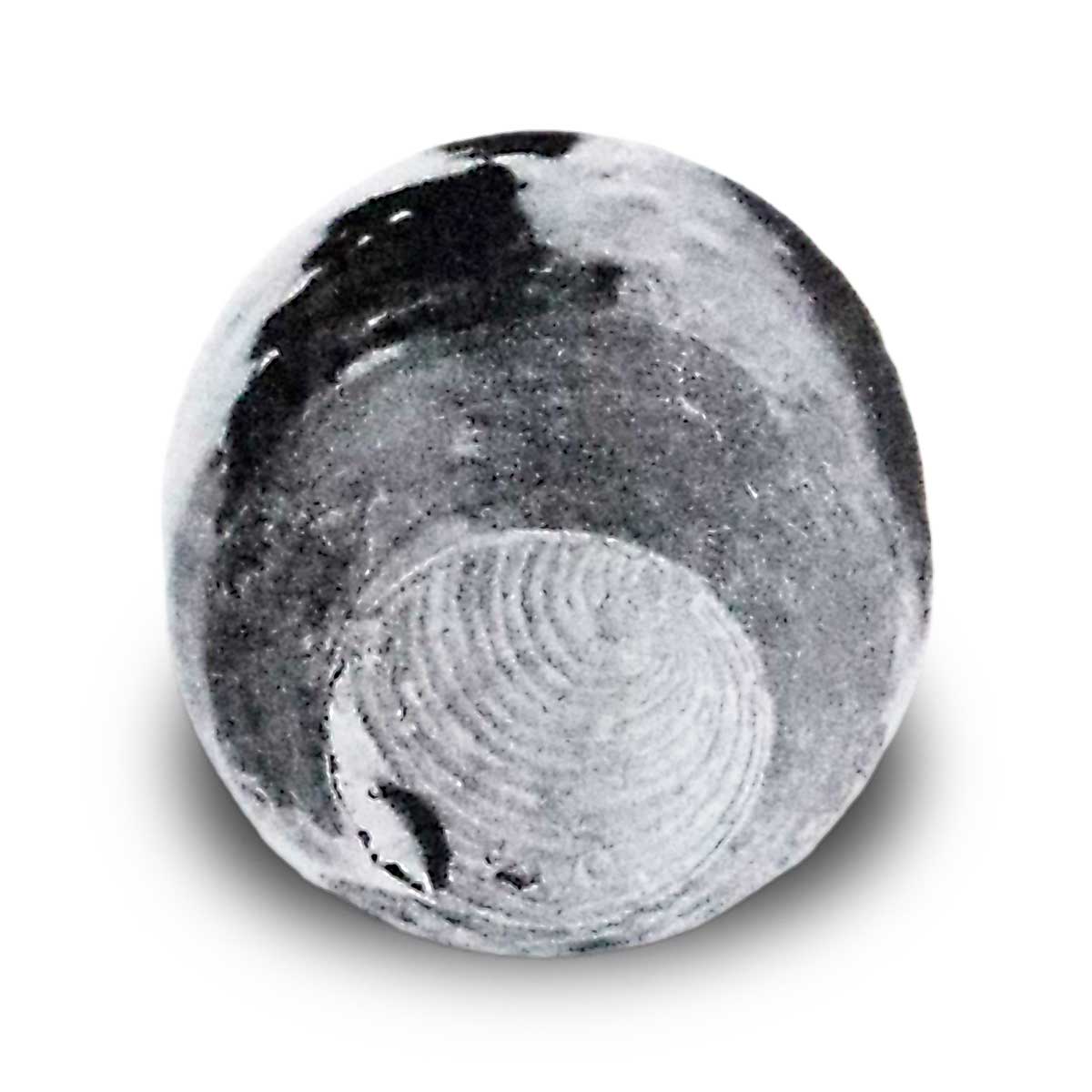
It was originally owned by the Yamanaka family, then passed down to Abe Bungo-no-kami (including Abe Masatake), and in April of Kyōhō 20 (1735), it became the property of Kōnoike Zen’emon. The thread-cut on the bottom is slightly rough, and there is a small stone chip (hazé). Brush marks are visible on the clay around the waist. The overall color has a metallic sheen with a hint of persimmon, displaying a pattern resembling quail spots. The shoulders are slightly flared, and the rim features a cord-like step. There is a single streak where the glaze has pooled. Below the shoulders, there is an unglazed “hima” (unfired area), revealing the brush marks of the base clay. The outer box is finished in black lacquer, and the lid fits exceptionally well. The outer box was made later by the Abe family.
・Chairi Kenbunroku:
Owned by Abe Bungo-no-kami. The base glaze is red, with black glaze spots resembling quail speckles. The rim is not turned back.
・Enshū Shūi:
An ancient Seto ware piece with a flared shoulder shape (katatsuki). It derives its name from Ariwara no Yukihira’s poem about Suma. Along with “Chu-an,” “Hatakeyama,” “Aisaka,” “Iyo-noren,” “Tsuri-fune,” and “Kyuko,” it is counted among the “Seven Famous Seto Meibutsu” (Nabemono).
・Chaji-dan:
When Kobori Enshu established the classification (rankings) of renowned Japanese and Chinese tea utensils, he selected “Hirosawa,” “Asukagawa,” “Hitachi,” “Aoe,” “Tamakashi,” “Tatsunoi,” and “Wakuraba.” “Wakuraba” is written as “byōba” (sick leaf). A commentary on the Ise Monogatari also presents the theory that “this is the name of a maple tree in March, and due to a writing error, the box is inscribed with ‘Kachū’ (or ‘Kachū’).”
・Kansō Zaki:
A fine example of ancient Seto ware. Originally owned by Enshū, then by Abe Bungo-no-kami during the middle period, and currently in the possession of the Kōnoike family. A senbei-de style katatsuki tea caddy. The body is persimmon-colored with a black glaze that has cracked and flaked off; the clay has a soft texture, and the base features a honshikiri finish.
・Katsu Kaishū’s Record of Notable Tea Utensils:
Owned by Kōnoike Zen’emon. Height approx. 7.6 cm, body diameter approx. 6.5 cm. Comes with numerous covers, including “Daitō,” “Tsuri-ishidatami,” “Shiraji Ginran,” and “Enshū Dōnso.” It has a single fire gap, the base features a “hon-ito-kiri” finish, and the clay is mouse-gray in color. A diagram of the tea caddy is also included.
・Chaki Mekiri Monjo, Unshu Matsudaira-ke Chadō Gohon, Tan’kai, Sekkan-sō, Unkan-sō Chadō Wakuge, Gokuhi Mekiri-sho, etc.:
This tea caddy features a single “bulge” (hi-fukure) as part of its design. Since this is considered a flaw in the piece, Enshū wrote “Kachu” (可中)—a pun on “wakuraba” (病葉)—and had it read as “wakuraba.” It was once owned by Enshū and later passed into the possession of Kōnoike Zen’emon of Osaka. Records indicate that it was traded at the extremely high price of 1,000 ryō in Keichō gold (koban). The clay is soft, and the piece is thinly crafted; it is characterized by a bulge at the boundary between the clay and the glaze.
Examples of Use in Tea Ceremony Records
・Morning tea ceremony on January 29, Kan’ei 7 (1630) (Host: Kobori Enshū)
“Wakuraba (Kachū)” was displayed on the shelf.
・Morning tea ceremony on July 13, Kan’ei 13 (1636) (Host: Kobori Enshū)
“Wakuraba” was used as a tea caddy.
・Morning tea ceremony on April 7, Kan’ei 19 (1642)
“Kachū” was displayed on an Ōsaka tray in front of the water jar.
・Evening tea gathering on March 28, Enpō 3 (1675)
“Kachū” was used at a gathering attended by Matsudaira Kazusa-no-kami and Inaba Mino-no-kami, among others.
History of Ownership
Originally owned by Kobori Enshū, it was passed down to the Kōnoike family, a wealthy merchant family in Osaka. It was later presented by the Kōnoike family to Abe Bungo-no-kami (a daimyō family). However, in April of Kyōhō 20 (1735), after passing through the hands of Sumiya Sukezaburō, a tea utensil dealer in Edo, and Toda Sōshio, a tea utensil dealer in Osaka, it was repurchased by the Kōnoike family for the enormous sum of 1,000 ryo of Keichō gold. It is a symbolic utensil that demonstrates Enshū’s exceptional “suki” (aesthetic sensibility).
Record of an Actual Inspection (Jitsukenki)
On May 4, Taisho 9 (1920), I had the opportunity to view this tea caddy in person at the villa of Konoike Zen’emon, located in Kawara-yabashi, Minami Ward, Osaka City.
The rim is tightly formed, with no twisted or folded edge. A single black streak runs around the rim. On the persimmon-colored base, which contains traces of gold, a speckled pattern resembling quail spots created by black glaze appears here and there. A single black sunken streak encircles the body, which tapers sharply from the hem downward. On the iron-rich clay, the thread marks at the bottom are left in a rough, unfinished state. The glaze, applied in a free-flowing style, extends all the way to the base, where a small, leaf-shaped protrusion (a glaze bubble) rises slightly in one corner. Both its shape and color evoke the very appearance of a “withered leaf,” making it entirely understandable why Enshū named this piece “Wakuraba.” Inside, the glaze covers only the rim; below that, beautiful wheel marks run all the way down. While the teapot as a whole has no damage (cracks or chips), there is a small fire blister in the clay at the base, and a small area where the glaze has been lost (hima) below the shoulder. Overall, it possesses a plump yet profoundly austere and wabi-infused presence. It masterfully overlays the scene depicted in the poem composed by Ariwara no Yukihira at Suma Bay with the natural landscape of withered leaves, making it a masterpiece imbued with two profound meanings in its name.