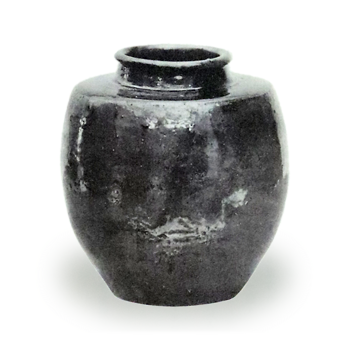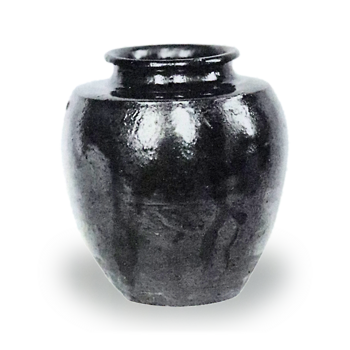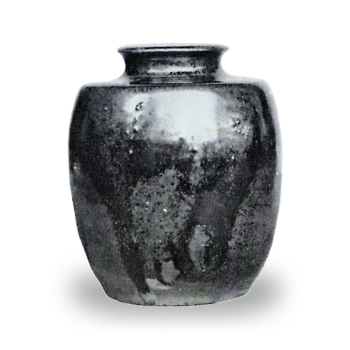
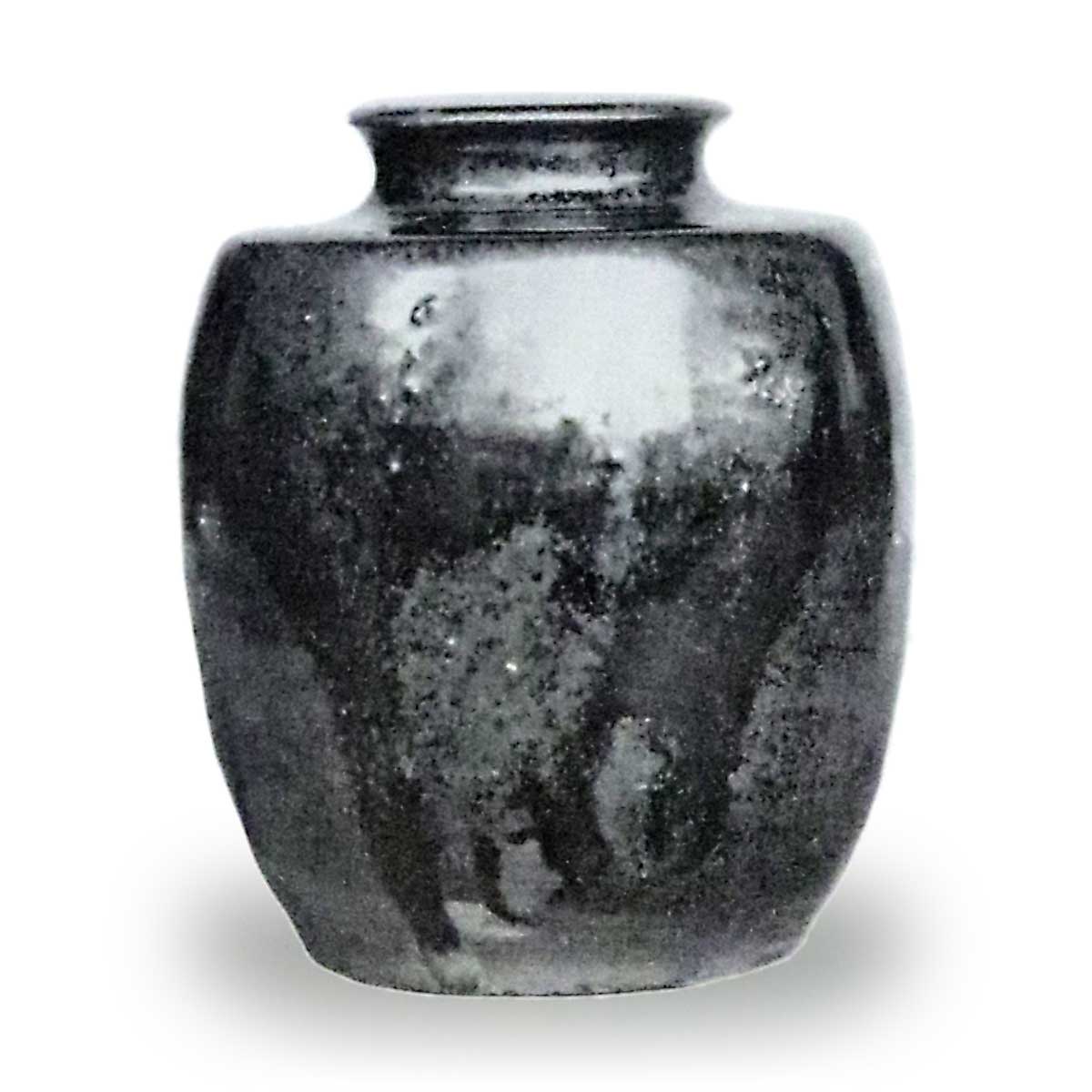
Made in China (Han-style) | Daimeibutsu | Formerly in the collection of Marquis Tokugawa Kuniyuki
Origin of the Name
This tea caddy was originally owned by Ōuchi Yoshitaka. However, during the Tō Harukata Rebellion in 1551 (Tenshō 20), the monk Gyokudō, who was residing at Ryūfuku-ji Temple in Yamaguchi at the time, took it with him when he fled to the Ōtomo clan in Kyushu. He later traveled to Kyoto and sold it, which is why it came to be known as the “Gyokudō Katatsuki.” Gakudō, whose secular name was Sōjō, was the 92nd abbot of Daitoku-ji Temple and passed away on January 17, 1561 (Eiroku 4), at the age of 82.
Dimensions
Height: Approx. 8.8 cm (2 sun 9 bu)
Body diameter: Approx. 7.9 cm (2 sun 6 bu)
Mouth diameter: approx. 3.9 cm (1 sun 3 bu)
Base diameter: approx. 5.1 cm (1 sun 7 bu)
Rim height (rise of the rim): approx. 1.1 cm (3 bu 5 rin)
Shoulder width: approx. 1.5 cm (5 bu)
Weight: approx. 142.5 g (38 monme)
Accessories
Lid: 1 piece, made of ivory
Carrying Pouch: White chirimen silk
Hikiya: Black lacquered, black interior
“Gyokudo” inscribed in silver powder (artist unknown)
Pouch: Arisugawa brocade, lined with striped Donshu silk, cord in dark brown
Box: Unfinished paulownia wood box
“Gyokudo” inscribed in regular script with ink (artist unknown)
Miscellaneous Notes
Gyokudo Katatsuki: Owned by Hariya Sōwa of Tachibai (near present-day Nakagyō Ward, Kyoto). This teapot is an interesting piece, as both its shape and rim suit modern tastes. (From Gunshū Ruijū Honchaki Meibutsu Shū)
Gyokudo Katatsuki: Belongs to Hariya Sōwa of Kyoto. This teapot is one whose rim also suits modern tastes. (From Yamagami Sōji no Ki)
Gyokudō: Owned by Sōwa. Height 2 sun 9 bu, width 2 sun 6 bu, circumference 8 sun 2 bu, base 1 sun 7 bu, rim 1 sun 4 bu, rim rise 3 bu 5, bulge 1 sun 6 bu; the glaze is monochromatic (illustration of the tea caddy included). (From Manpō Zenshū)
Gyokudo Katatsuki: Located in Kyoto, owned by Hariya Shōchin. (From Tenshō Meibutsu-ki and Higashiyama Go-mono Uchi Betsuchō)
Gyokudo: Owned by Murata Jukō, and later by Mandaiya Sōan. This jar, owned by Matsue Aki-no-kami (Asano Nagamasa), has four spatula marks and one on the surface; there are indentations and spatula marks at the top and bottom, and within them, there is a glaze run (drip). (From Kobutsuki)
Regarding the Gyokudo Katatsuki, Sōwa’s records state “Katatsuki Shijō,” as he lived in Shijō, Kyoto. Ancient texts state that “the Gyokudo Katatsuki is in Sōwa’s possession,” and it is also said to be “Sōwa the Needle Maker of Tachibana, Kyoto.” In a text by Kamiya Sōtan, it is recorded as having been present at a morning tea gathering on the 29th day of the first month of Tenshō 15 (1587), and in a text by Yamagami Sōji, it is also noted as “Sōwa the Needle Maker of Tachibana, Kyoto.” (From Rikyū Hyakukai Kai)
It is said that when Gyokudo Osho traveled to China (the Ming Dynasty) and returned home, he carried this tea caddy in his robe and brought it back, thus introducing it to the world. The current Gyokudo Katatsuki is this very caddy, and people of old claimed that this history serves as proof that it is a Tang-era (Chinese-made) item. (From Chaki Ben’gyoku-shū)
The Gyokudo was a personal possession of Priest Gyokudo. Fearing that such a magnificent tea caddy would be stolen during the turbulent war years, he smashed it into pieces, placed them in a bag, and carried them with him. It is said that he later pieced it back together once peace returned to the land. It is a Tang-style piece. This lid is an interesting pair; the right lid is the upper part, and together they were called the “Yin-Yang Lids.” The lid of the Gyokudo Meibutsu tea caddy is the “Yin.” While this may be a later fabrication, it is a well-crafted legend. (From Chaji Fukki Shū)
The lid of the famous Gyokudo Meibutsu tea caddy is to Sen no Rikyū’s taste. However, it is flat, with a recessed top on the handle and a groove running along the side of the handle. (From Chafu)
This is a tea caddy fired by Toshirō, who traveled to China with the second-generation Gokudō Osho; it is a famous piece known as “Gokudō.” It is in the possession of Matsudaira Aki-no-kami (the Asano family). (From Meibutsu Chairi Mekiri no Sho)
It is only recently that tea caddies have become so expensive. When I was a boy, the only items considered “famous pieces” in the world were the “Gokudō” tea caddy and Sen no Rikyū’s “Enza Katatsuki.” This did not have a specific price tag; rather, it was spoken of as a masterpiece without equal. (From Rōjin Zatswa by Emura Sensai)
Gyokutō (Gyokutō): A Chinese-style katatsuki. Owned by Lord Matsudaira Aki-no-kami. (From Ganka Meibutsu Ki)
Gyokutō: Daimeibutsu among Chinese-style katatsuki. Owned by Matsudaira Aki-no-kami. (From Kokin Meibutsu Ruiju)
Gyokutō: Made in China. It is from the same era as Meibutsu tea caddies such as Nitta, Setaka, Fudo, and Yanagimura. (From Seto Toki Ransho by Matsudaira Fumai)
(August, Tensho 19) At midnight on the 29th, Lord Ouchi Yoshitaka fled from Hosen-ji (Note: This is a mistake; the correct temple is Ryufuku-ji). While the enemy stormed the temple, slaughtering even the monks and burning the temple to the ground, committing every conceivable act of violence and debauchery, the Venerable Gyokudō of Ryūfuku-ji cast aside his splendid purple robes, donned ragged clothes, and placed black food into a cracked bowl. He then broke the katatsuki (a tea caddy) bestowed upon him by Lord Yoshitaka, hid it at the bottom of the bowl, and escaped while eating the food. People mistook him for a genuine beggar, and while no one recognized him, he secretly made his way to Kyoto, pieced the shoulder ornament back together, and sold it for a vast sum of tens of thousands of kan. From then on, this shoulder ornament was named “Gyokudō,” and people called the priest the greedy “Gyokudō Priest.” That shoulder ornament has been passed down to the present day and is considered one of the foremost Meibutsu tea utensils. (From Intoku Taiheiki: The Fall of Lord Yoshitaka at Hosen-ji)
Long ago, during the turmoil of the 20th year of the Tenmon era, Priest Gyokudo (the head priest of Ryufuku-ji in Yamaguchi, Suo—a temple founded by Ouchi Yoshitaka) attempted to flee with a kanten-style tea caddy, a treasured artifact of his temple. However, fearing that the rebels would seize it since it was a Meibutsu known to all, he smashed it, wrapped the shards in a torn kasaya robe, and placed it on his head as he fled. Later, he mended it and sold it, and it is said that people mocked him, calling him “Monk Yokudo” instead of “Monk Gyokudo.” Nevertheless, this mended piece became a nationally renowned Meibutsu known as the “Gyokudo Katatsuki.” (From Yamaguchi Meisho Kyuseki Zashi)
The Gyokudo tea caddy was originally owned by the Ōuchi clan. However, during Tō Harutaka’s rebellion, Monk Gyokudo happened to be in Yamaguchi, Suō, so he placed this tea caddy on his head and fled. Since the Ōtomo clan was a patron of Daitoku-ji and also had ties to the Ōuchi clan, Monk Gyokudo fled to the Ōtomo clan in Bungo. Later, it was purchased by Haruya Muneharu and subsequently passed to the Asano family in Hiroshima. The “Gyokudo” in Hiroshima is called “Gyokudo” because it was once owned by Priest Gyokudo of Daitoku-ji. Priest Gyokudo lived during the time of Gyokufu, the head priest of Kotō-in. Gyofu belonged to the Kokei school; temples of the Kokei school in present-day Daitoku-ji include Kōtō-in and Gyokurin-an. (From Enheiken by Kurokawa Dōyū)
Gyokudō: A possession of the Mito Tokugawa family (Lord Mito). Height: 3 sun; body: 2 sun 6 bu; mouth: 1 sun 8 bu 5 ri; base: 1 sun 7 bu; distance from mouth to shoulder: 4 bu. It is a Higashiyama Imperial Treasure (formerly owned by the Ashikaga Shogunate), which passed through the Oda and Toyotomi families before being bestowed upon Asano Danjō (Nagamasa). It was presented as a memento to Tokugawa Ieyasu (the Divine Lord), returned once, but presented again, and subsequently became part of the Mito Tokugawa family’s collection. Currently, the original storage box is in the possession of the Asano family (the Geishū branch). (From Shokake Meiki Shū)
On the morning of November 19, Tenshō 5 (1577), a tea gathering was held at the residence of Hariya Sōwa in Kyoto.
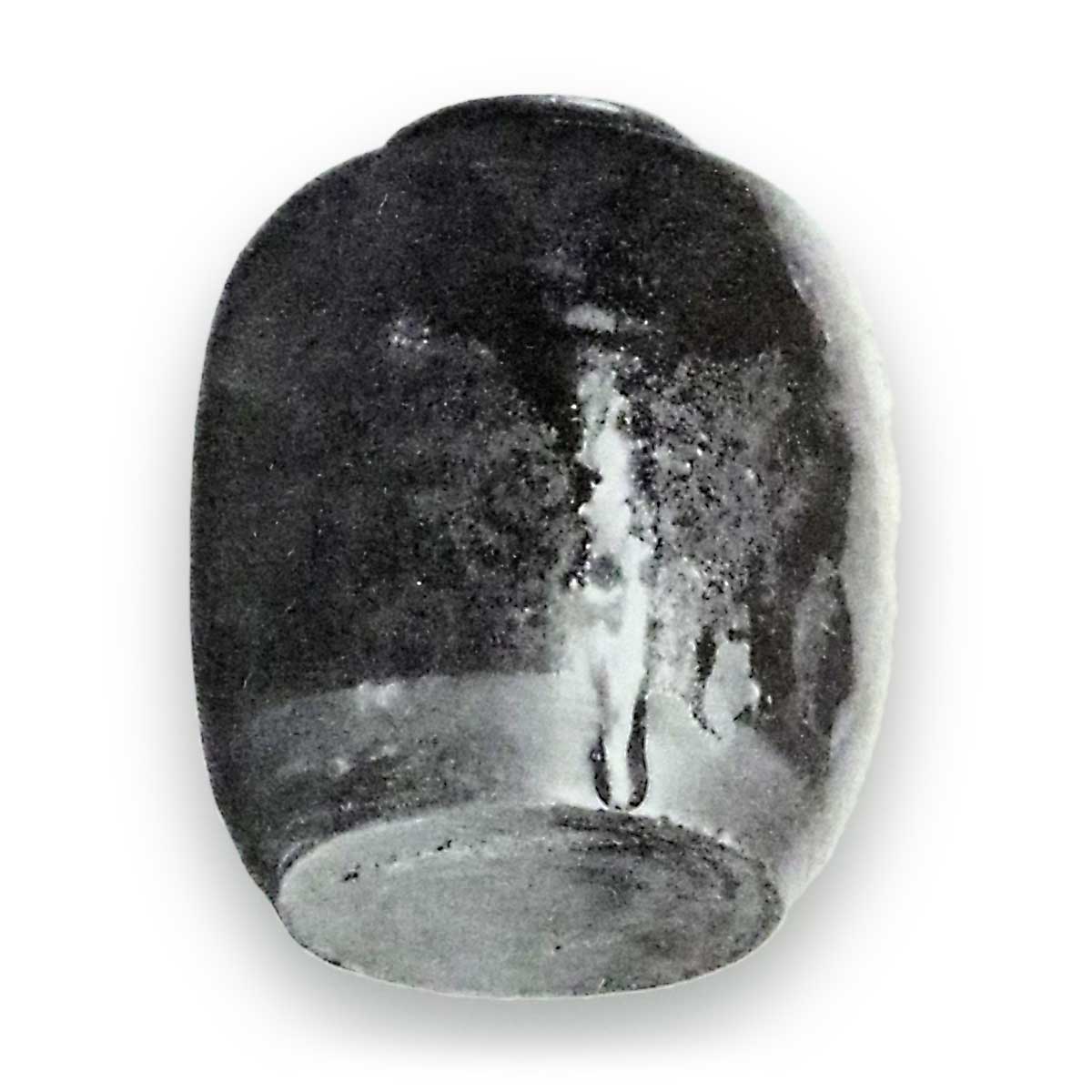
The guests were Tsuda Sōyuki and Sōnō; Kōan joined later. A kettle with a polished finish was suspended from the hearth by a chain, and a painting of eggplants was hung on the hand-washing stand (though the hand-washing mat was rolled up). A tenmoku stand, a tea whisk stand, and a gold-lacquered box were used. After the tea ceremony, a Gyokudo katatsuki was brought out on a shihō-bon tray. The bag was made of Kinran komon fabric of the Yodohon style (a type of textile?), with a light yellow cord. Sōyuki placed the katatsuki in the tokonoma and set it in the center. This katatsuki is a large-sized vessel shaped like a straight-sided jar, appearing to have no shoulders or hem. The clay is whitish, the glaze is black, and the overglaze is also black. There is a glaze drip on the front, and a cluster of glaze on the left side of the vase that catches the eye. There is slightly colored glaze at the tip of the drip, and a little bit on the back where there are marks resembling claw marks. Overall, it is entirely black. The glaze appears hard, with some areas having a pear-skin texture. The mouth is narrow and lacks a twisted rim; instead, it has a raised edge. The shoulder is wide, and there are no wheel marks at the rim. There is no waist, and the base is a scraped base (a base that appears to have been carved away). The width is slightly wider than three and a half tatami mats, but not quite four. The glaze stops at the best point, appearing as if it has been drawn up slightly. (From Tsuda Sōyū’s Tea Ceremony Diary)
On the morning of the 29th day of the first month of Tenshō 15 (1587), a tea gathering hosted by Hariya Sōwa, a street vendor from the capital.
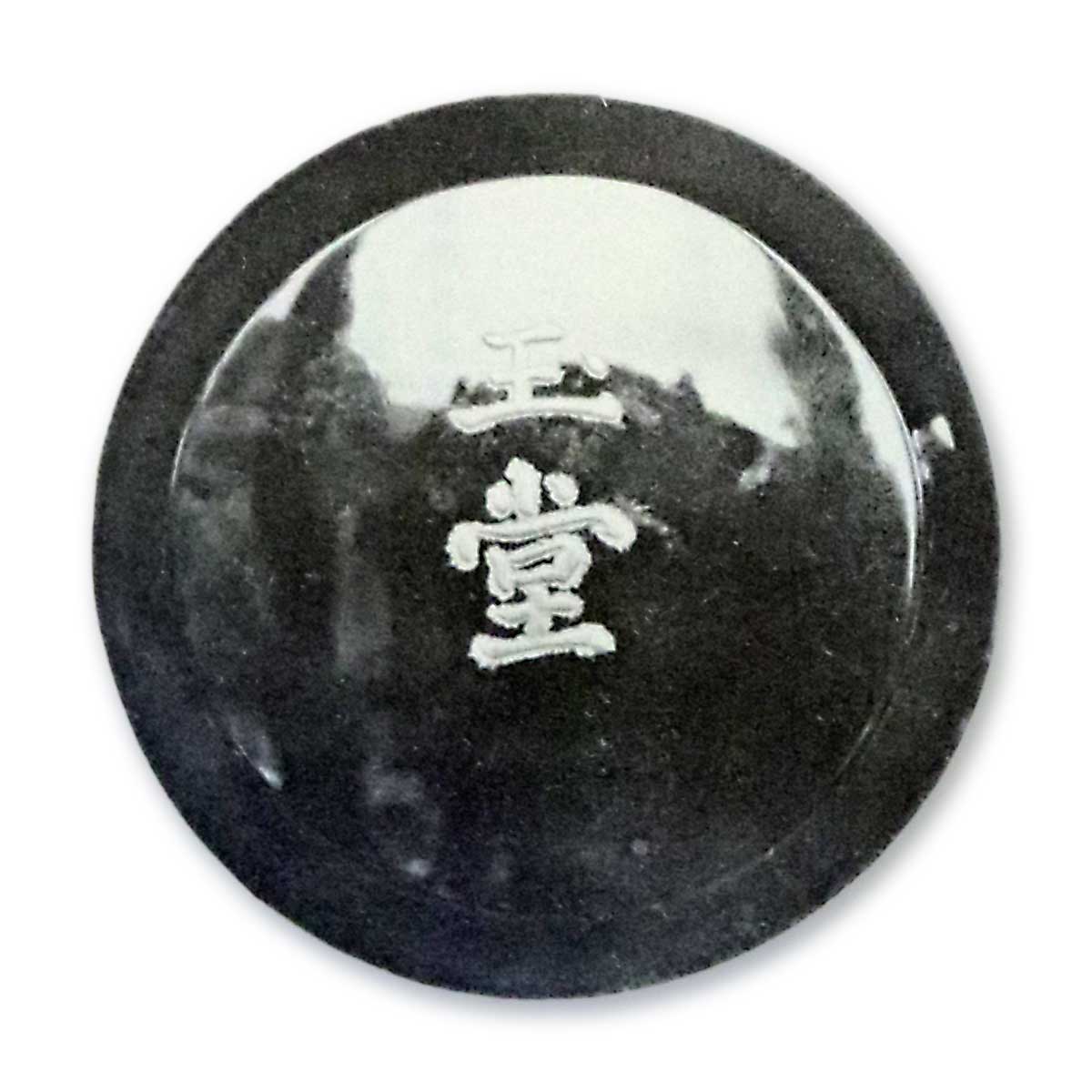
The guests were the elderly Sōyuki and Kamiya Sōtan. The tea room was a standard three-tatami mat size, with a 4-sun-wide lapis lazuli-edged tokonoma. The kettle was suspended from the back of the tokonoma using a swivel hook. The katanuki was placed in a bag on a shihō-bon tray and set beside the hanging scroll (toward the center of the tokonoma). The katanuki has reddish-brown clay with a blackish hue. The glaze has run down about 3 or 4 sun, and there is one streak. The tip of the glaze (the end of the drip) is white-yellow. There are two streaks within the glaze, and between them is a gap in the glaze shaped like a finger. There is also a glaze loss about the size of a thumb on the back. The glaze on the lower section is a pale black with a slight reddish tint and contains fine, silver-like streaks. The glaze on the upper section is black with an amber hue. There are two ridges above the ridge at the base of the rim; both are hidden by the glaze, and the inner ridge appears to stand out prominently. The bottom is a rough, unglazed base where the clay is visible. (From Sōtan Nikki)
Exhibited at the Kitano Grand Tea Ceremony on October 1, 1587.
As items belonging to Haruya Shōchin, a painting of eggplants by Gessan, a shoulder-resting round tray, and a shoulder-resting Gyokudō were exhibited. (From Illustrations of the Kitano Grand Tea Ceremony, held by Kitano Shrine)
It is said that when Lord Hideyoshi established his camp for the Odawara Campaign, Sen no Rikyū also inserted a seven-section ladle with a tea whisk attached as a flag (hatazashimono) and served tea from horseback. It is also said that he had a tea room (sukiya) built at the Ishigakiyama encampment, where Rikyu entertained Lord Ieyasu by preparing tea using items such as the Hashidate teapot and Gyokudo’s tea caddy. It is further said that Oda Nobuo, Hosokawa Tadaoki, Gamō Ujisato, Uesugi Kagekatsu, Hashiba Shimōsano-no-kami, Katsu Gagaku, and Maenami Han’iri also joined them to partake of the tea. (From Chaji Hiroku and Chayū Kojidan)
Afterward, a tea house was set up within the camp, decorated with the Hashidate teapot and the Gyokudō tea caddy. The host was Lord Suruga (Tokugawa Ieyasu), the attendants were Hosokawa Yūsai, Yumi, and Hōkyō Rikyū, and the hostess was Maenami Han’iri. After the tea ceremony, beautiful young maidservants aged 16 to 20 were made to pour sake, and they opened gold and silver fans to keep time, chanting “Zanza no matsu no koe no, gokeshina, gokeshina” like the song of a bush warbler. Even those of low status imitated the upper classes, and there was not a single person who did not enjoy themselves from the bottom of their hearts, thinking, “I wish to spend my life in a camp like this.” (From Shinsho Taikoki)
On the morning of March 23, Keichō 2 (1597), in Fushimi.
A tea gathering hosted by Lord Asano Danjō (Nagamasa). Guests included Sōtan and Ushin’u. A four-and-a-half-mat room, a four-shaku tokonoma, and a four-sun glass-edged shelf. A large kettle. A shoulder-rest was placed in a bag beside the hanging scroll and set on a square tray, and so on. During the hand-washing break (rest period), the shoulder-rest was placed beside the travel basket, and so on. The shoulder-rest is “Gyokudō.” There are three cascading patterns on the front, and the tips of the drapes have a whitish glaze. The overall glaze is blackish, with an amber-colored glaze bubbling up on top like a pear skin texture, and there is an area where the glaze has been lost on the back. The clay is black with a bluish tint and is slightly whitish. The clay where the glaze has been lost is visible for about 5 centimeters. The bottom is a “hege” bottom. The shoulders are prominent. The bag features a light green Donshu komon pattern, and the cord is purple with a twisted design. (From Sōtan Nikki)
On October 8, Keichō 18 (1613), a Tamadō katatsuki tea caddy was presented to Tōshōgū (Tokugawa Ieyasu) as a memento of Asano Yukinaga. (From Asano Kefu)
Asano Nagakira (also known as Tajima-no-kami; actually the second son of Nagamasa) was born in Obama, Wakasa, in 1586 (Tenshō 14). In 1613 (Keichō 18), his older brother Yukinaga died without an heir, so he inherited his domain. On March 18, Genna 2 (1616), while he was in mourning for his mother, he received an order to hold a ceremony marking the end of his mourning period and was presented with a crane. Later, when Ieyasu fell ill, he traveled to Sunpu to attend to him and was bestowed with a tea caddy by Gyokudo. This was a treasured artifact of the Nagakira family and had been previously presented to Ieyasu. He died on September 3, Kan’ei 9 (1632) at the age of 47. His principal wife was Furi-hime, the daughter of Ieyasu. His posthumous Buddhist name was Shōhōin. (From Kansei Shūshū Shokafu)
Asano Mitsuaki (Aki-no-kami; upon retirement, Kii-no-kami; his mother was Furi-hime, the daughter of Ieyasu) was born in Wakayama in 1617. On November 1, 1632, when he presented his gratitude for inheriting the family headship, he presented to the Shogun a Masamune wakizashi and a Gyokudo tea caddy, both heirlooms of his father, Nagateru. On the 2nd, he ceded 50,000 koku of his fief to his half-brother, Nagaharu. At that time, the Shogun bestowed upon him the Gyokudo tea caddy he had presented the previous day. He retired on April 18, 1672 (Kanbun 12), and on May 18, he presented the famous Masamune tantō and a Gyokudō tea caddy to the Shogun. He passed away in Hiroshima on April 23, 1693 (Genroku 6), at the age of 77. (From Kansei Shūshū Shokafu)
On April 5, 1616 (Genna 2), Sakai Gagaku-no-kami Tadamasa was also granted a tea caddy decorated with Chinese lanterns at Ieyasu’s sickbed. Asano Tajima-no-kami Nagateru was also granted a tea caddy by Gyokudo. It is said that this was the same one previously presented by his father, Asano Danjō-no-suke Nagamasa. (From Tokugawa Jikki)
On May 18, 1672 (Kanbun 12), Matsue Aki-no-kami presented a famous Masamune ko-wakizashi (valued at 5,000 kan) and a Gyokudo tea caddy. (From Imperial University Historical Materials: Record of Presented and Acquired Artifacts by Various Families)
The Gyokudo Katatsuki. It was owned by the Lord of Aki (the Asano family) and presented to the Shogunate (His Lordship the Shogun), becoming an imperial possession. It was presented to the Shogunate during the era of Lord Kii (the title given to Asano Mitsuaki after his retirement). The Asano family has no knowledge of its fate thereafter. The imperial bag was purple and crafted by Sasaki Tokuzan, but the bag was destroyed in a fire. At the time of presentation, it was wrapped in an old Donshu cloth—the original bag from the “Komura Katatsuki”—and then covered with two layers of cotton Kanto bags. It is said that both of these bags were sewn by Fujishige. (From Seiji-an no Setsumangusa: Chado Wakugai)
Gyokudo. Presented to the Shogunate by the Lord of Aki (the Asano family) and became a Shogun’s personal possession. The imperial bag was purple and made by Tokuzan, but the original bag was lost in a fire. At the time of presentation, an old bag from the Nomura Katatsuki was draped over it. Both the old Donshu and the cotton Kanto bag were crafted by Fujishige. (From Toda Roin’s Sekkan-so)
Hanging Scroll: Ingetsu-ko
Tea Caddy: Osumi Katatsuki
Flower Vase: O-sorori (with a single peony flower and leaf)
Tea bowl: Rikyu Ido
(Alternative utensils)
Tea caddy: Gyokudo
Tea bowl: Waritakadai
The tea gathering described on the right is a record of the occasion when a meal was presented to Lord Owari in the Seiko Room of the Kuro Shoin. After the Senior Councilor Sakai Gakuto delivered his greetings, it is said that they admired the flowers in the front garden and performed the tea ceremony. (From Tokugawa Ieyasu Chakai no Ki)
On September 25, Genroku 13 (1700), the Shogun (Tokugawa Tsunayoshi) visited the residence of the Mito Regent (the Mito Tokugawa family) and returned at the hour of the Snake (around 10:00 a.m.).
Items bestowed by the Shogunate (His Lordship the Shogun) upon the Mito Regent:
A genuine katana (valued at 10 pieces of gold), 2,000 pieces of silver
100 sets of seasonal clothing, 100 rolls of chirimen silk
50 rolls of shuchin silk
Items bestowed during the tea ceremony:
A katana (made by Nagamitsu, valued at 1,000 Sen), a wakizashi (made by Yoshimitsu, valued at 300 pieces of gold)
Items bestowed in private:
A tea caddy, “Gyokudo”
(From Godaidai-ki by Toda Shosui)
(Note) Toda Shosui was born in the Sannomaru of Sunpu Castle in 1629 (Kan’ei 6) and became an attendant to the Suruga Daikan (Tokugawa Tadanaga). In 1632 (Kan’ei 9), he was implicated in Tadanaga’s crimes and entrusted to the care of Ōzeki Tosa-no-kami; the following year, he was exiled with his family to Kurobe in Shimotsuke Province. He was later pardoned and returned to Edo, where he served Honda Tadanori, lord of the Okazaki domain, and lived in a residence in Hongo-Morikawa. He later retired and lived near Kinryū-ji Temple in Asakusa. He was known by the pen names Rihon and Inka, and was renowned as a poet. He passed away on April 14, 1706 (the 3rd year of the Hōei era), at the age of 78.
March 1850 (Kaei 3): Tea ceremony hosted by the Chūnagon of Mito
Hanging scroll: Calligraphy by Dōtō Kokushi (with accompanying letters from Ikkyū and Sōtan)
Flower vase: Bamboo-patterned blow-through cut (made by Sotakusai, inscribed “Hokushin”)
Tea caddy: Chinese ware, inscribed “Gyokudō”
Bag: Striped Guangdong silk; Tray: Chinese tray
Tea bowl: Kishu ware, black glaze, placed on an Amagasaki Tenmoku stand
(From Mr. Mokuzan Sōgi’s Record of Tea Ceremonies)
“The Danjō Pot (entirely Luzon ware, weighing 1,200 sen). It is unknown who originally owned this pot, but the characters ‘Teiwa 3’ and a seal mark are engraved on the bottom, and its maker is also unknown. During the Keichō era, the tea ceremony flourished throughout the land, and Toyotomi Hideyoshi (the Taikō) particularly loved this jar and kept it as a closely guarded treasure. At that time, Asano Danjō (Nagamasa) had distinguished himself in military service, so Hideyoshi presented this jar to him as a reward. Danjō accepted it and used it to store tea; even after many years, the flavor and aroma remained unchanged. He therefore presented it to the Divine Lord (Tokugawa Ieyasu). Ieyasu also cherished it, and because Danjō had presented it, he named it the “Danjō Pot.” Later, along with the Gyokudō tea caddy, it was bestowed upon Lord Takafusa (Tokugawa Yorifusa), the founder of the Mito clan. Since then, it has been passed down as a treasured artifact, so it must never be damaged.
Summer of Tenpō 8 (1837)
Written by Tokugawa Nariaki (Seal)
(From “Rekkō’s Handwritten Account of the Danjō Pot”)
(Note) In the aforementioned handwritten “Danjo-tsubo Ki” by Mito Retsukō (Tokugawa Nariaki), it is recorded that the Gyokudō tea caddy was received by Lord Ie (Yorifusa), the founder of the Mito Domain, from Ieyasu at the same time as the Danjo-tsubo. However, when compared with other records, it appears that the Gyokudō was received around the Genroku era (the time of Tsunayoshi). We leave this question open and await future research.
History
Originally owned by Ōuchi Yoshitaka, it was donated to Ryufuku-ji Temple in Yamaguchi, which he had founded. On August 29, 1551 (Tenshō 20), when Tō Harutaka invaded Yamaguchi, Ōuchi Yoshitaka fled to Hōsen-ji Temple. Since Ryūfuku-ji Temple was also burned down, the temple’s abbot, Gakudō, fled with this tea caddy and temporarily took refuge with the Ōtomo clan in Kyushu (the later legend that he smashed this tea caddy at that time is a misconception). Later, Priest Gyokudo traveled to Kyoto and sold it to Hariya Sōwa, a wealthy merchant in the street market district. It is said that people remarked, “It is not Gyokudo (the ‘Magnificent Hall’), but Yokudo (the ‘Greedy Hall’).” The fact that this tea caddy was used at tea ceremonies hosted by Hariya Sōwa in 1577 and 1587 is described in detail in the tea ceremony diaries of Tsuda Sōyuki and Kamiya Sōtan. It is believed that the tea caddy soon passed into the hands of Toyotomi Hideyoshi. During the Siege of Odawara in 1590, he displayed this tea caddy at his headquarters on Ishigakiyama to honor his generals, as recorded in sources such as the Shinsho Taikoki. Subsequently, Hideyoshi bestowed it upon Asano Danjō (Nagamasa), and the Sōtan Nikki notes that Nagamasa used this tea caddy at a tea gathering on March 23, 1597 (Keichō 2). Later in life, Nagamasa presented it to the Edo Shogunate (the Tokugawa family). In Keichō 18 (1613), Nagamasa’s son, Yukinaga, died without an heir, and his younger brother, Nagamasa, inherited the estate. However, on April 5, Genna 2 (1616), when Nagamasa visited Sunpu to pay a sick call on Tokugawa Ieyasu, Ieyasu presented this tea caddy to him once again. On November 1, 1632 (Kan’ei 9), when Nagateru’s son, Mitsuteru, succeeded him, he presented this item once more to Shogun Iemitsu; however, the very next day, Iemitsu bestowed this tea caddy upon him anew. On May 18, 1672, Mitsunari presented it once more to Shogun Ietsuna; it remained at the shogunate (Ryūei) for some time thereafter, and there is a record indicating that this tea caddy was used at a shogun’s tea ceremony in 1678. On September 25, 1700 (Genroku 13), when Shogun Tokugawa Tsunayoshi visited the Mito family’s residence, he secretly bestowed this tea caddy upon Tokugawa Tsunatomo, the Mito Chancellor.
Record of Actual Viewing
On September 2, 1918, I viewed this piece in person at the residence of Marquis Tokugawa Kuniyoshi in Komegicho, Honjo Ward, Tokyo.
The rim features a twisted edge and is shaped like a clam shell, with a double-beveled profile. Compared to the “Nitta (Meibutsu Tea Jar),” the rim (the rise of the mouth) is slightly lower, the shoulders are strongly flared, the narrowing from the rim downward is minimal, and the base is very wide. Overall, within the dark amber-colored glaze, drips of a slightly richer glaze of the same color create a scenic effect, and there are areas around the shoulders that take on a slight blue-green hue. From the rim downward, the body is an earthen color containing iron, and within the pools of glaze that flow down to the edge of the footring, a hint of blue-green can be seen. The base shows signs of wear from being lifted from a board (traces of where it was cut from the board with a string). Inside, glaze covers the rim of the mouth; the wheel marks run in a gentle spiral, and the center of the base is ring-shaped. While the overall body color is deep, so the patterns are not particularly vivid or sharp, this is a tea caddy with a calm, dignified, and majestic atmosphere.