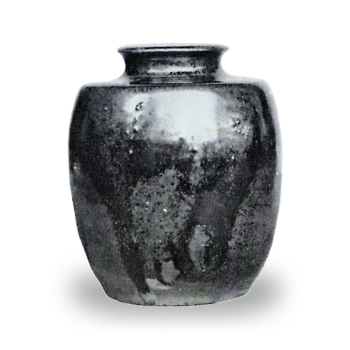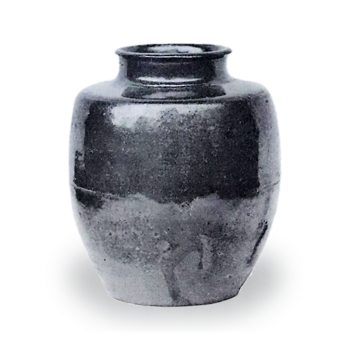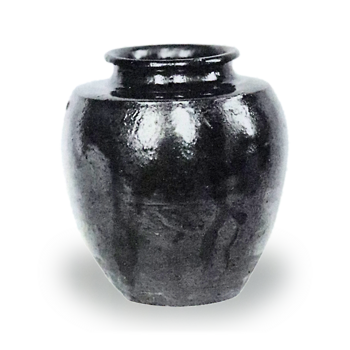
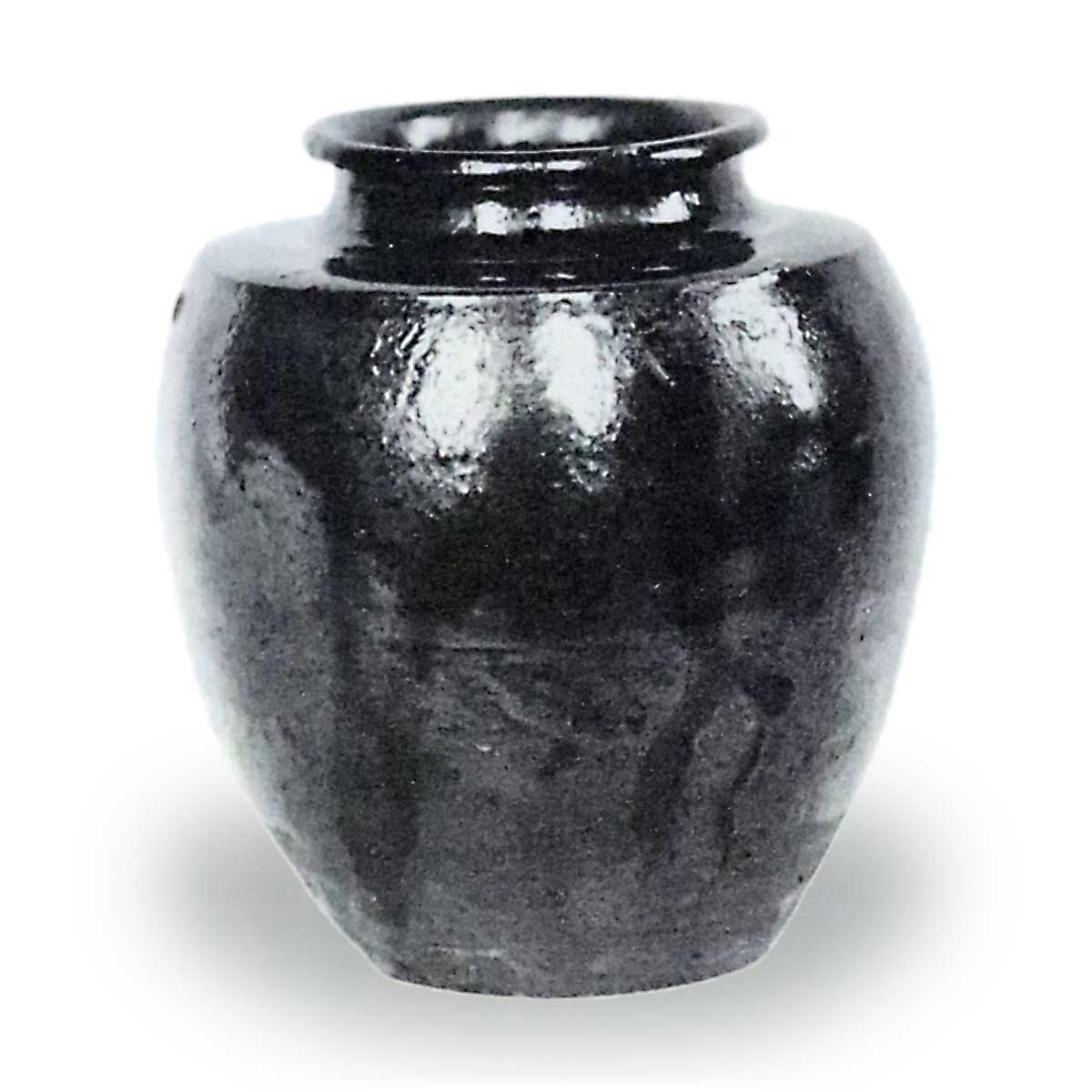
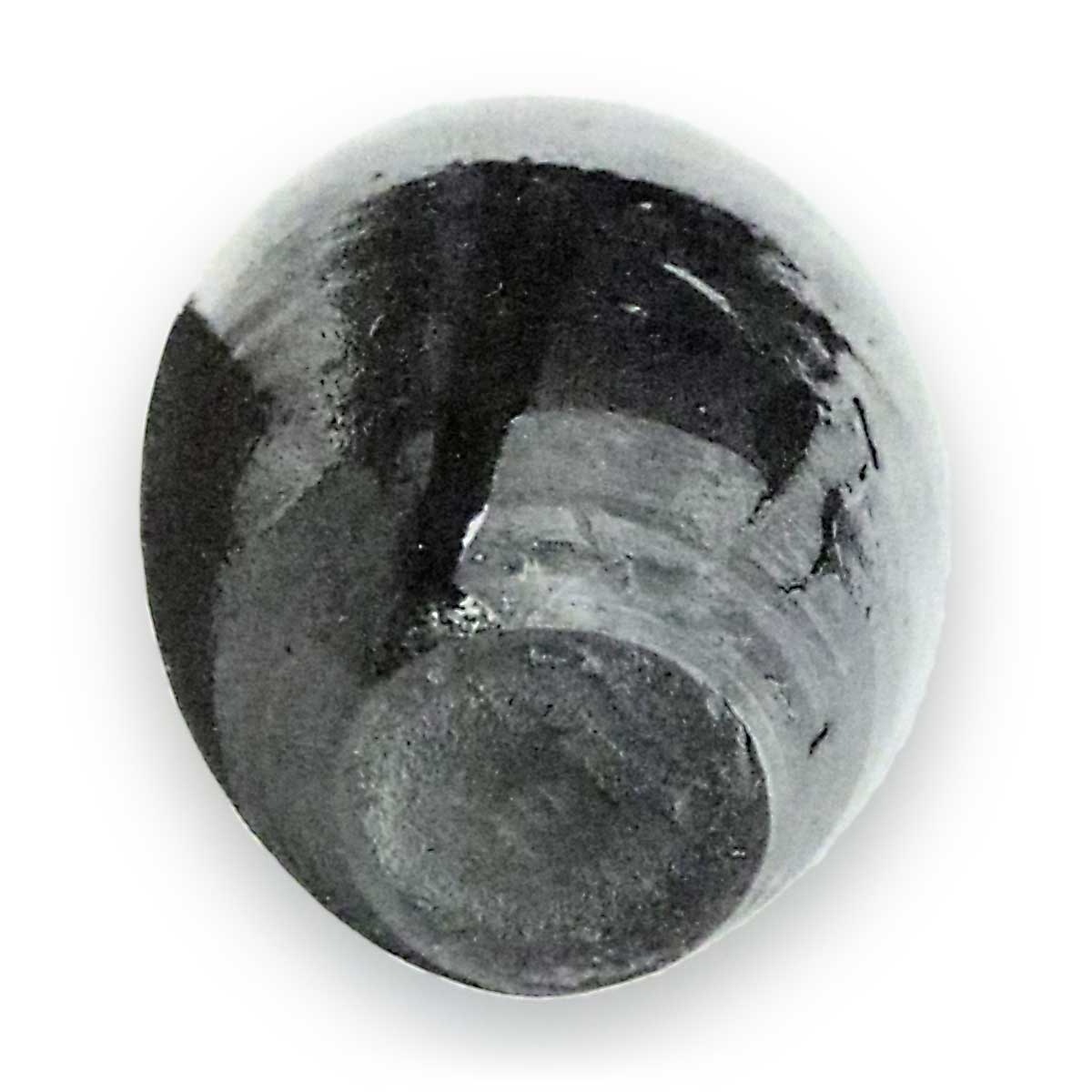
Made in China; Daimeibutsu; formerly owned by Duke Ietatsu Tokugawa
Origin of the Name
According to the Tokugawa family’s catalog of tea utensils, the name “Osazakura” was given in contrast to the famous tea caddy “Hatsuhana.” It states, “The name was bestowed by Lord Higashiyama (Ashikaga Yoshimasa), who drew inspiration from the spirit of the poem in the Kinyo Wakashu: ‘The late-blooming cherry blossoms mingling with the green leaves of summer mountains—how much more rare and wonderful they are than the flowers that bloom at the beginning of spring.’” Incidentally, this poem appears in the “Summer” section of the Kon’yō Wakashū, accompanied by a preface stating, “Poems composed at the residence of the Kanpaku of Nijō, using the theme of flowers left behind after the blossoms have fallen,” and the author is Fujiwara no Morifusa.
Dimensions
Height: Approx. 8.7 cm (2 sun 8 bu 8 rin)
Body diameter: Approx. 8.1 cm (2 sun 6 bu 9 rin)
Mouth diameter: approx. 4.8 cm (1 sun 6 bu)
Base diameter: widest point approx. 4.2 cm (1 sun 4 bu), narrowest point approx. 4.1 cm (1 sun 3 bu 5 rin)
Neck height: approx. 1.0 cm (3 bu 2 rin)
Shoulder width: approx. 1.4 cm (4 bu 5 rin)
Weight: approx. 144 g (38 monme 4 bu)
Accessories
The set includes two storage pouches (shifuku) for the tea caddy, a white paulownia wood box to hold each pouch, a black-lacquered tube (Hikiya) to protect the tea caddy, a bag to hold the tube, and inner and outer boxes to store the entire set. As a note, old records indicate that a calligraphy scroll by Emperor Go-Yōzei was once included, but it is reportedly missing today. Additionally, there is one ivory lid and a bag made of white ha-ni-ju fabric.
Miscellaneous Notes
A Chinese-made late-blooming cherry blossom-shaped shoulder-strike. This inscription was intended as a contrast to “Hatsuhana.” During the era of Ashikaga Yoshimasa, had it been selected as a masterpiece before “Hatsuhana,” it would likely have been regarded as the finest in the world; however, since it was recognized after “Hatsuhana” had already been established as the first, it was likely considered the runner-up. It is said that Ashikaga Yoshimasa named it based on the meaning of a poem in the Kinyo Wakashu (Collection of Gold-Leaf Waka). Its height is approximately 8.8 cm (2 sun 9 bu).
According to the Tokugawa-ke Godo Shosho Mokuroku (Catalog of the Tokugawa Family’s Artifacts), there are slight traces of repair on the rim, the base is constructed using the “ita-oki” method, it has a worn-looking luster, the base glaze has a persimmon-black hue, and it is a thin, elegant piece. There are two ridges on the body, and details such as the bag and Hikiya are recorded.
The Meibutsu-ki records its weight, precise dimensions, and characteristics such as the “avocado-black” glaze pattern (a glazed effect).
The Rinpō-kuryū notes that it is a Daimeibutsu, describing the type of bag, the “avocado-black” glaze pattern, and its exceptionally strong metallic luster.
In Kankyū Guhitsu, a record of a secret viewing after the piece was removed for maintenance states: “Some say that Chizakura is slightly inferior to Hatsuhana, but if shown to a connoisseur without explanation, they would surely say it is a beautiful piece of Kyoto-yaki or Senzoku-yaki. The glaze patterns (quail-spot and flowing patterns) are beautiful, and it is a Meibutsu that is in no way inferior to Hatsuhana.”
The Makuan Bunko A No. 1 notes that it is a Chinese tea caddy second only to the Hatsuhana, with a solid form, a vivid amber glaze, and a heavy application of black glaze on top, giving it an overall black appearance.
An entry from the Tsuda Sōyū Chayū Nikki dated Tenshō 3 (1575) offers a somewhat harsh assessment: “I saw this pot (Otsuzakura) for the first time, but its shape is poor, with broad shoulders and a small base. Both the clay and the glaze are black.”
An entry from the Matsuya Hoki dated Genna 5 (1619) states that at the residence of Todo Takatora, a Oshizakura katatsuki and other pieces were displayed in the tokonoma, and tea was served there.
The Higashiyama Gomono Naibetsucho records that it was in the possession of Matsudaira Shimotsuke-no-dono (Gamo Tadasato).
Finally, a brief biography of Tadasato, the grandson of Matsudaira Shimotsuke-no-dono (Gamo Ujisato), begins.
Tadakata succeeded to the family at the age of 10, ruled over the 600,000-koku domain of Aizu, and was styled Shimotsuke-no-kami. He was treated with great favor, including being granted the Matsudaira surname by the Shogunate, but he died in 1627 (Kan’ei 4) at the age of 25, leaving no heir, and the family line was extinguished. (From Hankanfu)
This is a record of the Shogun’s visit to the residence of Matsudaira Shimotsuke-no-kami (Gamō Tadakata) in the first year of the Kan’ei era (1624). It is noted that the tea room was adorned with Meibutsu renowned throughout the land, and the tea caddy was a “Kara no Katatsuki” (referring to the “Otsuzakura Katatsuki”). (From Excerpts from the Memoirs of Sakurayama Fuji-an)
Regarding Matsudaira Tadaaki (Shimōsa-no-kami). In the 11th year of Kan’ei (1634), when he requested leave to travel to his domain, he was granted a tea caddy named “Ban-zakura (i.e., Otsu-zakura)” by the Shogun through the Rōjū Doi Ōtsukasa. (From Kansei Shūshū Shokafu)
A Record of Matsudaira Tadaaki’s Deeds. With the realm at peace, in the spring of Kan’ei 10 (1633), Shogun Iemitsu ordered Tadaaki to return home and govern his domain. On that occasion, in recognition of his past service, he was granted a tea caddy named “Ban-zakura.” Although he received countless gifts, this one is cited as particularly significant. (From Ōkusa)
Matsudaira Tadaaki was the grandson of the Taisho (Tokugawa Ieyasu). He distinguished himself during the Siege of Osaka and served as the castle governor of Osaka Castle. He later moved to Yamato-Koriyama and then to Himeji, where he passed away in 1644 at the age of 62. (From Hankanfu)
Matsudaira Tadahiro (son of Tadaaki) presented the shogunate (the shogun) with his father’s遺物, including a Sada-mune wakizashi and a Ban-zakura (Late Cherry Blossom) katatsuki tea caddy, as a token of gratitude for succeeding to the family headship in the first year of Shōhō (1644). (From Kansei Shūshū Shokafu)
Subsequently, it was listed in Ganka Meibutsu-ki as an item owned by the shogunate, and Gyokuro-sō records that in the 4th year of Keian (1651), it was transferred to Tokumatsu-kun (later Shogun Tokugawa Tsunayoshi) as part of Shogun Iemitsu’s estate.
Records indicate that the “Late Cherry Blossom” katatsuki tea caddy was present at the Kanda Palace, Tsunayoshi’s residence, in Genroku 12 (1699).
History of Ownership
Originally owned by Ashikaga Yoshimasa of the Muromachi Shogunate, it passed to Shinoya Sōkyū, a wealthy merchant in Kyoto, during the Azuchi-Momoyama period (around the Tenshō era). Later, in the early Edo period (during the Genna era), it was held by Todo Takatora, and at the beginning of the Kanei era, it passed to Matsudaira Tadasato, the grandson of Gamo Ujisato. In the 4th year of Kanei, Tadasato died without an heir, causing the family line to end, and this tea caddy became the property of the Edo Shogunate.
In the 11th year of Kanei, Shogun Tokugawa Iemitsu bestowed it upon Matsudaira Tadaaki, the lord of Himeji Castle. In the first year of the Shōhō era (1644), Tadaaki’s son, Tadahiro, presented it to the shogunate once again as his father’s heirloom, and in the fourth year of the Keian era (1651), it was given to Lord Tokumatsu of Kofu (later the 5th Shogun, Tokugawa Tsunayoshi) as a memento of Shogun Iemitsu. In the 12th year of the Genroku era (1700), it became a treasure of the shogunate once more, and since then, it has remained in the Tokugawa family’s treasury to this day.
Firsthand Account (Impressions from Seeing It in Person)
On November 29, 1918, I had the opportunity to view the actual piece at the residence of Duke Ietatsu Tokugawa in Sendagaya, Tokyo.
Although this tea caddy has long been praised as rarer than the “Hatsuhana,” as its name “Late Cherry Blossoms Mixed with Green Leaves” suggests, it does not give the same vibrant impression as the “Hatsuhana.” The overall background has a purplish hue with patches of dark brown glaze here and there; while the design is magnificent, both the base color and the glaze are deep and dark, so the design does not stand out clearly, giving a somewhat dark and subdued impression.
On the left side of the front design, near the shoulder, there is a bulge caused by the firing process. The rim is deeply folded back, and there is a small repair mark on the underside of the rim. The body features two mist-like horizontal lines that diverge and break off midway. On the front, the dark amber glaze flows at a slight angle down to the base, where it has pooled. Below the rim, reddish-iron-colored clay is visible. The base is made using the “ita-oki” technique, but since the entire surface has been worn down flat, it appears to have lost some of its natural character.
This is a stately, substantial teapot with a sense of weight, but because both the body color and the flowing glaze are dark, the appearance lacks clarity—not only from a distance but even when held in hand—which feels somewhat unsatisfying. That said, this style is not uncommon among Chinese teapots; pieces like the “Yutang Kenzuki” feature a similar glaze color. While it lacks a certain brilliance, it possesses a refined dignity in its place—perhaps this is a case of pros and cons.