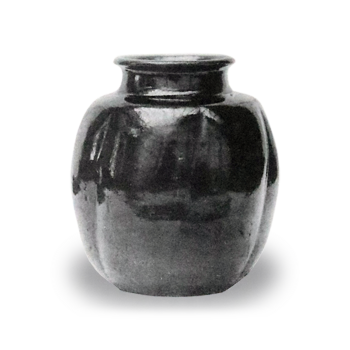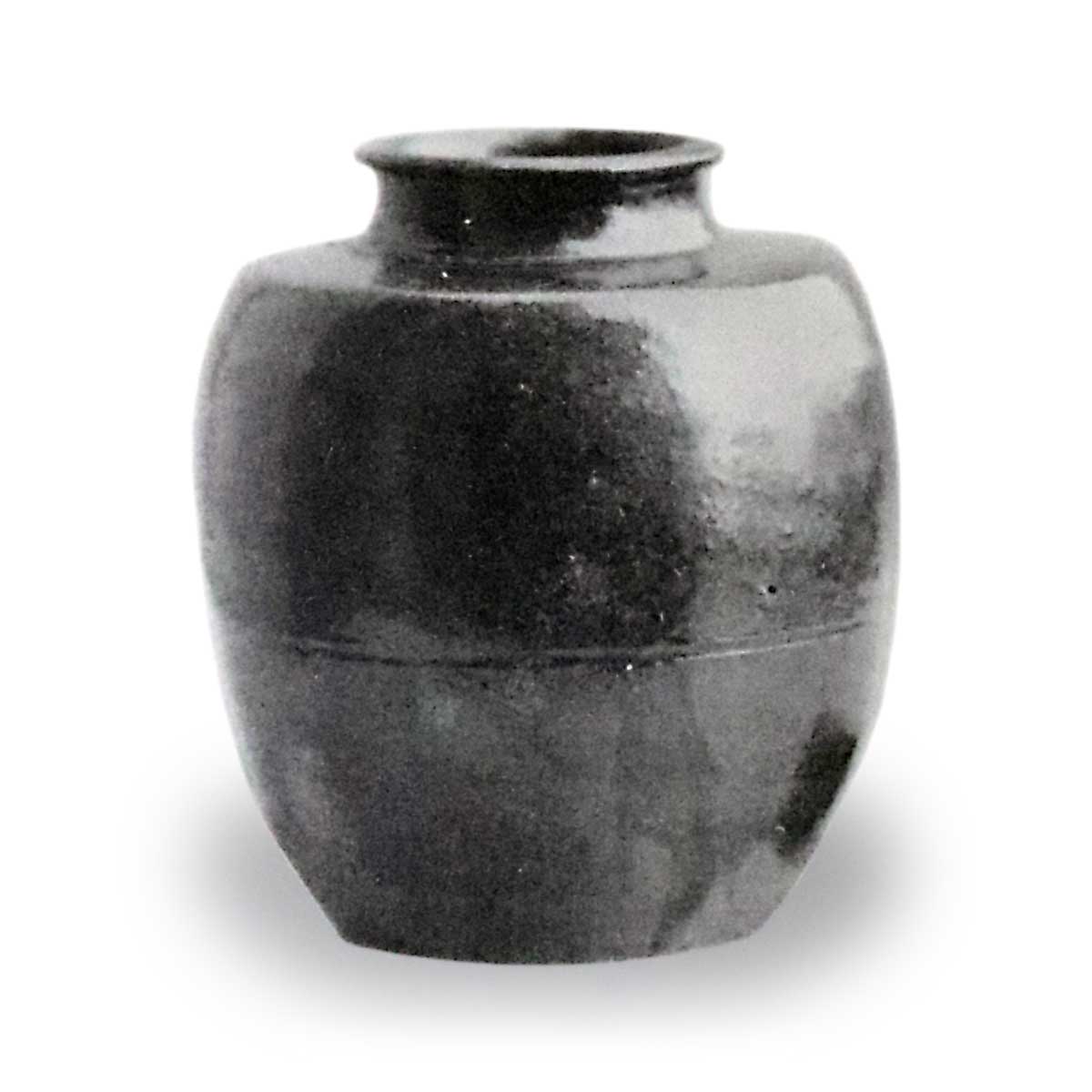



A Daimeibutsu tea caddy made in China (Han-saku); also known as the “Yamanoi Katatsuki.”
It is currently in the collection of Baron Koyata Iwasaki.
Origin of the Name
It was named “Higuchi Katatsuki” because it was once owned by the Sengoku-period warlord Higuchi Iwami-no-kami Tomohide.
Its alternative name, “Yamanoi,” derives from an ancient waka poem found in the Kokin Wakashū: “Though shallow, it is fine; surely no one else will draw water from this mountain well—for it is mine alone.” Since it is water from a mountain well sufficient for my own use alone).“ The tea caddy named ”Yamai Katatsuki” based on this waka poem shares the same origin as the Old Seto Yamai Katatsuki (transmitted from Hosokawa Sansai and currently in the collection of Count Matsudaira Naoaki).
Modern measurements
Height: approx. 8.5 cm (2 sun 8 bu)
Body diameter: approx. 7.4 cm (2 sun 4 bu 6 rin)
Mouth diameter: approx. 3.9 cm (1 sun 3 bu)
Base diameter: approx. 4.8 cm (1 sun 6 bu)
Koshiki height: approx. 1.0 cm (3 bu 3 rin)
Shoulder width: approx. 1.4 cm (4 bu 5 rin)
Weight: approx. 139.5 g (37 monme 2 bu)
List of Accessories
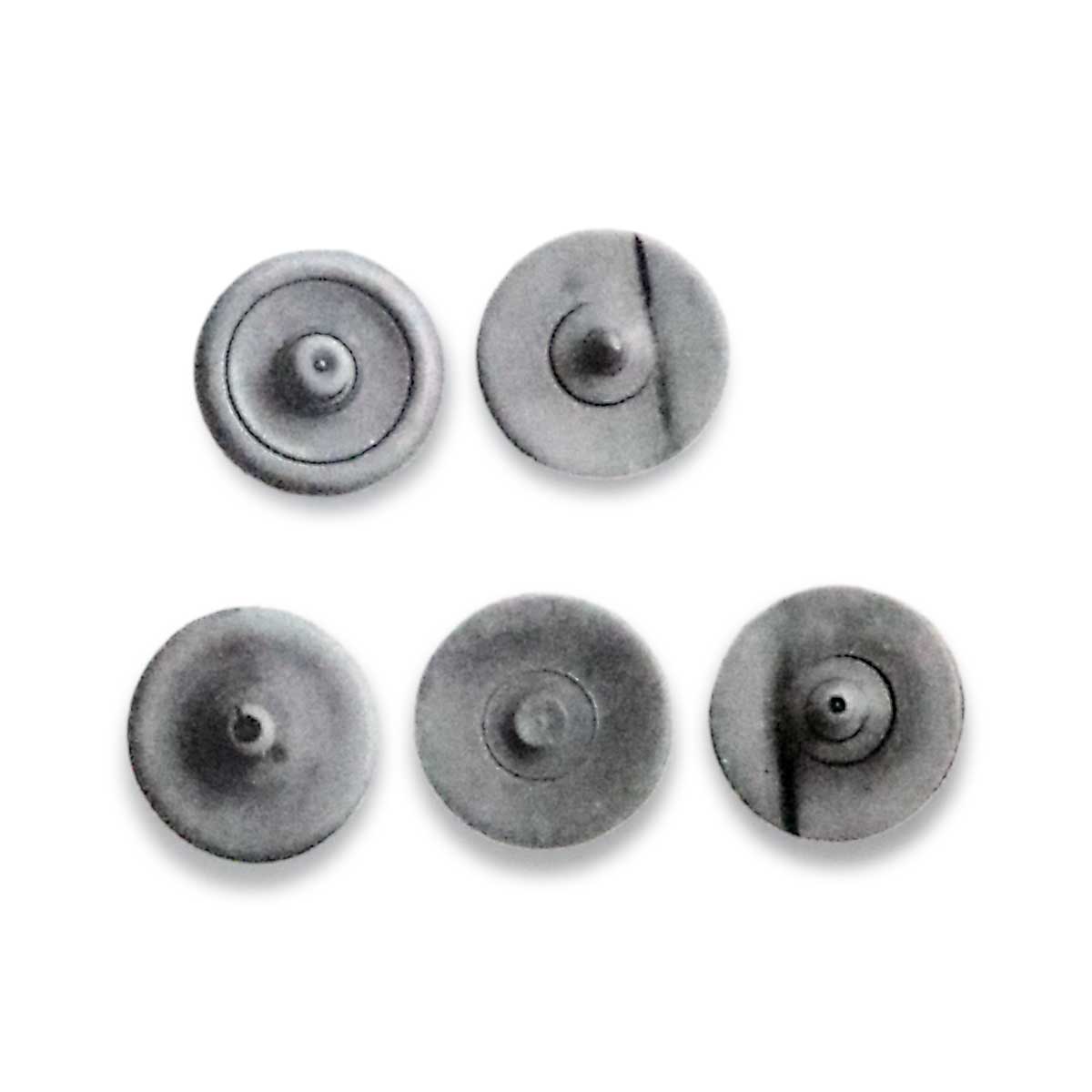
There are as many as five lids, stored in the inner lid of the bag-style box.
・Lids with a nest (kago) design: Made by Insai in the style of Kobori Enshu, and by Kyumi in the style of Furuta Oribe
・Lids with visible wood grain (kiguchi-gai): Made by Kyumi in the style of Furuta Oribe, and by Juami in the style of Sen no Rikyu
・Yamai lid: Made by Shoshin-ko. It is housed in a box, and there is an inscription on the outside of the box lid.
The storage pouch is made of white chirimen silk with a white cord.
There are two types of protective covers (bags): “Toridasuki Donshu” and “Kantō Oridome.”
The unvarnished paulownia wood box containing the bags is inscribed with “Yamai Bags 2, Lids 4.”
Hikiya is made of mulberry wood, with characters written in gold powder. It bears the inscription “Yamai Katatsuki” in the handwriting of Kobori Gonjūrō. The pouch containing the Hikiya is made of Kinran with a phoenix and chrysanthemum pattern.
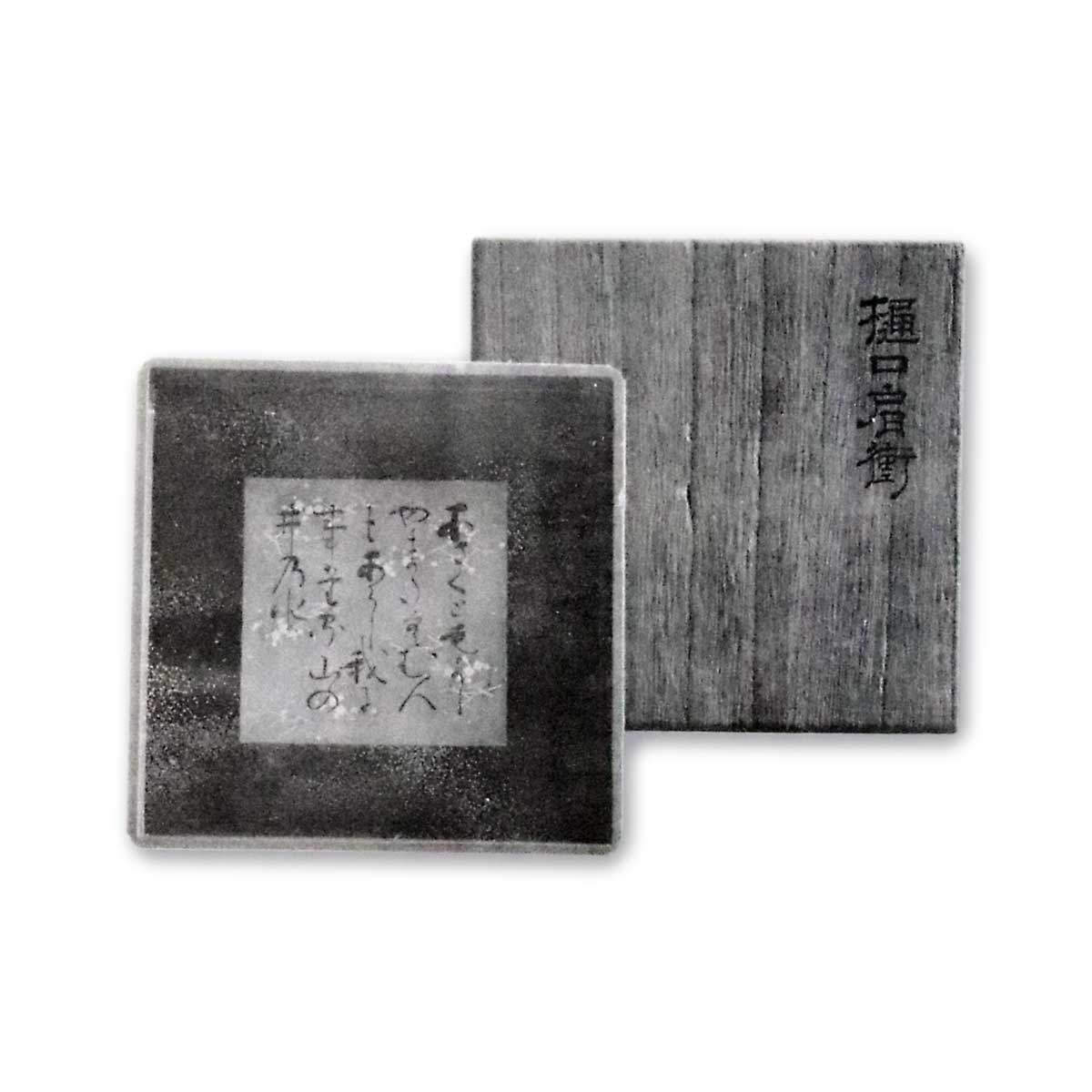
The middle box is made of untreated paulownia wood and bears the inscription “Higuchi Katatsuki” in black lacquer by Kobori Gonjūrō.
The inner box is coated in black lacquer, with the inscription located within a rectangular frame decorated with gold-powder maki-e.
Inscriptions on the Boxes and the Accompanying Tray
(Continued from previous page)
On the front of the inner box is inscribed “Higuchi Katatsuki,” and on the back is a waka poem: “Though the morning is early, / Yoshiyama weaves, / There are people like that, / Yet matters concern me— / The water of Yama-i.” Both the front and back inscriptions are in the hand of Kobori Gonjūrō.
The outer box is made of natural paulownia wood and bears the inscription “Yamai no Ko.”
Accompanying the set is a vermilion square tray (with a black base). The inner diameter of this tray is approximately 20 cm (6.7 sun), the diameter of the mirror (the flat inner surface) is approximately 15.7 cm (5.2 sun), the base diameter is approximately 18.5 cm (6.1 sun), and the height is approximately 3.5 cm (1.15 sun). The paulownia box containing this tray is inscribed with “Vermilion Lacquer Square Tray, Yamai Tray.”
The outermost outer box is made of paulownia wood with Shunkei lacquer and bears the inscription “Yamai Katatsuki” in gold leaf.
Characteristics of the “Higuchi (Yamai) Katatsuki” as seen in various tea ceremony texts
・『Komonbuki』: Higuchi Katatsuki. Owned by Matsudaira Mutsu-no-kami (of the Date clan).
・Ganka Meibutsu-ki: Hinokuchi (Higuchi) Tang-style Katatsuki. Owned by Lord Matsudaira Mutsu.
・Kokon Meibutsu Ruiju: Hinokuchi Katatsuki. A Daimeibutsu. Owned by Matsudaira Mutsu-no-kami.
・Bian Bunko: Hinokuchi Katatsuki. Tang-style. Originally owned by Matsudaira Mutsu-no-kami; currently owned by the Iwasaki family.
・Chaki Benran: Among tea caddies of the “dōtaka” style are the Kishū family’s Hira-me Katatsuki, the Sendai Lord (Date family)’s Higuchi Katatsuki, and the Sakai Katatsuki. These are all characterized by vertical ridges created by a spatula around the body, along with slight warping; the areas between the ridges are slightly bulged and raised, hence the name “dōtaka.”
Detailed records in red ink from the Baian Bunko
“Higuchi Katatsuki. The round pouch is made of pale yellow crepe. Hikiya made the body from mulberry wood and inscribed it with the name ‘Yamai Katatsuki’ in the style of Kobori Gonjūrō. The pouch is made of Kinran silk with a phoenix crest on a light green background. The box is made of untreated paulownia wood and bears an inscription by Kobori Gonjūrō reading ‘Higuchi Katatsuki’; inside are four small cushions.
There are five lids. One is a wooden lid by Juami, in the style preferred by Sen no Rikyū. One is a wooden lid by Kyūmi, in the style preferred by Furuta Oribe. One is a lid by Kyūmi, in the style preferred by Furuta Oribe, featuring a large ‘su’ (nest), with paper pasted on the underside. One is a lid by Insai, in the style of Kobori Enshu, containing a fine “su.” Another is a wooden lid in the style of Lord Aoyama. The box is made of natural paulownia wood and bears the inscription “Lord Yamai Masakokoro.”
Lord Katagiri Sekishu named it with the spirit of the waka poem “The water of Yamai, which is a matter to me.” The lacquered box has a pear-skin finish on the inside with gold powder on the edges, and contains a strip of paper inscribed with the name. Originally, Lord Sekishu called it “Higuchi.” The lacquered lid depicts “mountain” and the body depicts “water,” forming a design where the mountain is reflected in the water.
A Gift from Tokugawa Ieyasu to Date Masamune
On April 14, 1610 (Keichō 15), Date Masamune traveled from Edo to Sunpu to pay his respects to the retired shogun, Tokugawa Ieyasu (the Divine Lord). On that occasion, he received from Ieyasu the “Higuchi Katatsuki” tea caddy, which had once been presented by Higuchi Iwami-no-kami Tomohide. This tea caddy is also known as “Yamanoi,” named after the ancient waka poem: “Though shallow, it is good; no one else draws from it—the water of the mountain well is mine alone.”
(Continued from previous page)
(From Buto Hennen Shusei, Jukoroku, and Kansei Shoshu Shokafu)
After Date Masamune’s death, on July 21, 1636 (Kan’ei 13), his son Date Tadamune, who succeeded him, presented the famous sword “Masamune” and the “Yamanoi Katatsuki tea caddy” to the third shogun, Iemitsu, as his father’s遺品. However, several years later, on May 11, 1643 (Kan’ei 20), when Tadamune paid his respects before returning to his domain, Shogun Iemitsu bestowed this “Yama-no-i Katatsuki” upon him once again. Thus, this treasured artifact, which had once been presented to the Shogun’s household, returned to the Date family. (From Kansei Shoshu Shokafu)
Dates Masamune’s Banquets for the Shogun and the Taisho
When Date Masamune invited Shogun Iemitsu and the Taisho Hidetada to his residence, he used this “Yama-no-i Katatsuki” to host them with great pomp.
・March 13, 1628 (Kan’ei 5): When Shogun Iemitsu paid a visit to Masamune’s residence, Takatora Todo and others were in attendance. A “Kyodo” hanging scroll, a “Kinuta” (with handles) flower vase, and a “Wari-Sen” tea bowl were used. (From “Tobu Jitsuroku”)
・April 6, 1630 (Kan’ei 7): When Shogun Iemitsu visited Masamune’s residence, a “Seisetsu” hanging scroll, an ‘Ariso’ flower vase, and a “Wari-Sen” tea bowl were used.
・April 11 of the same year: When the retired shogun Hidetada paid a visit to Masamune’s residence, the “Yamai Katatsuki” was also displayed. A hanging scroll by Seisetsu, a flower vase of the Ariso style with irises (kakitsubata), and a red square tray were used. (From Tobu Jitsuroku and Date-shi Chika Kiroku)
An Anecdote Regarding Higuchi Shinano’s Presentation and Land Grant
The Sekken-sō: A Guide to the Mysteries of the Tea Ceremony records the following:
“The Higuchi Katatsuki is in the possession of the Lord of Sendai. Long ago, it was owned by Higuchi Shinano Kyuzaemon, who presented it to Toyotomi Hideyoshi. As a reward, he was granted a fief (chikyō) in Settsu Province. Later, he returned that fief and was granted a 200-koku fief near Takatsuki. Higuchi, the current actor of the Kanze School, is his descendant. In the past, he went by the name Higuchi Kyuzaemon. The Lord of Sendai still possesses this katamuki today.”
Summary of the History
The Higuchi Katatsuki was originally owned by Higuchi Iwami-no-kami Tomohide and was presented to Tokugawa Ieyasu in Keichō 5 (1600). In April of Keichō 15 (1610), Ieyasu gave it to Date Masamune. When Masamune passed away in 1636 (Kan’ei 13), his son Tadamune presented it once again to Shogun Iemitsu as part of the deceased’s estate upon succeeding to the family headship. However, in May 1643 (Kan’ei 20), when Tadamune paid his respects upon returning to his domain, Iemitsu bestowed it upon Tadamune once more.
Since then, it had long been passed down as a treasure of the Sendai Domain (the Date family), but during the Tenpō era in the late Edo period, it was entrusted to a merchant named “Sumiyasu (Sumiya Hosaburō),” who served as a financial officer (in charge of raising funds) in Osaka, along with other famous treasures associated with Date Masamune, such as the “Celadon Vase,” “Small Shoulder-Striking Tea Caddy,” “Kiba Saru Tea Caddy,” and “Ash-Coated Tenmoku Tea Bowl.” It is said that every year, an envoy from the Sendai Domain would travel to Sumiho’s residence in Osaka to air out the Meibutsu.
However, the large chest containing these various Meibutsu eventually became Sumiho’s property amid the turmoil of the Meiji Restoration. Around 1887 (Meiji 20), Sumiho’s family approached Yanosuke Iwasaki about purchasing these Meibutsu. Mr. Iwasaki traveled to Osaka accompanied by his regular supplier of tea utensils, Motokura (Dogen) Ogawa, and purchased the entire collection.
This is why the current Iwasaki Baron family holds a large collection of items associated with the Sendai Date clan.
(Incidentally, according to a letter from Toda Rocho, a tea utensil dealer in Osaka, the personal effects of Sumihiko—a member of the Sumi clan—were passed on to the Akahoshi family, and the Sumizen household remains prosperous to this day.)
Academic Inspection Report (Appraisal Record) from the Taisho Era
On November 4, 1920 (Taisho 9), this tea caddy was physically examined at the residence of Baron Iwasaki Koyata in Takanawa, Tokyo.
The rim is shaped with a “double bevel,” resembling the edge of a clam shell, and the flared rim is deep. The area below the koshiki (flange) protrudes, and a single raised ridge (ukigane) runs around its perimeter. The shoulders are powerfully (sharply) flared. The recessed ridge (uchigane) running around the body is interrupted in two places. From the shoulder tip to the rim, six vertical ridges (ken-suji) run at a slight angle. Because the area between these ridges is raised (bulging), this type of tea caddy is called a “dō-takashi.”
Below the rim, the clay body (raw material) is visible, a reddish-brown color with an extremely fine grain. The base is raised, with a slight depression in the center and a jagged, irregular rim.
Overall, it has a deep chestnut color with a purplish tint, and around the rim, there are areas covered in a powdery blue glaze. From the shoulder, two wide streams of glaze of the same color flow down. One stops near the rim, forming a pool of glaze with a bluish tint, while the other reaches the edge of the base (the foot), revealing a beautiful lapis lazuli blue at its tip (the exposed edge).
On the opposite side of this front view (the standing side), there is a similar cascade of glaze, though the color of the glaze here is slightly lighter.
Inside, glaze covers the rim of the mouth, while a thin, watery glaze spreads across the entire interior below it, revealing coarse wheel marks. The center of the base has a ring-like shape.
There is a single vertical crack running from the rim of the mouth. It feels very light in the hand, and the vivid, beautiful red of the red clay at the base is a most rare and distinctive feature.