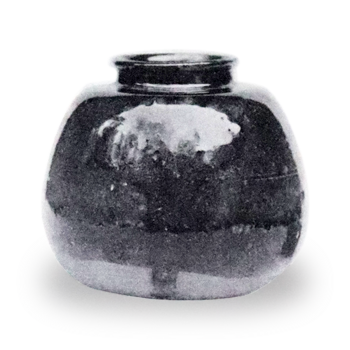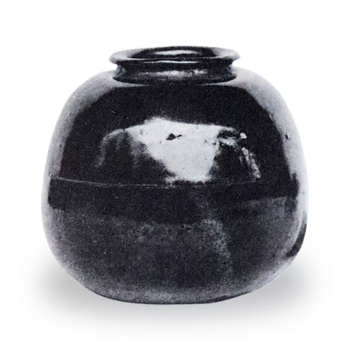
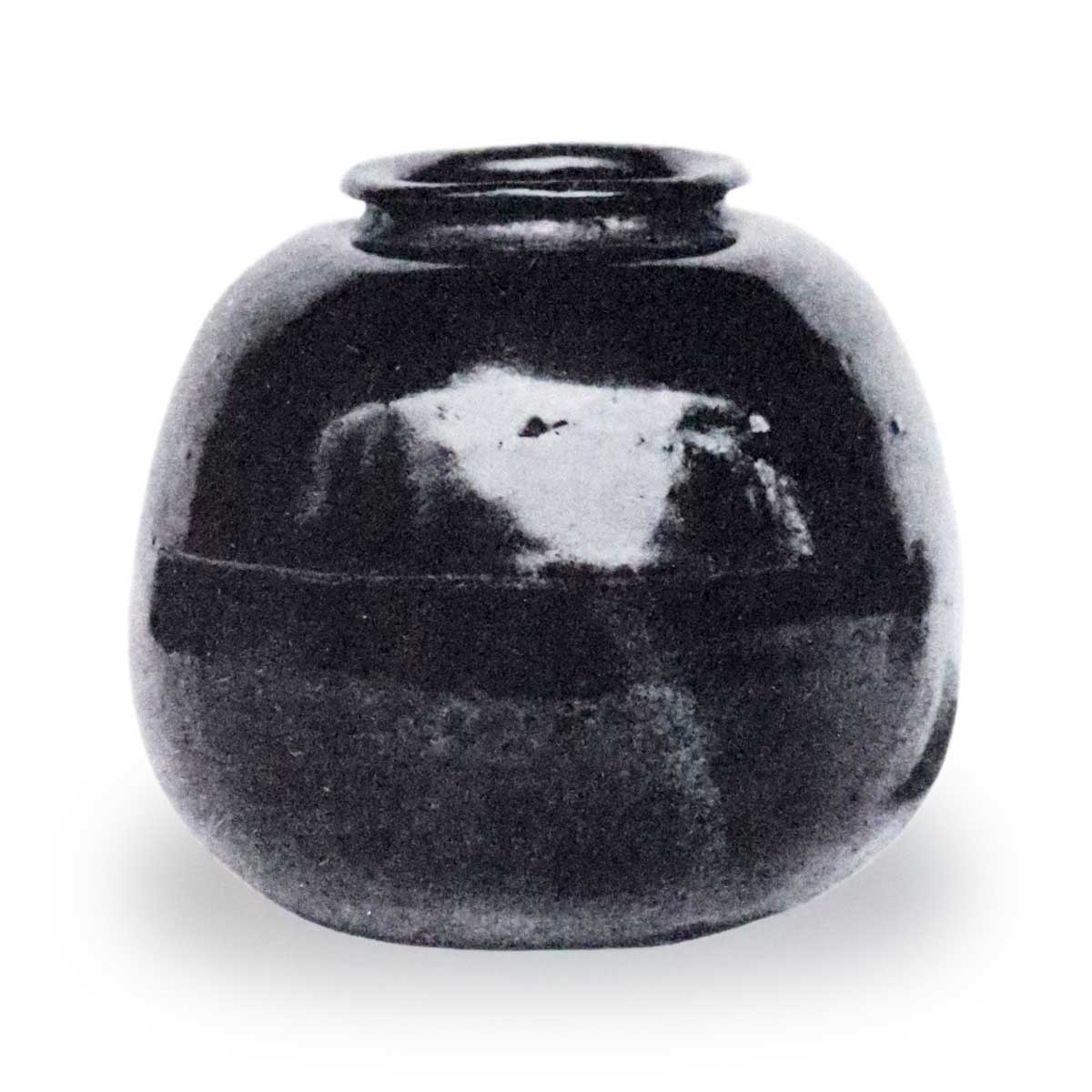
Imported Daimeibutsu, Collection of Marquis Tokugawa Yoshichika
Name
This is an eggplant-shaped tea caddy that was once owned by Akaneya Yoshimatsu, a resident of Sakai. Due to its large size, it is sometimes referred to as the “Akaneya Great Eggplant.” The Kokon Chajin Keifu lists a Sakai figure named “Akaneya Sōsa” as a disciple of Takeno Jōō, but it is unclear today whether this is the same person as Yoshimatsu.
Dimensions
Height: 2 sun 4 bu 5 rin (approx. 7.4 cm)
Body diameter: 2 sun 5 bu 6 rin (approx. 7.8 cm)
Mouth diameter: 1 sun 3 bu (approx. 3.9 cm)
Base diameter: 1 sun or 1 sun 5 rin (approx. 3.0 cm or approx. 3.2 cm)
Koshiki (ring) height: 1 bu 5 rin (approx. 0.5 cm)
Shoulder width: Virtually none
Weight: 28 monme 7 bu (approx. 108 g)
Accessories
Lid: 1 piece, ivory
Imperial bag: White chirimen (crepe)
Bag: 1
Donsu (satin) with a “treasure-filled” pattern on a blue-green background; lining is iridescent; cord ends are pale yellow
Storage box: Paulownia wood
Hikiya: Black lacquer
Pouch: Vertically striped Cantonese weave; lining is a floral-patterned (light blue-green) satin with a small peony and arabesque design; cord fasteners are white
Inner box: Paulownia wood, natural finish, with gold-leaf lettering
“Akaneya Nasuhi Tea Caddy”
Outer box: Paulownia wood, lacquered
Miscellaneous Notes
Large Eggplant: Sakai Branch, Akaneya Yoshimatsu
(From Tenshō Meibutsu-ki and Higashiyama Go-mono Uchi-betsuchō)
Small Chinese Vase: Akaneya Nasuhi, Owari Style
(From Ganka Meibutsu-ki)
Akaneya Large Eggplant: Chinese Small Jar, Daimeibutsu, Lord of Owari
(From Kokin Meibutsu Ruiju)
Akaneya Eggplant: It has a chestnut-brown (kuri-kara-iro: dark brown) color with a lustrous sheen and a single line running along the body. Tokugawa Ieyasu presented it to his ancestor, Yoshinaga, in Sunpu, and it has been passed down ever since.
(From Oshu Tokugawa Family Collection Register)
Transmission
An item originally owned by Akariya Yoshimatsu of Sakai was passed down to Tokugawa Ieyasu, who then presented it to Tokugawa Yoshinaga, the founder of the Owari Domain, while in Sunpu. Since then, it has been passed down through the generations and remains in the possession of the Owari Tokugawa family.
Record of Inspection
Inspected on June 5, 1919, at the residence of Marquis Tokugawa Yoshichika in Ozone-cho, Higashi Ward, Nagoya City.
A Chinese-style tea caddy. The rim features a deep “kukurigae” (a curved, flared rim). A black amber-colored glaze covers the entire surface, over which a “dakatsuyu” (a glaze with a pattern resembling snake or lizard skin) flows in a wedge-shaped pattern from below the shoulder, stopping at the point where the unglazed clay of the base becomes visible.
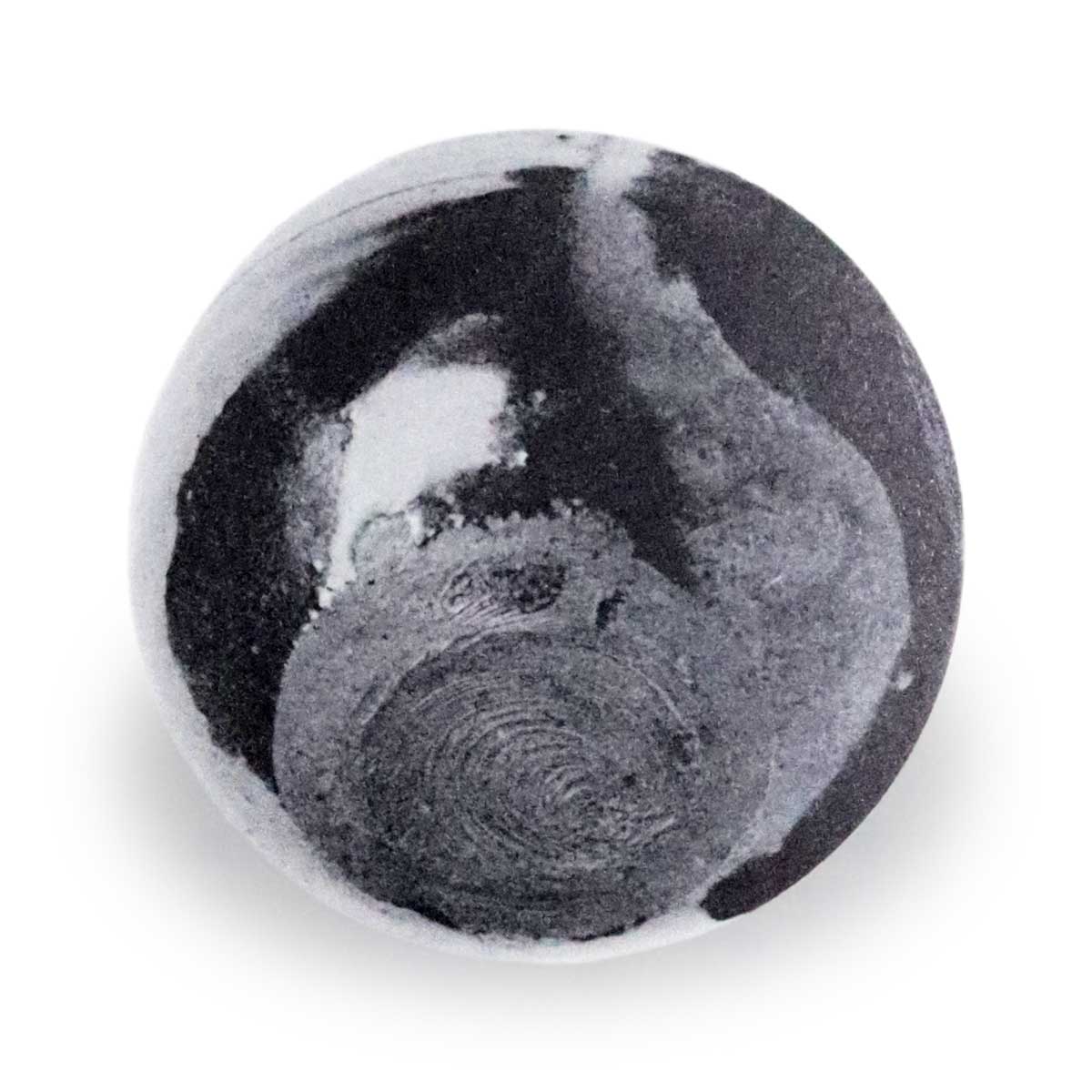
The sunken ridges running around the body are slightly misaligned in places. There are many areas where the unglazed clay is visible around the base, and the thread marks (traces of the base being cut off) are extremely fine. It is considerably larger than a standard eggplant-shaped tea caddy, and both the underglaze and overglaze resemble those of the Kokushi Nasu (one of the Meibutsu tea caddies). Inside, the glaze covers the rim, while below that, wheel marks run around the interior, forming a swirl pattern at the base. The piece is entirely intact, and because it is a large eggplant-shaped tea caddy, it appears majestic, opulent, and beautiful at first glance.