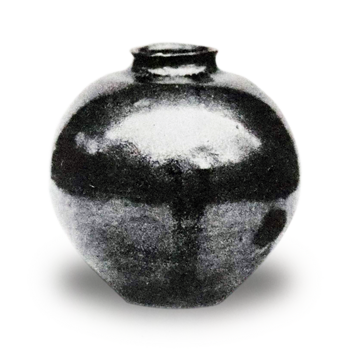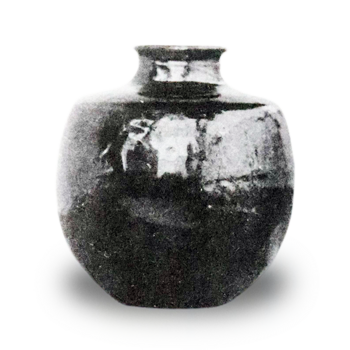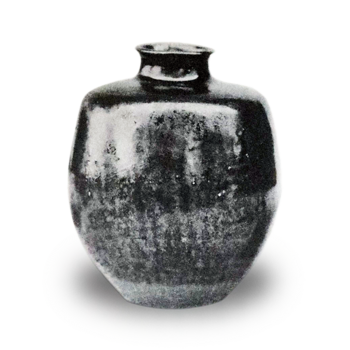
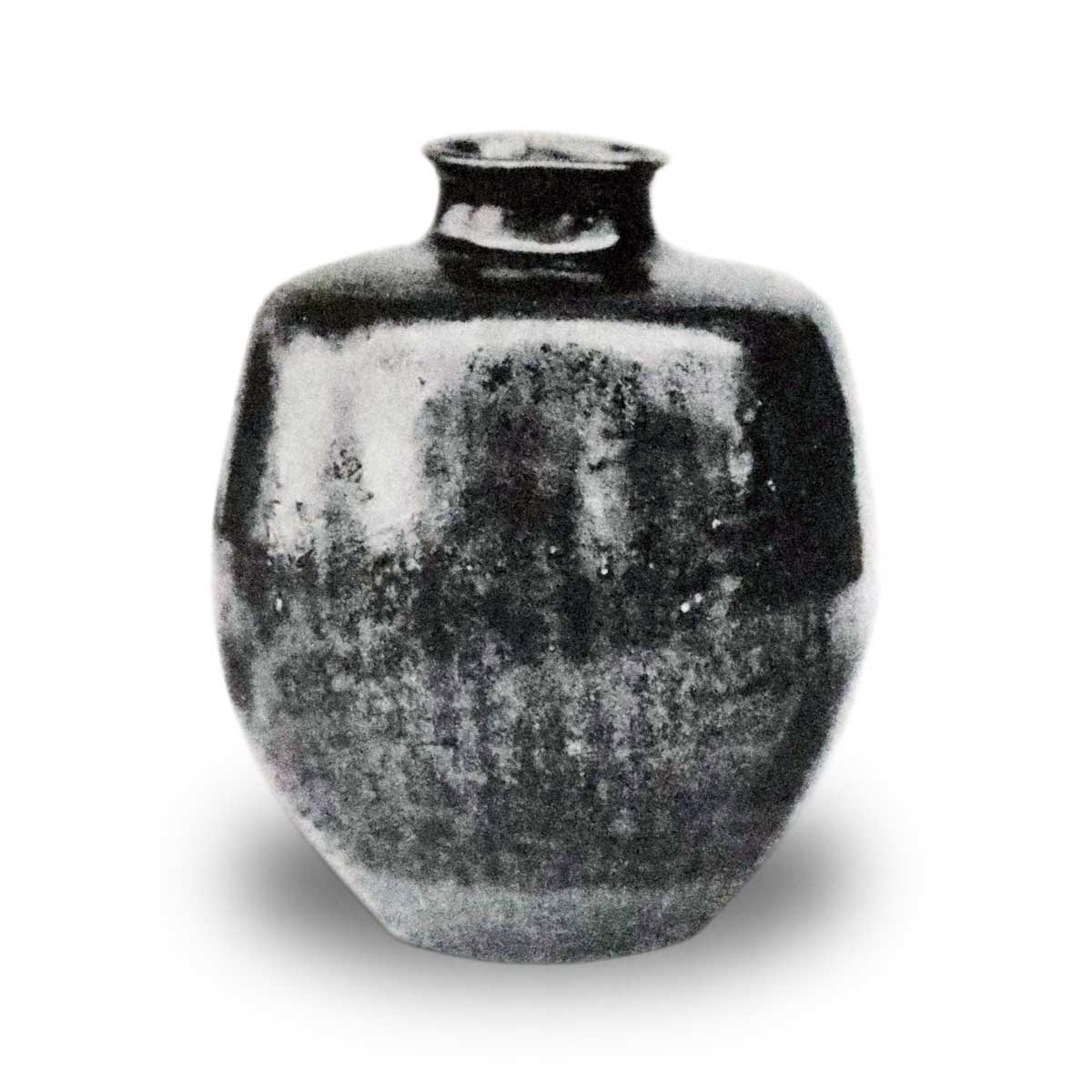
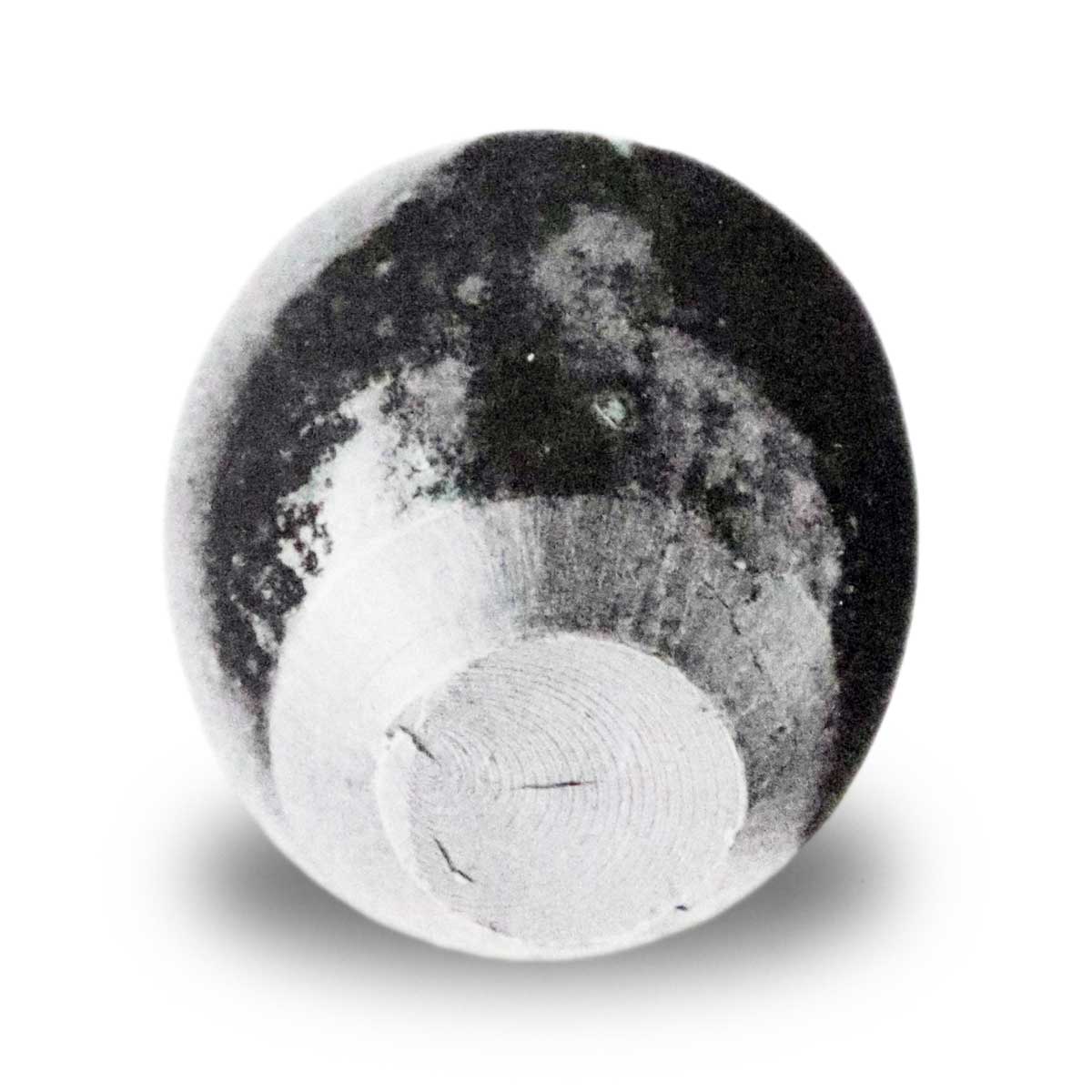
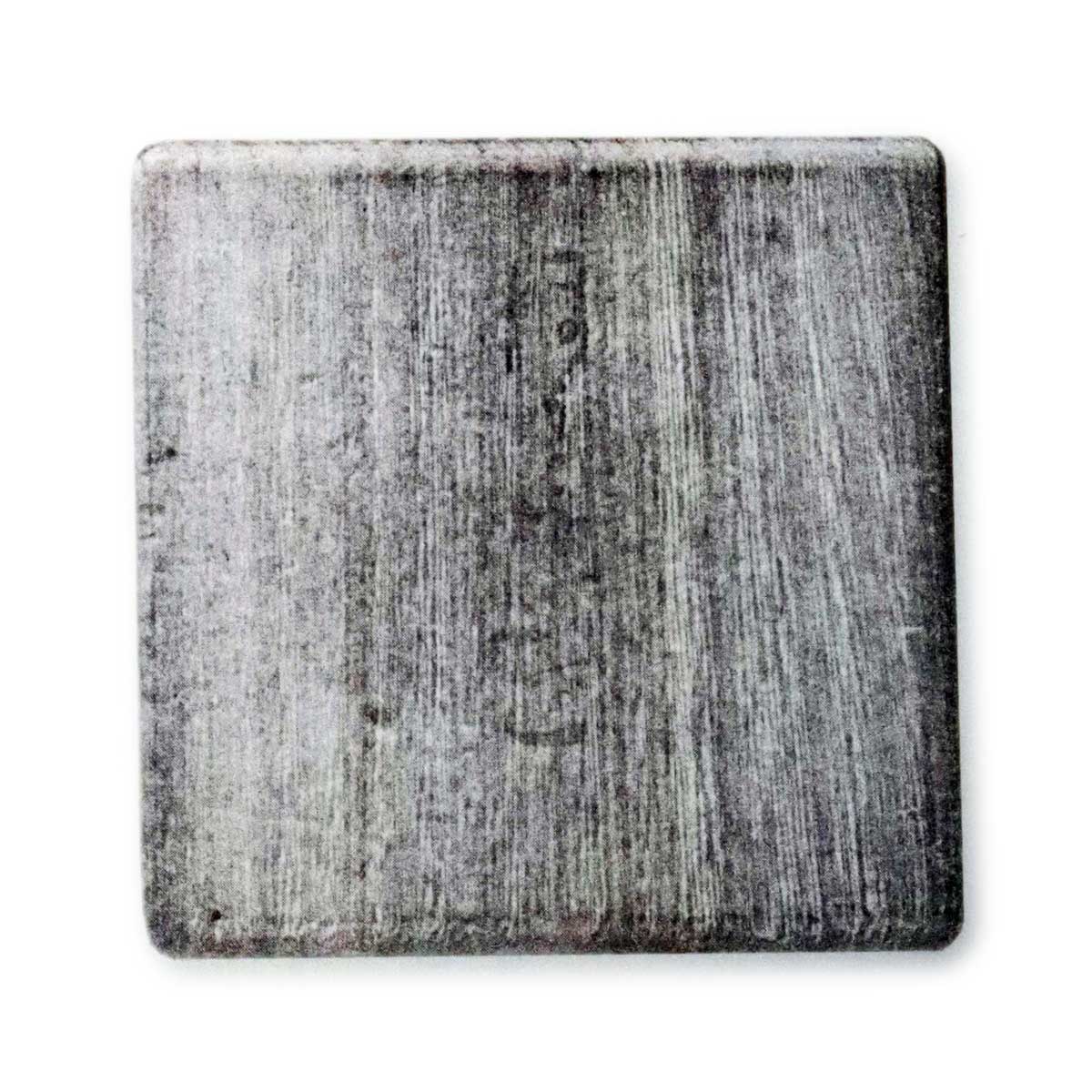
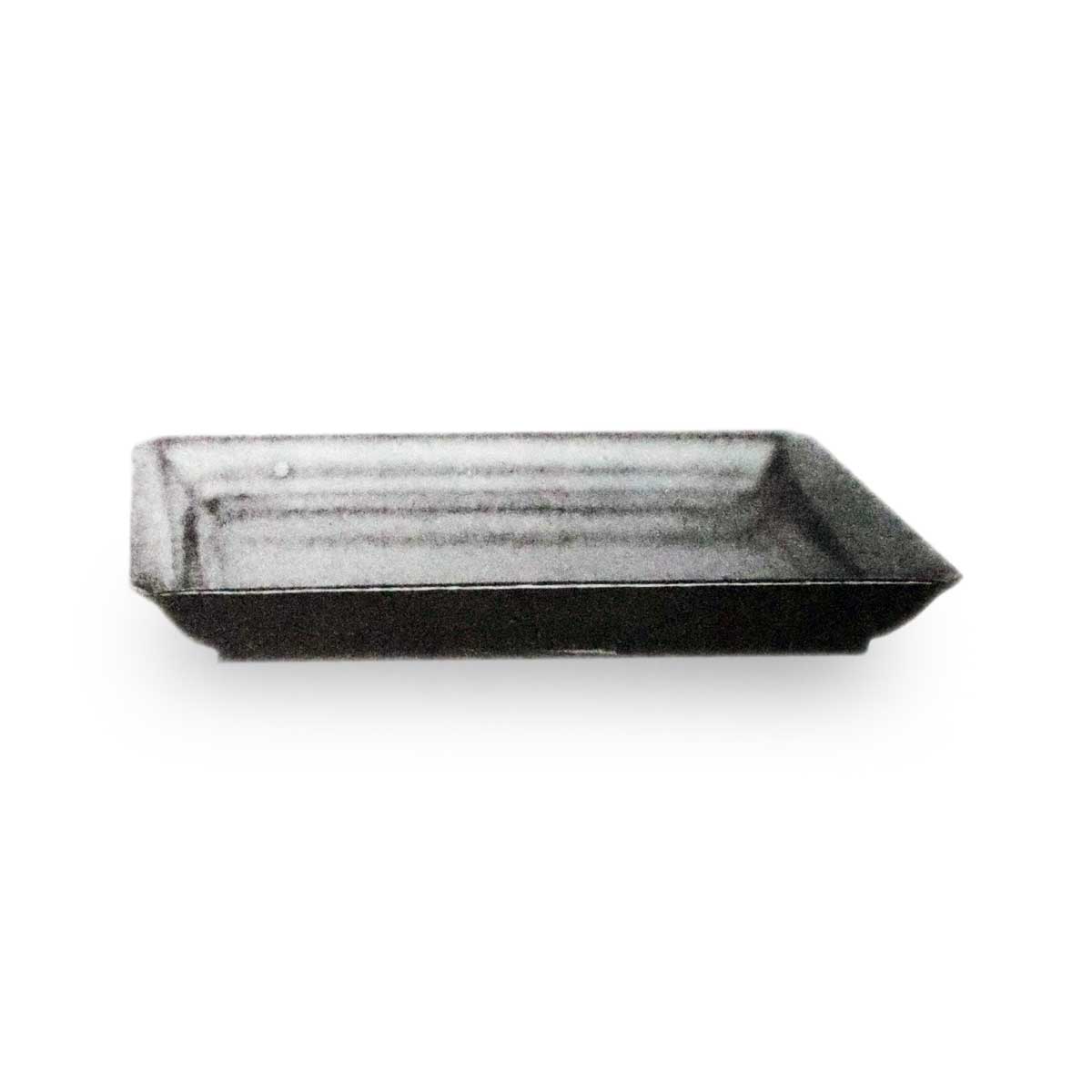
Made in China; Daimeibutsu; Collection of Count Tadamasa Sakai
Name
Named for the resemblance of the tea caddy’s shape and glaze color to a Chinese lantern plant (hoozuki).
Dimensions (converted at 1 sun ≈ 3.03 cm)
Height: Approx. 7.15 cm (2 sun 3 bu 6 rin)
Body diameter: Approx. 7.51 cm (2 sun 4 bu 8 rin)
Mouth diameter: Approx. 2.73 cm (9 bu)
Base diameter: Approx. 3.33 cm (1 sun 1 bu)
Koshiki (stand) height: Approx. 1.06 cm (3 bu 5 rin)
Shoulder width: approx. 1.52 cm (5 bu)
Weight: approx. 68.25 g (18 monme 2 bu *1 monme = 3.75 g)
Accessories
・Lids: 2 (one of which has no indentation)
・Carrying pouch (bag for the tea caddy): White ha-ni-jū, with a white cord
・Three protective covers (pouches)
Antique Kinran with Eikando square dragon pattern (lining: Tamamushi Kai silk, cord: purple)
Funakoshi Koto weave (lining: Kakidai, cord: purple)
Satin with bamboo vine pattern (lining: light green, cord: purple)
・Bag box: Unfinished paulownia wood
Box inscription: “Sangyo-Bunrin,” “Hōzuki tea caddy with three replacement bags,” “Place the replacement bags in the inner box (kakko)”
・Hikiya (cylinder for storing the tea caddy): Black lacquer
Bag: Purple leather, purple cord
・Box: Unfinished paulownia wood
Box inscription: “Hōzuki”
・Accompanying tray: Wakasa-style tray
Dimensions: Diameter approx. 20.91 cm (6 sun 9 bu), diameter of the mirror (central indentation) approx. 15.76 cm (5 sun 2 bu), diameter of the base approx. 17.88 cm (5 sun 9 bu), height approx. 2.42 cm (8 bu)
The character “Tok” is painted in vermilion lacquer on the bottom of the tray.
Tray bag: Brown satin (lining is a cloud-patterned Fursu weave; cord is pale green)
Tray box: Paulownia wood with Shunkei lacquer finish; a black lacquered label is attached.
Inscription on the box: “Wakasa Tray”
・Outer box (containing all items): Sliding lid, with lock
The inscription on the front of the lid reads as follows:
“On February 2, Genna 2 (1616), at Sunpu Castle, His Majesty Toshogu (Tokugawa Ieyasu) personally bestowed this treasure upon Lord Gagaku-no-kami Tadayuki, and it has been passed down through his family ever since.
Tea caddy: Name is “Hoozuki,” Meibutsu ‘Bunrin’ design
In the New Year of Bunsei 6 (1823), the outer box was crafted
by the 11th-generation Sakai Gagaku-no-kami, Chamberlain Minamoto no Tadazane”
・Oibitsu (carrying case): Black-lacquered paulownia wood
Miscellaneous Notes
Hoozuki (Chinese lantern plant) Bunrin
Hoozuki. The storage pouch is made of white ha-niji fabric with a matching cord. There are two covers: one is made of Kanto-ori fabric with vertical stripes of Sanada-ori on a white background (purple cord), and the other is made of satin with a bamboo vine pattern (lined with light green Kai silk, wisteria-colored cord). The Hikiya has black lacquered chamfered edges, and the pouch is made of brown leather (purple cord). The box is made of natural paulownia wood with a lid featuring four crossbars. The box for the accompanying tray is finished in Shunkei lacquer with a black-lacquered beveled rim. The tray’s bag is made of satin (lined with Fursu, with a brown cord). (Illustration of the tea caddy and base available)
(From the Bakuan Bunko, Series A, No. 7)
Honeysuckle-patterned katatsuki. It has two lids. It comes with three pouches: one made of old Kinran with the Eikando corner dragon motif (lined with yellow Kaiki fabric), one made of satin with a bamboo vine pattern (lined with light green Kakidai fabric), and one made of Funakoshi Kanto weave (lined with iridescent green Kakidai fabric).
(From the Makuan Bunko, Series A, No. 17)
Hōzuki. The clay is white and light blue, with red areas where the glaze pooled. Counter-clockwise thread-cut. Two replacement lids. Two pouches: one in light brown Kanto-ori with Sanada cord (lining: kakidai; cord: purple), and one in satin with a bamboo vine pattern (lining and cord: same). The box has a lid with four crossbars, tied with nine purple cords. The accompanying tray is a Wakasa tray. The tea caddy is slightly thick-walled. The box is a Shunkei-lacquered, meticulously finished piece. It is labeled “Hōzuki.”
(From the Makuan Bunko, Series A, No. 9)
Bunrin katatsuki. The shape of this tea caddy is like a gourd, tapering downward, and the bottom lacks the usual spatula marks. The glaze is a single, pale persimmon color, and the rim is narrow. October 10, Eishō 13 (1516). (Illustration of the tea caddy included)
(From Aiami’s Tōyama-dono Kashiki-no-ki and Chaki Meibutsu Zui)
(Note) Because this tea caddy has a narrow rim resembling Bunrin and an overall shape resembling Katatsuki, it is referred to as either “Bunrin” or “Katatsuki” depending on the tea ceremony text. Currently, when consulting the Chaki Meibutsu Zui compiled by Kusama Waraku, one finds that Soami’s Higashiyama-den Kashiki-no-ki, included therein, bears the date October 10, 1516 (Eishō 13), and features an illustration of the tea caddy under the name “Bunrin Katatsuki.” It is believed that this is the very piece that came to be known in later generations as the “Hōzuki Bunrin.”
(From Tokugawa Gomiki)
Sakai Tadayori, Head of the Court Music Office. He was born in Nishio, Mikawa Province, in the 3rd year of the Genki era (1572). In the 2nd year of the Genna era (1616), because Tōshōgū (Tokugawa Ieyasu) fell ill, he accompanied Daito-in-dono (Tokugawa Hidetada) to Sunpu in his palanquin. At that time, he was presented with a “Sangyo” tea caddy by Toshogu. He passed away on March 19, 1636 (Kan’ei 13). He was 65 years old.
(From Kansei Shoshu Shokafu)
Origin
On February 2, 1616 (Genna 2), Lord Ieyasu’s illness grew severe, and Lord Hidetada traveled to Sunpu. At that time, Sakai Tadayori accompanied him as an attendant and was presented with the renowned “Sanjō” tea caddy by Lord Ieyasu.
(From the Imperial University Historical Materials Collection, Himeji Sakai Family Genealogy)
On February 2, 1616 (Genna 2), Sakai Chūyo, the Gagaku-no-kami, arrived in Sunpu and received this item during an audience with Ieyasu. Since then, it has been the foremost family treasure of the Himeji Sakai family.
Record of Actual Viewing
On December 5, 1920, I had the opportunity to view this piece in person at the residence of Count Sakai Tadamasa in Haramachi, Koishikawa Ward, Tokyo.
The mouth is tight with a rounded rim, and the flaring (curvature) is shallow. The area below the neck is flared, and the shoulders are rounded and protrude. The body is flared and tapers toward the base. From the rim downward, the clay is white with a reddish (ochre) tinge, and the thread marks are fine and very distinct. There is a slight misalignment at the starting point of the thread marks, and there are small firing cracks in the center and one corner of the base.
The overall glaze is a mixture of black amber glaze and persimmon-colored glaze, a characteristic that is particularly prominent at the tips of the shoulders. Furthermore, persimmon-colored glaze with a metallic sheen forms vertical mottled patterns within the black amber glaze, creating a visual effect reminiscent of the Meibutsu “Yanagi Tōshirō.” There are traces of lacquer repairs (repair marks) from the fire cracks extending from the tip of the shoulder down the body. On the exposed clay areas from the rim downward, fine vertical spatula marks are applied throughout. One corner of the thread-cut rim on the base is slightly worn.
Inside, the glaze covers the rim, and below that, fine wheel marks run around the interior. The center of the base features a large swirl pattern. Overall, the glaze has a beautiful luster; the teapot is very light when held, and the white clay has a rich, dense texture, making it a highly refined and elegant teapot.