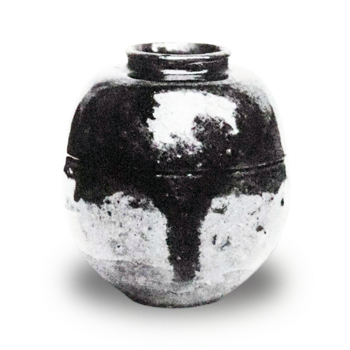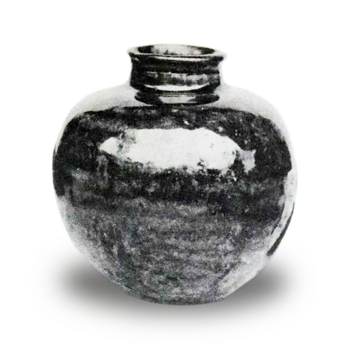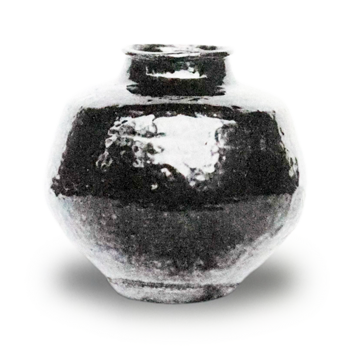
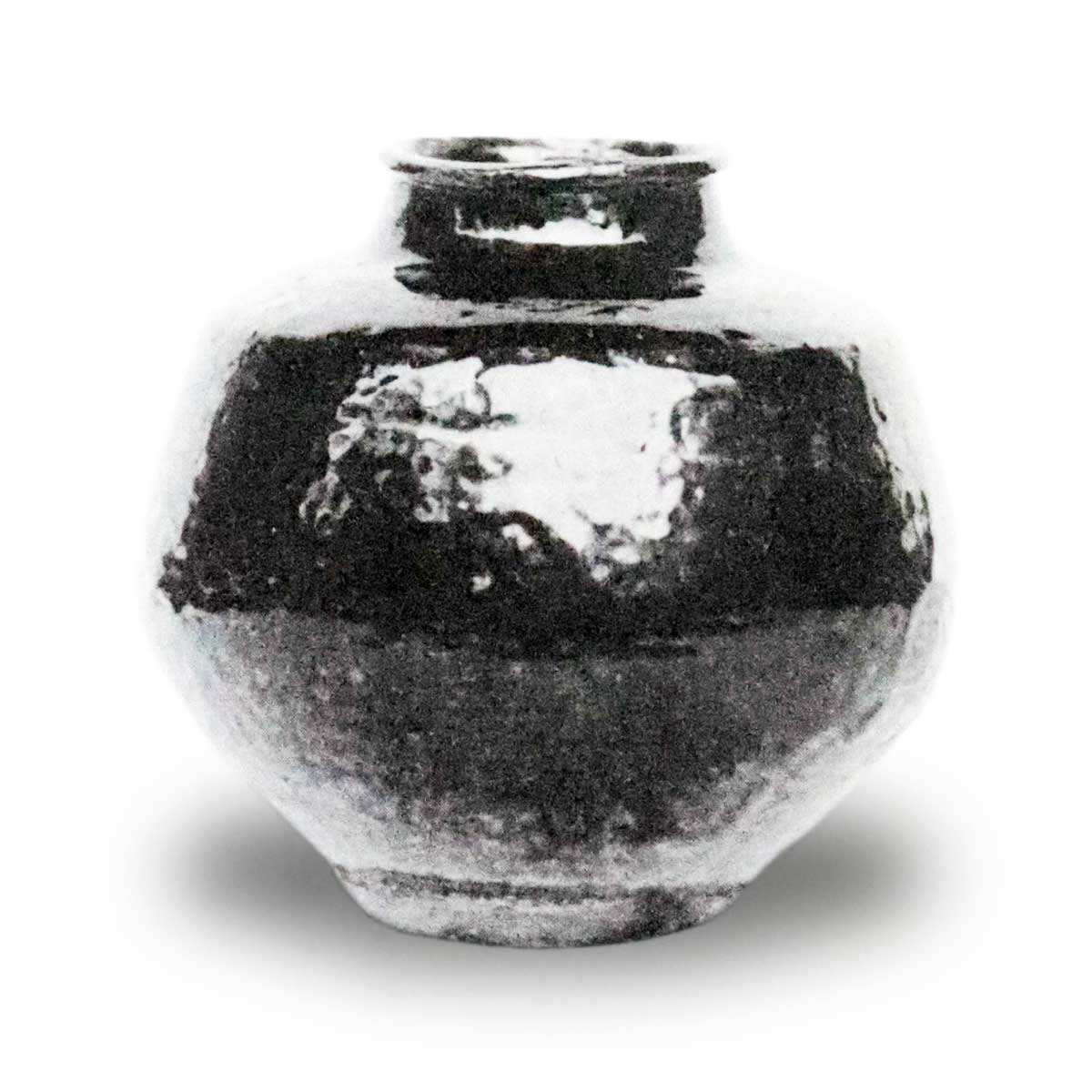
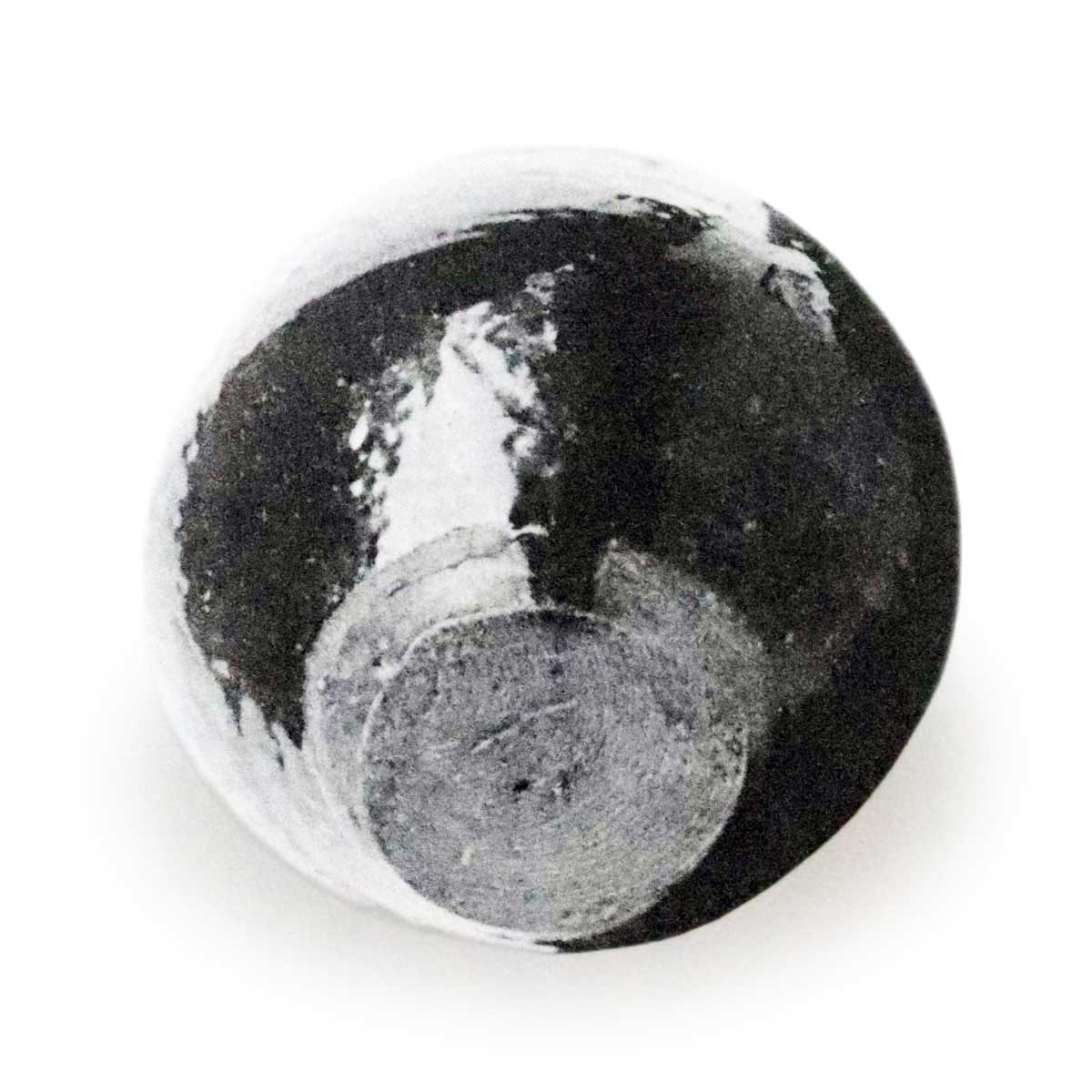
Made in China; Daimeibutsu; Owned by: Tokugawa Yoshichika, Marquis
Origin of the Name
According to Matsuya Hikki by Matsuya Genzaburō of Nara, “When Takenaka Saemi requested a name for the Bunrin she possessed, Kobori Enshū named it ‘Tomaya.’ Since it is a teapot without any decorative patterns, the name is derived from Fujiwara no Teika’s poem: ‘Looking around, there were neither flowers nor autumn leaves—an autumn twilight at the thatched hut by the shore.’ This explains the origin of the name.” This passage clarifies the origin of the name.
Dimensions (converted at 1 sun ≈ 3.03 cm)
Height: Approx. 6.82 cm (2 sun 2 bu 5 rin)
Body diameter: Approx. 7.42 cm (2 sun 4 bu 5 rin)
Mouth diameter: Approx. 3.33 cm (1 sun 1 bu)
Base diameter: Approx. 3.03 cm (1 sun) or approx. 3.33 cm (1 sun 1 bu)
Koshiki (steamer) height: Approx. 0.97 cm (3 bu 2 rin)
Shoulder width: Approx. 1.36 cm (4 bu 5 rin)
Weight: 88.5 g (23 monme 6 bu *1 monme = 3.75 g)
Accessories
・Lid: 1 piece (with a recessed center)
・Storage pouch (for the tea caddy): White chirimen (crepe silk)
・Cover pouches: 2 pieces
Flower-patterned Shimotsuma satin (lining: Jodai Kaiki, cord: purple)
Moe-green bamboo vine satin (lining: Jodai Kaiki, cord: purple)
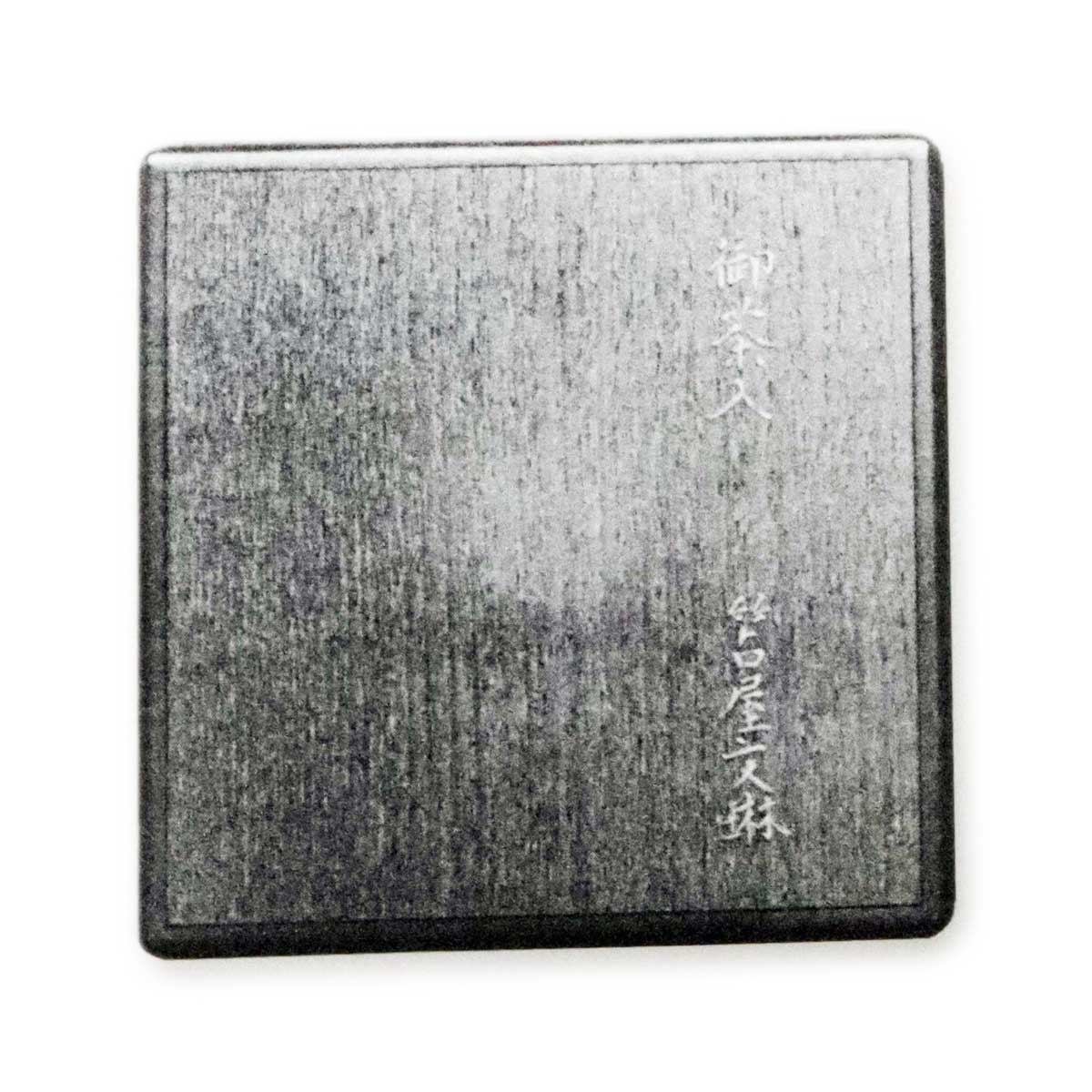
・Carrying Case: Made of paulownia wood. A Shogunate-era imperial storage box. Features silver-plated Ginza metalwork with a round design on a seven-grain ground. Inscribed with “Tomoya Bunrin Bag No. 2.”
・Hikiya (cylinder for storing the tea caddy): Black lacquered. The bag is made of jacquard with a wave and Chinese floral pattern (lining: Kaiki, cord: brown).
・Inner box: Made of paulownia wood. A box for imperial artifacts of the Ryoei (Shogunate). Inscribed in gold powder: “Imperial Tea Caddy, Tomoya Bunrin.”
・Middle box: Black lacquered. Inscribed in gold powder: “Imperial Tea Caddy, Tomoya Bunrin.”
・Outer box: Unlacquered paulownia wood. The inscriptions are as follows:
(Front) “Tea caddy: Tomoya Bunrin”
(Back) “In March of Meiji 2 (Year of the Snake), while accompanying the Emperor on his eastern journey (procession to Tokyo) and traveling eastward as a vanguard, I met His Excellency the New Third Rank, Middle General, in Sunpu on the 18th of that month. Upon that occasion, I was sent to His Excellency the Grand Counselor by his verbal instruction.”
(Note) The “Shin-sanmi Chūjō” mentioned in the inscription on the outer box on the previous page refers to Tokugawa Yoshiyoshi, the son of Tokugawa Yoriyori. “Shin-sanmi Chūjō (rank at the time of the inscription)” refers to the current Lord Tokugawa Ietatsu.
Miscellaneous Notes
When Takeuchi Ume no Miya requested a name for the Bunrin tea caddy she possessed, Kobori Enshū (Ko-Enshū) named it “Tomoya.” It is a tea caddy without a landscape design, and the name is taken from Fujiwara no Teika’s poem: “Looking around, there were neither flowers nor autumn leaves—the autumn twilight at the seaside hut.”
(From the Matsuya Nikki)
Tomoya Bunrin: A small jar made in China. Owned by Kato Fuuan.
(From the Kobimotsuki and Kokin Meibutsu Ruiju)
Tomaya Bunrin: Owned by Kato Fuuan. (Red-ink inscription: “Since it lacks scenery, it was named after the sentiment of the poem ‘Looking around, there were neither flowers nor autumn leaves—an autumn twilight at the seaside Tomaya.’ It is said that Kato Fuuan, a retainer of Kato Higo-no-kami, presented it, and it was subsequently passed on to the Lord of Kishu.”)
(From the Bakuan Bunko edition of Ganka Meibutsu Ki)
Kato Fu’an was the fourth son of Kato Kazushige of Kataoka in Higo Province (who later reverted to his original surname, Kato), and was known as Umanojo Masakata. He served Kato Kiyomasa alongside his father, and in Keicho 15 (1610), he succeeded his brother-in-law Shigekiyo to become the lord of Yatsushiro Castle. When Kiyomasa’s daughter, Yōrin-in, married Tokugawa Yorinobu, the founder of the Kishū Domain, Masakata sent his adopted son, Masashige, to serve the Lord of Kii. After Kiyomasa’s death, when his son Tadahiro’s lands in Kumamoto were about to be confiscated, Masakata traveled to Edo to plead his case, but to no avail. Consequently, he had Masashige present the Kii Lord with the famous tea caddy “Renge-ō” and the renowned Daimeibutsu tea caddy “Toya Bunrin”—both items his father, Kazushige, had received as gifts from Kiyomasa.
Thereafter, he adopted the pseudonym “Kataoka Fuan” and spent his days enjoying the arts and nature in Kyoto and Fushimi. He was also close friends with the monk Nisshō of his family temple, Hongaku-ji in Kyoto. On occasion, he would speculate on the rice market in Osaka, causing the market prices to fluctuate wildly; this phenomenon came to be known in the world as the “Fuan Market.” Later, by order of the shogunate, he was transferred to the Hiroshima Domain, where Lord Asano treated him as an honored guest and granted him a stipend of 1,000 koku. There, he associated with figures such as Ueda Sōko—a famous tea master in the domain who held a fief of 10,000 koku—and lived a life devoted to the arts of tea and refined pleasures. He passed away in Hiroshima on September 23, 1648 (Keian 1). He was 69 years old.
(From the “Kataoka Family Documents”)
The “Toya Bunrin” was originally owned by Takenaka Ume, but I persuaded her to sell it to me and advanced 250 kan for it. After Takenaka fell from grace, I reported the matter to the shogunate, and upon receiving the imperial decree to “make it your own,” I continued to possess it. In accordance with Fuan’s last will, it was passed from Masashige to the Kishu family, and is now an imperial possession (owned by the Shogun’s family) housed in Edo Castle.
(From the “Kataoka Family Documents”)
Tomoya Bunrin: Made in China. Presented to the Lord of Kii Chūnagon upon his retirement. Height approx. 6.82 cm, body diameter approx. 7.42 cm, mouth diameter approx. 3.33 cm, shoulder width approx. 7.58 cm (2 sun 5 bu), base diameter approx. 3.48 cm (1 sun 1 bu 5 rin). Two pouches are included (one made of Shimotsuma satin with a lining of Jōdai Kaiki and a purple cord; the other made of Sasamatsu satin with a lining of Jōdai Kaiki and a purple cord). The imperial pouch is made of white chirimen with a white cord. The lid has an ivory rim. Hikiya has no inscriptions; the pouch is made of mon-dōtsu with a lining of Kai silk and a brown cord. Comes with a tray. Left-side thread-cut design; the entire piece is covered in amber glaze, with a landscape scene (on the front) rendered in the same glaze color. The body shows wheel marks, and there are two cracks on the bottom surface. (Image of the tea caddy available)
(From the Tokugawa Family Collection, Catalog of Imperial Artifacts and Paintings)
By Tomo-ya Bunrin. Presented to the Nishinomaru on February 21, 1775 (the Year of the Goat), when the Kii Chūnagon retired. Stored in the third chest. Comes with two pouches (one in bamboo-patterned satin, the other in bird-patterned sashiko).
(From Jō-godo)
By Tomoya Bunrin. Height approx. 6.82 cm, body diameter approx. 7.42 cm. It was presented to the Kishū family by Kato Fuan, a retainer of Kato Higo-no-kami. It was presented to the Nishinomaru in February of the 4th year of An’ei (1775) upon the retirement of the Kii Chūnagon.
(From Kishū Family Documents)
August of the Year of the Dragon, Shōtoku 2 (1712)
Record of the visit by Miura Higo-no-kami, who served as an envoy to the Kishū family
Decorations in the tokonoma of the reception room
・Hanging scroll: Pair of panels depicting a rooster and a turtle (painted by Lee Dong-yang)
・Scroll: Written by Fujiwara no Teika
・Calligraphy: Written by Daito Kokushi
・Flower vase: Celadon vase without a neck (headless shape)
・Tea caddy: Tomaya Bunrin
・Tea scoop: Made by Sen no Rikyū
October 1815 (Bunka 12) Kii Clan Tea Ceremony (Hosted by Lord Jihō)
Tomaya Bunrin
Hikiya: Inscribed with an ancient poem (penned by Kobori Enshū)
Bag: Gold-thread brocade
(From Documents of the Kishū Clan)
History
Originally owned by Takenaka Uneme. Uneme’s real name was Shigeyoshi; he held the title of Governor of Etchu and ruled over 20,000 koku as the lord of Funai Castle in Bungo Province (Oita Prefecture). In 1632 (Kan’ei 9), he became the Nagasaki Magistrate, but due to his unruly conduct—including stealing a merchant’s concubine—he was reported to the shogunate and had his lands confiscated. In 1634 (Kan’ei 11), he was ordered to commit seppuku at Kaizen-ji Temple in Asakusa and was granted death. He was 47 years old at the time. The tea caddy by “Toya Bunrin” that he had owned had previously been pledged to Kato Fu’an for 250 kan; after Takenaka’s death, when Fu’an submitted a request to the shogunate regarding it, he was told, “Keep it as your own,” and thus the tea caddy became the property of Kato Fu’an. Fuan later presented this to the Lord of Kii, and it remained a treasure of the Kishū family thereafter. However, in February of the 4th year of An’ei (1775), when Kii Chūnagon Munemasa retired, he presented it to the Shogunate’s Nishinomaru (Edo Castle).
However, since the Kishū family documents indicate that this tea caddy was used at a tea ceremony hosted by Jihō-kyō (the 11th Lord of Kishū, who died on the 8th day of the first month of the 6th year of Kaei [1853] at the age of 82) in the 12th year of Bunka (1815), it is believed that it was subsequently bestowed by the shogunate back to the Lord of Kishū, and then presented by the Lord of Kishū to the shogunate once again.
In March 1869 (Meiji 2), during Emperor Meiji’s imperial visit to Tokyo, Tokugawa Yoshinori served as the lead attendant. When he met Lord Tokugawa Ietatsu, the newly appointed Junior Third Rank, Middle General, in Sunpu (Shizuoka) on the 18th of that month, Lord Ietatsu entrusted this item to Yoshinori to present to Tokugawa Yoshinori’s father, Tokugawa Yoshinori, the Owari Daikan.
Record of Actual Viewing
On June 5, 1919 (Taisho 8), I had the opportunity to view this piece in person at the residence of Marquis Tokugawa Yoshichika in Ozone-cho, Higashi Ward, Nagoya.
This Chinese-made tea caddy features slightly flared shoulders, reaching its widest point at the body, and then tapering sharply toward the base, giving it a shape that differs somewhat from typical Bunrin ware. A brownish amber glaze covers the entire surface, and on the front (the side facing the viewer), the glaze of the same color flows down to the thread-cut edge at the base. The rim is exquisitely crafted with a rounded edge, and a single sunken groove runs around the base of the neck. From the shoulders down, horizontal bands of the same-colored glaze appear in stages, creating a most beautiful effect in combination with the grayish-brown clay of the thread-cut rim. The rim of the base, where it meets the tray, features deep notches made with a spatula, forming a stepped pattern, and within this, there are three pits resembling insect bites. Inside, glaze covers the neck, while below that, deep wheel marks run around the interior, forming a swirl pattern at the center of the base. The overall color scheme is subdued, and since the patterns are not particularly striking, it makes perfect sense that it was named after the spirit of Fujiwara no Teika’s poem “Ura no Tomaya.” For a Bunrin piece, it has relatively broad shoulders and a bulging body; being in pristine condition with great charm in both form and glaze color, it can be said to be the most distinctive tea caddy.