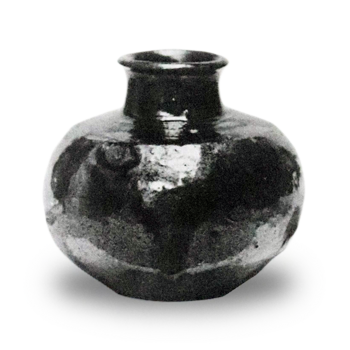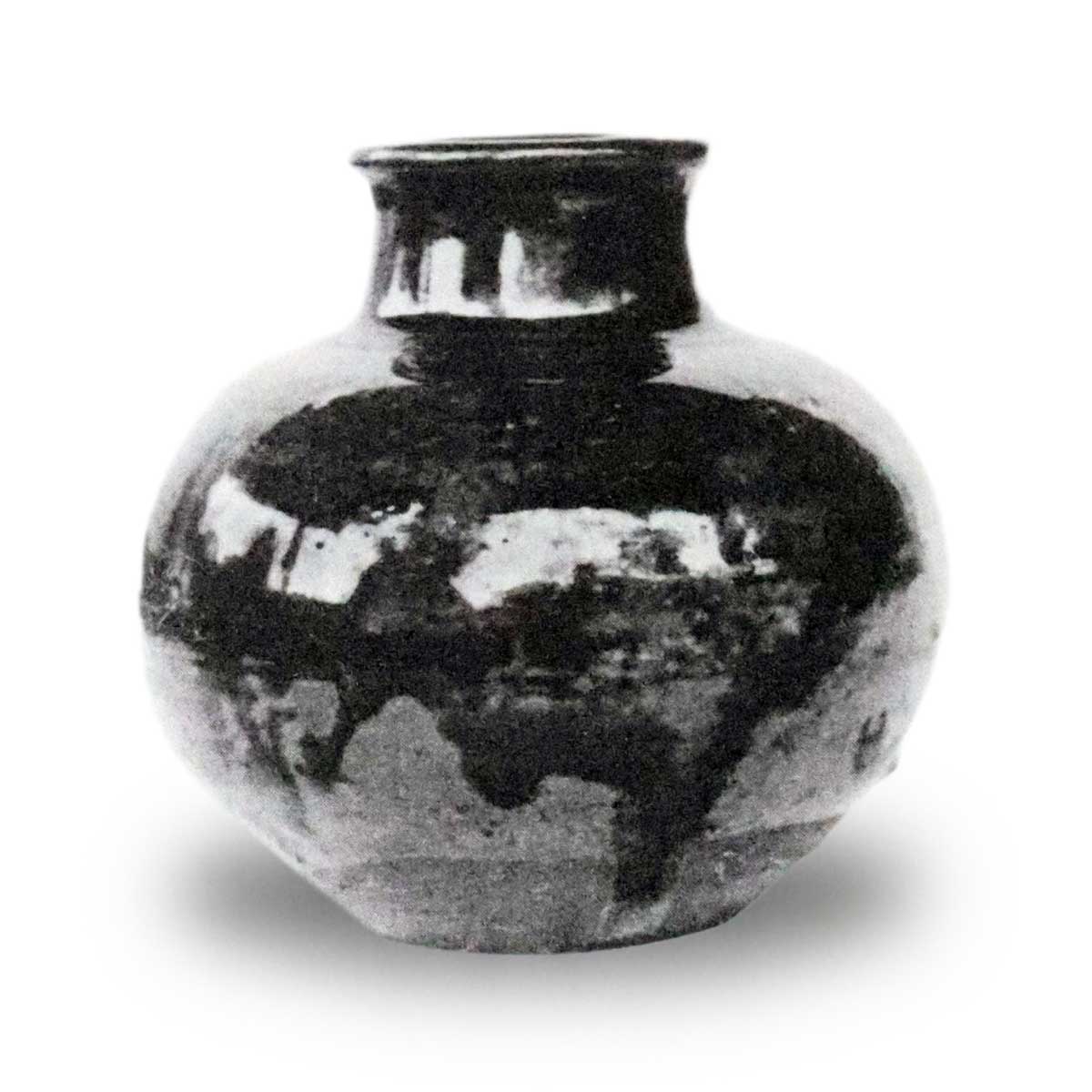
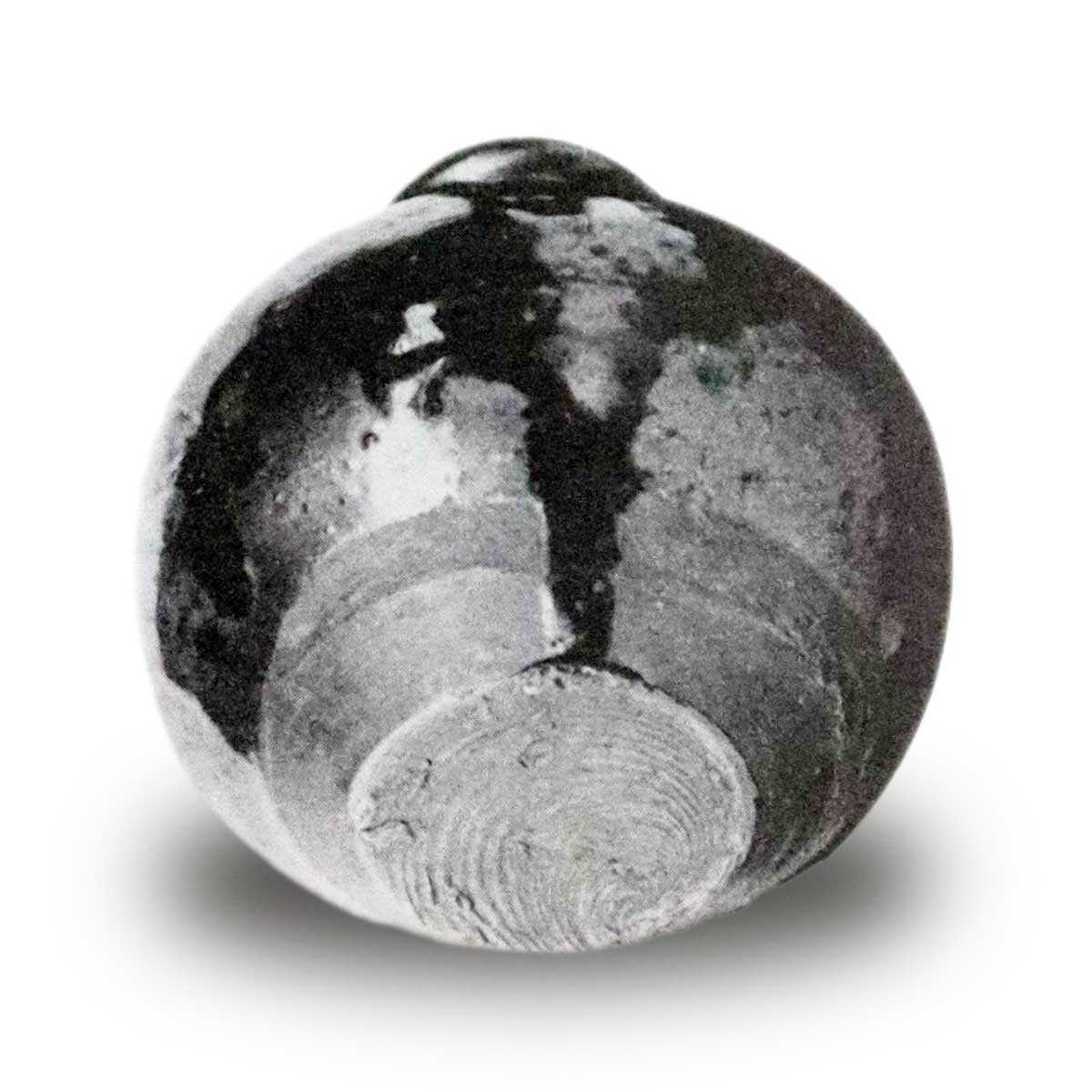
Made in China; a Meibutsu from the Zhongxing period; Collection of Count Tadamichi Sakai
Origin of the Name
It is said to have been named after Kinoshita Katsutoshi, who owned this round jar. Katsutoshi was the son of Sugihara Iesada, the older brother of Kitano-no-Miyako, the principal consort of Taiko Hideyoshi. He served Hideyoshi from a young age and, upon coming of age, became the lord of Tatsuno Castle in Harima Province (Hyogo Prefecture); he later moved to Wakasa (Fukui Prefecture), where he ruled over a domain of 90,000 koku. In Keichō 5 (1600), when Tokugawa Ieyasu launched a campaign into the eastern provinces, Katsutoshi served as the commander of Fushimi Castle; however, after the war, he abandoned his domain and retired to the Higashiyama district of Kyoto, later moving to the Nishiyama district in his later years. He went by the pen names Chōshōshi and Ten’ya-ō. He cultivated a passion for waka poetry and found companionship in the beauty of nature; he passed away on June 15, Keian 2 (1649) at the age of 81. His collection of poems is titled Kyohaku-shū. Chōshōshi had no heir, and his lineage died out; however, his younger brother, Toshifusa, ruled over 25,000 koku in Ashimori, Bitchū (Okayama Prefecture), and became the ancestor of the current Viscount Kinoshita Toshigen. Toshifusa’s younger brother, Nobutoshi, ruled over 25,000 koku in Higo Hide (Oita Prefecture) and became the ancestor of the current Viscount Kinoshita Toshitetsu. These are referred to as the “Two Houses of Kinoshita.”
Dimensions (converted using 1 sun ≈ 3.03 cm and 1 monme ≈ 3.75 g)
Height: Approx. 6.79 cm (2 sun 2 bu 4 rin)
Body diameter: Approx. 6.67 cm (2 sun 2 bu)
Mouth diameter: Approx. 3.09 cm (1 sun 2 rin)
Base diameter: Approx. 3.03 cm (1 sun)
Weight: Approx. 84.0 g (22 monme 4 bu)
Accessories
・Lid: 1 (no indentation)
(Note) The Tsuchiya Storehouse Ledger states, “7 lids, including 1 made by Kyūmi, 1 made by Tatsusa, and 5 replicas of the lid for the Aisaka Maru-tsubo,” but currently only one remains.
・Storage Pouch (bag for holding the tea caddy): Purple chirimen; brown cord
・Covering Bags (4):
Satin with bamboo vine pattern (lining: umi-ki; cord: purple)
Cotton Guangdong weave (lining: umi-ki; cord: purple)
Satin with light green lion pattern (lining: umi-ki; cord: purple)
Satin with swastika pattern (lined with sea-green, cord in Enshu brown)
In addition to these, there are four bags that have been unstitched.
・Bag box: Made of natural-finish paulownia wood
Inscribed with “Kinoshita Marutubo” and “Bag”
・Hikiya (cylinder for storing the tea caddy): Black lacquered, with chamfered edges
Lid inscribed with “Kinoshita” in gold powder
The pouch is made of “Ichigo-saki” fabric (lining: five-color stripes; cord: Enshū brown)
・Box: Made of natural paulownia wood
Inscribed with “Kinoshita Marutubo”; includes an inscription by Kobori Jūzaemon
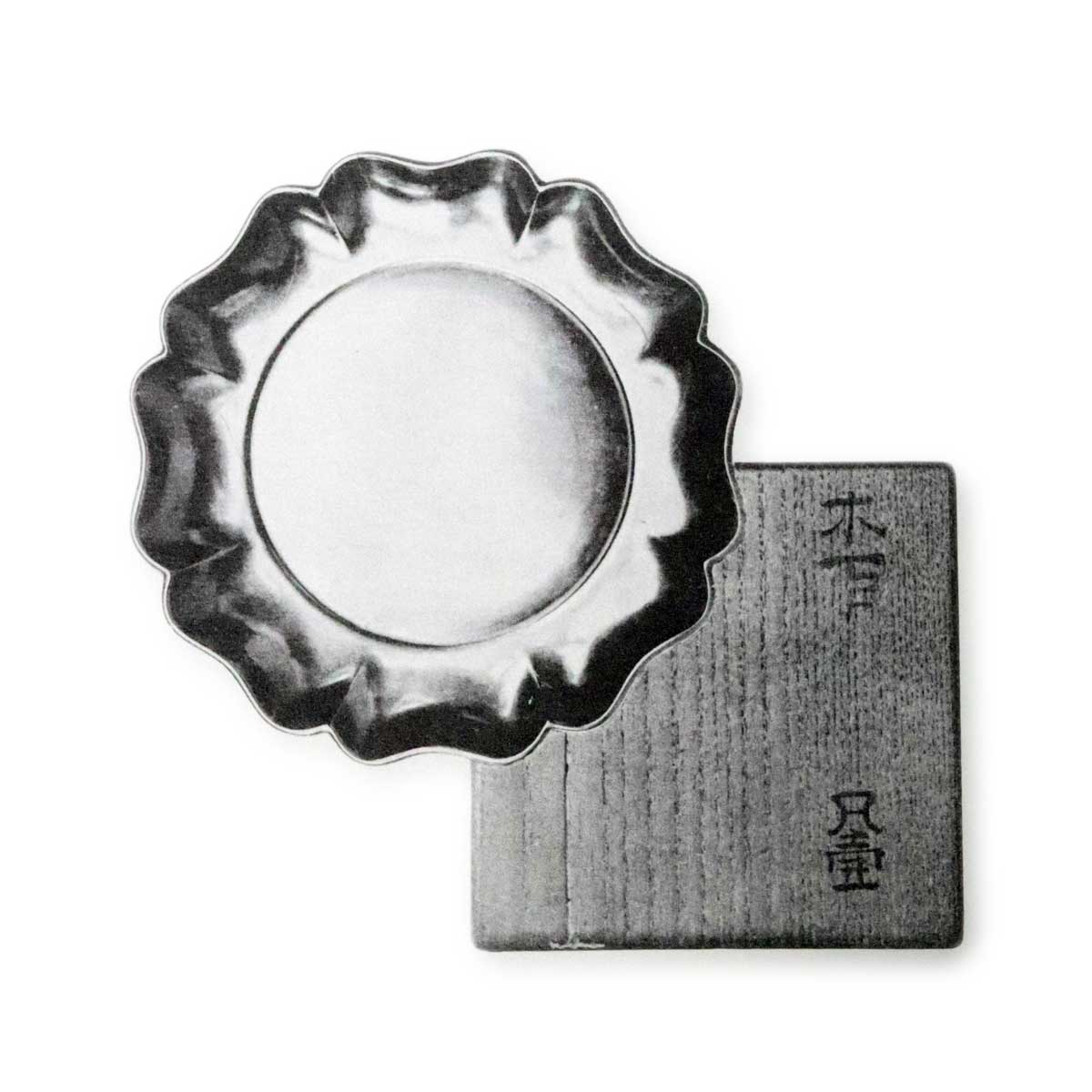
・Accompanying tray
・Box for the accompanying tray: Tsuishu lacquer with carvings on the edges; interior is red; bottom is black. Made by Yang Mao (Chinese lacquer artisan)
Front: “Red-interior tray, made by Yang Mao”; Back “Made by Yang Mao”
・Accompanying notes: 3 letters
“The Kinoshita tea caddy was originally owned by a certain Miyakoshi of Kaga (Ishikawa Prefecture), and later passed into the hands of Kikuraya. It is said that 40 years ago, Tanimatsuya acquired it for 40 ryō of gold. The main Kinoshita family’s collection was destroyed by fire, leaving only this piece; while there are quite a few similar items, it is said that there is likely no other of this caliber.”
“One half of a Kinoshita-style cut (saki) and an excerpt from a Wakuda-style cut, along with the fabric from the Chōraku-ji spinning top pouch”
“The Kinoshita family possessed two Seto round jars, which Kobori Enshū reportedly acquired after strongly requesting them; the one on the right is the ‘Aisaka Round Jar.’ A few years ago, when Sōchū mentioned Aisaka, Fumai-den expressed a desire to view it, so it should have been acquired, but the transaction was called off. Later, when I spoke with Sōchō, he told me that although he had viewed the Aisaka and was in a position to acquire it, he simply could not appreciate its merits. Perhaps because he could not discern its appeal—despite it being an item Enshū had treasured so dearly—he thought the Ishiguro round jar might be superior and decided to hold off on the purchase for the time being. Afterward, when he viewed the Ishiguro round jar, he found the Aisaka to be far superior to the Ishiguro. However, he told me he still could not understand why Enshū had treasured the Aisaka so dearly. When I relayed this story from Sōchō to Sōchū, Sōchū remarked that since there were originally two of these pieces in the Kinoshita family, and Enshū had strongly requested and received one of them, the Kinoshita family likely sent the second-best one. Therefore, he said, the Kinoshita Maru-tsubo is probably superior to the Aisaka.”
Miscellaneous Notes
Kinoshita Marutubo. Owned by Tsuchiya Sōshū (Tsuchiya Sagami-no-kami). Height: approx. 6.48 cm (2 sun 1 bu 4 rin); body diameter: approx. 6.67 cm (2 sun 2 bu); mouth diameter: approx. 3.09 cm (1 sun 2 rin); base diameter: approx. 3.03 cm (1 sun). Includes one lid and four pouches (bamboo-vine damask—lining: umi-ki; cord: purple; Guangdong cotton—same as above; light green lion damask—same as above; manji damask—cord: Enshū brown). The handle is a black-lacquered Hikiya (intermediate) style with chamfered edges, inscribed with “Kinoshita” in gold powder. The pouch is made of “ichigo-zori” fabric (lining: five-color stripes; cord: Enshū brown). The box is made of untreated paulownia wood. (Illustration of the tea caddy available)
(From Meibutsu-ki)
Kinoshita Maru-tsubo—Made in China (Dimensions and descriptions of accessories are the same as in Meibutsu-ki)
(From Kokin Meibutsu Ruiju Shiyu no Bu)
Kinoshita Maru-tsubo (listed in the “Old Seto” section). Mouth diameter approx. 3.03 cm (1 sun), height approx. 6.51 cm (2 sun 1 bu 5), body diameter approx. 6.67 cm (2 sun 2 bu), base diameter approx. 4.55 cm (1 sun 5). The pouch is made of Guangdong-woven cotton, with a satin fabric featuring diamond and swastika patterns, and a damask fabric depicting bamboo vines and lions. The handle is lacquered black; the box is made of paulownia wood; and the pouch by Hikiya Jūzaemon is made of makai-ori fabric. The lid consists of seven pieces (one by Kyūmi, one by Tatsusa, and five replicas of Aisaka’s work), weighing 20 monme 6 bu. (Illustration of the tea caddy included)
(From Rinpō-kīryū)
Kinoshita Maru-tsubo: Made in China; features a magnificent Seto glaze.
(From the Maku-an Bunko, Series A, No. 9)
Kinoshita Maru-tsubo: Made in China. It has seven lids (one made by Kyūmi, one by Tatesa, and five replicas of Aisaka’s work) and four pouches (rhombus-manji satin, Guangdong-woven cotton, bamboo-vine satin, and pale green lion-crest satin). The tea caddy is black-lacquered with a hamakai-woven pouch; the outer box is made of paulownia wood and bears an inscription by Hikiya Lord Kobori Bitchū-no-kami (Enshū).
(From the Tsuchiya Storehouse Ledger)
Kyōhō 10 (1725), Year of the Snake, February 20—Tea gathering hosted by Lord Tsuchiya Sagami-no-kami Naotoshi of Sagami Province
Guests: Kobun, Tanimura, Nomura
・Hanging scroll: A single-line calligraphy by Ikkyū Sōjun
・Tea caddy: Kinoshita Maru-tsubo (Owned by Kobori Enshū)
Tray: Tsuishu lacquer, crafted by Haruari, designed by Eikawa Tōbō
・Tea bowl: Seto ware (owned by Kobori Enshū)
・Tea caddy: Copper, thin-walled round
(From Appendices to Tea Ceremony Utensils by Kinzen Sōgi)
Provenance
Originally owned by Kinoshita Chōshōshi (Katsutoshi), it was subsequently passed down within the same family (the Kinoshita family). It is said that Kobori Enshū strongly desired this piece, but since the Kinoshita family owned two round-vase tea caddies at the time, they did not give him this “Kinoshita Maru-tsubo” but instead ceded the other one, the “Aisaka Maru-tsubo.” Subsequently, this “Kinoshita Maru-tsubo” was passed down to Tsuchiya Sagami-no-kami, and when the Tsuchiya family’s tea utensils were sold, it became the property of the Sakai family of Wakasa Province (Fukui Prefecture).
Record of Actual Viewing
On April 28, Taisho 8 (1919), I had the privilege of viewing this item in person at the residence of Count Tadamichi Sakai in Yarai-cho, Ushigome Ward, Tokyo City.
It is a Chinese-made round teapot; the purple glaze shines beautifully, and the luster of the black glaze is so intense that it reflects objects. The pattern covering the entire surface is clearly visible; its beauty is beyond words, and not a single flaw can be found anywhere on the piece. A single dark, sunken line runs around the rim of the neck; the pattern on the front is wide but narrows into a thin, flowing line near the base, ending just where it meets the tray. The black glaze is applied in multiple layers, creating a strikingly beautiful pattern.
A black streak runs around slightly more than half the body of the tea caddy, and from the rim downward, the vermilion-clay-colored (reddish-brown) clay is exposed; at the boundary between the glaze and the clay, there is a single spot that is slightly raised, bulging like a rice cracker. In addition, there are numerous small traces of kiln adhesion within the crisp, thread-like glaze lines.
The rim has a shallow outward curve; the elegance of its form and the vividness of the glaze’s color are beyond words, and given its flawless condition, it is a masterpiece rarely seen even among Chinese round pots.