

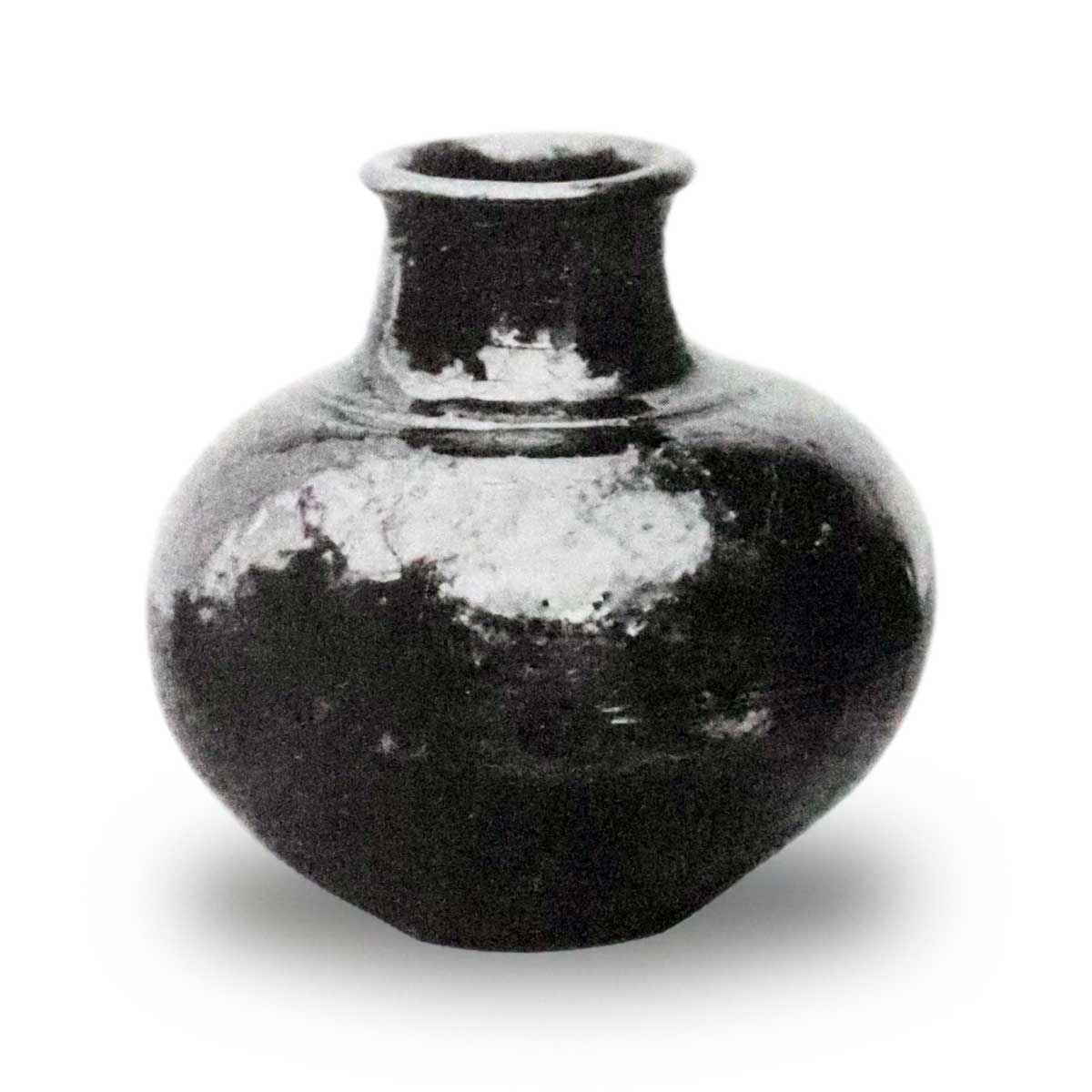
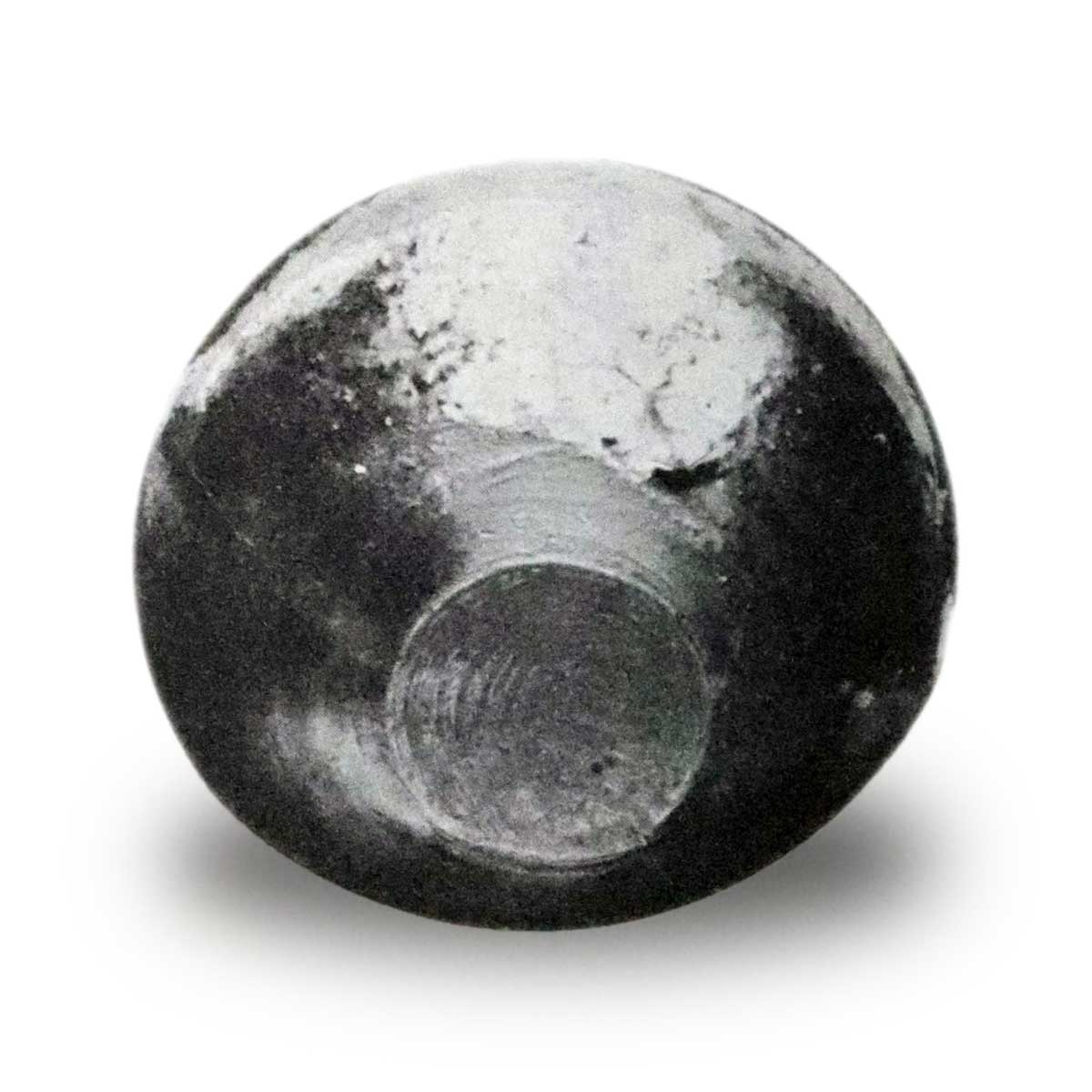
Made in China; Meibutsu of Unshu; Collection of Count Matsudaira Naoaki
Origin of the Name
“Tsuchida” is believed to be the name of the person who originally owned this tea caddy, though it is unclear who that person was.
Dimensions (converted at 1 sun ≈ 3.03 cm)
Height: Approx. 6.82 cm (2 sun 2 bu 5)
Body diameter: Approx. 6.97 cm (2 sun 3 bu)
Mouth diameter: Approx. 2.73 cm (9 bu)
Base diameter: Approx. 2.48 cm (8 bu 2 rin); approx. 2.73 cm (9 bu) in some areas
Accessories
・Lid: 1 piece (with a depression; in the style preferred by Takeno Jōō)
・Lid box: Made of natural paulownia wood, with an inscription by Matsudaira Fumai
“Tsuchida Lid”
・Gomono-bukuro (bag for holding the tea caddy): Purple habutae silk, with a purple cord
・Shifuku (cover bags): 6 pieces
Satin with a plum blossom pattern on a tea-colored ground (lining: light blue-green “Umi-ke,” cord: pale yellow)
Guangdong-striped pattern (lining: pale yellow “Umi-ke,” cord: purple)
Tortoiseshell-patterned satin (lining: iridescent “Umi-ke,” cord: purple)
White-tea-colored satin with a rain-dragon pattern (lining: light blue-green “Umi-ke,” cord: white)
Chiffon with a bird-sash pattern (lining: iridescent sea-green; cord: purple)
Chiffon with a Teika-style pattern on a brown ground (lining: floral-patterned sea-green; cord: pale yellow velvet)
・Storage box: Paulownia wood with Shunkei lacquer finish, featuring 6 compartments
Wrapping cloth: Purple crepe fukusa
・ Hikiya (a tube for storing a tea caddy): Black lacquer
Pouch: Smoked leather; cord is indigo-blue velvet
・Inner box: Unfinished paulownia wood
Pouch: Iris-patterned leather; cord is pale yellow velvet
・Outer box: Unfinished paulownia wood, with an iron lock
Inscription in ink on the body
“Tsuchida Marutubo”
・Accompanying tray: Chinese-made leaf tray (presumably tray-shaped); bears the Tsuchida (Furuta?) Oribe seal on the bottom
Wrapping: Purple habutae fukusa
Box: Unvarnished paulownia wood
Wrapping: Floral cloth (backed with “Onado” brown habutae)
Miscellaneous Notes
Tsuchida Maru-tsubo: Made in China. Classified as a Daimeibutsu. The accompanying tray is a black Chinese “ha-iri” tray bearing the Tsuchida (Furuta?) Oribe seal on the bottom. It was owned by Ishida Mitsunari, then by Lord Honda, and was sold by Motoya Sokichi around the Bunsei era.
(From Fushimiya Tekoro: Unshu Meibutsu-roku)
Tsuchida Maru Pot—Handled by Honso (Honya Sokichi) and Honryo (Honya Ryo), sold together with the Fukakusa incense container for 50 ryō.
(From Osaki-sama’s Record of Artifact Costs)
History of Ownership
Originally owned by a certain Tsuchida, it was passed down to Ishida Mitsunari and subsequently became part of Lord Honda’s collection. Around the Bunsei era, through the mediation of Honya Sokichi and Honya Ryo, it was transferred to Lord Matsudaira Fumai along with the Fukakusa incense container for a total of 50 ryō. Since Lord Fumai passed away on April 24 of Bunsei 1 (1818; the era name was changed from Bunka 15 to Bunsei in April of that year), it is believed that the purchase of this tea caddy was indeed his very last acquisition of tea utensils.
Record of Actual Viewing
On May 28, Taishō 7 (1918), I had the opportunity to view this item in person at the office of the household of Count Matsudaira Naoaki in Matsue City.
This is a round jar made in China. The rim has a shallow outward curve, and three lines run around the base of the slightly elongated neck. There are spatula marks extending about halfway up the body, and from the neck down to the base of the marks on the body, running across the front, there is a large repair mark (mending).
Overall, within the black amber and light purple hues, patches of persimmon color appear mottled, and the tip of the front pattern—which flows down near the rim—displays a blue-lapis lazuli color. To the left of this front design, there are two areas where the glaze has not adhered, resembling eyes.
From the rim downward, the mouse-gray clay is exposed, and the base is exceptionally well-defined. There are traces of kiln adhesion within the fine thread-like cracks. It feels light in the hand, offers many visual highlights, and, due to its small base, is a teapot of exceptionally graceful form.

