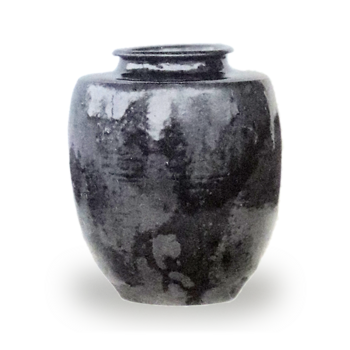
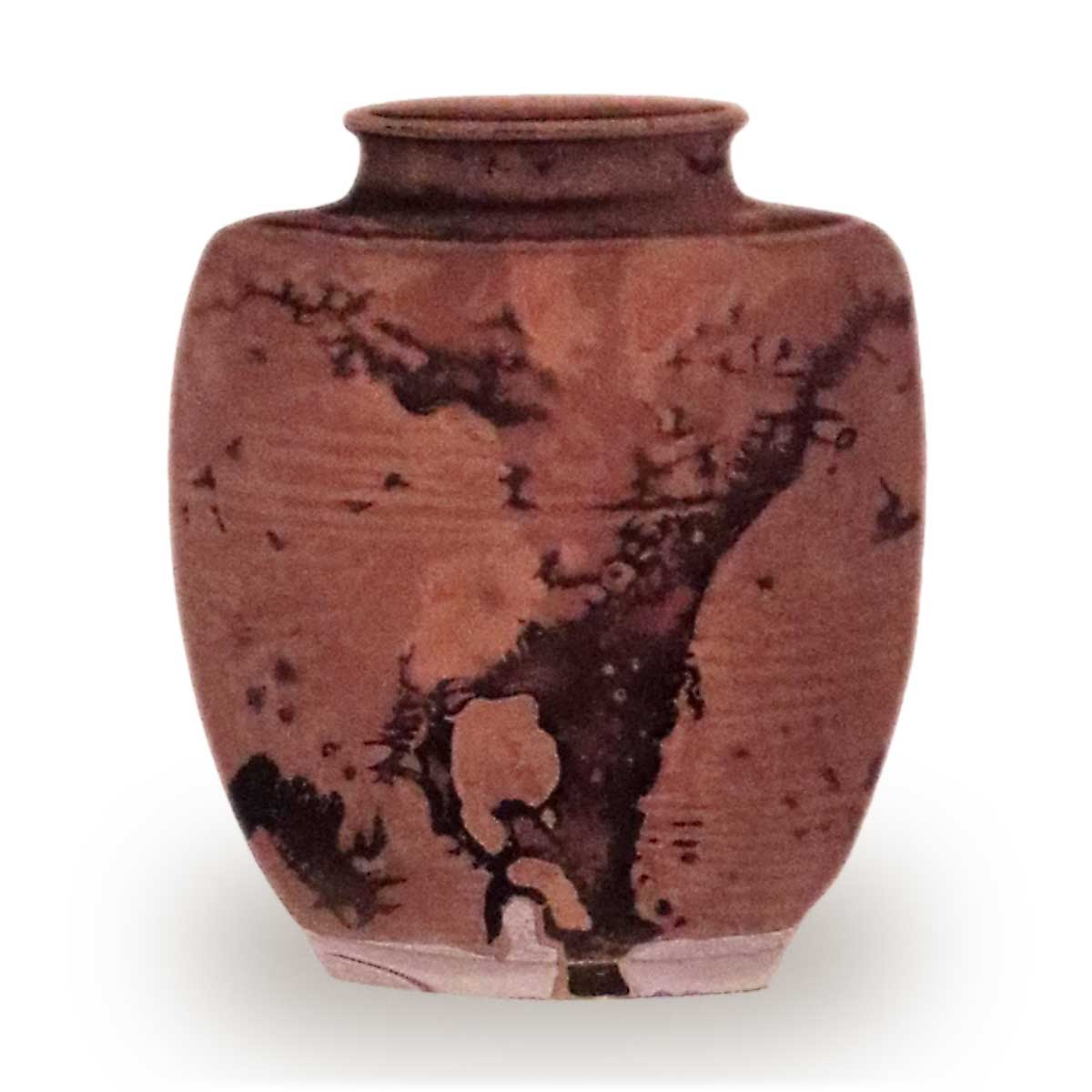
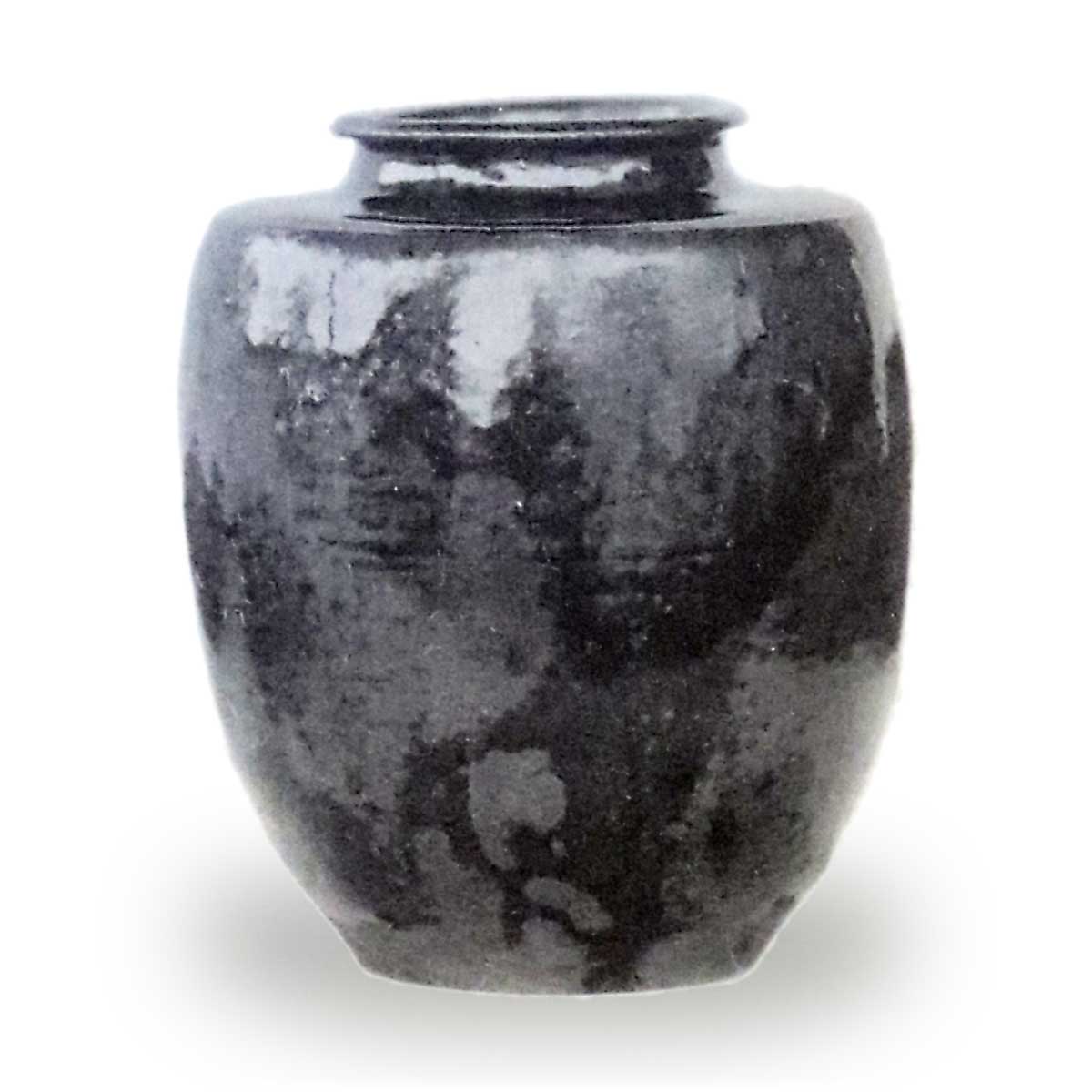
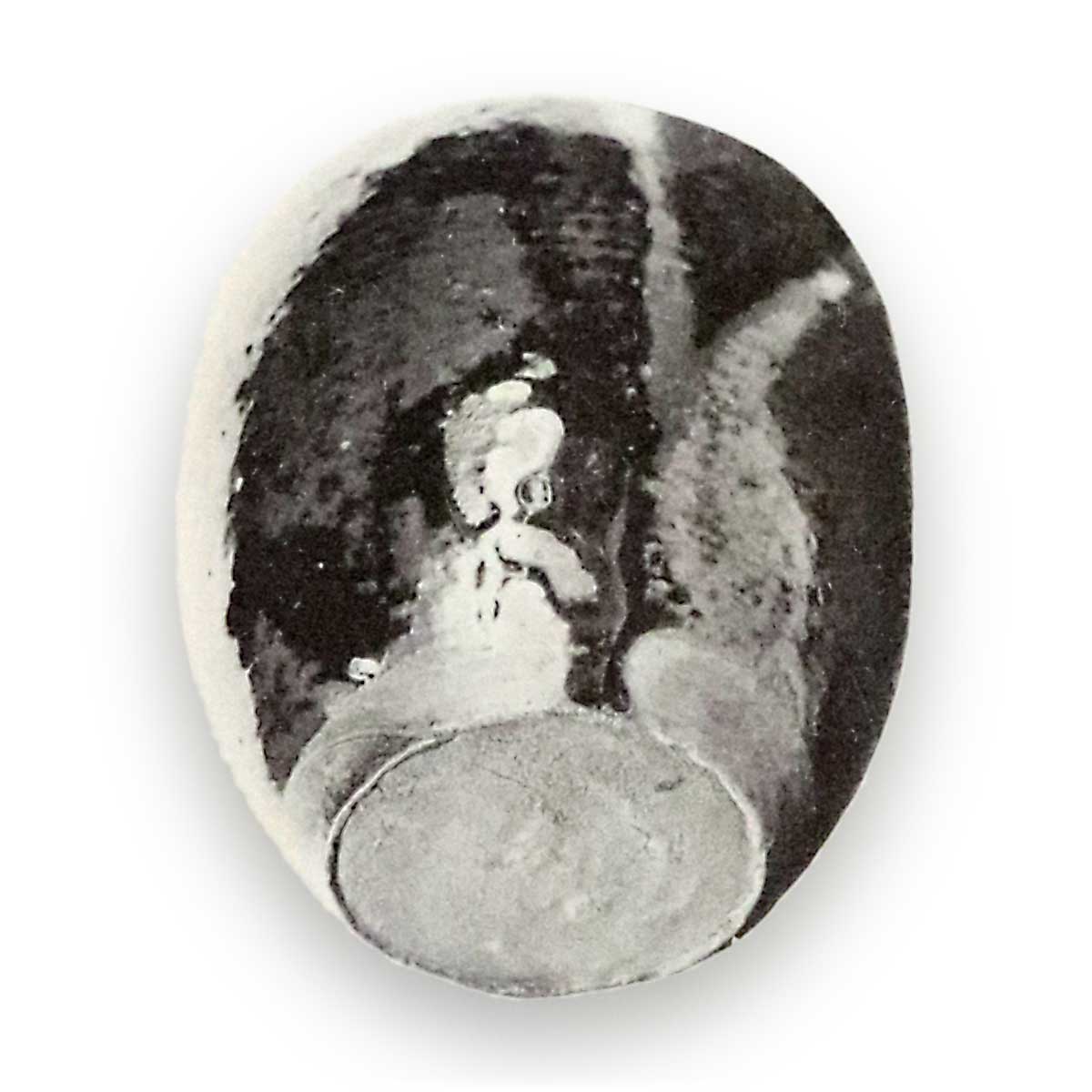
Made in China (Han-saku) | Daimeibutsu | Collection of Count Tadamichi Sakai
Name
Its original name was “Karasuma Katatsuki.” This is because it was passed down through the Karasuma Daikan family. In 1587 (Tenshō 15), it was exhibited by the Karasuma family at the Kitano Grand Tea Ceremony, where it caught the eye of Toyotomi Hideyoshi, leading it to be known as the “Kitano Katatsuki.”
Dimensions
Height: Just over 2 sun 9 bu
Body diameter: Just over 2 sun 5 bu
Mouth diameter: 1 sun 4 bu
Base diameter: 1 sun 4 bu
Height of the neck (koshi): Just over 3 mm
Shoulder width: 4.7 mm
Weight: 34 monme 4 bu
Accessories
・Lid: 1 (ivory)
・Imperial bag (white ha-niwa fabric, white cord)
・Bags: 3 (Tachibana-ya fabric with beaded cord, Honno-ji fabric with beaded cord, Kamakura Koto fabric with beaded cord)
・Storage box (Paulownia, natural wood, cord: blue Sanada cord. Contains a replacement pouch for the Kitano Katatsuki, Tachibana-ya fabric, lid, Honno-ji woven cloth, and Kamakura Koto)
・Hikiya (a container made by turning wood; Paulownia, natural wood, hollowed-out box; red leather pouch, cord: yellow)
・Outer box (Shunkei lacquer with chamfered edges, lock included)
・3 accompanying documents
The Origin of the Kitano Katatsuki
The Kitano Katatsuki was once owned by Miyoshi Sōsan, who received it from Lord Ashikaga Yoshimasa, and later passed to Tsuda Sōtatsu of Sakai. Subsequently, it was bestowed upon Karasuma Dainagon Mitsuhiro (Karasuma Mitsuhiro), and the family held it for generations.
In the first year of the Tenshō era, when Oda Nobunaga gathered tea utensils from various regions in Kyoto, this katatsuki was presented by the Karasuma family. Afterward, it came to be known in the world as the “Karasuma Katatsuki.”
It was also exhibited at the Kitano Grand Tea Ceremony.
During a tea ceremony held by Hideyoshi in Kitano, Sen no Rikyū remarked, “There is also a fine katatsuki at this teahouse.” Consequently, although Hideyoshi had already passed by, he turned back to view it. Because of this connection to the Katanuki, it also came to be known as the “Kitano.”
It was treasured as a family heirloom by the Karasuma family for several decades, but during the Hōkei era, a man named Miki Gonda-no-yū acquired it for 10,000 ryō of gold. Around the Genbun era, it passed to the Mitsui Hachirōemon family (the Mitsui family), who held it until recently, when I acquired it from Sōroku, who had retired from the family business.
Memorandum
- 4,850 ryō of gold
・Kitano Katatsuki tea caddy
・Niji Tenmoku tea bowl
・Miyoshi Konbiki tea bowl
・Koryo cylindrical flower vase
I have gratefully and securely received the above four tea utensils in exchange for the payment. I record this as proof for future reference.
December, Ansei 2 (1855) Mitsui Hachiroemon (Seal)
To Mr. Takahashi Yu
(Note) Takahashi Yu was the steward of the Sakai family in Wakasa Province at that time.
The Origin of the Kitano Katatsuki
Neither the Honda clan nor Kobori Enshu had ever seen the Kitano Katatsuki. As for those who had seen it since the Tenmei and Kansei eras, the only instance was when Lord Matsudaira Fumai, after retiring, visited Hachiroemon’s residence, accompanied solely by his retainer, Nedo Sosei. At that time, Fushimiya Jin’emon also attempted to accompany him but was unable to do so, leaving only Sōsei. Due to various circumstances involving Hachirōemon’s household, Jin’emon was unable to view the piece.
However, there is the following anecdote associated with this story. When Lord Fumai planned to tour Kyoto and Osaka to view tea utensils while on a hot-spring cure, he intended to be invited to a tea ceremony at the residence of Mitsui Hachirōemon in Aburanokoji.
Before departing, he informed Fushimiya Jin’emon of his plans, saying, “I intend to visit Mitsui to view the Kitano Katatsuki in his possession. Please tell him that you will accompany me to Mitsui.” Jin’emon was deeply grateful and immediately set out for the capital to accompany him.
When Lord Fumai requested a tea gathering at Mitsui’s residence, Hachirōemon’s side agreed immediately, and the date was set. When he informed Mitsui that “the escorts will be Nedo Sōsei and Fushimiya Jin’emon,” they accepted Sōsei but replied, “We must decline Fushimiya, as he is a dealer in tea utensils.” Lord Fumai was deeply disappointed and, saying, “How can he not accompany us now that we’ve made such a promise?” immediately summoned Jin’emon to explain the situation. Jin’emon was also deeply perplexed and felt sorry for Lord Fumai, so he devised various strategies. He then proposed, “If the other party insists on refusing the escort, there is no choice but to have Sōsei accompany you alone. In exchange, on the day of the event, I will go to the Mitsui residence and announce, ‘I have come to inquire after Lord Fumai’s well-being.’ “At that time, if Lord Fumai could ask to be shown into the tea room on the pretext of having business to attend to, we should be able to view the katatsuki. Please keep that in mind,” he proposed. Jin’emon was overjoyed at this and took his leave.
Now, after exchanging letters regarding what time to arrive at Mitsui the following day, Lord Fumai, accompanied only by Sōsei, paid a visit to Hachirōemon’s residence on the appointed day. As the tea ceremony proceeded, Hachirōemon brought out the katatsuki on a tray and waited by the back entrance. Lord Fumai examined it closely and had Sōsei look at it as well. Lord Fumai spent a long time examining it, hoping that Fushimiya might somehow appear, but he did not come out at all. “Could it be that the arrangements I conveyed yesterday were mistaken?” he worried deeply, but since the item simply would not appear, he decided it would not be good to prolong the matter any further, so he placed it in a bag and returned it to Hachirōemon.
After Hachirōemon took it and withdrew, he opened the back door again and came out, saying, “Fushimiya Jin’emon has arrived to pay his respects.” Since the audience had already concluded, there was nothing to be done; Lord Fumai simply replied that he understood, made preparations to leave, and returned to his inn. Jin’emon arrived shortly thereafter. Jin’emon said, “I went to Mitsui around 10 a.m. and asked them to announce that I had come to pay my respects since Lord Fumai was present. They said they understood the details and would inform him immediately, then led me to a separate room and treated me with great courtesy. However, since I was never summoned, I asked them to relay the message three or four times. I am very suspicious as to why the promise was broken,” he said. Lord Fumai replied, “Well now, it seems Hachirōemon sensed our plan and kept you detained until the tea ceremony was over.”
I later learned that this was a ploy by Hachirōemon to prevent anyone from witnessing the shoulder-bump.
During the Tenpō era, Hayanosuke, a retainer of the Himeji domain, was invited to a tea ceremony hosted by Hachirōemon and was able to witness it. No one else has ever seen it. It was not shown to Matsudaira Shūshū or Mizuno Echizen-no-kami either. Not a single person from Kyoto has ever seen it. It was a well-known fact among those in the Honda and Kobori Enshū lineages that, from the Tenmei era until recently, the only people who had seen it were Lord Fumai, Hayanosuke, and Nedo Sōsei—and no one else.
At the time of the Kitano Grand Tea Ceremony, it was in the possession of the Karasuma family. However, it was originally a heirloom from the Ashikaga Shogunate and shares the same lineage as the Hino Katatsuki.
It passed from the Karasuma family to Miki Gonda, and was subsequently acquired by the Mitsui family. Furthermore, regarding the Hino Katatsuki, it is said that a man named Omotoya Hikita from the Hino family presented the “Hatsuhana” to the Hino family, and in exchange, the Hino Katatsuki was purchased; Furuta Oribe acted as the intermediary in this transaction.
Grand Tea Ceremony
Two tea caddies, “Menpaku” and “Nitta,” were presented at Hideyoshi’s seat (separated from the one in front). At the second seat, in front of Tsuda Sōyuki, there were three. Sen no Rikyū also had four. Miyoshi Sōsan had the same. “Hatsuhana” was presented at Sōyuki’s seat. “Nara-shiba” was presented at Rikyū’s seat. At Sōsan’s seat, the “Eki (Snipe) Katatsuki” was presented. It was exhibited at the Kitano Grand Tea Ceremony. The Karasuma Katatsuki was also exhibited in the same manner. The Matsumoto Katatsuki was placed at the head seat; this had formerly been owned by the Matsumoto family of Kyoto, then passed to the household of Tsutsui Junkei, lord of Yamato Province, and finally to the Domon family, retainers of Daibutsu Sakyo.
Miscellaneous Notes
April 4, 1542: Tea gathering at Tennojiya Sōtatsu in Sakai
Guests: Hisamasa, Matagoro, Shōsei
Placed on a long tray in the tokonoma: Kitano Katatsuki and Tenmoku tea bowl
The clay is bluish-black with a coarse grain. There are “snow avalanches” (drips of glaze) within the glaze; the glaze is generally dark, with some areas where it is applied thinly; there are six spatula marks; and there are thread-like cracks.
(From the Matsuya Notes)
Kitano Katatsuki: Formerly owned by Kashiwaya. Later, it came into the possession of Lord Karasuma Dainagon Mitsuhiro.
(From the Record of Ancient Treasures)
Karasuma Katatsuki: From the Kyoto collection, owned by Lord Karasuma.
(From the Higashiyama Imperial Collection Supplementary Register)
Kitano Katatsuki: Belongs to Lord Karasuma of the court nobility.
(From the Records of Yamagami Sōji and the Collection of Meibutsu)
Katatsuki: Owned by Lord Karasuma, the Grand Counselor.
(From the Record of Precious Objects and Curiosities)
Katatsuki Kitano: A Daimeibutsu (Chinese, Tang-style) tea caddy. Owned by Lord Karasuma, the Grand Counselor.
(From Kokin Meibutsu Ruiju)
Kitano Katatsuki: Made in China (Han-style). It is from the same period as tea caddies such as “Zangetsu,” “Kokushi Nasu,” “Matsuyama,” and “Kuga.” Furthermore, it shares the same construction and glaze application as “Matsuyama” and “Kuga.”
(From The Origins of Seto Pottery by Matsudaira Fumai)
Karasuma Katatsuki: Also known as Kitano Katatsuki. Height: 2 sun 9 bu; the base is covered with persimmon glaze and coated with black glaze. The base features a “honshikiri” finish.
(From Setsumangusa: A Guide to the Tea Ceremony)
Kitano Karasuma: Owned by Tsuda Sōtatsu. Height: 2.95 sun; width: slightly over 2.4 sun; circumference: 7.8 sun; base diameter: 1.4 sun; mouth diameter: 1.35 sun; mouth length: 0.3 sun; bulge: 1.5 sun. It has a dark persimmon-colored glaze, with “cross-shaped” marks on the surface, and some areas exhibit a reddish persimmon hue. The clay is coarse and black. (Illustration of the tea caddy available)
(From the Manpō Zenshū)
Kitano: Originally owned by Karasuma Daikan, now in the possession of Mitsui Hachirōemon. It is exceptionally beautiful and features black speckles. It was made during the same period as the “Zangetsu,” and the base is formed by pressing a clay slab.
(From the section on the “Rinpō-kame-ryū” Daimeibutsu)
Karasuma Katatsuki: Later renamed Kitano Katatsuki. Height: 2 sun 2 bu; circumference: 7 sun 9 bu; finger span: 2 sun 5 bu; base (bottom contact area): 1 sun 3 bu 5 rin; neck: 2 bu 8 rin; shoulder width: 4 bu; diameter at the same point: 2 sun 2 bu. It comes with three storage bags: Honnoji-zori, Tachibana-ya-zori, and Kamakura-Koto. It is made of Tsurugaoka clay, giving it a pale yellow hue; the interior has a persimmon glaze base, while the shoulders are coated with black glaze. It features “yukizore” (glaze drips) and is coated with black glaze. (Image of the tea caddy available)
(From “Ushu Tekiganroku”)
In October of Tenshō 16 (when Hideyoshi was 50 years old), during the Kitano Daichayū tea gathering, Lord Toyotomi Hideyoshi, accompanied by Sōeki (Sen no Rikyū), toured various tea houses to observe their arrangements. As they were about to pass by the garden of Karasuma Asō (Dainagon), Rikyū remarked, “There is a fine kettle inside this tea house,” and had Hideyoshi enter to view it.
(From Shadō Shigetsu-shū)
With the world largely pacified, Lord Hideyoshi decided to hold a tea ceremony in the outlying area of Kitano. Thus, in the autumn of Tenshō 13 (the Year of the Rooster) (perhaps a misprint for “Hideyoshi’s 50th year”?), the “Great Kitano Tea Ceremony” was held after public notices were posted in Kyoto, Nara, and Sakai.
(Omitted) Afterward, wishing to view the garden furnishings in various places, he took about 18 pages with him and first entered the garden of Hachiya Dewa-no-kami to partake of tea. He then took Dewa-no-kami with him to look around various places, and upon being urged, entered the garden. At that time, Rikyu said, “There is a fine shoulder-rest here.”
(From Chaji Hiroku)
History
Originally owned by Ashikaga Yoshimasa, it passed through Miyoshi Sōsan and was inherited by Tsuda Sōtatsu, known as Tennōjiya of Sakai. It is clear that Tsuda Sōtatsu possessed it, as records indicate he used it at a tea gathering on April 4, 1542. Subsequently, it became the property of Karasuma Dainagon Mitsuhiro. It was at this time that it began to be called the “Karasuma Katatsuki.” However, when Lord Hideyoshi hosted the Kitano Grand Tea Ceremony in the 15th year of the Tenshō era, Karasuma Dainagon exhibited this item at the event. Soon after, Lord Hideyoshi personally admired it, and from that time onward, it came to be called the “Kitano Katatsuki.”
Although there are discrepancies in the records regarding when it came into the possession of the Karasuma family and when it was parted with by them, it is certain that the family owned it around the time it was exhibited at the Grand Tea Ceremony. Subsequently, around the Hōei era, it came into the possession of Miki Gonda, and thereafter, from the Genbun era onward, it belonged to Mitsui Hachirōemon. (The above is excerpted from Taishō Meiki-kan [Catalog of Famous Artifacts of the Taishō Era], compiled by the Mitsui family and published in April 1925. However, since the date “Tenshō 15” was erroneously recorded as “Tenshō 16,” we correct this here.)
The Kitano Katatsuki was destroyed in the Great Kanto Earthquake of September 1923. It is unclear whether it was in the possession of Marquis Inoue at the time or had been transferred elsewhere, but its loss is truly regrettable. The photographs and measured drawings presented here were taken and recorded by the Mitsui family when the piece was transferred from them to Marquis Inoue, and they must be considered truly invaluable materials.
Record of Actual Viewing
On April 25, 1919, I had the opportunity to view this piece in person at the residence of Count Tadamichi Sakai in Yaraicho, Ushigome Ward, Tokyo.
This is a Chinese-made (Han-style) tea caddy featuring an exquisitely crafted turned rim and a low, broad shoulder. The overall body has a purplish persimmon-brown base, with a single line of black glaze encircling the neck (the neck portion), and the upper half of the shoulder is covered in a thick layer of black glaze. Furthermore, there are three spots near the shoulders where the base glaze is thin, appearing as if the glaze had not been applied. In pieces of this type, the “snow avalanche” (the pattern created by dripping glaze) extends down to the base (the part in contact with the surface), and there are two places where the persimmon-colored base appears within the black glaze, resembling a dragon’s eye.
The body features horizontal striations covering two-thirds of the teapot, as well as extremely small, cracker-like protrusions (bumps). The glaze is applied deeply, revealing a pale reddish-gray clay color at the edge of the base. The bottom shows traces of being cut from a slab (a mark left when separated from the slab), with the line slightly raised; there are some worn areas, and one or two fine, file-like striations run from the lower rim to the edge of the base. It feels light in the hand, and its vivid appearance bears a strong resemblance to the famous “Meibutsu” style. It possesses great elegance, is completely intact with not a single flaw, and must surely be considered one of the finest Chinese tea caddies.