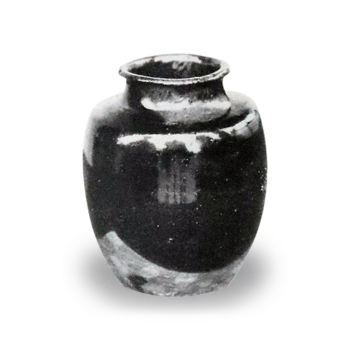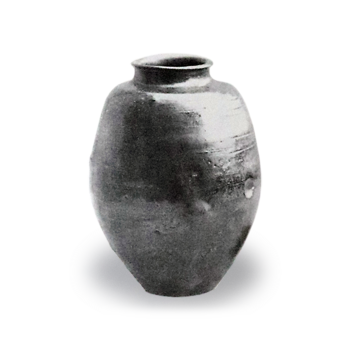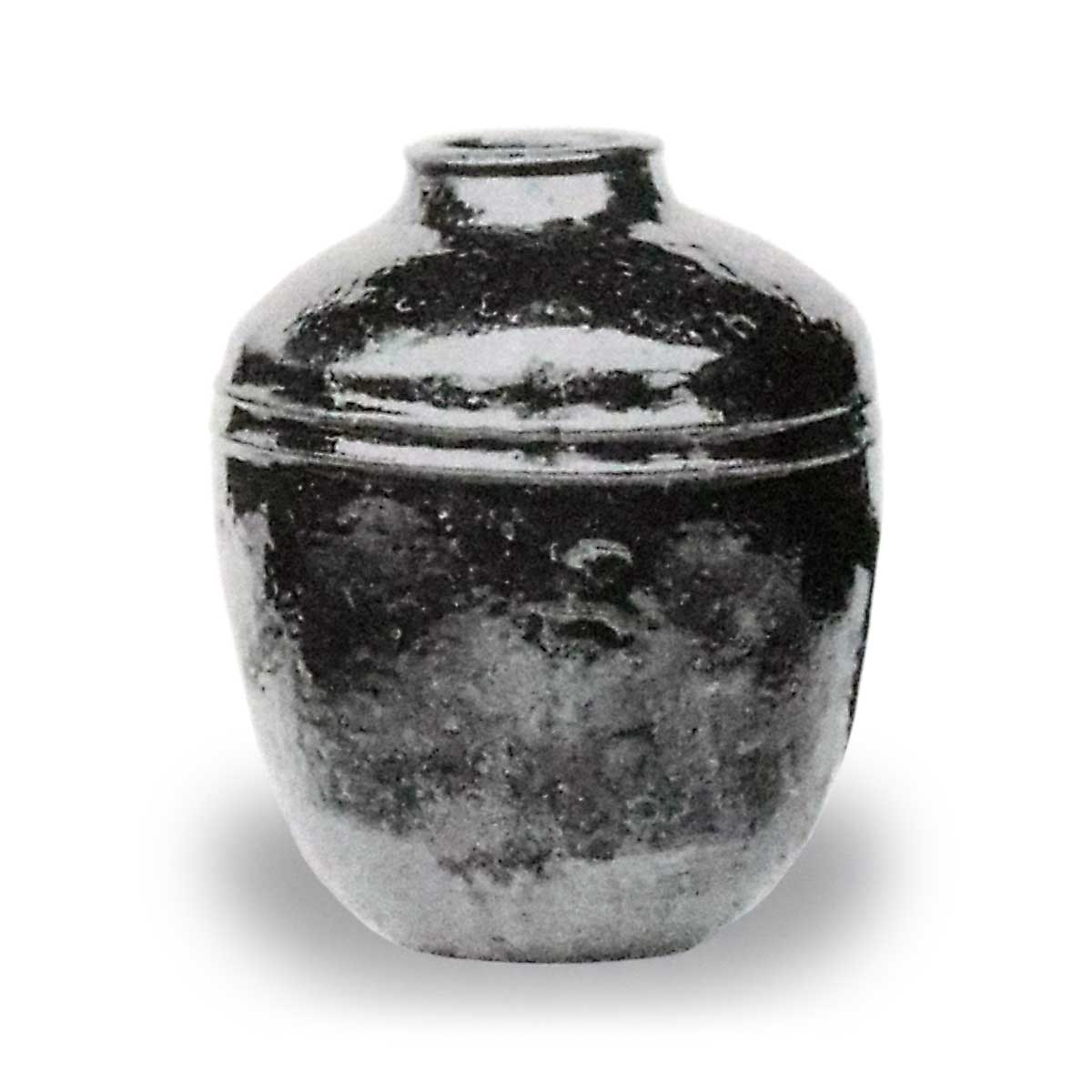

A Chinese tea caddy from the Tang Dynasty, currently in the collection of Baron Atsushi Matsuura.
Origin of the Name
Because the shoulders of this katatsuki-style tea caddy are rounded, it is called “Maru Katatsuki” (Round Shoulder Katatsuki). The name “Shirakumo” is believed to derive from the design found in the Chinese poetry collection Tozai-chū, which contains the verse: “White clouds, like a sash, circle the mountain’s mid-slope.” This name was likely chosen because the body of the teapot features a pattern where horizontal stripes (resembling a sash) appear translucent.
Modern Equivalents of Dimensions and Weight
Height: Approx. 8.5 cm (slightly over 2 sun 8 bu)
Body diameter: Approx. 7.2 cm at the sash section (2 sun 3 bu 7 rin)
Mouth diameter: Approx. 2.7 cm (9 bu)
Base diameter: Approx. 3.5 cm (1 sun 1 bu 5 rin)
Rim height: Approx. 0.7 cm (2 bu 2 rin)
Weight: Approx. 124.5 g (33 monme 2 bu)
List of Accessories
There are two lids; there is no nest (kago). The storage pouch is made of brown habutae silk with a white cord.
There are four types of protective covers (pouches).
・Ishidatami Junko (lining: Tamamushi Kaiki, cord: Moegi): A favorite of Hosokawa Sansai.
・Cha-shima Koto (lining: Tamamushi Kaiki, cord: purple)
・Chiku Koto (lining: Nezumi Kaiki, cord: purple)
・Sasa-tsuru Junko (lining: Moegi Kaiki, cord: purple)
The carrying case is black lacquered, and the bag for storing it is made of tanned leather.
The box is made of black-lacquered paulownia wood and bears a label inscribed with “Hakun, Tea Caddy.”
Letter from Hosokawa Sansai to Oyabu Shin’emon (scroll)
The scroll accompanying this tea caddy contains a highly enthusiastic letter (letter of thanks) from Hosokawa Etchū-no-kami (Sansai, Tadaoki) addressed to Oyabu Shin’emon, the owner at the time.
“Your repeated letters are a source of great joy. In particular, I am at a loss for words to express my gratitude for your thoughtfulness in going to the trouble of grinding tea specifically for me, and for sending a goose caught by your falcon and five abalone. I immediately prepared the delicacies you sent and intended to have the tea you gifted me prepared, but since there is no one here skilled enough to prepare tea, I must, to my shame, prepare it myself.
First, I had heard rumors of this tea caddy (Shirakumamaru Katatsuki), but I had never seen it before. Viewing it without prior knowledge, I was astonished and my eyes widened in surprise. I wonder why you have not brought this out until now. The unusual design took my breath away (I was greatly astonished). The messenger was likely a reliable person, but I was dumbfounded that such a renowned treasure was sent so casually (in such a haphazard manner).
First, do you intend to adorn the lid of the tea caddy with gold clouds? Also, I do not think this bag is suitable. If you could bring it with you when you come to the capital next year, I will have a splendid bag made for it. Even so, I had no knowledge of this tea caddy until last year, and I am constantly amazed by its magnificence.
- According to the report from the messenger who brought this… (omitted: regarding arrangements for future communication)…
- Your seal was stamped on the outer bag of the tea caddy, but when I return it to you, I will stamp it with my own seal and present it to you.
- I will not send a messenger to express my gratitude for this gift. Please forgive me. Also, I ask that you please refrain from sending me a letter tomorrow (meaning: I do not wish to cause you any further trouble). With deepest respect.
November 19, Hosokawa Etchū (Seal)
(This letter vividly conveys the surprise and excitement of Hosokawa Sansai upon seeing this masterpiece for the first time.)
Regarding Ōyabu Shin’emon
(Note: Ōyabu Shin’emon, the recipient of this letter, was originally named Shinpachi or Kuniyasu. Born in Yamashiro Province, he initially served Nakamura Kazushi. At the Battle of Sekigahara, he distinguished himself serving under Tokugawa Ieyasu and was granted 500 koku. He also distinguished himself during the Siege of Osaka, receiving an additional 500 koku, and was assigned to Tokugawa Yorinobu (Nanryuin) in Kii Province. Around that time, Furuta Shigetada, the lord of Matsusaka Castle, was transferred to Iwami due to certain circumstances, so Oyabu was appointed by the shogunate to oversee Matsusaka Castle. He died of illness on July 23, 1632 (Kan’ei 9).)
Other Accompanying Documents (Receipts)
I have received a box containing an accompanying document, along with items such as the “Bell Painting (hanging scroll),” “Iro-kō Tea Kettle,” “Kinjirashi Vase,” “Kanzukuchi Tea Caddy,” “Jikō-ji Tea Bowl,” and “Hakun Tea Caddy.” The items on the right are among the goods bestowed upon me by His Lordship, which I have undertaken to transport and am bringing to Edo on this occasion. I record this here as proof for future reference.
February 5, Year of the Boar. Ura Shinpachi (Seal)
(Addressed to four individuals, including Lord Shimanosuke of Iki and Lord Uchida Samon of Horie)
Another Hanging Scroll (Letter from Hosokawa Sansai)
A separate letter from Hosokawa Sansai addressed to Ōyabu Shin’emon has been mounted as a hanging scroll and included here. Within that letter are the words: “It is an unusual tea caddy unlike any I have seen recently. Although I am not familiar with it, I perceive it to be a magnificent Chinese artifact.”
Traces of the “Hakunmaru Katatsuki” in Various Records
・A record of the sale of tea utensils by Matsudaira Bizen-no-kami, former lord of the Otaki Domain (Genroku 9–Shōtoku 4), states: “Hakunmaru Katatsuki, 140 ryō in gold. Sold to Lord Tsuchiya Sagami-no-kami.” (From a scroll accompanying the “Matsuyama Katatsuki” in the collection of Viscount Ōkochi)
・The Matsuura family’s inventory records state: “Chinese Hakumaru Katatsuki. The body has two raised veins. This tea caddy is a treasure as precious as the ‘Uji Bunrin’ tea caddy passed down from our ancestors.”
・A record from the tea ceremony journal of Meiji 11 (1878) (the Kuchikiri tea ceremony) notes that this tea caddy was used on November 26 when Matsudaira Kakudo and others were invited.
・On April 24, 1902 (Meiji 35), at a tea gathering commemorating the 200th anniversary of the death of Matsuura Chikashin (Tokuyu Kōji), the lord of the Hirado Domain, Matsuura Sen (Shingetsuan) served as the host and invited Viscount Kato and others. Records indicate that at this event, a calligraphy scroll by Tadamichi was hung in the tokonoma; the tea caddy used was the “Sōkai Shoshi Denrai, Tang ware, inscribed ‘Hakun’”; the cover was “Sasatsuru Junko”; and “letters from Hosokawa Sansai and Kanamori Izumo-no-kami were included.”
(Continued from previous page) Other utensils used at the 200th Anniversary Tea Ceremony
The tea bowl was a “Genji Komogai,” and the inscriptions on the box read “Prince Yōzen” on the inside and “Matsuura Tadamichi” on the outside. The spare tea bowl was a new “Oniwayaki” (garden-fired ware). (From Kokon Chayūshū)
Summary of the History of Transmission
This tea caddy was once owned by Ōyabu Shin’emon Kuniyasu (originally named Shinpachi), a retainer of Tokugawa Yorinobu (Nanyūin), the founder of the Kishū Domain. The surprise and excitement displayed by Hosokawa Tadaoki (Etchū-no-kami, Sansai) when he was shown the caddy are described in the aforementioned accompanying scroll (letter).
It was subsequently passed down to Matsudaira Bizen-no-kami of the Otaki Domain, and later purchased by Tsuchiya Sagami-no-kami for “140 ryō.” In later years, it was passed to the Matsuura family (Hirado Domain), where it was treasured and kept in secret as one of the family’s most important treasures (jūhō), alongside the “Uji Bunrin” tea caddy, another renowned treasure.
Academic Inspection Record (Appraisal Record) from the Taisho Era
On November 26, 1919 (Taisho 8), this tea caddy was physically examined at the residence of Count Atsushi Matsuura in Asakusa Mukoyanagihara-cho, Tokyo.
The mouth is tight, with a rounded rim and a shallow turn-up. From the edge of the base, it slopes gently outward in a broad “sloping shoulder” shape, and below the shoulder, two raised ridges (yang ridges) run all the way around.
The entire piece is covered in an amber-colored glaze, within which a black, amber-colored glaze appears throughout in a stepped pattern (dan-mon). The glaze stops high up, revealing the reddish-brown clay body (sujiki) from the rim down.
The base is made with a raised rim, and on the inner side, a black glaze with a metallic luster (black metallic glaze) forms a pattern resembling three horizontal bands.
Inside, the glaze covers the rim, while below that, shallow wheel marks are visible. It is of very ancient origin and appears to be a Chinese “Han-style” piece.
With two raised bands on the body and a rim that is extremely small despite the very wide shoulders, this teapot possesses a unique style that could be described as “one of a kind” among the many teapots that exist.