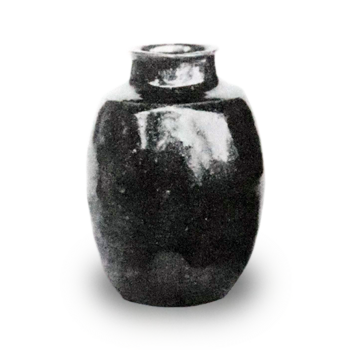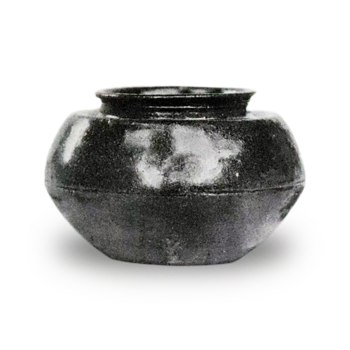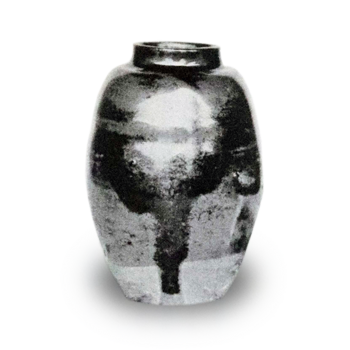
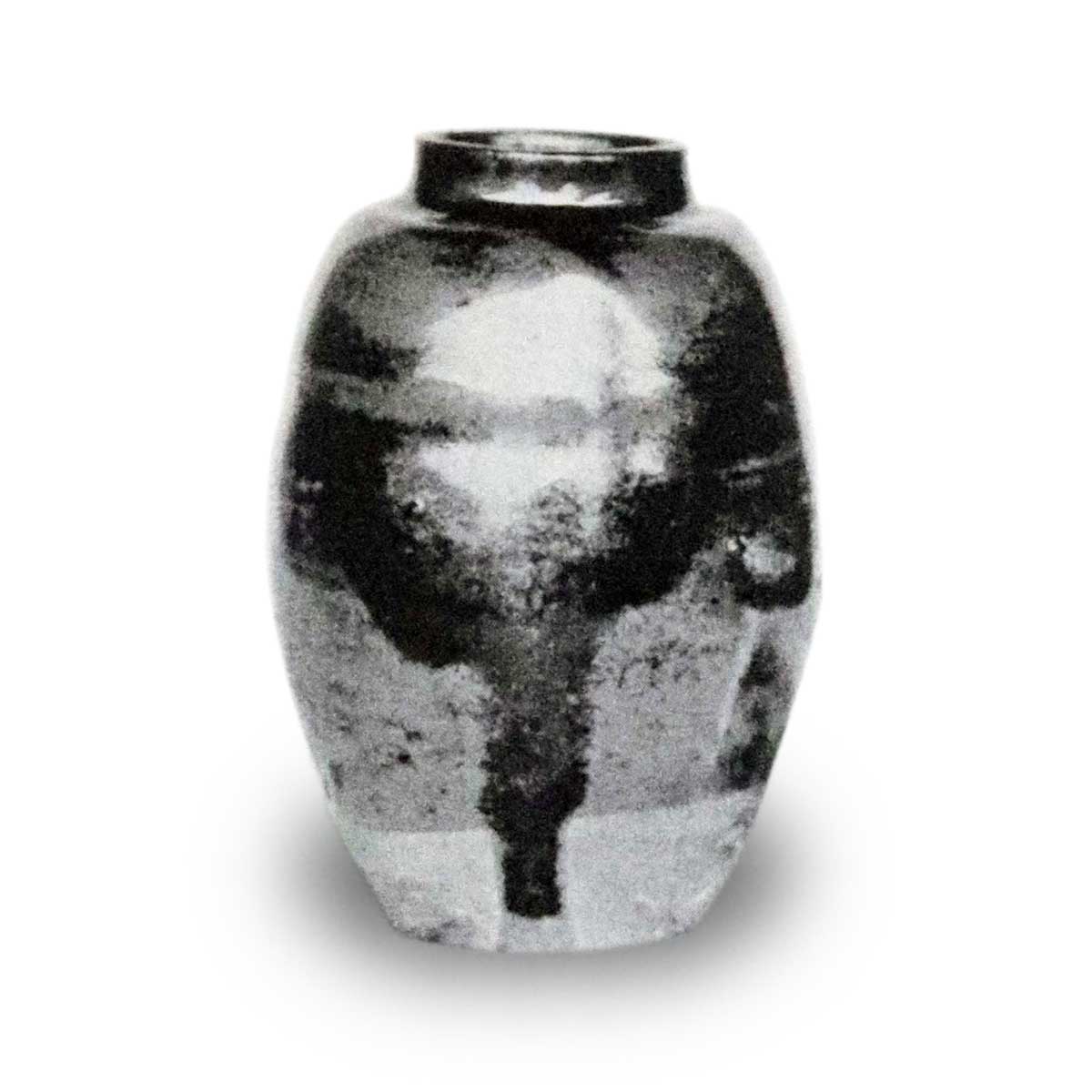

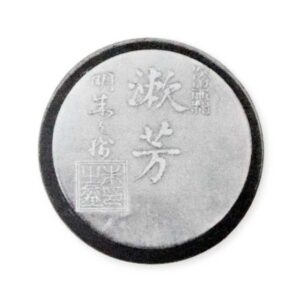


Tang Dynasty, “Crane’s Child,” Baron Sumitomo Kichizaemon Collection
Name
This is an inscription by Zhu Shunshui, which reads: “While the fragrance of many plants lies in their flowers and fruits, (omitted) it overflows as one rinses, and the resulting pure fragrance and sweetness endure indefinitely.” For details, please refer to the entry on the accompanying objects.
Zhu Shunshui, whose given name was Zhiyu and courtesy name was Luyu, was a native of Yuyao County, Zhejiang Province, China. Born on August 12, Wanli 28 (1600), he served the Ming Dynasty from an early age and was recommended as an “en-gong-sheng” (a scholar recommended by the local authorities). Later, he was offered a high-ranking position but declined it. As the Ming Dynasty neared its end, he valued righteousness above all else and considered it a disgrace to eat the grain of the Qing (i.e., to serve the Qing Dynasty). In the 2nd year of the Wanji era (1659), he fled to Nagasaki. In the 4th year of the Kanbun era (1664), he accepted an invitation from Tokugawa Mitsukuni (Yoshikuni), the lord of the Mito Domain, and began compiling the Great History of Japan, making a significant contribution to the culture of the Mito Domain. He passed away on April 17, Tenna 2 (1682), at the age of 83, and was buried at Zuiryūzan in Hitachi Province. Mitsukuni bestowed upon him the posthumous name “Bungyō” and personally inscribed the tomb with the words “Tomb of Zhuzi, the Enlightened and Upright Gentleman.”
Dimensions
Height: approx. 7.0 cm (2 sun 3 bu 2 rin)
Body diameter: approx. 5.0 cm (1 sun 6 bu 5 rin) or approx. 4.8 cm (1 sun 6 bu)
Mouth diameter: approx. 2.4 cm (8 bu)
Base diameter: approx. 2.7 cm (9 bu)
Height of the koshiki: approx. 0.5 cm (1 bu 8 rin)
Shoulder width: approx. 0.3 cm (1 bu) or approx. 0.4 cm (1 bu 3 rin)
Weight: approx. 46.9 grams (12 monme 5 bu)
Accessories
・Lid: 1 piece, with a “su” (pattern)
・Storage pouch: white chirimen (crepe silk) with a brown tying cord
・Pouches: 3
Antique Kinran and Shuin-giri Koshigawari (lining: mon-patterned kakemono; tying cord: purple) Antique pouch
Hanawari Donshu (lining: kakemono; tying cord: yellow) Antique pouch
Wakuda-zori (lining: mon-patterned kakemono; tying cord: purple) New—in the style preferred by Baron Sumitomo
・Pouch box: Paulownia, natural wood; inscription by Lord Teizan (Tokugawa Saishu)
Front inscription: “Sōhō”
Back inscription: “Antique brocade, Shuin-giri, Donshu, Hanawai, Koshikawari, seal”
(Note) Lord Teizan refers to Tokugawa Nariyoshi, the 8th lord of the Mito Domain, who was posthumously honored with the title “Ai-kō.” He passed away on October 4, Bunsei 12 (1829) at the age of 33.
・Hikiya (cylinder for storing the tea caddy): Variegated karin wood
Gold-powdered characters on the lid; inscription by Zhu Zhiyu (Zhu Shunshui)
“Ming Zhu Zhiyu (Seal)”
“Shufang”
・Outer box: Paulownia, natural finish
Pouch: Iris-patterned leather; purple tying cord
・Inner box: Paulownia, natural finish; inscription by Lord Ding Shan
“Shufang,” “Teapot,” “Shufang”
・Accompanying scroll: 1 scroll
“Shufang”
The 16th day of late summer in the year of Jiwei (Enpō 7, 1679)
An 80-year-old man
Zhu Shunshui of the Ming Dynasty (Seal)
The fragrance of most plants lies in their flowers or fruits, but tea alone lies in the buds of its leaves. The fragrance of flowers fades when they fall, and the sweetness of fruit changes when it is gone. But tea alone—when a piece of Longdan (tea cake) is cut, brewed in pure water, held aloft in a jade bowl, and served in a white porcelain vessel—first sends its aroma to the tip of the nose, caresses the lips and teeth, passes through the throat and tongue, and permeates both body and mind. Even as one rinses one’s mouth, the umami overflows, and its pure fragrance and sweetness linger endlessly. It refreshes the spirit and clears the eyes—qualities far beyond the reach of ordinary plants. That is precisely why refined cultured people cherish drinking it even more than wine, and it possesses such a profound flavor that they have even composed poems declaring, “I cannot drink even seven bowls.”
(Enpō 7)
Late Summer of the Year of the Goat (Jiwei) — Shunshui of the Ming Dynasty — Zhu Zhiyu (Seal)
Reply (Appendix)
In your letter, you inquired about the origin and intended use of this jar (tea caddy).
- Manufacturing Method: This jar was fired in a kiln in the Tang Dynasty (China).
- Intended Use
It is used to store palace cakes, dragon’s-saliva cakes, Shangqing pills, scented tea, rose petals, jasmine, orchids, and plum blossoms. Some people use it to hold decoctions of musk or agarwood, but this is a practice that experts find laughable. If you wish to store borneol, you should place chicken feathers and si-zi (a type of adzuki bean) in the jar along with it; this will prevent the borneol from diminishing even over a long period of time.
Items made in Japan these days look very similar to those made in China, but they have slight gaps, and because the clay is not soft enough, they crack when hot water is poured into them. This is the key difference.
An 80-year-old man, Zhu Zhiyu (Seal)
To begin with, these vessels are made according to ancient methods; they are extraordinary and one-of-a-kind. Just as Fuxi carved paulownia wood to make a qin and the Yellow Emperor cast metal to make a ding, this tradition has been passed down through various treasured vessels. Today, there is nothing that surpasses these vessels crafted according to ancient styles. Beholding this rare and beautiful “Shufang”—a treasured piece—one must truly call it a trusted companion by springs and rocks, and a valuable friend in the scholar’s study.
“O beautiful quality of jade, O melodious sound of gold and jade. As blue and clear as green waves, with a pure breeze blowing from both sides.”
Written (and sealed) by Du Duo of Donggao Yue
(Note) Since the original text on the right was written in clerical script, it has been converted to regular script for easier reading and marked with diacritical marks (such as return marks).
To Lord Nakayama Shuma, from Shuri-no-suke Kuwayama
I am deeply grateful for your generous inquiry yesterday and your prompt response. I have carefully examined the tea caddy. I believe it is undoubtedly a Tang-era piece. It feels excellent to the touch, and I find it to be an exceptionally fine tea caddy. I am returning the tea caddy to you. That is all.
June 5th Seal (Seal)
There is a tea caddy (chabine) in the collection of a certain Mr. Tani, a retainer of our Mito Domain. It bears inscriptions by Master Shunsui and Master Tōsōetsu, along with a record of the tea caddy’s history; furthermore, it is accompanied by a certificate of authenticity from Kuwayama Tamagawa (Shūri-ryō) and has been treasured and passed down through generations.
In the year Bunsei Kōshin (Bunsei 7, 1824), it was presented to the feudal lord (Lord Teizan). Upon seeing it, the Lord was delighted; without compromising its ancient lineage, he had it newly mounted as a scroll and ordered me (this old fool) to record the full account of the matter.
In my view, the things people treasure in this world are like coral—difficult to find even in the depths of the ocean. Such items might occasionally be acquired and kept in secret by families of high status and great wealth. However, when it comes to objects like this tea caddy and this scroll, it would be impossible to obtain them a second time. They are equivalent to a precious jewel (the “Jade of Liancheng”) of such value that it could be exchanged for a country. It is only natural that His Lordship should praise them so highly. This “Lord” refers to Ding Shan Gen-kō (Tokugawa Saishū).
Daikō Rōjin respectfully writes this. At the time, he was 70 years old. (Seal)
(Note) Daikō Rōjin was the sixth son of Munehira (posthumous name: Ryōkō), the fifth lord of the Mito Domain; his given name was Raikyū, his courtesy name was Shitoku, and his pen name was Kenzan. He became the adopted son of Yorita, the head of the Otsukidō branch, and succeeded the Shishido family; he passed away on May 4, Bunka 13 (1816) at the age of 75.
Miscellaneous Notes
A name given to a matcha jar at the request of Shufu Tokusai Tanishige
The fragrance of most plants lies in their flowers or fruits, but with tea alone, it lies in the buds of the leaves. The fragrance of flowers fades when they fall, and the sweetness of fruit changes when the fruit is gone. (The rest is omitted. The content is as described in the preceding supplementary scroll.)
(From Collected Works of Master Shu Shunsu, Vol. 21)
November 24, Taisho 10 (1921): Tea ceremony at the villa “Sōhō-an” in Shishigatani, Kyoto. Host: Sumitomo Shunsui
Guests: Umakoshi Kasei, Fujita Koseki, Takahashi Hōan, Nozaki Gen’an, Yamazumi Rikitarō
・Hanging Scroll: Two poems by Fujiwara no Teika on kaishi paper
“Washing Clothes at a Mountain Hermitage” “Though no one comes, I still stoke the fire at the pine-wood door; / With bundles of firewood, I beat out my autumn garments.”
“Dawn Mist on the Seki Road” “Beneath the trees I struggle to cross, amidst the dark mist, the Ashigara Mountains, unaware of the dawn”
・Flower Vase: Single-layered cut by Sōtan; inscribed “Shigure”; Flowers: White camellia, Tani-kuwa
・Tea Jar: Chinese antique; inscribed “Shufang” by Zhu Shunshui; Pouch: Wakuda
・Tea Bowl: Chūkyō Meibutsu; East Goryeo; comes with a box inscription by Enshū
・Tea Scoop: Made by Matsuura Shizunobu; inscribed “Sakahi”
(From Shin Taishō Chadōki)
History of Transmission
Originally owned by Nakayama Shuma, it was passed down to Taniguchi Shigeyo, a samurai of the Mito Domain known as Ittoku-sai. In Enpō 7 (1679), Zhu Shunshui inscribed it with the name “Shufang.” In Bunsei 7 (1824), it was presented by the Tani family to Lord Teizan (Tokugawa Nariyoshi), the lord of the Mito Domain, and had since been treasured by the Mito Tokugawa family. However, during an auction of the Mito family’s collection in October of Taishō 9 (1920), the current owner (Sumitomo Kichizaemon) won the bid.
Record of Actual Viewing
On December 16, Taishō 10 (1921), I viewed the actual object at the residence of Baron Sumitomo Kichizaemon in Tennoji-Chausuyama, Minami Ward, Osaka City.
For a Chinese-style “Crane’s Child” teapot, it is on the taller side. The upper edge of the rim is flat with no fold, the base protrudes slightly, and the shoulders are narrow.
The body protrudes slightly; toward the upper part, wide and deep wheel marks encircle about half of the tea jar, and the body tapers from the waist downward. The thread-cut finish on the bottom is rather rough, with a slight misalignment at the starting point; to the left of that starting point, extending toward the bottom rim, there is a single, somewhat long streak left by the potter’s spatula. In addition, there are “sticking marks” (traces of other objects adhering inside the kiln) and glaze splatters.
The overall color is a pale purple, with black glaze running around the rim of the kettle. On the right side (as viewed), the black glaze flows down in two branches from below the shoulder; on the left side, it flows down from the upper part of the body. These two streams converge and flow down to the waist, where they merge into a single line that cascades down to the edge of the base (near the bottom). The glaze drips have turned brown where they stopped, and the glaze is peeling away from the rim of the base. There are three or four areas of clinging of varying sizes around the body; a hint of yellow glaze is visible along the edges of the larger ones.
From the lower rim downward, the mouse-gray clay is exposed, and there are several spots shaped like fingertips on its surface. Inside, glaze covers the rim; below that, coarse wheel marks run around the interior, and the center of the base forms a swirl pattern. Although it is unclear exactly what purpose this teapot served in China, it is entirely intact. It feels light in the hand, features vivid decorative patterns, and has a well-defined, compact shape—making it a charming and ingenious rarity.